Ethereum Foundation Targets December 2029 as Final Date to Address Quantum Computing Threat

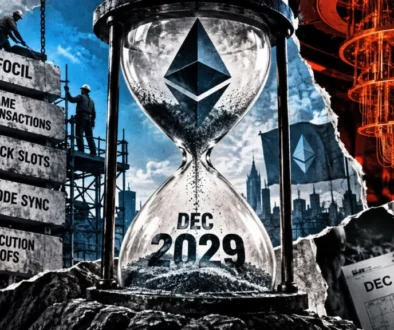
The Ethereum Foundation has set a hard December 2029 deadline for quantum-resistant upgrades across the network’s base layer, treating the target as non-negotiable through at least January 2027. This aggressive timeline matches migration schedules announced independently by Google, Cloudflare, and Microsoft, positioning Ethereum to address cryptographic vulnerabilities before quantum computers pose an existential threat to blockchain security.
- Ethereum Foundation commits to quantum resistance by December 2029, treating date as fixed deadline rather than research aspiration.
- Roughly 65% of ETH currently sits in quantum-vulnerable addresses, according to Project Eleven data.
- Hegotá hard fork will serve as first test of whether the 2029 timeline can be met across execution, consensus, and data layers.
- Dec 2029 Ethereum Foundation’s non-negotiable deadline for full quantum resistance deployment.
- 65% Portion of ETH supply currently held in quantum-vulnerable address formats.
- 7.2 mo Average timeline per hard fork needed to hit December 2029 quantum deadline.
The Ethereum Foundation’s Protocol cluster published its quantum resistance commitment alongside a comprehensive evaluation of 62 proposals for Hegotá, the hard fork scheduled to follow Glamsterdam. The Foundation aims to harden Ethereum’s base layer across execution, consensus, and data layers before quantum computers become capable of breaking the cryptographic schemes that currently secure the network.
The December 2029 target reflects an assessment that Q-day, the point at which quantum computers pose a practical threat to current encryption, could arrive as early as 2030. This timeline is particularly significant because the overwhelming majority of Ethereum’s economic value currently rests in cryptographic protections that quantum computers could potentially compromise, leaving holders of quantum-vulnerable addresses at risk of losing access to their funds.
Planning for Quantum threats earlier than most industry forecasts
The Foundation acknowledged that its 2030 Q-day assumption is deliberately aggressive, front-running most credible expert predictions about quantum computing timelines. Established research institutions and quantum computing firms typically estimate that cryptographically relevant quantum computers remain at least a decade away, making Ethereum’s 2029 target significantly more conservative than industry consensus.
The commitment aligns with parallel migration schedules independently announced by Google, Cloudflare, and Microsoft, each setting similar timelines to transition critical infrastructure away from quantum-vulnerable cryptography. The Protocol cluster will treat the December 2029 deadline as fixed and non-negotiable at minimum through January 2027, when outside quantum computing experts will conduct a formal reassessment of the field’s progress. This staged commitment structure acknowledges uncertainty while maintaining decisive action.
“Planning for Q-day in 2030 is a deliberately aggressive assumption,” the Foundation’s priorities blog states.
Hegotá becomes the critical first step in the 2029 timeline
The Ethereum Foundation framed the Hegotá hard fork as the deciding factor for whether the full sequence of post-quantum upgrades can ship on schedule. Complete quantum resistance is positioned five hard forks away, meaning the network must average 7.2 months per fork to meet the December 2029 target, a pace the cluster describes as aggressive. Hegotá’s success in shipping key quantum-readiness components will determine feasibility for subsequent upgrades.
Coordinating multiple hard forks at this velocity represents an unprecedented operational challenge for Ethereum’s distributed governance structure. The Foundation’s multi-layer approach distributes quantum-resistance work across execution, consensus, and data layers, but sequencing dependencies between these layers could create bottlenecks that delay subsequent forks.
The Foundation assigned Frame Transactions the highest execution-layer priority, grading it A-tier as the must-ship item that will allow Ethereum to adopt new signature schemes without requiring a hard fork for each transition. A complementary A-tier package comprising EIP-8298 and EIP-8151 will enable accounts to abandon secp256k1 as their master key, moving away from the vulnerable cryptography standard.
EIP-8365, also prioritized, begins the process of retiring validator withdrawal credentials still locked to vulnerable cryptographic schemes. These execution-layer changes represent the technical foundation upon which subsequent consensus and data layer upgrades will depend.
The consensus layer faces different constraints because its cryptography cannot be swapped without a fork, requiring components to await complete design finalization.
Hash-Chain RANDAO for the consensus layer received a B-tier rating, reflecting that while the direction is sound, sequencing places it later in the upgrade roadmap. The Foundation took a cautious approach to execution-layer cryptographic verification, dropping ML-DSA verification precompiles to C tier rather than enshrining a single scheme before a dedicated cryptographic review is completed.
This conservative stance reflects awareness that locking in specific post-quantum algorithms prematurely could create technical debt if the field’s understanding of quantum-resistant cryptography shifts. The cryptographic community continues to evolve its assessment of which algorithms offer the strongest security properties against future quantum attacks, making premature standardization strategically risky.
The January 2027 reassessment point marks the next critical moment for the quantum resistance timeline. At that review, the Foundation and outside experts will evaluate whether quantum computing progress warrants adjusting the December 2029 deadline or whether Hegotá’s outcomes justify confidence in the five-fork acceleration schedule required to meet it.
BlockWest is a news publication. Nothing here is investment advice. Read our disclaimer and editorial policy.