
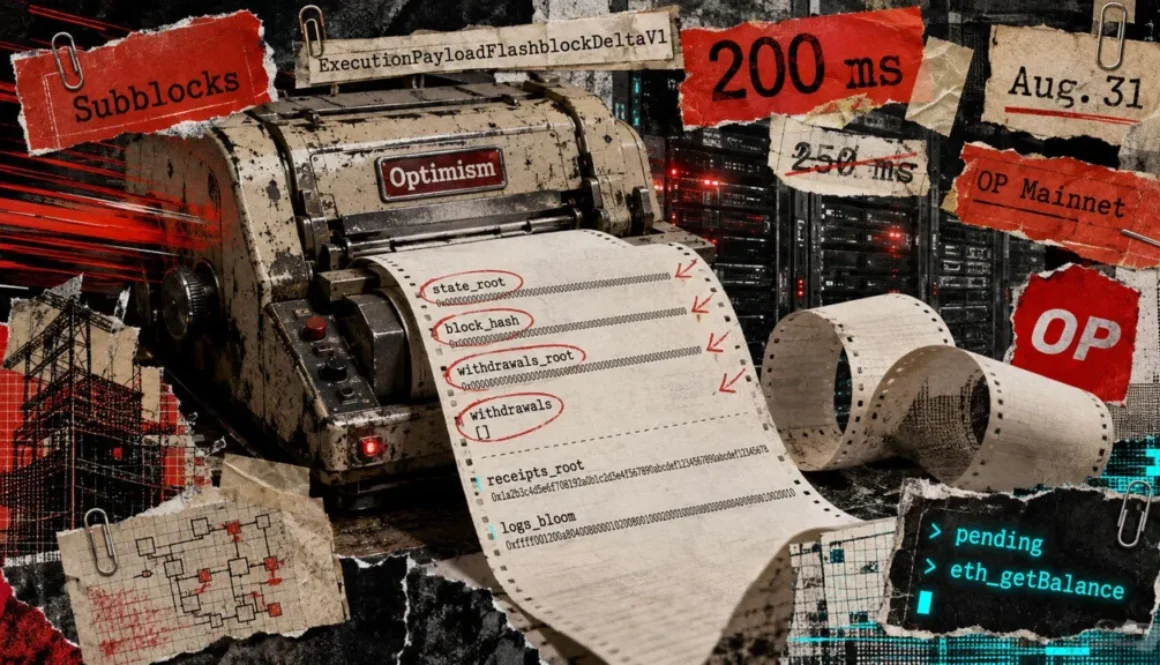
Network speeds reach 200 ms on confidence surge, though standard data feeds lose critical information
Optimism is accelerating its subblock confirmation time to 200 milliseconds, a 20% speedup that introduces a critical compatibility risk for applications and data providers ingesting raw blockchain payloads. The upgrade requires careful auditing of downstream systems to prevent zeroed fields from corrupting state and balance data.
- Optimism targets 200 ms subblocks on OP Mainnet, down from 250 ms preconfirmation interval, in rolling change for Aug. 31
- Four payload fields will carry all-zero values after upgrade: state_root, block_hash, withdrawals_root, and empty withdrawals list
- Risk falls on direct stream consumers and RPC providers forwarding raw payloads, who must audit systems to prevent zeroed fields entering state calculations
- 200 ms New subblock confirmation target, versus prior 250 ms interval
- 4 Payload fields transitioning to unusable zero or empty values in the migration
Optimism is rolling out a network upgrade targeting 200 millisecond subblocks on OP Mainnet, reducing the preconfirmation interval from 250 milliseconds in a phased deployment aimed at Aug. 31. Subblocks, formerly called Flashblocks, are incremental state updates the sequencer publishes while constructing a standard block, allowing applications to receive feedback before final block confirmation. The 20% latency improvement addresses demand for faster transaction visibility in a Layer 2 environment where users and applications depend on rapid finality signals.
In the Ethereum and Layer 2 ecosystem, reducing confirmation time is a persistent priority. Faster subblock confirmation improves user experience for decentralized exchanges, lending protocols, and other time-sensitive applications by allowing them to display more current state to users and execute downstream operations more quickly. Optimism’s move reflects broader industry competition among Layer 2 platforms to minimize latency while maintaining security and data integrity.
Four Key Fields Will Carry Zeroed Values Starting Aug. 31
The upgrade introduces a silent compatibility hazard: four fields in each streamed payload will retain their data structure but stop carrying usable information. The fields state_root, block_hash, and withdrawals_root will be set to all-zero values, while withdrawals will become an empty list. Other fields including receipts_root and logs_bloom will continue to carry real data.
The payload type designation remains ExecutionPayloadFlashblockDeltaV1, meaning software can parse the stream without raising parsing errors even when critical fields have zeroed. This creates a trap for systems that treat successful decoding as implicit confirmation that every field contains meaningful data. According to Optimism’s migration notice, the zero-valued state root and block hash should be treated as absent entirely, with preconfirmed state derived instead by executing the transactions carried in the stream itself.
From a systems design perspective, this approach represents a tradeoff: Optimism avoids breaking the payload schema, allowing existing parsers to continue functioning without modification, but shifts validation responsibility to consuming applications. Schema stability reduces deployment friction across the ecosystem, but it also means that applications relying on implicit field validation may not detect the change without deliberate code review.
Direct Stream Consumers and Providers Face Auditing Requirements
Most applications avoid direct exposure to raw subblock payloads by connecting through a subblocks-aware RPC provider using standard Ethereum methods, often with the pending tag. A correctly configured provider maintains its own state view, allowing calls such as eth_getBalance to return preconfirmed data without relying on a usable state root in the raw payload, per Optimism’s integration guide.
The audit burden falls most heavily on two categories: applications that ingest the WebSocket stream directly and RPC providers that forward raw fields to downstream customers. Both must identify any code reading the four affected fields, treat the placeholder roots and block hash as unavailable, and prevent those values from entering downstream state calculations, balance derivations, or proof inputs. Alchemy and QuickNode have both updated their OP Mainnet documentation to reflect the 200 ms subblock cadence and associated migration requirements.
For teams operating infrastructure, the migration represents a compliance checkpoint. Operators of subblock monitoring systems, indexing services, and blockchain analytics platforms similarly need to audit their pipelines to ensure that zeroed fields do not corrupt historical records or analytics results. The risk is primarily one of silent propagation rather than immediate failure, as incorrectly formatted data may persist undetected until it reaches downstream consumers who depend on field accuracy.
Aug. 31 Target Date Remains Provisional With Gradual Rollout
Optimism has stated that the Aug. 31 target for 200 ms subblocks may shift and that the rollout will proceed gradually, with no documented network-wide completion date. Optimism’s status page showed systems operational with no recent incident notices at the time of review.
Gradual rollout strategies reduce the risk of ecosystem-wide breakage by allowing affected services to detect and address issues incrementally rather than all at once. However, they also extend the transition window during which different parts of the network may operate under different assumptions about subblock intervals and field contents.
Official and provider notices frame the zero-valued fields as a migration risk requiring preventive work rather than evidence that balances or proofs have already been corrupted. Applications and providers with direct subblock stream access must complete their audits before the rollout begins in order to avoid silently propagating invalid state data into downstream systems.