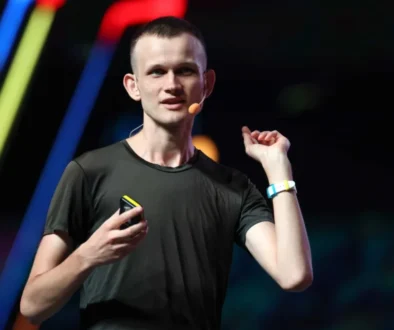
Vitalik Buterin outlines Ethereum’s shift to zero-knowledge proofs by 2030

Vitalik Buterin has published a roadmap describing how Ethereum’s core architecture could look by 2030, framing the network as a “cryptographic world computer” rather than a conventional blockchain. The plan matters to developers and allocators because it turns decentralization into a scaling tool rather than just a security cost, even as ETH itself struggles to hold above $2,700.
- ETH reclaimed its 200-day moving average but was rejected near $2,800 last week, per analyst Daan Crypto Trades
- Buterin expects transaction verification to shift toward PeerDAS combined with SNARKs by 2030
- Hegotá, planned for next year, is expected to be Ethereum’s last “normal” fork before deeper changes
- $2,700 ETH’s price this week, down 2.5% over the prior 24 hours
- $2,800 resistance level ETH was rejected from last week
- 47% ETH’s discount to its all-time high near $4,950
- next year planned timing for Hegotá, Ethereum’s last “normal” fork
Ethereum co-founder Vitalik Buterin has published a roadmap describing how the network’s core design could change after its Hegotá upgrade, as CryptoPotato reported. In a post titled “The Cryptographic World Computer”, Buterin argues Ethereum is moving away from the block-by-block verification model Bitcoin popularized. He expects zero-knowledge proofs to take on a far larger role in how the network confirms transactions and computation by 2030.
Verification moves to PeerDAS and SNARKs by 2030
Bitcoin’s original design has every participant download, check and re-execute each block’s transactions. Buterin says Ethereum still works broadly the same way today.
He expects that to change as the network adopts PeerDAS, which lets participants verify samples of data rather than the full set, paired with SNARKs that confirm large computations were carried out correctly without repeating them. Consensus has already moved from proof-of-work to proof-of-stake, and Buterin expects a more efficient version of PoS to follow. Block production could also spread across several participants instead of one party assembling an entire block.
Buterin pointed to a set of supporting upgrades, including FOCIL, EIP-8288, Lean consensus, formal verification and changes to Ethereum’s mempool. State management is another piece of the shift, since the network will need to handle far more data without requiring every participant to redo identical work.
Buterin: decentralization becomes a scaling tool, not just a cost
Buterin argues the changes will also affect how applications get built. Ethereum will favor computation split into smaller, separately handled pieces rather than one large transaction, letting developers record what the network needs directly on-chain while other work happens before a block is finalized.
Buterin wrote that a distributed network could serve a purpose beyond security alone.
decentralize not just for robustness but also to increase scale
Vitalik Buterin, Ethereum co-founder
He noted that goal dates back to ambitions held by Ethereum’s builders as early as the mid-2010s, more than a decade before this roadmap was written.
ETH stays below $2,800 resistance as Hegotá looms
Buterin expects Hegotá, planned for next year, to be Ethereum’s last “normal” fork before recursive STARKs, automated formal verification, more efficient consensus and quantum-safe technology take over the longer-term roadmap. Those elements would phase in gradually rather than arrive through a single upgrade.
The technical shift comes as ETH trades well below its prior highs. The token reclaimed its 200-day moving average last week but was rejected near $2,800, a level analyst Daan Crypto Trades called a major obstacle.
ETH was trading near $2,700 at the time of writing, down nearly 2.5% over 24 hours and about 2% for the week. It had still risen almost 5% over 14 days and 8% over the previous 30 days, though it remained about 34% below year-ago levels and roughly 47% under its all-time high near $4,950.
The BlockWest read. We read Buterin’s framing as turning decentralization into a scaling lever rather than just a cost, which matters most to teams building rollups and data-availability layers that gain headroom under PeerDAS and SNARK-based verification. For treasuries holding ETH through this transition, we think the multi-year technical runway argues against reading short-term price weakness, still 47% below the token’s high, as a verdict on the protocol’s direction.
Ethereum’s developers have not set an exact date for Hegotá, and Buterin’s post leaves open how quickly PeerDAS and SNARK-based verification move from testnets to mainnet. Traders, meanwhile, are watching whether ETH can clear the $2,800 resistance level before any of that timeline plays out.
BlockWest is a news publication. Nothing here is investment advice. Read our disclaimer and editorial policy.