Galaxy Digital adds $100M Sky token to treasury and loan collateral
Update (Sep 25, 2:05am): Galaxy also acquired an undisclosed amount of SKY token, which was not mentioned in the published version.
Galaxy Digital has put $100 million of Sky Protocol’s yield-bearing sUSDS token onto its own balance sheet and cleared the token for use as loan collateral by institutional clients. The move deepens a lending relationship between a Nasdaq-listed digital-asset firm and one of the largest onchain capital allocators, but it leaves the actual scale of client-side adoption undisclosed.
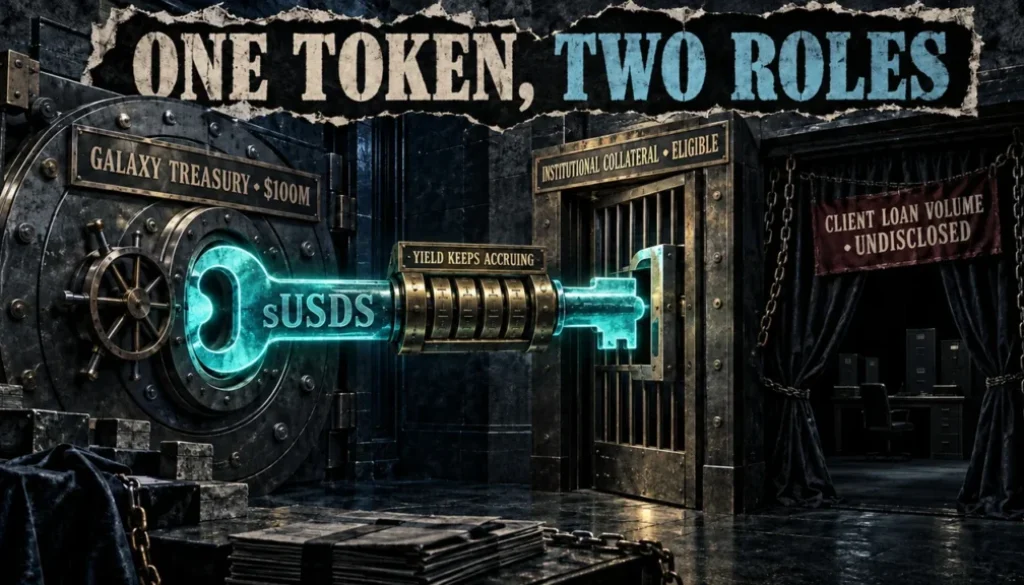
- Galaxy added $100 million of sUSDS to its corporate treasury and approved the token as institutional loan collateral, on September 23.
- Galaxy’s institutional trading platform serves more than 1,600 total trading counterparties and carries a $1.4 billion average loan book.
- Neither company disclosed a figure for client lending secured by sUSDS or named a first completed sUSDS-backed loan.
- $100M sUSDS added to Galaxy’s treasury against its $1.4B loan book
- $500M Grove warehouse facility that funds Galaxy’s loan originations
- $304M Sky agents’ exposure to Galaxy as of Sept. 1, before the treasury deal
Galaxy Digital (Nasdaq: GLXY) and Sky Protocol said Wednesday, September 23, that Galaxy has added $100 million of sUSDS to its corporate treasury and approved the token as eligible collateral across its institutional trading business, according to CryptoSlate. The companies described the treasury position as complete in a joint press release, which called Galaxy one of the first public companies to hold sUSDS on its balance sheet. The announcement did not include a figure for client lending secured by the token or name a completed sUSDS-backed loan.
Galaxy puts $100 million into sky’s savings Token
The $100 million treasury purchase sits against a $1.4 billion average loan book across Galaxy’s institutional platform, which counts more than 1,600 trading counterparties. Approving sUSDS as collateral makes the token usable by any of those clients borrowing against Galaxy, though the release does not say how many have done so.
The appeal of the design is that collateral keeps working. Clients who post sUSDS against a loan continue accruing the Sky Savings Rate on the full position for as long as the loan runs.
Sky’s governance sets that rate and funds it from aggregate protocol surplus. Holders keep the same number of sUSDS tokens while the amount of USDS redeemable for each token rises as it accrues.
That rate is not fixed. Sky’s governance can change it at any time, so future accrual on a client’s collateral is not guaranteed for the life of a loan.
Sky was built so the same savings rate can be made available to anyone, from an individual saver to a Nasdaq-listed balance sheet. This partnership carries that across the full breadth of institutional finance: onto Galaxy’s balance sheet, through its lending book, and into its Global Markets franchise.
Greg Feibus, Global Head of Capital Markets, Sky Frontier Foundation
Grove’s $500 million facility already linked the two firms
The treasury purchase builds on an existing credit relationship. In July, Grove, a Prime Agent within the Sky ecosystem, announced a $500 million warehouse lending facility that commits USDS capital for Galaxy to originate and service institutional loans. Collateral in that facility is limited to Bitcoin and Ethereum, including staked forms of Ethereum.
Galaxy has since borrowed on Spark, a second Prime Agent in the Sky network, to support its GOFR financing product, diversifying its funding sources and tying that product to an onchain rate.
A Sky Frontier Foundation ecosystem update published Thursday, September 17, said Sky agents held roughly $304 million with Galaxy as of Sept. 1, driven largely by the Grove facility. That figure describes Sky-side exposure before Wednesday’s treasury announcement.
What Galaxy and Sky have not disclosed
The companies confirmed the $100 million treasury position is in place, but gave no outstanding balance for client borrowing against sUSDS and did not point to a single completed loan. That leaves Galaxy’s own $100 million purchase as the only concrete figure tied to the new collateral eligibility, separate from whatever clients choose to post.
Sky’s broader numbers are more fully disclosed. sUSDS supply reached $5.52 billion at the close of the second quarter of 2026, up 149% over the prior year, and the protocol posted five straight profitable quarters, including $107.35 million in gross revenue and a $33.29 million net surplus in Q2 2026. Onchain real-world assets excluding stablecoins topped $33 billion in July 2026, roughly four times their level in early 2025, a backdrop the companies cite as favorable for tokenized collateral.
What is missing is the client-side number. Whether institutions actually post sUSDS against loans, and in what volume, is not answered by Wednesday’s announcement.
The BlockWest read. The bigger signal here is accounting precedent, not lending volume. By putting sUSDS on a Nasdaq-listed balance sheet, Galaxy gives other treasurers a live example of how a yield-bearing stablecoin gets classified and disclosed. Corporate finance teams weighing similar allocations now have a public comparable to point to, even before any client loan volume proves the collateral use case works at scale.
The open question is whether either firm discloses an actual sUSDS-backed loan or an outstanding client collateral balance, something Wednesday’s announcement did not include. Galaxy’s next earnings disclosures and any future Sky Frontier Foundation ecosystem update are the likeliest places that figure would surface.
BlockWest is a news publication. Nothing here is investment advice. Read our disclaimer and editorial policy.