Cardano’s delegated voters reject Input Output’s 12.29 million ADA funding request
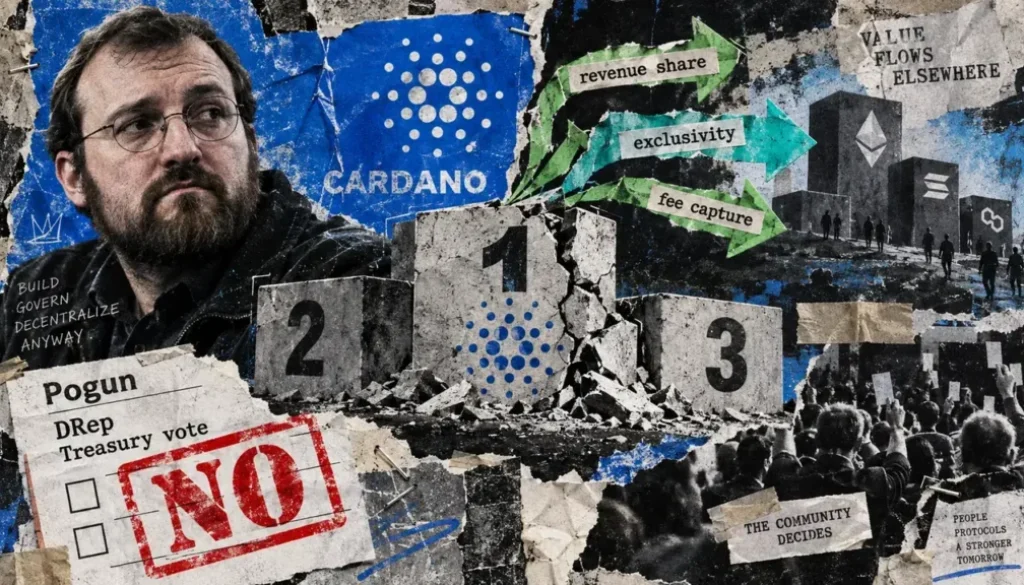
Cardano’s delegated voters let a 12.29 million ADA funding request from Input Output-backed venture Pogun expire without ratification, rejecting a revenue-sharing proposal from the network’s own founding development firm. The split result, with delegated representatives voting against the measure while Cardano’s Constitutional Committee approved it unanimously, shows the network’s treasury now operates independently of Input Output’s historical influence.
- Pogun sought 12.29 million ADA from Cardano’s treasury to fund a Bitcoin-focused credit and liquidity product.
- Delegated representatives voted 64.33% against the request while Cardano’s Constitutional Committee recorded seven yes votes, equal to 100% committee approval.
- Charles Hoskinson says Input Output will place future products on whichever network fits best, ending an automatic Cardano-first policy.
- 12.29M ADA treasury withdrawal request that Cardano voters let expire
- 64.33% share of DRep voting power that rejected the Pogun funding
- 100% Constitutional Committee approval despite the DRep rejection
- $2.95M earnings threshold tied to Pogun’s proposed repayment structure
Cardano’s governance system allowed a 12.29 million ADA funding request for Pogun, a Bitcoin-focused credit and liquidity product backed by Input Output, to lapse without ratification, according to reporting by CryptoSlate. Pogun’s proposal offered Cardano a share of the business in exchange for development funding, but the network’s delegated voters declined to approve the withdrawal. Charles Hoskinson has said the product is still headed to Cardano, though on different terms than the rejected deal.
DReps reject pogun’s 12.29 million ADA request 64.33% to 35.67%
The Pogun governance action asked Cardano’s treasury for 12.29 million ADA and expired without either ratification or enactment. The final Koios voting summary recorded 35.67% of delegated representative voting power in favor against 64.33% opposed. DReps vote with authority assigned to them by ADA holders, and their result determined whether the withdrawal could advance.
Cardano’s Constitutional Committee ran a separate review and recorded seven yes votes, 100% committee approval. The two outcomes are not contradictory: the committee tally showed institutional support, while the DRep tally simply failed to ratify the spending request.
Input Output helped build Cardano and remains one of its largest ecosystem participants. Even so, the network’s separate governance institutions, not Input Output’s founding status, controlled the funding outcome.
Input Output offered 20% earnings share, then perpetual 5% return
The proposal came with a defined commercial trade for Cardano’s treasury. Input Output’s April 2026 overview said Pogun would return 20% of earnings to the Cardano treasury until initial funding was repaid, followed by a perpetual 5% return on Cardano-related products.
The formal proposal tied repayment to $2.95 million in quarterly earnings before interest, taxes, depreciation and amortization. Cardano would have funded product development in exchange for a defined path to recover that outlay and share in later earnings.
DReps avoided exposing the treasury to a venture with uncertain revenue and adoption, and in doing so declined its defined upside as well. Pogun has not yet established the future earnings, usage or network distribution needed to value that trade-off, so any claim about how much Cardano forfeited by voting no remains speculative.
Hoskinson targets October realFi, mid-december Pogun launch
In a broadcast on Friday, September 18, 2026, Hoskinson said Input Output will choose the best network for each product rather than following a Cardano-first-and-forever policy. He still described Cardano as the strongest technical fit for Bitcoin DeFi applications built around Bitcoin-like transaction outputs.
Hoskinson said RealFi will launch on Cardano in October 2026, and that Pogun would arrive within 90 days of the broadcast, roughly mid-December 2026. Both dates remain forward-looking targets rather than committed deployments.
Hoskinson said Pogun could still generate transaction fees, total value locked and volume for Cardano once it deploys, an economic relationship distinct from the rejected revenue share. He also said the unfunded product will not be exclusive to Cardano, that traffic may route to other networks, and that a competing ecosystem could receive exclusivity in return for support. That exclusivity claim needs careful attribution: the on-chain Pogun proposal contains the funding request, repayment structure and intended Cardano deployment, but no explicit exclusivity covenant. Input Output’s broader multichain approach also predates the vote; a related application, Midnight City V2, was already documented on the Midnight network in July 2026.
The BlockWest read. The vote sets a precedent other Cardano-adjacent builders will watch closely: founding-team status buys no shortcut past DRep scrutiny, so future treasury asks from Input Output or anyone else must clear the same commercial bar as outside applicants. For allocators evaluating ADA exposure, the episode is a governance signal, not a revenue event; Cardano kept its capital but now competes for Input Output’s product roadmap like any other chain.
The next tests are dated: RealFi is slated for Cardano in October 2026, and Hoskinson has put Pogun’s arrival at roughly mid-December 2026, though neither commitment is contractual. Whether Pogun ultimately deploys on Cardano, routes activity elsewhere, or grants exclusivity to a rival network will determine whether the rejected revenue share turns out to be a cost Cardano’s treasury avoided or one it will not recover.
BlockWest is a news publication. Nothing here is investment advice. Read our disclaimer and editorial policy.