
S&P Global acquires OpenZeppelin smart contract security firm
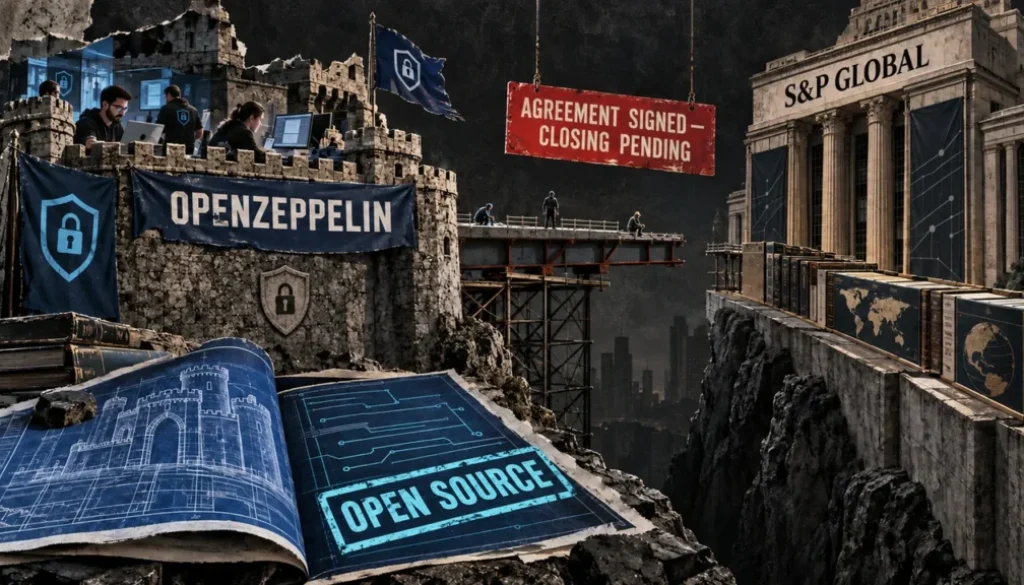
S&P Global’s acquisition of OpenZeppelin marks the entry of a major institutional ratings and data firm into direct control of Web3 security infrastructure used across blockchain development. The deal signals growing convergence between traditional financial market gatekeepers and the crypto ecosystem’s foundational tooling.
- S&P Global has agreed to acquire OpenZeppelin, the smart contract security company, in an undisclosed transaction subject to closing conditions.
- More than $37 trillion in value has been transferred through OpenZeppelin’s Contracts software since the company’s founding in 2015.
- OpenZeppelin will remain a standalone business unit under current leadership, with all released code staying open source permanently and unable to be withdrawn.
- $37T Total value transferred through OpenZeppelin Contracts since 2015 launch
- Demian Brener OpenZeppelin CEO continuing to lead company after deal closes
According to S&P Global’s announcement, the ratings and data corporation will acquire OpenZeppelin, bringing the Web3 security auditor under the umbrella of S&P Global Ratings. The transaction remains subject to closing conditions, and S&P disclosed no financial terms, stating it does not expect the deal to materially affect its financial results. The agreement represents a rare instance of a major Wall Street institution acquiring direct operational control over critical blockchain infrastructure. The story was first reported by CryptoSlate.
OpenZeppelin’s code and leadership remain unchanged under acquisition
S&P Global committed that OpenZeppelin would retain its name, independence as a business unit, and existing leadership structure following the deal’s close. Demian Brener will continue as chief executive and report to Yann Le Pallec, president of S&P Global Ratings. OpenZeppelin confirmed that its security audits, engineering work, and ecosystem programs will continue with the same team.
All released versions of OpenZeppelin Contracts will remain open source permanently and cannot be withdrawn from circulation. The current repository operates under the MIT License, which grants broad rights to use, copy, modify and distribute the software. OpenZeppelin extended its commitment to keeping its other open-source applications and tools open source as well.
For developers and institutions relying on OpenZeppelin’s publicly available code, the acquisition does not alter access or licensing terms.
S&P Global gains Smart contract Security expertise within institutional risk division
The acquisition gives S&P Global direct access to blockchain security knowledge and embeds OpenZeppelin’s capabilities within one of the world’s largest institutional risk and data operations. S&P stated that OpenZeppelin would gain access to the parent company’s research capacity, market data, institutional reach and additional resources, expanding the security firm’s operational and distribution capabilities without changing the public availability of its code.
This integration adds smart contract security expertise to S&P Global’s suite of institutional offerings alongside its credit ratings, market intelligence and regulatory compliance products. The move does not immediately affect the pricing, features or usage terms of OpenZeppelin’s paid or hosted plans, though OpenZeppelin’s terms of service permit certain changes to those elements with protections and notice varying by change type.
For OpenZeppelin’s paying clients, the deal creates ambiguity about product roadmap and pricing beyond what OpenZeppelin has explicitly guaranteed regarding core audit work and engineering continuity.
Open questions remain on future product development and client pricing
Until closing, OpenZeppelin remains the subject of a pending acquisition agreement rather than an S&P business unit. S&P has made specific continuity promises about audits, engineering work, ecosystem programs and open-source code, but has not committed to holding constant every price, product feature or usage limit after the transaction closes.
If the deal closes as announced, the primary operational change for users would be corporate ownership and access to S&P’s data, research and institutional distribution channels. OpenZeppelin states that its public code, core client work and security mission will continue, though the scope of that commitment relative to product features and commercial terms remains narrower than the open-source guarantees.
The BlockWest read. We see a traditional financial institution acquiring proven security tooling rather than building its own, betting that OpenZeppelin’s reputation and installed base matter more than proprietary development. S&P’s commitment to keeping code open suggests confidence that institutional distribution and data integration, not gatekeeping, create the real economic value here.
The acquisition remains subject to closing conditions, with no announced timeline or regulatory approval hurdles disclosed. OpenZeppelin’s customer base should monitor for concrete commitments on pricing, feature roadmap and paid-service terms once the deal closes and S&P integrates the business into its Ratings division.
BlockWest is a news publication. Nothing here is investment advice. Read our disclaimer and editorial policy.