Teraswitch routing error takes 29% of Solana validator stake offline
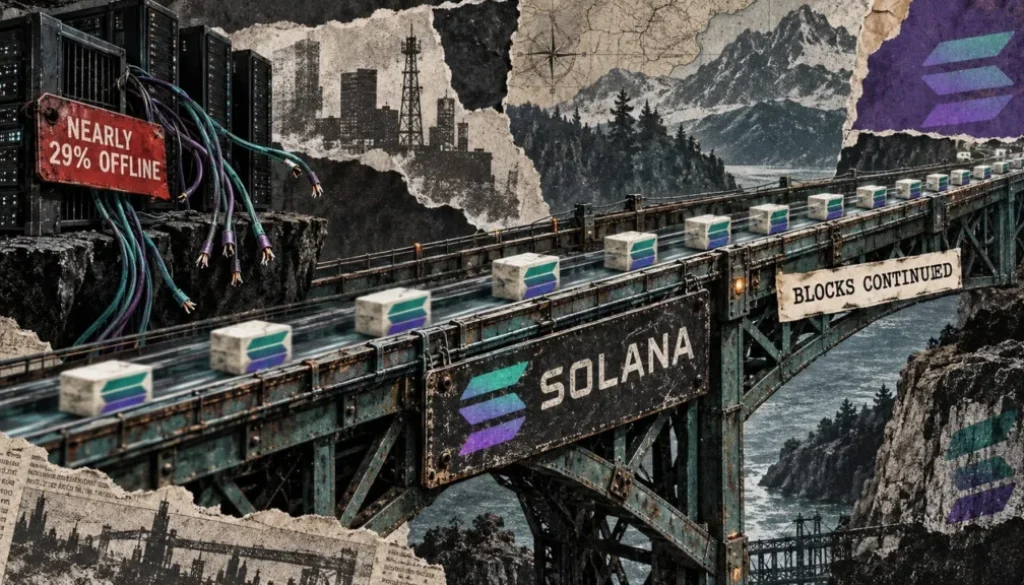
A routing misconfiguration at a single infrastructure provider knocked nearly 30% of Solana’s validator stake offline, exposing the network’s reliance on centralized hosting and pushing finality dangerously close to failure. The incident demonstrates that even when a blockchain continues producing blocks, concentration risk in infrastructure can severely degrade user experience and settlement guarantees.
- A misconfigured default route at Teraswitch, Solana’s largest infrastructure provider, took 29% of network stake offline on August 12.
- Transaction throughput fell to below 300 per second from a typical 1,100 to 1,300, while skipped slots exceeded 32% during the outage.
- Solana narrowly avoided finality failure, with offline stake remaining 4% to 5% below the 33% threshold needed to halt consensus.
- 29% Network stake taken offline by Teraswitch routing failure on August 12.
- 33 min Time until Teraswitch’s provider traffic fully recovered after first alarm.
- ~300 TPS Transaction throughput during outage versus typical 1,100 to 1,300 per second.
- 38% Portion of Solana stake Teraswitch hosted in 2025 before concentration reduction.
The Solana network continued producing blocks on August 12 when a stale routing configuration at infrastructure provider Teraswitch prevented validators holding nearly 29% of network stake from voting, according to an account published by the Solana Foundation on September 14. CryptoSlate reported that while the chain remained live, performance degraded sharply: leader slots were skipped at elevated rates, transaction throughput collapsed, and newly produced blocks took roughly half an hour to reach finality. The incident exposed how infrastructure concentration can undermine network resilience even when no outright chain halt occurs.
Teraswitch router misconfiguration knocked out multiple data centers
A postmortem from Teraswitch traced the outage to a default route left on a Miami edge router. Routine transit-provider maintenance activated that route, and transposed values in a routing policy applied a “no-export” instruction toward Europe and Asia-Pacific regions. The bad route propagated across Teraswitch’s network, preventing twelve data centers across Europe and Asia-Pacific from reaching the Internet through healthy local routers and blocking inter-site connectivity. Sites hosting Solana validator and RPC nodes were among those affected.
Recovery took 33 minutes from the first alarm.
Transaction throughput and settlement finality deteriorated significantly
Independent blockchain-risk monitoring firm Metrika corroborated both the disruption scale and the network’s continued block production. During the outage, skipped slots rose above 32% compared to normal operation, while non-vote transaction throughput plummeted to below 300 transactions per second from a typical range of roughly 1,100 to 1,300. Most critically, newly produced blocks spent approximately 30 minutes without reaching finality, the point at which transactions become irreversible. The backlog finalized as connectivity returned and the network resumed normal operation.
Solana skirted consensus failure by a narrow margin
Solana requires more than 66% of stake voting to maintain consensus finality. The roughly 29% of stake that went offline stayed approximately 4% to 5% below the 33% threshold at which the network would halt block finality altogether. This narrow safety margin underscores concentration risk: Teraswitch had hosted 38% of network stake in 2025, though the Solana Foundation reduced that share below 30% before the outage.
The fact that many independently operated validators lost connectivity together because they shared a single provider failure domain illustrates how physical and logical separation can diverge in practice. Many validators operated by different teams still depend on identical infrastructure, meaning one provider’s mistakes affect dozens of distinct node operators simultaneously.
Teraswitch deployed hardening, but observability gaps remain
Teraswitch deployed provider-side hardening on August 12 so that an invalid route can no longer prevent sites from using healthy local edge routers. Its September postmortem noted that additional route monitoring remained in progress, leaving infrastructure diversity and observability as continuing resilience tests for the ecosystem.
The BlockWest read. The outage affirms what Solana has publicly acknowledged: the network requires genuine geographic and provider distribution, not just validator count. Whether validators and projects respond by actively shifting stake away from Teraswitch, or passively accepting continued concentration, will shape whether the ecosystem uses this incident as catalyst for decentralization or treats it as an edge case.
Metrika’s postmortem and Teraswitch’s incident report are both public; the open question is whether Solana publishes any measurable target for maximum provider concentration and whether validators redistribute stake accordingly in coming months.
BlockWest is a news publication. Nothing here is investment advice. Read our disclaimer and editorial policy.