
Hackers create trillions of counterfeit Bitcoin while recovery of 15 BTC from bridge fails to compensate liquidity providers
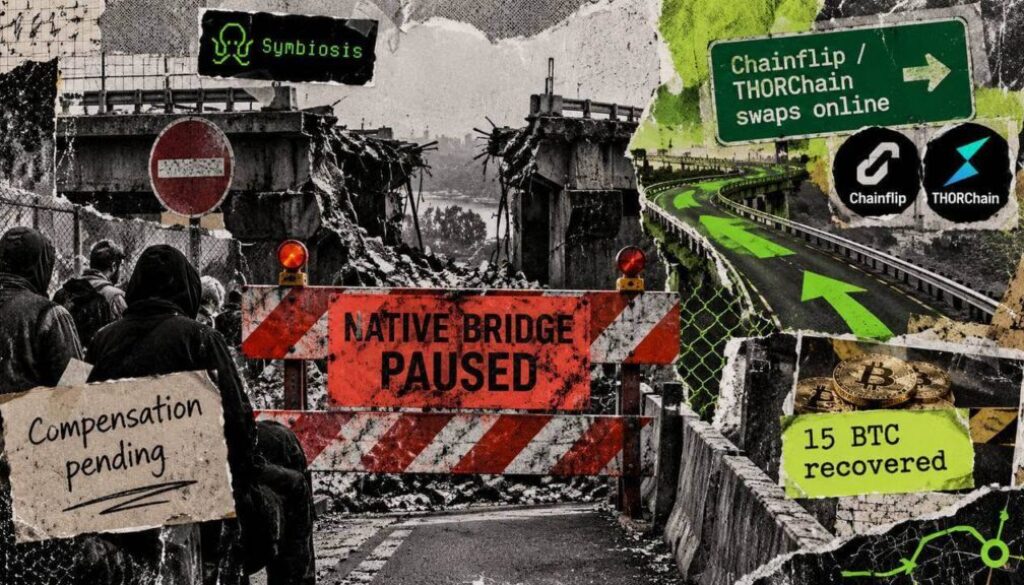
A cross-chain bridge exploit on Symbiosis has left liquidity providers in limbo as the protocol recovers assets but delays compensation details. The incident underscores growing risks in decentralized finance infrastructure, where bridge vulnerabilities continue to threaten user funds across multiple blockchain networks.
- Symbiosis recovered approximately 15 BTC after an attacker exploited its native Bitcoin Bridge on September 11.
- The attacker minted roughly 2^62 raw units of syBTC and converted about 4.39 WBTC for approximately $336,000.
- The protocol has not disclosed compensation criteria, timelines, or final loss figures to affected liquidity providers.
- 15 BTC Amount Symbiosis recovered from the bridge exploit to date
- $336,000 Value of WBTC proceeds the attacker converted on Ethereum
- Sep. 13 Deadline for attackers to claim a 20% white-hat bounty offer
- 2^62 Raw units of synthetic Bitcoin minted to a newly created wallet
Cross-chain protocol Symbiosis disclosed a security breach in its native Bitcoin Bridge that occurred at approximately 04:28 UTC on September 11. An attacker exploited the protocol’s BridgeV2 system, which inadvertently accepted a malicious transaction as legitimately signed, leading to the creation of synthetic Bitcoin tokens on an unintended scale. Security firm Blockaid identified that the attacker minted approximately 2^62 raw units of syBTC, a synthetic representation of Bitcoin, to a newly created wallet on BNB Chain. The protocol stated that only the Bitcoin Bridge was affected, while other routes spanning EVM chains, TRON and TON remained operational, and its relayer group continued securing the network.
Understanding cross-chain Bridge vulnerabilities in DeFi
Cross-chain bridges have become critical infrastructure in decentralized finance, enabling users to move assets between different blockchain networks. These protocols operate by locking assets on one chain and minting equivalent representations on another, creating liquidity pools and swap routes across ecosystems. However, bridges represent a concentrated attack surface, as exploits can affect multiple chains simultaneously and expose large quantities of user funds.
The Symbiosis incident reflects a pattern of bridge vulnerabilities that have emerged across the industry. Previous major bridge exploits, including incidents at Poly Network and Ronin, demonstrated that signature verification mechanisms and transaction validation logic require rigorous security auditing. Bridge protocols typically maintain significant liquidity reserves to facilitate swaps, making them attractive targets for sophisticated attackers. The Symbiosis case highlights how flawed validation logic in the signing process can bypass security assumptions that developers built into the system.
Liquidity providers who deposit assets into bridge pools to earn trading fees face elevated risk compared to other DeFi activities, as they bear exposure to both smart contract vulnerabilities and the capital requirements of cross-chain operations. When exploits occur, liquidity providers often experience losses before recovery mechanisms activate.
Attacker Converts $336,000 in Wrapped Bitcoin on Ethereum
Following the token mint, the beneficiary sold approximately 4.39 WBTC on Ethereum, realizing roughly $336,000 in proceeds at the time Blockaid’s alert was issued. The figure represents only the value the attacker demonstrably converted and does not establish Symbiosis’s final loss or total exposure for liquidity providers on the bridge.
Symbiosis stated that the 15 BTC it recovered remains secured in a team-controlled multisig wallet. The protocol acknowledged that final accounting was still in progress and committed to publishing confirmed figures in a subsequent update. The recovery of 15 BTC suggests the protocol retained visibility into transaction flows or maintained on-chain leverage points that enabled asset retrieval, though Symbiosis did not detail the recovery mechanism.
Bitcoin Bridge remains paused while partner routes resume
Symbiosis initially suspended all Bitcoin-related swaps to deploy security updates. The protocol later clarified operational status by distinguishing between its own bridge and partner integrations: Bitcoin swaps routed through partners Chainflip and THORChain returned online, while the native Symbiosis Bitcoin Bridge remained paused. This separation allows users to access alternative Bitcoin liquidity routes while the affected bridge undergoes remediation.
The decision to maintain alternative routes reflects industry practice during bridge recovery efforts. Rather than blocking all Bitcoin swaps, Symbiosis preserved user access through third-party bridges while focusing internal resources on remediating the vulnerability. This approach distributes liquidity across multiple protocols and reduces dependence on a single bridge during repair windows.
The protocol has not announced a timeline for restoring the native bridge.
Compensation framework undefined as Liquidity Providers await details
Symbiosis stated it was contacting every affected liquidity provider directly and building a compensation framework with criteria to be announced later. The protocol has not disclosed which providers will qualify, how compensation will be calculated, or when payments could commence.
Compensation structures following bridge exploits typically consider factors such as the size of a provider’s liquidity contribution, the duration of their exposure, and whether they were present when the exploit occurred. Some protocols have used insurance mechanisms, token allocations, or direct reimbursements funded by protocol treasuries. The absence of announced criteria creates uncertainty for affected providers and prevents market participants from assessing the financial impact of the incident.
The protocol offered the attacker a 20% white-hat bounty through September 13, after which the same percentage would be extended to anyone providing information leading to recovery. The statement did not specify an exact cutoff time or timezone for the bounty window. This incentive structure aims to encourage responsible disclosure, though the effectiveness of white-hat bounties depends on whether attackers prioritize financial incentives over proceeding with exploitation.
Affected liquidity providers are waiting for three critical disclosures from Symbiosis: confirmed loss and exposure figures, compensation criteria and qualification terms, and any status change regarding the native bridge’s return to service. Until the protocol publishes this information, the 15 BTC recovery figure and the $336,000 proceeds estimate should not be treated as a final loss tally.
BlockWest is a news publication. Nothing here is investment advice. Read our disclaimer and editorial policy.