Bitcoin miner spends millions in cryptocurrency to purchase computing power, yet newly generated coins fail to reach company reserves
BitFuFu’s August production surge reflects new mining capacity coming online, but the company’s decision to spend Bitcoin on hashrate expansion means most newly mined coins are not flowing back to its treasury. Shareholders face an open question about whether the expanded operations will generate returns that justify the Bitcoin already deployed.
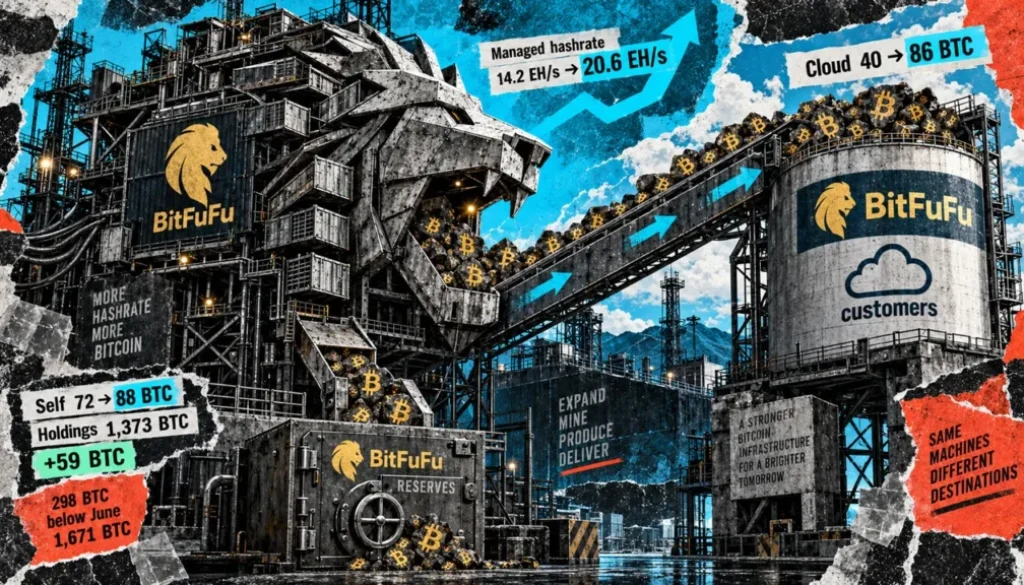
- BitFuFu reported 174 BTC production in August, a 55.4% increase from 112 BTC in July as new capacity went live.
- Cloud-mining customers accounted for 86 BTC of August output, which does not count toward company holdings or treasury replenishment.
- BitFuFu’s Bitcoin holdings rose only 59 BTC to 1,373 BTC despite producing substantially more, signaling ongoing capital deployment.
- 174 BTC August production, up 55.4% from prior month’s 112 BTC
- 20.6 EH/s Managed hashrate as of August 31, up from 14.2 EH/s in July
- 1,373 BTC Total Bitcoin holdings at month-end, 298 BTC below June peak
- 357 BTC Net decline from June, attributed to hashrate capacity purchases
BitFuFu, a Bitcoin miner and cloud-mining provider, disclosed an August production rebound driven by new computing capacity that came online during the month. Total output reached 174 BTC, compared with 112 BTC in July. The company’s managed hashrate, a measure of mining computing power, climbed to 20.6 exahashes per second as of August 31, up from 14.2 EH/s a month earlier, reflecting the deployment of capacity secured in June and July.
The Bitcoin mining industry has experienced significant consolidation and capacity expansion in 2024 as larger miners pursue economies of scale and invest in next-generation hardware. BitFuFu’s strategy of deploying Bitcoin reserves to accelerate hashrate growth reflects broader industry trends toward using accumulated Bitcoin reserves as capital for infrastructure investment rather than holding coins passively.
Cloud Mining revenue outpaces Treasury recovery
The August output split reveals a structural challenge for BitFuFu shareholders evaluating capital deployment returns. Cloud-mining production climbed from 40 BTC to 86 BTC, accounting for 46 of the 62 BTC monthly increase. Self-mining rose from 72 BTC to 88 BTC, contributing the remaining 16 BTC of growth. Cloud-mining revenue represents a separate business line, but those coins are owned by customers and excluded from BitFuFu’s Bitcoin holdings by definition.
BitFuFu’s total Bitcoin holdings increased only 59 BTC to 1,373 BTC despite producing 88 BTC through self-mining operations.
The limited treasury growth reflects ongoing capital deployment. In July, the company disclosed that it had spent Bitcoin on advance payments for hashrate capacity scheduled to run for 330 days. The net Bitcoin decline from June’s peak of 1,671 BTC to August’s 1,373 BTC totals 298 BTC, creating a gap that remains unfinanced through August’s production gains.
Cloud-mining platforms have become increasingly important revenue sources for larger miners seeking to diversify income streams beyond self-mining operations. By offering hashrate to retail and institutional customers, companies like BitFuFu generate fee-based revenue while scaling infrastructure that serves both internal and external demand. However, this model means that a significant portion of operational hashrate and production benefits customers rather than accumulating to the company’s Bitcoin treasury.
Hashrate Expansion completes ahead of financial disclosure
BitFuFu’s managed hashrate reached approximately 20 exahashes per second by mid-August, CEO Leo Lu stated in an August 17 earnings release. The September 3 operating update confirmed that the full month of August produced 174 BTC at that expanded capacity level, validating the capacity ramp-up.
The September disclosure adds production and holdings data to the capacity expansion already in progress but does not provide contract economics or payback figures for the Bitcoin committed to hashrate purchases. Investors lack visibility into the specific terms, duration, or expected returns from the capacity deals funded through Bitcoin reserves in prior months.
For mining companies, the decision to deploy accumulated Bitcoin reserves for hashrate expansion represents a bet on long-term Bitcoin appreciation and sustained mining profitability. If Bitcoin prices rise significantly or if mining margins remain attractive, the investment in capacity can generate multiples of return. Conversely, if Bitcoin prices decline sharply or mining difficulty increases faster than production growth, the capital deployment could underperform a strategy of holding Bitcoin or returning reserves to shareholders.
BitFuFu’s capital allocation strategy also reflects confidence in mining fundamentals. By committing 300 BTC in net reserves over two months to fund 45 percent hashrate growth, management is signaling conviction that incremental hashrate will generate sufficient Bitcoin production to offset the opportunity cost of deploying capital today.
BitFuFu’s next operating update will test whether the expanded 20.6 EH/s platform continues to drive production gains and whether management discloses contract economics or profitability metrics that justify the Bitcoin capital deployed. Without incremental profit or payback figures, shareholders remain unable to assess the return on the 357 BTC net decline from June through August. Sustained production growth at or above 88 BTC monthly from self-mining operations would provide evidence that the capital deployment is generating returns, while any decline would raise questions about the economics of the capacity purchases.
BlockWest is a news publication. Nothing here is investment advice. Read our disclaimer and editorial policy.