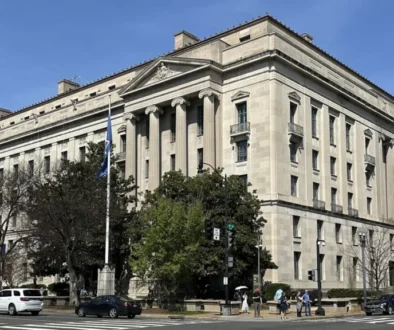
Justice Department files civil forfeiture claim for $1.1 billion in Binance theft proceeds

The Justice Department filed a civil forfeiture claim for more than $1.1 billion in USDC tied to North Korean cyber actors’ theft from Binance last month. The action is the latest step in a government effort that has so far helped freeze, seize or return more than $2.9 billion of the over $6 billion stolen from the exchange.
- Civil claim targets more than $1.1 billion of USDC, the Circle-issued stablecoin, as theft proceeds
- Theft from Binance occurred on or about Oct. 29; total loss attributed to North Korean actors exceeds $6 billion
- Watch for how the forfeiture case proceeds in federal court and whether any party contests the claim
- $1.1B+ USDC targeted in today’s forfeiture claim
- $6B+ total Binance theft attributed to North Korea
- $2.9B+ recovered or frozen across all efforts to date
- ~48% share of the $6B theft recovered so far
The Justice Department announced Monday that it filed a civil action to forfeit more than $1.1 billion in cryptocurrency criminally obtained by North Korean actors from Binance last month, according to the release. The department said the action is “part of the greater government effort to assist Binance in recovering over $6 billion in stolen assets,” and that since the theft on or about Oct. 29, the United States has assisted in freezing, seizing or returning more than $2.9 billion of cryptocurrency from multiple sources.
A civil claim against funds, not a named defendant
The filing is a civil forfeiture complaint seeking over $1.1 billion of USDC that the government alleges is “proceeds and laundered funds from the cryptocurrency theft from Binance.” No individual hacker or entity is named as a defendant in the release; the action proceeds against the asset itself.
The release states the USDC “had previously been subject to a government-requested restraining order” following an earlier DOJ announcement this month, referenced in that prior release. The matter remains at the civil forfeiture stage; the document does not indicate any claimant has contested it.
The $2.9 billion figure and what it does not clarify
The department’s math leaves a gap unaddressed: it does not say whether the $1.1 billion targeted today is counted within, or additional to, the $2.9 billion already described as frozen, seized or returned. If the two figures overlap entirely, roughly $3.1 billion of the $6 billion theft remains unaccounted for; if they are additive, the recovered total could approach $4 billion.
Three agencies, the FBI, the U.S. Secret Service and IRS Criminal Investigation, are listed as investigating the case, and the release credits Circle Internet Financial with providing “valuable assistance.” The release does not detail how or when forfeited funds would be returned to Binance or to victims, nor does it name the specific North Korean actors or laundering intermediaries involved.
“By working closely with the digital asset industry, we can disrupt illicit financial activity, protect victims, and recover stolen assets before they move beyond the reach of law enforcement.”
A. Tysen Duva, Assistant Attorney General, Justice Department Criminal Division
Stablecoin issuers as recovery chokepoints
The case turns on Circle’s ability to track and act on USDC it issued, the kind of centralized control that distinguishes fiat-backed stablecoins from bitcoin or ether in theft cases. For exchanges and custodians, the episode reinforces that a stablecoin issuer’s cooperation can determine how much of a nine- or ten-figure hack is recoverable within weeks rather than years.
Five Assistant U.S. Attorneys for the District of Columbia, two National Security Cyber Section attorneys and a senior counsel from the Criminal Division’s Computer Crime and Intellectual Property Section are handling the matter, a roster size that signals the government intends to keep working parallel tracks on the remaining stolen funds.
The BlockWest read. The speed of this filing, weeks after an October hack, shows that stablecoin rails cut both ways for criminals: issuer-level freezes make large thefts partially reversible in ways cold wallets and privacy coins are not. Exchanges and allocators should treat USDC exposure in any future hack as faster to claw back than other crypto assets, but the unresolved $6 billion minus $2.9 billion gap means the bulk of this theft is still outstanding.
The civil forfeiture case now proceeds in federal court in the District of Columbia, where the Justice Department has not disclosed a date for resolution or said whether any party will contest the $1.1 billion claim.
BlockWest is a news publication. Nothing here is investment advice. Read our disclaimer and editorial policy.