
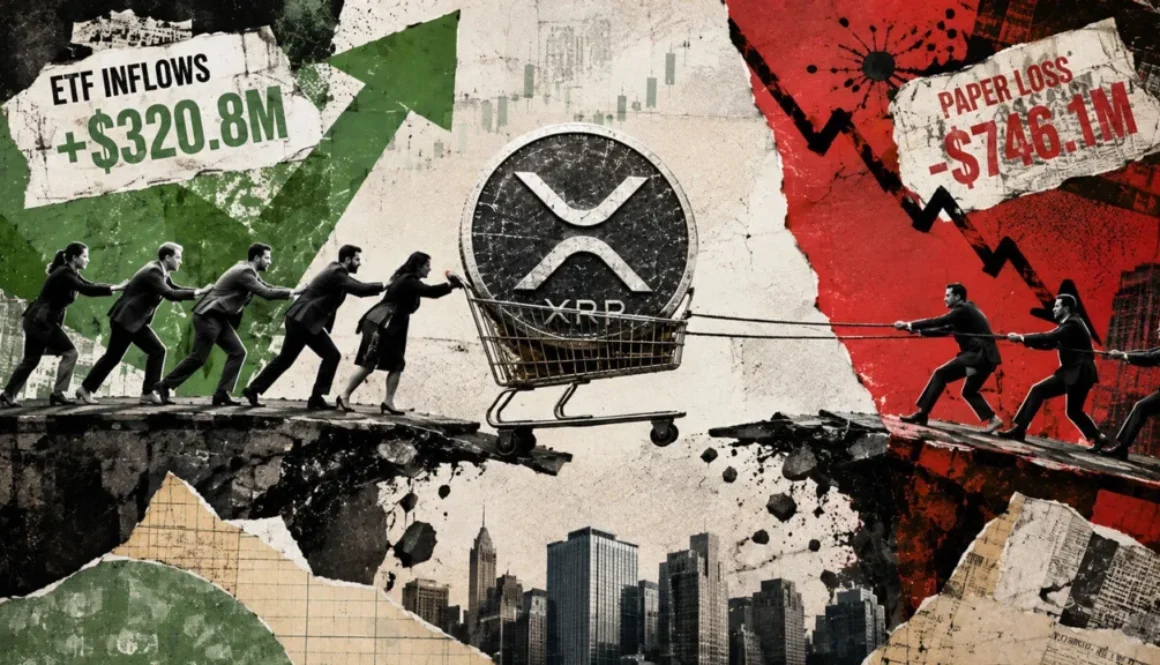
XRP ETF investors contributed $320M in fresh capital despite the funds carrying a $746M unrealized loss
XRP ETF investors continued pouring capital into products that sat deeply underwater as of mid-year, raising questions about whether the inflows reflect genuine conviction or fund-specific rotation. The sustainability of this pattern hinges entirely on XRP’s price recovery over the coming months.
- Five major US spot XRP ETFs held XRP worth $746.1 million less than their accounting cost as of June 30.
- Investors created $629.9 million in new shares against $309.1 million in redemptions during the first half of 2024.
- Net inflows of $320.8 million arrived despite the combined XRP holdings trading 44.1% below their $1.7 billion recorded cost.
- $746.1M Paper loss on five-fund XRP holdings versus accounting cost basis
- 44.1% Percentage below cost that June 30 XRP fair value represented
- $320.8M Net capital inflows during first half despite underwater positions
- $1.87 Price per XRP needed to recover five-fund cost basis entirely
Five major US spot XRP products recorded a combined unrealized loss of $746.1 million as of June 30, with their holdings valued at $947.3 million against an accounting cost of $1.693 billion. Despite this significant drawdown, investors continued adding capital. According to SEC filings, Bitwise, Canary Capital, Franklin Templeton, 21Shares, and Grayscale together recorded $629.9 million in share creations during the first half of 2024, compared with $309.1 million in redemptions, producing net inflows of $320.8 million. The pattern reveals a split market: three funds absorbed steady buying pressure while two saw meaningful outflows.
Market Context and the Broader XRP ETF Landscape
The emergence of spot XRP ETFs represents a significant shift in how retail and institutional investors access the cryptocurrency. Prior to regulatory approval of these products, investors typically purchased XRP through cryptocurrency exchanges or crypto-focused investment vehicles, each carrying different fee structures, custody arrangements, and tax treatment considerations. The arrival of traditional ETF wrappers lowered friction for investors seeking exposure through brokerage accounts and retirement accounts.
XRP itself has remained among the top ten cryptocurrencies by market capitalization, though its price trajectory has differed markedly from Bitcoin and Ethereum. The token’s connection to Ripple, a company focused on cross-border payment infrastructure, creates a unique narrative around utility versus pure speculative demand. This distinction may explain why some investors continued buying during drawdowns: they were making a conviction bet on the underlying asset’s fundamental value rather than trading cyclical momentum.
Three Funds Drove Inflows While Two Hemorrhaged Redemptions
Bitwise, Canary Capital, and Franklin Templeton accounted for the bulk of creation activity, with combined inflows of $484.5 million against just $53.3 million in redemptions during the period. That trio retained roughly $9.90 in new capital for every $100 that arrived, despite their combined XRP holdings trading 42.9% below accounting cost. The three funds together absorbed outflows at Grayscale and 21Shares, which recorded net redemptions of $163.7 million.
Grayscale alone saw $180.8 million redeemed against $66.6 million created, a net outflow of $114.2 million that dominated the five-fund sample.
21Shares recorded $75 million in redemptions against $25.5 million in creations for a net outflow of $49.5 million. The concentration of redemptions in these two legacy or higher-fee products suggests investors may have rotated toward alternative structures rather than universally lost conviction in XRP as an asset class. Bloomberg ETF analyst James Seyffart characterized the overall pattern as “surprisingly resilient” demand, estimating cumulative net inflows across the XRP ETF complex at $1.8 billion as of late August.
Fee Structures and Investor Behavior
The differential flow patterns between Grayscale and the newer competitors likely reflect fee competition within the emerging category. Established cryptocurrency investment products typically carried higher fee structures than newly launched ETFs, and investors often gravitate toward lower-cost alternatives once they become available. This mechanical rotation would explain why a product like Grayscale, which previously dominated XRP exposure, began shedding assets as investors shifted to cheaper competitors offering the same underlying exposure.
Fee compression remains a persistent trend across the broader cryptocurrency ETF space, mirroring the pattern that unfolded in traditional equity and bond ETFs over the past two decades. Newer entrants like Franklin Templeton and Canary Capital positioned themselves as lower-cost alternatives to incumbent products, using fee advantages as a primary marketing lever to attract flows.
The Breakeven Point Requires a 35% Recovery From Current Levels
The five funds held approximately 906.8 million XRP at June 30, which implies a rough cost-basis breakeven near $1.87 per token. XRP currently trades around $1.38, meaning the sample would remain underwater by roughly 26% if marked at today’s price. That gap narrows the closer XRP climbs toward $1.50 to $1.90, a range that would erase most of the accounting loss without requiring the asset to make a fresh cycle high.
A recovery to $1.87 would leave the funds roughly flat to their recorded cost basis, transforming the resilience narrative from a stress test into vindication for investors who kept buying through the drawdown.
The bear case presents a different picture. If XRP slides toward $0.75 to $0.90, the five-fund sample would trade 52% to 60% below cost, potentially triggering broader redemption activity beyond the outflows already visible at Grayscale and 21Shares. That scenario would test whether conviction buying was concentrated in a handful of funds or spread across the entire product category.
Implications for the Cryptocurrency ETF Industry
The willingness of investors to add capital to deeply underwater positions suggests either high conviction in mean reversion or active tactical buying by investors who view drawdowns as buying opportunities. This pattern has parallels in traditional market cycles, where contrarian investors rotate capital into depressed assets expecting recovery. Whether this XRP ETF behavior reflects genuine fundamental conviction or momentum-chasing disguised as conviction will ultimately be determined by subsequent price action and redemption patterns.
The divergence between continued inflows at three funds and outflows at two means the next critical data point is XRP’s sustained price level. A move above $1.50 would likely stabilize the funds nearest their cost basis and reinforce the resilience story; a decline toward $0.90 or lower would determine whether redemptions accelerate across the broader complex.