
Uniswap’s daily trading volume surges past 7 million to all-time highs while fee revenue fails to keep pace
Uniswap has reached record trading volumes while simultaneously rolling out protocol fees across multiple blockchain networks, creating a natural test of whether heightened activity translates into meaningful token burn and revenue capture. This matters to BlockWest readers tracking both DeFi adoption metrics and the mechanics of tokenomic value extraction in a maturing ecosystem.
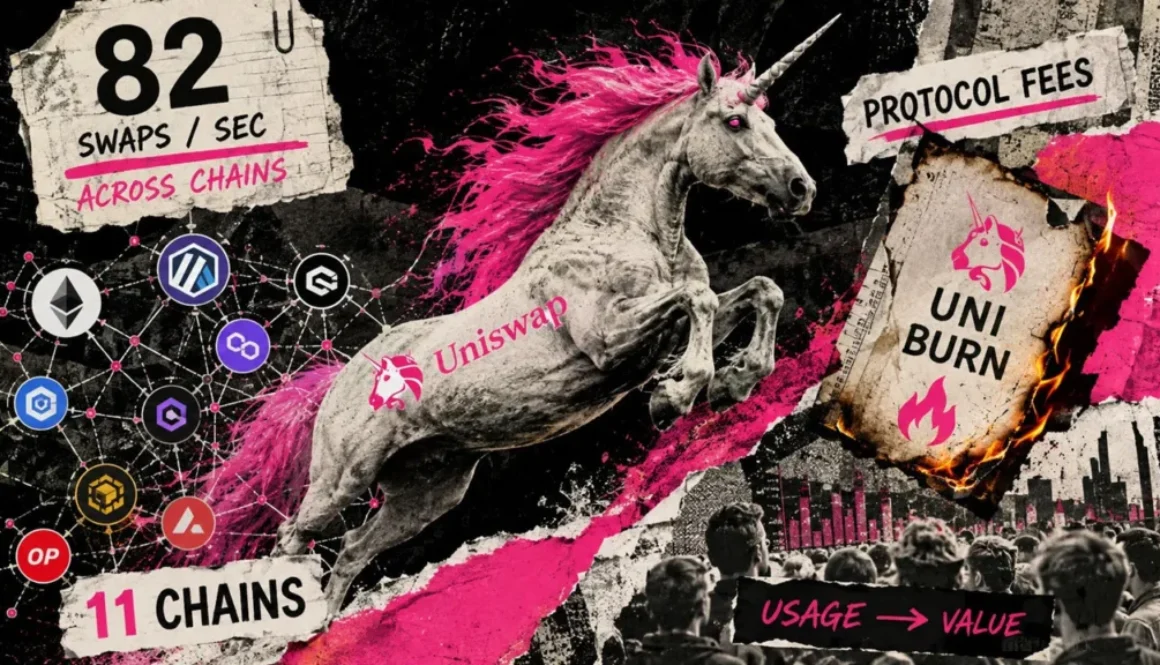
- Uniswap handled approximately 82 swaps per second on September 1, recording more than 7 million swaps in a single day.
- Protocol fees accrued roughly $4 million over 30 days in August, with v4 contributing approximately $300,000 during its first two weeks of operation.
- Fee-enabled pools now span 10 of 12 authorized chains with roughly 229,000 v4 pools active, but available data does not connect the record swap day to specific fee revenue generated.
- 7M+ Swaps executed in a single day, a new record for the protocol
- $4M Protocol fees accrued over 30 days in August across all versions
- $44M Liquidity provider fees earned over the same 30-day window
- 7.5M UNI tokens burned since December using accumulated protocol fees
Uniswap founder Hayden Adams confirmed on Tuesday that the decentralized exchange was processing roughly 82 swaps per second across all chains, a rate consistent with the reported daily total of over 7 million swaps. The milestone represents the protocol’s busiest day by swap count to date, though the metric itself tracks transaction volume rather than dollar value or unique participants. The surge in activity occurs as Uniswap has rapidly expanded its fee infrastructure across multiple versions and blockchain networks.
This record arrives at a critical moment for the protocol’s evolution. Uniswap has established itself as the leading decentralized exchange by trading volume since its 2018 launch, but the protocol long operated without a direct mechanism to capture revenue for token holders or fund ongoing development. The introduction of protocol fees represents a fundamental shift in how the platform generates sustainable value, particularly as governance has expanded fee collection across an increasingly fragmented multi-chain landscape.
Protocol Fees Live Across 11 Chains Following Governance Expansion
Uniswap governance activated fees across all v2 and v3 pools on 11 chains beginning July 7, then added Robinhood Chain for both versions on July 27. On the same date, governance executed the first part of its v4 fee proposal, activating fee controllers on Ethereum, Arbitrum, Base, BNB Chain, Polygon, Optimism and Robinhood Chain, while deferring five other chains to a subsequent proposal.
By mid-August, roughly 229,000 v4 pools had activated fees across 10 of 12 authorized chains, with nearly all pools across Uniswap versions contributing a portion of swap fees to the UNI token burn mechanism.
The multi-chain rollout reflects the complexity of managing protocol upgrades across decentralized governance structures. Each chain operates with its own validator set and economics, requiring Uniswap governance to carefully calibrate fee levels that balance protocol revenue capture with competitive positioning against other DEXs on the same networks. Some chains like Arbitrum and Optimism have emerged as major Uniswap hubs, while others represent smaller but still meaningful revenue contributors.
Fee Revenue Growth Outpaced By Record Swap Volume
Uniswap’s protocol accrued approximately $4 million in fees over 30 days in August, while liquidity providers earned roughly $44 million across the same period. V2 and v3 generated $3.64 million of the protocol total, while v4 contributed approximately $300,000 during its first two weeks of operation. Under Uniswap’s design, liquidity providers retain most v2 and v3 swap fees while the protocol receives a defined share, with v4 applying a separately governance-controlled fee.
The disparity between protocol fees and LP fees illustrates a core design principle in Uniswap’s economics. Liquidity providers bear the risk of impermanent loss and require sufficient incentives to supply capital, which means the protocol intentionally captures only a small percentage of total swap fees. This structure differs from centralized exchanges that retain all trading fees, but it aligns with Uniswap’s decentralized ethos and competitive positioning against other protocols that may offer higher fee rewards to liquidity providers.
Uniswap Labs reported in July that accumulated protocol fees had funded approximately 7.5 million UNI in burns since December, worth roughly $25.6 million at that valuation. Monthly protocol fees rose from approximately $3.1 million in February to $5.1 million in June, indicating a trend of growing revenue before the September record activity date. This upward trajectory suggests that both increased adoption and successful fee rollouts across new chains have contributed to revenue growth independent of the September 1 spike.
Fee assets accumulate in TokenJar and can be claimed by third parties who burn UNI through Firepit, a process separate from the one-time 100 million UNI treasury burn approved through UNIfication.
The Gap Between Swap Records and Measurable Fee Impact
The September 1 record for swap count does not establish how many of those swaps occurred in fee-enabled pools or how much protocol revenue they generated. Public Uniswap and analytics pages do not currently link the record day’s swap count to corresponding fee status, volume and protocol revenue accrual, leaving a data gap that obscures the true value capture from the milestone activity.
This transparency gap raises important questions about how effectively the protocol can demonstrate the connection between increased activity and token holder value. In mature traditional markets, transaction volume metrics directly correlate with revenue, but in DeFi the relationship depends on factors like fee tiers, chain distribution, and pool participation rates. Without clear attribution between the record swap day and specific fee accrual, the September 1 milestone reads more as a usage metric than as proof that volume translates predictably into protocol revenue.
The challenge reflects broader tensions in DeFi analytics. Real-time data on DEX activity remains fragmented across multiple sources, and connecting specific trading events to their impact on protocol economics requires integrating information from smart contracts, fee collectors, and token burn mechanisms across dozens of chains. Uniswap’s own infrastructure has matured faster than the analytical tools available to track its full economic picture.
For now, protocol value capture remains measurable through dollars accrued to the protocol and UNI burned rather than as a percentage of latest swap volume. Observers tracking whether record activity translates into material fee revenue will need to monitor subsequent official disclosures or analytics updates that connect the September 1 swap record to actual protocol fee generation and UNI burn execution. The next monthly fee report will provide the clearest signal of whether this record day meaningfully accelerated the protocol’s revenue trajectory.