
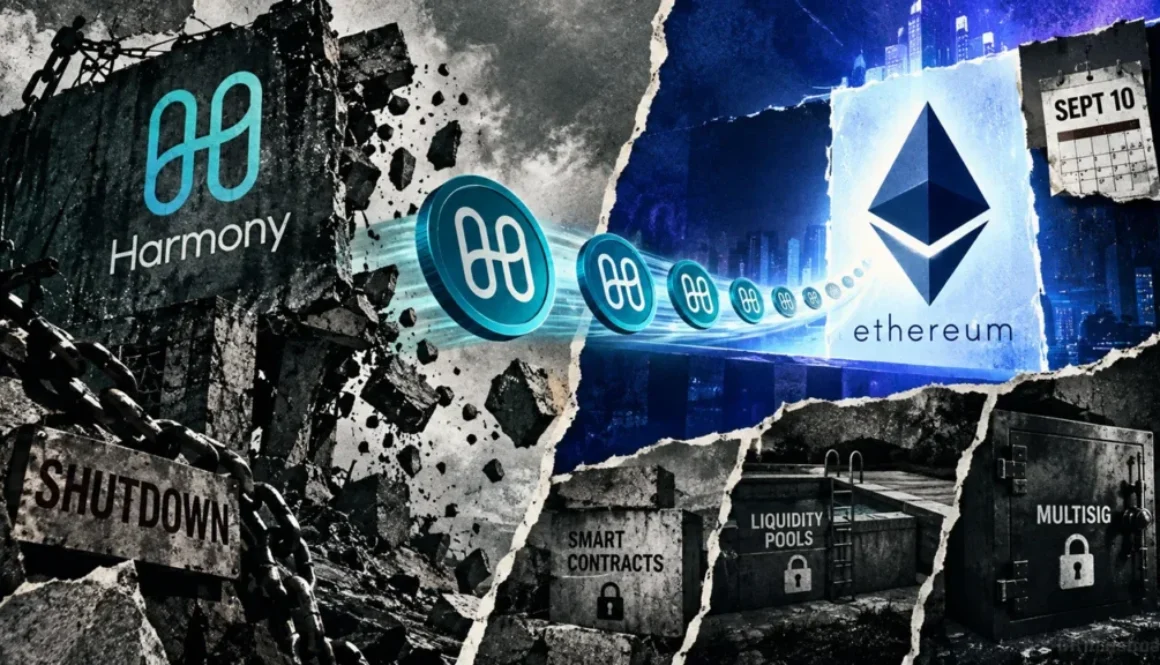
Seven-year-old blockchain abandons its network and migrates to Ethereum for protection
Harmony, a blockchain that once reached an $18 billion market cap, is abandoning its independent network entirely to migrate its ONE token to Ethereum. The decision follows a catastrophic August exploit that created over 3 trillion unauthorized tokens and forced a rollback, leading leadership to conclude that state and AI-based threats make standalone operation untenable.
- Harmony proposes permanent shutdown of its independent blockchain and full migration of ONE token to Ethereum via snapshot and airdrop.
- August 2024 exploit minted approximately 3.01 trillion unauthorized ONE tokens across six forged transactions, necessitating a rollback of 109,000 transactions.
- ONE trades at $0.0072, down roughly 99% from its $18 billion peak market cap, as the network abandons its original mission to operate independently.
- $18B Peak market capitalization during 2021 boom, versus current market cap near $10.75 million
- 3.01T Unauthorized ONE tokens created in August cross-shard exploit, requiring network rollback
- $100M Funds drained from Horizon bridge in June 2022 attack attributed to North Korea’s Lazarus Group
- $0.0072 Current ONE trading price, representing 99% decline from peak value
Harmony, a seven-year-old blockchain network, announced on September 6 that it will permanently shut down its independent chain and migrate its ONE token to Ethereum, marking a dramatic reversal from its original vision as a high-performance, sharded blockchain. The proposal would transfer ONE holdings to Ethereum through a snapshot-based airdrop mechanism, preserving the token’s total supply and emission schedule while allowing existing holders to receive new tokens based on their final block holdings. The decision comes after a catastrophic August 11 security exploit that exposed the network’s fundamental vulnerabilities and prompted leadership to conclude that maintaining an independent blockchain now carries unacceptable risks.
Harmony was founded to address scalability limitations of existing blockchains through a sharding architecture that divides the network into parallel processing segments. By distributing transaction processing across multiple shards, Harmony aimed to achieve throughput comparable to centralized payment systems while maintaining decentralization. The network attracted significant investor interest during the 2021 cryptocurrency boom, briefly joining the ranks of top-20 cryptocurrencies by market capitalization.
August Exploit Minted 3 Trillion Unauthorized Tokens Across Six Transactions
The August 11 attack exploited a cross-shard receipt vulnerability that allowed attackers to mint tokens without corresponding debits elsewhere on the network. Harmony initially reported 4 billion ONE created in the attack, but subsequent reconstruction revealed the true scale was vastly larger: approximately 3.01 trillion ONE tokens across six forged transactions. This massive unauthorized issuance would have severely diluted all existing token holders had the attack remained undetected.
Harmony executed a rollback on August 21, discarding more than 109,000 regular transactions and 315 staking transactions from the affected shard-0 archive. The network announced it was operating normally following the restoration. However, rollbacks represent an extreme remedy in blockchain governance, as they reverse the finality that blockchain systems are fundamentally designed to provide, undermining a core principle of decentralized ledgers.
Such security incidents are not uncommon in the blockchain industry, particularly for networks attempting novel scaling solutions. Cross-shard communication protocols are inherently complex and require rigorous cryptographic verification to prevent exactly the type of exploit Harmony experienced. The failure highlighted how one vulnerability in a sharded system can compromise the entire network’s economic integrity.
Leadership Cites State and AI Threats as Justification for Full Shutdown
Despite completing the rollback, Harmony’s leadership determined that the risks of maintaining an independent blockchain outweighed the benefits of continued operation. The project cited concerns about state-sponsored attacks and emerging threats from artificial intelligence systems as key reasons for abandoning its core infrastructure entirely. This reasoning represents a significant strategic pivot from Harmony’s original mission to operate as a secure, high-performance standalone network.
The decision contradicts Harmony’s position from just weeks earlier. On August 17, the project had explicitly rejected migration to another blockchain, arguing the move would be too disruptive to users and the network. Instead, Harmony had chosen to pursue the rollback strategy, suggesting confidence in the security fix. The rapid reversal signals that leadership’s confidence in the fix proved short-lived once the full scope of the exploit became clear.
By migrating to Ethereum, Harmony transfers security responsibility to the world’s second-largest blockchain, which has operated uninterrupted since its 2015 launch and benefits from substantially larger validator incentives and institutional participation. The move also provides access to Ethereum’s mature DeFi ecosystem and significantly greater liquidity for the ONE token. However, it effectively abandons Harmony’s original value proposition as an independent scaling solution.
Harmony’s security troubles predate the August incident. In June 2022, the Horizon bridge was drained of nearly $100 million in an attack the FBI later attributed to North Korea’s Lazarus Group, triggering a prolonged decline in ONE that eventually reached approximately 99% below its peak.
Migration Plan Requires Manual User Action and Excludes Smart Contracts
Under the proposed migration plan, token holders will receive new ONE on Ethereum based on their holdings at the network’s final block, with delegated stakes and unclaimed rewards transferred into individual governor vaults. However, smart contracts, liquidity pools, and multisig safes will not automatically migrate to Ethereum. Harmony has urged users to exit smart contracts before September 10, and validators may begin shutting down operations starting at 7 a.m. Pacific Time that day.
Users will need to manually redeploy applications and liquidity on Ethereum or other platforms, placing the burden of migration directly on developers and token holders rather than handling it at the protocol level. A proposed $1.37 million compensation pool would pay governors and delegators over four quarters, contingent on shutdown and service conditions. The plan would also redirect future ONE emissions toward Harmony’s AI-video initiative, further disconnecting the token’s future from the blockchain infrastructure it was originally designed to secure.
This approach contrasts with other blockchain migrations, which have sometimes provided automated bridging mechanisms or proportionally larger compensation pools for affected users. The relatively modest compensation relative to losses incurred by those who held ONE through the 99% decline reflects the constrained resources available to a network with a current market cap under $11 million.
The proposal remains non-binding at this stage, and Harmony has not yet disclosed the final block number or the specific date for the airdrop to Ethereum. Community response to the migration plan will likely determine whether the shutdown proceeds as proposed, and token holders and affected protocols face a September 10 deadline to exit smart contracts before validator shutdown operations begin.