
Money-market funds absorbed 85% of Treasury bill surge this summer, Treasury data shows
Money-market mutual funds, not stablecoins, drove the Treasury Department’s record bill issuance surge this summer, according to newly disclosed buyer data. The finding reshapes how policymakers and investors should assess cryptocurrency’s actual role in funding short-term government debt.
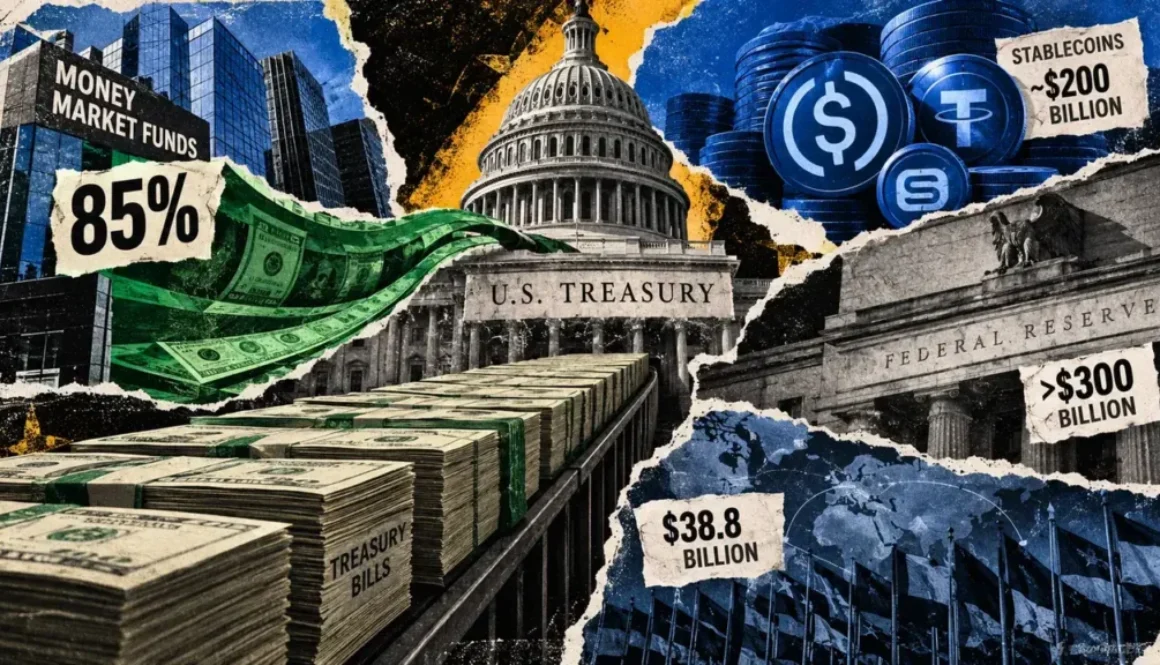
- Money-market mutual funds absorbed approximately 85% of more than $550 billion in net bill supply during July and August 2026.
- Stablecoin providers hold nearly $200 billion in Treasury bills and other close-to-maturity securities, a substantial but distinct stock measure.
- The Federal Reserve purchased more than $300 billion in bills through 2026, while foreign residents increased holdings by $38.8 billion in July alone.
- 85% Share of new bill supply absorbed by money funds in two months
- $200B Stablecoin holdings of near-term Treasury securities, date unspecified
- $550B Net bill supply growth in July and August versus prior two months
- $38.8B Foreign resident bill holdings increase in July alone
Deputy Treasury Secretary Francis Brooke delivered remarks on September 22 that money-market mutual funds took down most of the additional Treasury-bill supply issued during the summer months. The Treasury Department said net bill supply grew by more than $550 billion in July and August, an increase of roughly 8% in two months. Stablecoin providers remain material holders of short-dated government debt, with Treasury estimating their combined holdings at nearly $200 billion, yet that figure measures an aggregate stock of securities rather than the flow of new purchases that drove the recent issuance wave. The story was first reported by CryptoSlate.
Money Funds Claimed 85% Of Summer Treasury Bill Surge
The Treasury’s buyer breakdown reveals that traditional cash managers, not digital-asset firms, captured the clearest claim to demand for government debt during the peak issuance period. Brooke’s remarks, delivered at a time when debt ceiling negotiations and fiscal uncertainty have intensified focus on Treasury financing mechanics, attributed approximately 85% of the additional $550 billion in net bill supply to money-market mutual funds. The remaining portion was not allocated among other buyer classes in the speech.
The distinction matters because the money-fund figure measures purchases tied to a specific two-month supply increase, while the stablecoin total represents a point-in-time holdings stock without a specified measurement date or breakdown by security type. The categories also overlap in practice: stablecoin reserve structures can channel demand through government money-market funds and repurchase agreements, meaning some digital-asset buying may appear inside the money-fund aggregate.
Stablecoin Reserve Structures Blend With Money-Fund Holdings
Circle, a major stablecoin issuer, disclosed in its second-quarter filing that approximately 84% of USDC reserves were held in the Circle Reserve Fund at June 30, 2026. The company describes the vehicle as a Rule 2a-7 government money-market fund, creating an accounting overlap between the two buyer classes that Treasury’s figures do not fully isolate.
The fund’s annual shareholder report listed $19.111 billion of direct Treasury obligations and $46.998 billion of repurchase agreements at April 30, 2026. The repos were collateralized by Treasuries but remained a separate asset category in the fund’s disclosures. Because that portfolio date precedes Circle’s June reserve filing and the mix can shift, the filings establish the structural overlap rather than an exact allocation for the summer months. Circle is one issuer, so its allocation pattern does not describe the entire stablecoin market, but it demonstrates why the broad buyer labels used by Treasury cannot be treated as cleanly separated categories.
Regulatory Framework Could Expand Stablecoin Treasury Demand
Treasury presented stablecoin demand as a source of potential future growth rather than as an explanation for the July-August absorption.
Brooke stated that stablecoin providers may continue expanding and add to their Treasury holdings as rules implementing the GENIUS Act are finalized, but Treasury did not quantify this as a forecast or measure it as a driver of the current surge. The conditional language makes the regulatory channel an option for incremental demand once legislation takes effect, not a documented factor in the 2026 issuance wave.
The Federal Reserve has also become a major bill buyer in 2026, purchasing more than $300 billion through reserve-management purchases and reinvestment of principal payments from agency securities, according to Treasury’s account. Fed holdings of Treasury bills expanded from $233.592 billion on December 31, 2025, to $550.482 billion on September 16, 2026, based on published balance-sheet data. Foreign residents increased their bill holdings by $38.8 billion in July, reversing three consecutive monthly declines in April, May and June. Private foreign holdings rose by $45.0 billion in July, while foreign official holdings fell by $6.3 billion during that same month.
The BlockWest read. The Treasury’s granular buyer disclosure underscores that near-term government debt remains a tool for institutional cash management across multiple asset classes and geographies. While stablecoins have grown into a material holder of short-dated Treasuries, their reserve structures funneled significant summer demand through the money-fund channel, making the marginal buyer less novel than the aggregate stablecoin stock might suggest. Policymakers monitoring fiscal stability should track whether regulatory clarity on stablecoins produces the incremental demand Treasury projects, rather than assume digital-asset growth alone will solve near-term refinancing needs.
The Treasury Department did not specify a measurement date for the nearly $200 billion stablecoin holdings total, leaving open how much of that stock was accumulated during the summer issuance period versus earlier quarters. As the GENIUS Act moves toward rulemaking, Treasury will determine whether and how stablecoin reserve requirements affect future bill-market demand, with the outcome directly affecting the sizing of subsequent auction calendars.