
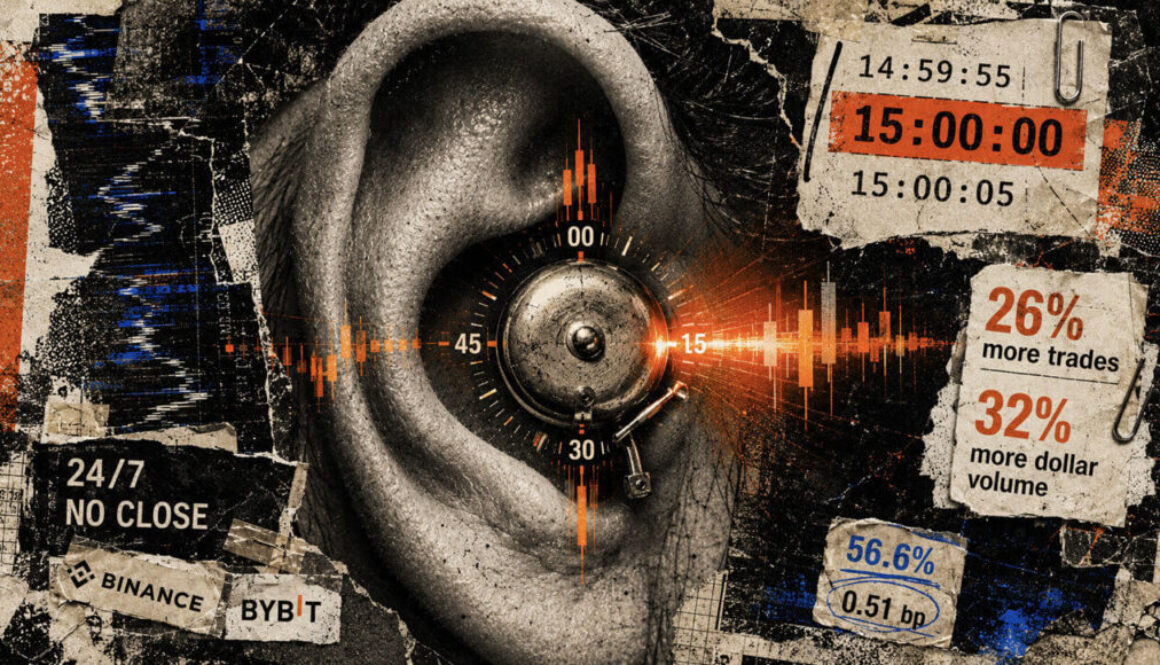
A $14 billion Bitcoin perpetual futures market powered by ultra-short 15-minute trading intervals
A new study reveals that Bitcoin perpetual futures markets experience synchronized trading surges every 15 minutes, driven by algorithmic systems responding to standardized charting intervals rather than fundamental price drivers. For traders seeking to exploit this pattern, transaction fees eliminate any practical profit opportunity, though the finding has implications for market makers and large institutional traders managing order execution.
- Bitcoin perpetual futures volume on Binance averaged $14.58 billion daily from January 2021 through October 2024, with trades spiking 32% higher at precise 15-minute intervals.
- During the opening ten seconds of each quarter-hour boundary, algorithmic participation surged while round-number trade sizes fell by 0.20 standard deviations at the top of the hour, five times the effect at ordinary minute openings.
- A predictive model correctly forecast price direction 56.6% of the time but generated only 0.51 basis points average gross return per trade, making it unprofitable after accounting for Binance’s 5 basis point taker fees.
- $14.58B Bitcoin perpetual futures daily contract volume on Binance during the sample period
- 32% Increase in dollar trading volume during 15-minute interval openings versus ordinary windows
- 56.6% Directional accuracy of the predictive model on out-of-sample forecasts
- 0.51 bps Average gross return per trade using the pattern, before transaction fees
Bitcoin perpetual futures markets on Binance exhibit a striking mechanical pattern: at precisely 15:00:00 UTC and again at 15, 30, and 45 minutes past every hour, trading volume spikes sharply for roughly ten seconds. During these compressed windows, more trades execute, more capital changes hands, and prices move with greater magnitude, despite the absence of any new information to justify the activity. This recurring phenomenon was documented and analyzed by Korean policy researcher Chan Kim and Peter Reinhard Hansen of the University of North Carolina in an August 2026 study examining trade records across six Binance futures markets from January 1, 2021, through October 31, 2024.
The 15-Minute Rhythm Spans Six Major Cryptocurrency Markets
The research covered Bitcoin, Ethereum, XRP, Solana, Dogecoin, and Cardano perpetual futures contracts across 1,400 full days of continuous trading. The statistical evidence proved consistent across all six assets studied. During those opening ten seconds of each 15-minute interval, the markets registered 26% more trades and 32% more dollar volume compared to identical ten-second windows during ordinary minutes. Absolute price returns, which measure the magnitude of price movement regardless of direction, were 26% larger during these bursts.
Bitcoin averaged 1.54 million daily trades and $14.58 billion in daily contract volume during the sample period, while Cardano, the smallest asset studied, recorded approximately 290,000 trades and $544 million in daily volume.
Despite this massive size difference between the largest and smallest markets examined, both exhibited the same rhythmic pattern, suggesting the phenomenon reflects how trading systems are collectively structured rather than any feature specific to individual tokens. Perpetual futures, or perps, allow traders to bet on whether an asset’s price will rise or fall while using borrowed capital to amplify their exposure. Unlike conventional futures contracts with fixed expiration dates, perps remain open indefinitely as long as traders maintain adequate collateral, with recurring funding payments between long and short positions keeping the perp price anchored to the underlying spot market.
Trading Software Candles Create Artificial Market Openings Every 15 Minutes
The root cause lies in how trading software displays and processes market data. Most trading platforms compress continuous price streams into standardized candles representing one minute, five minutes, 15 minutes, or other familiar intervals. Each candle captures the open, close, high, and low prices during its period, creating a manageable visual representation for humans and a standard data block for automated systems. When a candle closes, technical indicators recalculate and automated strategies receive updated instructions based on the newly completed data block.
Programs fragmenting large trades into smaller pieces often release additional portions at these boundaries, while market makers adjust their quote spreads in anticipation of changing flow patterns. Faster automated systems trade preemptively in front of both groups. Once sufficient numbers of independent machines synchronize to the same clock boundaries, a mere data display convention transforms into an actual market force.
Cryptocurrency markets, which operate continuously without opening or closing bells, have inadvertently created miniature exchange openings through shared charting intervals and software defaults, with these artificial openings repeating every 15 minutes while trading never stops.
Algorithmic Participation Intensifies at Quarter-Hour Boundaries
While Binance’s trade records reveal what was traded, the quantity, and the price, they do not identify whether a human trader, a market-making firm, a liquidation engine, or an algorithm initiated each transaction. Kim and Hansen developed an indirect approach using trade size patterns as a behavioral fingerprint. Humans tend to favor round numbers because they are intuitive and require minimal calculation, while algorithms typically derive quantities from mathematical formulas incorporating volatility, available capital, current exposure, or targeted shares of larger orders, producing sizes that appear arbitrary to human eyes.
The researchers counted how frequently trade sizes ended in trailing zeros, focusing only on transactions large enough to mathematically support the zero-patterns being measured. They discovered that round quantities became noticeably less common during the opening seconds of the recurring bursts, with the effect intensifying at increasingly significant boundaries. For Bitcoin trades eligible to end in at least two zeros, the share of round-sized trades fell by 0.04 standard deviations at an ordinary minute opening and by 0.20 at the top of the hour, making the hourly effect five times larger.
This behavioral shift precisely coincided with the jump in overall trading activity, providing statistical evidence of increased algorithmic participation during these windows. The researchers validated their findings through robustness checks showing the pattern persisted even when major funding payment windows and top-of-hour observations were removed, and analysis of Bybit, another major exchange, produced similar structures, confirming the pattern reflects broad electronic coordination rather than isolated exchange behavior.
Statistical Predictability Does Not Translate to Profitable Trading
After establishing the pulse’s consistency, Kim and Hansen asked whether information available before each quarter-hour boundary could forecast the price move during its first ten seconds. They developed a rolling model incorporating earlier quarter-hour returns alongside standard price and volume indicators, generating out-of-sample forecasts using only information available at prediction time. The model correctly predicted price direction 56.6% of the time across the six contracts, with an average out-of-sample R-squared of 3.4%, indicating it explained a small portion of variation in ten-second returns.
Executing trades in the model’s predicted direction at every quarter-hour boundary generated an average gross return of 0.51 basis points per trade before fees, equivalent to approximately 0.0051% or roughly 51 cents on a $10,000 trade. During the sample period, Binance’s base fee structure charged 5 basis points for taker orders executed immediately against existing quotes, and 2 basis points for maker orders providing quotes for others to accept. A $10,000 taker trade therefore cost approximately $5 to open and another fee to close, making the model’s average gross return roughly one-tenth of the opening fee alone.
This outcome illustrates a fundamental principle of modern electronic markets: a pattern can repeat with statistical significance while remaining unprofitable for ordinary traders after accounting for transaction costs.
Market Makers and Large Traders Can Exploit the Pattern Differently
Market makers and large institutional traders, however, face a different calculation. A firm quoting both sides of the market could widen its spread during those ten seconds to capture the anticipated volatility, or reduce its offered quantity when one-sided order flow becomes easier to forecast. A large trader working through a substantial order could release pieces at less crowded points on the hourly clock to minimize the price impact from its own activity.
The ten-second opening window also carried information extending beyond the immediate moment. When buyer-initiated volume exceeded seller-initiated volume at a quarter-hour boundary, that order imbalance was associated with returns over the following four to 12 hours, with the relationship reversing when sellers dominated the opening burst. At the four-hour horizon, much of this relationship appeared to reflect earlier quarter-hour flow carrying forward into later boundaries, while at eight and 12 hours, conventional price and volume indicators explained more of the relationship, consistent with algorithms using the quarter-hour boundary as a shared moment to process information that had accumulated across the wider market.
The study’s findings demonstrate that cryptocurrency markets, despite operating without traditional market hours, have inadvertently rebuilt opening bells through shared software standards. Kim and Hansen’s work raises a practical question for institutional traders: whether the predictable order flow patterns at these boundaries can be reliably incorporated into execution algorithms designed to minimize market impact on large orders, particularly for trades sized to operate across multiple 15-minute windows.