
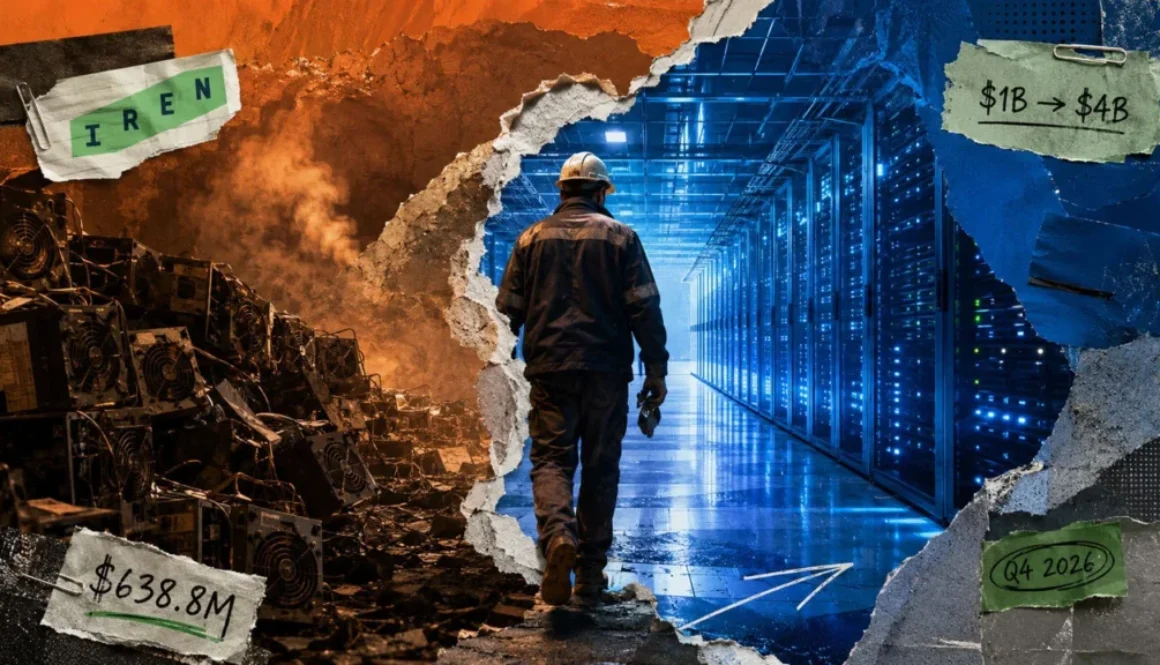
Bitcoin miner IREN maintains 82% revenue from BTC while expanding capacity for Microsoft AI cloud services
IREN’s strategic pivot toward AI infrastructure is underway, yet Bitcoin mining still accounts for over 80% of current revenue, highlighting the lag between contracted capacity and realized earnings. The company faces a critical execution window through 2027 to bridge a $3 billion gap between its current AI run-rate and contracted commitments while managing substantial financing costs.
- Bitcoin mining generated $578.2 million of IREN’s $707 million in fiscal 2026 revenue, or 81.8 percent.
- AI Cloud Services contributed $128.8 million in the same period as the company repurposed data centers.
- IREN recorded a $638.8 million non-cash impairment charge from decommissioning mining hardware for AI infrastructure.
- $4B Contracted AI annualized run-rate revenue targeted by year-end 2026.
- $1B Current operating annualized run-rate revenue as of August 26, 2024.
- 81.8% Share of total revenue from Bitcoin mining in fiscal 2026.
- $702.6M Net loss reported for the fiscal year including impairment charges.
IREN continues to derive the overwhelming majority of its revenue from Bitcoin mining operations despite a substantial strategic reorientation toward artificial intelligence infrastructure. According to fiscal 2026 results filed August 27, Bitcoin mining accounted for $578.2 million of the company’s $707 million in total annual revenue. AI Cloud Services contributed $128.8 million during the same period. The company’s transition has involved repurposing data center capacity from mining hardware to GPU-based infrastructure serving enterprise AI workloads, a shift that generated a $638.8 million non-cash impairment charge as retired mining equipment was replaced before new systems reached full operational status.
Bitcoin Mining Still Dominates Current Revenue Mix
IREN’s reliance on Bitcoin mining revenue underscores the practical reality of infrastructure transformation: contracting future revenue does not immediately replace current earnings streams. While the company has committed significant capital to AI deployment, mining operations continue to provide the financial foundation for operations and debt service. The shift reflects industry-wide pressures on mining economics, where specialized hardware proliferation and rising network difficulty have compressed margins, versus the AI sector’s current demand for GPU computing capacity at substantially higher utilization costs.
The cryptocurrency mining industry has matured considerably over the past decade, with enterprise-scale operations becoming increasingly capital-intensive and electricity-dependent. Miners compete not only on hardware efficiency but also on access to renewable energy sources and optimal cooling infrastructure. In contrast, the emerging AI infrastructure market presents an opportunity for data center operators to transition away from single-use mining hardware toward more versatile computing platforms serving multiple customer segments and use cases.
The $638.8 million impairment, while non-cash, signals the accounting recognition of retired assets before replacement infrastructure became productive. This accounting treatment demonstrates the real economic cost of transitioning hardware from one purpose to another, even though it does not affect current cash flow.
Substantial Gap Between Contracted And Realized AI Revenue
IREN maintains $4 billion in contracted annualized run-rate revenue for AI services compared to only $1 billion in current operating run-rate as of August 26, creating a $3 billion execution gap the company aims to close by December 31. This disparity reflects the time required to physically construct data centers, install equipment, commission systems, and secure customer acceptance before GAAP-recognized revenue can be recorded. The distinction between annualized run-rate (ARR), which projects contracted pricing across full utilization, and GAAP revenue, which recognizes only delivered services, is material for investors evaluating the company’s progress.
Revenue recognition depends on completion of multiple sequential steps: data center construction and energization, hardware installation and commissioning, performance testing, and formal customer acceptance. Delays in any phase postpone revenue recognition while financing and operating costs continue to accrue. The company cautions that recognized revenue may prove substantially lower than contracted ARR if utilization assumptions or pricing do not materialize as projected.
The gap between contracted commitments and realized revenue is common in the infrastructure sector when major facilities require extended buildout periods. Data center deployments typically span many months from initial site preparation through full customer acceptance, creating visibility challenges for investors and stakeholders attempting to forecast cash generation. IREN’s $3 billion gap therefore represents both an opportunity and a risk: successful execution would transform the revenue base, but delays could extend the period during which mining continues subsidizing operations.
Mining operations require primarily computational power and reliable electricity, whereas AI cloud customers demand sophisticated networking, storage integration, guaranteed performance levels, and compliance with specific security and regulatory requirements. This difference in customer expectations materially affects project complexity and timeline.
Phased Microsoft Deployment Extends Into 2027
IREN’s infrastructure buildout follows a staged timeline designed to distribute commissioning risk and demonstrate capability incrementally. Microsoft accepted the initial Horizon 1 installation in August, with Horizons 2 through 4 scheduled for phased delivery throughout the fourth quarter of 2026 and contractual grace periods extending into early 2027. This staggered approach allows Microsoft time to integrate capacity into its cloud offerings while reducing the concentration of capital expenditure and operational risk into a single period.
The staged deployment model reflects industry best practices for large-scale infrastructure projects, particularly when new equipment configurations or operating procedures are involved. By phasing deployments, IREN can address technical issues from earlier stages before scaling to subsequent phases, reducing the probability of systemic failures affecting the entire contracted base. This approach also provides Microsoft with flexibility to optimize allocation of capacity across its AI cloud service portfolio and customer demand patterns.
The financing structure supporting this buildout carries embedded costs that will compress margins unless revenue ramps on schedule. IREN secured GPU financing through a delayed-draw loan at one-month SOFR plus 2.25 percent and senior notes at 5.96 percent. A separate Mackenzie financing facility of up to $2.4 billion carries a 9 percent fixed rate and matures 30 months following each staged funding date. As of June 30, the company maintained approximately 23.2 exahashes per second of installed Bitcoin mining capacity across roughly 380 megawatts of infrastructure.
The cost of capital embedded in these financing arrangements directly affects IREN’s profitability on AI services and underscores the importance of rapid revenue ramp. Each month of delayed recognition extends the period during which interest accrues without corresponding AI revenue, compressing returns on invested capital. This financing structure creates both urgency and risk around the company’s execution timeline through 2027.
Microsoft and NVIDIA together represent a substantial portion of IREN’s contracted revenue, concentrating counterparty and performance risk among these major technology firms. The next critical validation will come through customer acceptance of remaining Horizon deployments and the GAAP-recognized revenue they generate when commissioned throughout the fourth quarter of 2026 and into early 2027. Investor confidence in IREN’s transformation will depend significantly on whether the company achieves material progress reducing the gap between contracted and realized AI revenue during this critical window.