
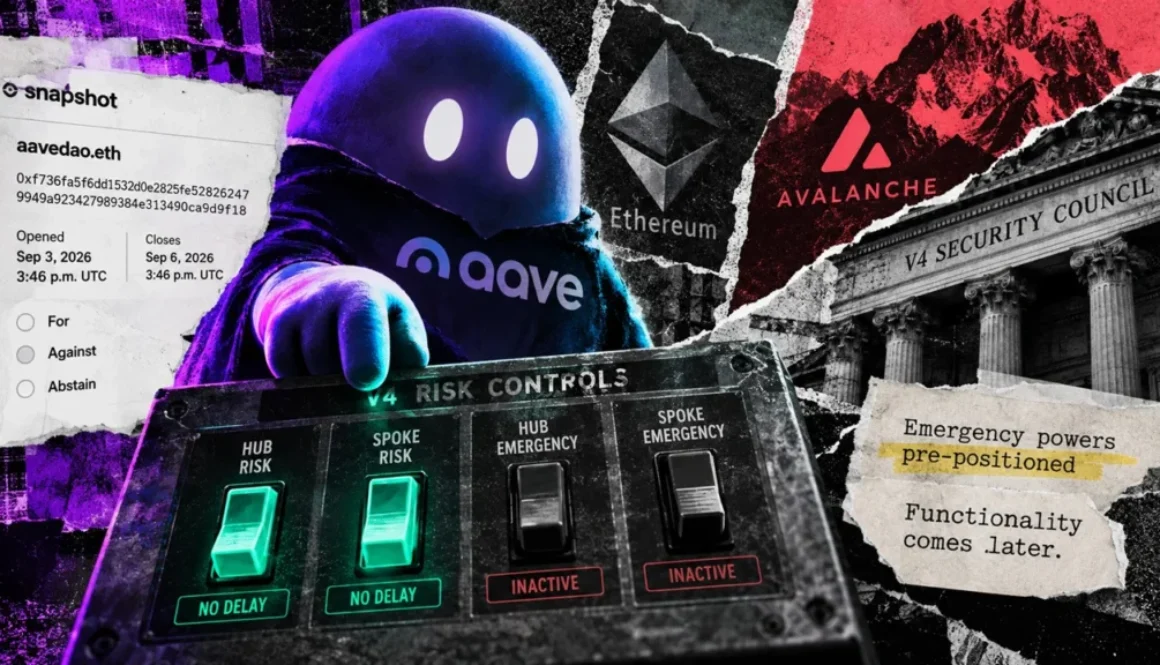
Aave’s cryptocurrency lending proposal grants emergency powers to halt markets while blocking reversal of those halts
Aave’s proposed Risk Steward framework would grant specialized teams emergency powers to freeze markets while blocking their own ability to unfreeze them, introducing a split governance model that trades operational speed for accountability constraints. The vote opens a window into how decentralized lending protocols balance rapid crisis response against the risks of concentrated emergency authority.
- Risk Stewards would receive no-delay access to four roles controlling protocol parameters on Ethereum and Avalanche immediately upon execution.
- Emergency powers are one-way only: stewards can freeze or halt assets but cannot unfreeze, unpause, or reactivate them without separate governance approval.
- Emergency permissions would remain inactive until a future software release, pre-positioning authority to reduce response lag during actual security crises.
- Sept 3-6 Snapshot vote window for Risk Steward governance proposal on Aave DAO
- 36-72 hrs Minimum cooldown periods for routine parameter updates by type
Aave DAO is holding a governance vote on a proposal that would restructure how the protocol manages risk and emergency response across Ethereum and Avalanche. The Snapshot vote opened September 3 at 3:46 p.m. UTC and closes September 6 at the same time. If approved, execution would require action from the V4 Security Council before the new roles take effect.
The proposal addresses a persistent challenge in decentralized finance: the tension between governance speed and security. Large lending protocols like Aave face potential threats ranging from smart contract exploits to oracle manipulation, yet traditional governance processes can require days or weeks for approval. Risk Stewards would represent a middle ground, capable of responding within hours while remaining constrained by mechanisms preventing unilateral market reopening.
Risk Stewards Receive Four Compartmentalized Control Roles
The proposal grants Risk Stewards four distinct roles: Hub and Spoke risk-management roles plus Hub and Spoke emergency roles, all operating without execution delays once activated. Rather than concentrating governance power, the redesign splits each V4 instance’s configurator controls into five granular categories: two flag-control roles, a listing role, an emergency role and a risk-management role. Existing domain admins would inherit these new roles to preserve their current operational scope.
This compartmentalization reflects an industry-wide shift toward distributing governance responsibilities across specialized teams. By separating control over different protocol functions, Aave aims to reduce the attack surface and limit damage from any single compromised account. The philosophy mirrors lessons learned from earlier DeFi incidents where centralized authority or unitary admin keys created catastrophic failure modes.
Routine parameter updates governing interest-rate settings, collateral factors, liquidation settings and oracle caps would be subject to minimum cooldowns of 36, 48 or 72 hours depending on the parameter type, with these bounds applying to both chains. These cooldown periods allow time for community monitoring and intervention while still enabling faster adjustments than standard governance cycles.
The tiered cooldown structure balances protocol responsiveness against governance safety, allowing faster parameters to adjust frequently while slower parameters affecting fundamental economics receive more deliberation time.
One-Way Emergency Powers Prevent Unilateral Market Restoration
The emergency category is restricted strictly to one-way safety actions. Hub calls can deactivate or halt assets and Spokes, while Spoke calls can pause or freeze individual reserves or entire markets. Critically, these functions cannot reactivate, unhalt, unpause or unfreeze affected markets, preventing Risk Stewards from unilaterally restoring market access without additional governance approval.
The separate flag-control roles, which operate bidirectionally and can change states in both directions, would not be granted to Risk Stewards. This design intentionally decouples emergency shutdown authority from recovery authority, combining faster bounded maintenance with immediate emergency power while requiring broader consensus for market reopening. The constraint mirrors common practices across decentralized finance, where shutting down markets quickly is valued for security but restarting them is reserved for consensus-driven processes to prevent abuse.
This asymmetry creates what governance theorists would recognize as a ratchet mechanism: easy to restrict but difficult to restore. Such designs are common in safety-critical systems, from industrial controls to blockchain protocols, where recovery decisions warrant higher scrutiny than protective actions taken under duress.
Emergency Permissions Remain Inactive Until Future Software Release
The emergency permissions would remain inert until a future software release adds support for them. By pre-positioning these roles now, Aave seeks to address a known vulnerability in decentralized governance: the lag between detecting a critical threat and receiving authorization to respond. Establishing permissions in advance would allow a later version to respond without waiting through another governance cycle.
Aave Labs confirmed that Risk Steward contracts are undergoing a Certora audit nearing finalization, though the code is not being presented as fully audited. Certora specializes in formal verification that mathematically proves certain properties about code behavior, signaling that Aave is prioritizing rigorous security validation for a system granting elevated protocol access. Formal verification has become increasingly important in DeFi as protocols manage billions in user assets.
If the Snapshot passes and the Security Council executes, the immediate change would be no-delay access to bounded parameter controls, with one-way emergency powers pre-positioned but not yet usable. This staged activation allows community members to monitor steward behavior under normal conditions before emergency authorities become available.
Forum participants have requested public rationales, post-action reports, periodic reviews and reporting on the frequency and size of steward actions, none of which is required in the current proposal.
This accountability gap highlights broader challenges in decentralized governance, where delegating authority to specialized teams improves operational efficiency but requires robust mechanisms to prevent abuse. Community members have suggested that implementing reporting requirements and periodic governance reviews could address these concerns without compromising emergency response capabilities, setting the terms for debate as the September 6 vote approaches.