
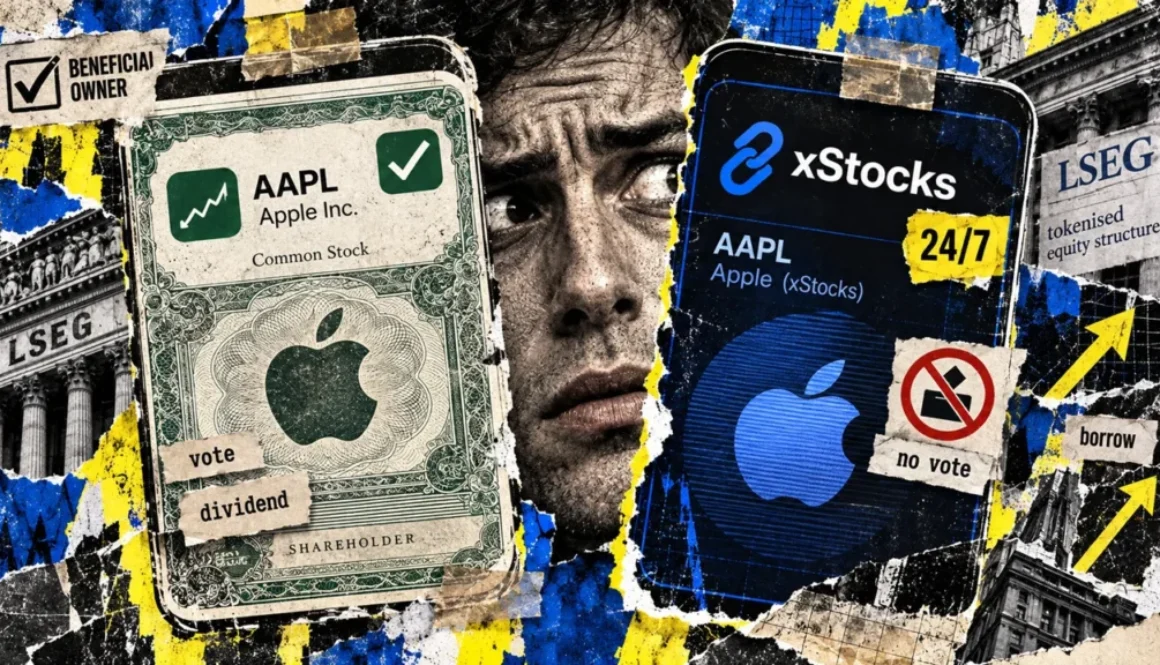
What appears to be a stock and behaves like a stock but lacks the actual classification of a stock?
Tokenized stocks create confusion between genuine ownership and price-tracking derivatives that can look identical on a trading app. Understanding what rights each product actually conveys is critical as blockchain-based equity instruments proliferate and regulatory frameworks take shape.
- Kraken’s xStocks tokens provide price exposure but exclude voting rights and deliver dividends through account adjustments rather than cash payments.
- The London Stock Exchange is exploring blockchain-based shares that preserve full shareholder rights while assessing regulatory pathways for listing xStocks in 2027.
- Tokenized products enable continuous trading and collateral borrowing against equities during off-market hours, potentially amplifying price volatility and investor losses.
- 20% Price decline wiping out 30% of leveraged investor capital in tokenized equity exposure
- 2027 Target year for London Stock Exchange xStocks listing, pending regulatory approval
A trader opening an investment app can see an identical company name and similar price displayed two different ways. One represents a traditional stock held through a broker. The other represents a tokenized instrument designed to track that stock’s value. Both investments move in tandem when prices change, yet their owners hold fundamentally different claims on the underlying company and its assets. The interface makes them appear interchangeable, but the legal structures determining what investors can actually do with each holding are not.
How Shareholder Rights Survive or Disappear in Tokenized Form
Owning stock in a company ordinarily conveys specific legal entitlements. Common shareholders participate in the company’s financial performance, vote on certain corporate decisions, receive dividends when distributed, and hold residual claims on assets if the business fails. Brokers typically hold these shares through nominees on investors’ behalf, maintaining records of beneficial owners and transmitting voting instructions and dividend payments through intermediaries. This administrative chain has functioned reliably across markets for decades.
Tokenization introduces a parallel record-keeping mechanism using blockchain networks. Companies could integrate tokens directly into their shareholder administration systems, allowing token transfers to represent actual share transfers while preserving all underlying rights. The SEC’s January taxonomy staff guidance describes this issuer-sponsored structure as one legitimate approach. However, a second arrangement complicates that picture. When third parties unrelated to the company create new tokens designed to track its shares, the situation changes entirely. Those tokens become separate financial instruments with their own contractual terms, rather than direct expressions of shareholder status.
Kraken’s xStocks Structure Excludes Voting and Reimagines Dividends
Kraken’s xStocks product exemplifies this second model. The platform acquires shares and holds them with a custodian, then issues tokens intended to mirror the value of those holdings. Customers who buy xStocks tokens receive exposure to the underlying equities’ price movements but do not acquire shareholder voting rights or receive dividend payments as cash. Instead, dividends are reflected through adjustments to the effective holdings displayed in user accounts, allowing reinvestment at the displayed price without a separate payment transaction.
A simple example illustrates this mechanism. An investment representing $100 of share exposure receives a $2 net dividend reinvested at $100 per share, automatically purchasing 0.02 additional shares of exposure, raising the effective holding to 1.02 shares rather than one.
Kraken’s documentation further specifies that xStocks tokens cannot be transferred into ordinary brokerage accounts as the underlying shares themselves. The platform also excludes several jurisdictions from the offering, including the United States. These design choices reflect both regulatory boundaries and product architecture. The distinction matters because token holders depend on Kraken’s arrangements with custodians and the company’s own financial solvency to access any benefit from the underlying shares, whereas traditional shareholders maintain a direct legal claim against the issuing company itself.
The London Stock Exchange’s Dual Approach to Blockchain Equity
The London Stock Exchange Group is pursuing two structurally different paths forward. In September, it announced an arrangement with Payward to explore how shares could be brought onto blockchain networks while preserving the legal rights attached to share ownership. That structure remains under assessment and requires regulatory approval before implementation. Separately, the exchange plans to list xStocks tokens on its LSE 24 trading venue in 2027, also subject to approval.
These projects represent competing visions of tokenization’s role in equity markets. One aims to maintain the relationship between investors and the companies whose ownership they acquire; the other creates an additional trading venue for stock-linked products whose holders possess weaker claims.
Off-Hours Trading and Leverage Create New Risk Channels
Tokenized equity products enable continuous trading during hours when underlying stock exchanges are closed. Weekend and overnight markets allow buyers and sellers to transact when the underlying shares cannot be readily purchased or sold, potentially causing token prices to drift from the stock’s last official quotation. Fewer market participants during those windows reduce liquidity and widen spreads, though platforms benefit from increased trading volume and the fees or spreads those transactions generate.
The accessibility also enables borrowing against tokenized holdings more readily than traditional stock accounts might permit. Consider an investor holding $100 in tokens who borrows $50 against that collateral and purchases an additional $50 of exposure. That investor now commands $150 in total price exposure while owing $50. If token prices decline 20%, the holdings fall to $120 in value. After subtracting the $50 debt, the investor retains $70, representing a 30% loss on their original $100 capital before interest and fees. Automated liquidation clauses can trigger forced sales when collateral falls below contractually required thresholds, potentially accelerating losses during market declines.
The Financial Stability Board’s 2024 assessment acknowledged this dynamic in examining tokenization’s potential for broader adoption. While judging current token market scale too small to pose material financial-stability risks, the FSB warned that expanded adoption and greater interconnection among market participants could transmit losses more efficiently and amplify volatility. The concern focuses on what wider adoption could enable rather than a finding that current tokenized stock products have destabilized markets.
Cost Reduction and Access Gains Require Full Transaction Scrutiny
Tokenized equity products promise lower barriers to foreign stock investment and reduced friction in small-value transactions. Fractional investing already exists through conventional brokers, however, and any practical advantage depends on which services an individual investor can actually use in their jurisdiction. Kraken excludes United States investors from xStocks, and comparable regulatory boundaries apply across other platforms and products.
Lower per-trade costs must survive the entire transaction sequence to benefit investors, including any spreads between buying and selling prices and conversion charges.
A larger pool of accessible equity exposure may appear beneficial, but the distinction between genuine progress and mere speculation requires attention. Companies issuing new tokens must purchase backing shares to support them, adding demand to underlying markets. Investors switching from ordinary shares into tokens, however, largely relocate existing exposure rather than create new investment demand. Redemptions can reverse those flows. Secondary market purchases of tokenized equities typically pay existing owners rather than provide fresh capital to companies. The claim that tokenization strengthens stock prices therefore depends on the detailed balance of buying, selling, and switching flows rather than on broader market activity alone.
The London Stock Exchange’s 2027 target date for xStocks listing and its ongoing assessment of blockchain share issuance structures will clarify how regulators distinguish between products that preserve shareholder rights and those that provide only price exposure with reduced legal claims. Investors entering tokenized equity markets should examine contract terms directly rather than relying on superficially identical user interfaces, and platforms should disclose custody arrangements, collateral policies, and the precise claims token holders retain if an issuer fails.