
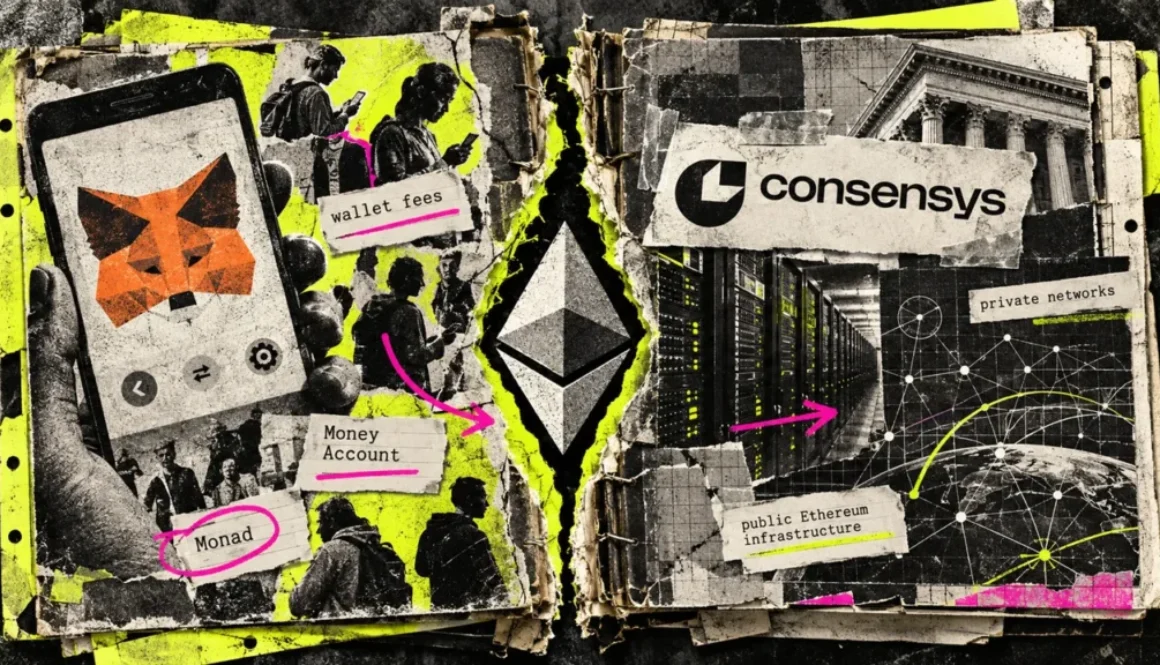
Consensys and MetaMask separation reveals disconnect between Ethereum usage and ETH token demand
Consensys’s plan to split MetaMask from its infrastructure business exposes a critical distinction often blurred in adoption metrics: not all blockchain activity generates direct demand for ETH. The separation forces investors to examine which services actually drive token economics versus which merely use Ethereum-compatible software.
- Consensys announced on Sept. 9 plans to operate MetaMask separately, with completion expected by end of 2026.
- MetaMask’s Money Account runs on Monad blockchain, not Ethereum Mainnet, despite existing within the MetaMask wallet.
- Private institutional networks using Besu software can be Ethereum-compatible without generating Mainnet gas demand or ETH fees.
- 0.875% MetaMask’s swap fee, charged separately from network fees on each transaction
- 20% Linea’s historical design allocates post-L1 gas fees to ETH burning after costs
- June 30 Date MetaMask Money Account launched with mUSD stablecoin and Monad integration
- 2026 Expected completion year for full operational separation of both businesses
Consensys announced on September 9 its intention to separate MetaMask from its protocol and infrastructure operations, creating two independently managed companies by the end of 2026. Joe Lubin will serve as chairman and CEO of MetaMask while taking the role of executive chairman at the new Consensys entity, which will be led by CEO Mike Kriak. The restructuring leaves a fundamental question unresolved for ETH holders: how much of the activity flowing through Consensys’s expanding ecosystem actually generates direct demand for Ethereum’s native token.
The move reflects broader industry trends in which wallet providers and infrastructure operators have increasingly diversified their service offerings across multiple blockchains and private networks. Decoupling these businesses allows each to optimize independently for its particular market dynamics and user base, rather than forcing a single company strategy to serve both retail wallet users and enterprise infrastructure clients.
MetaMask’s Business Economics Operate Independently From Ethereum
A wallet serves as the interface through which users manage holdings, execute trades and access financial services. That position creates a business model distinct from the underlying blockchain’s transaction fees. MetaMask’s fee disclosure for swaps makes this explicit, listing a 0.875% MetaMask fee separately from both the network fee and the quoted exchange rate on each transaction. The wallet operator captures revenue from this arrangement regardless of which network processes the underlying transaction.
A larger volume of swaps through MetaMask could expand wallet operator revenue without automatically increasing Ethereum network activity or ETH demand.
MetaMask’s Money Account, launched on June 30, illustrates the problem more sharply. The service converts deposits into the mUSD stablecoin and routes them to lending markets through Veda infrastructure and Steakhouse’s vault curation. Critically, Money Account uses Monad blockchain as its settlement layer, not Ethereum. Users see a dollar-denominated balance and yield rather than holding ETH. The product demonstrates how a consumer application can exist within the MetaMask interface while channeling transaction volume away from Ethereum entirely.
This layering of services reflects a broader shift in wallet design toward becoming financial super-applications rather than simple Ethereum interfaces. Money Market features compete directly with traditional finance and other crypto platforms for user capital, but the underlying settlement choice determines which blockchain network benefits from the economic activity.
Institutional Software Use Does Not Guarantee Ethereum Mainnet Fees
The infrastructure side of the split raises a parallel distinction at the enterprise level. Besu, the Ethereum client software that will remain part of the new Consensys business, supports both public Ethereum and private permissioned networks. Private deployments typically use separate chain identifiers and proof-of-authority consensus with approved validators, creating isolated ledgers that are Ethereum-compatible without being Ethereum Mainnet.
An institution using Besu for a private network processes transactions on that network’s own chain, not on Mainnet, and incurs no Ethereum gas fees.
The distinction separates software adoption from token economics. Ethereum-compatible infrastructure can reach more users and institutions through MetaMask and the new Consensys’s institutional offerings. A private network operator gains the benefit of familiar tooling and developer ecosystems without contributing to Mainnet’s fee market or ETH’s value capture. This has become a common enterprise pattern, with many corporations and financial institutions choosing Ethereum-compatible private chains to achieve regulatory certainty while avoiding the volatility and unpredictability of public networks.
On Mainnet itself, gas fees are paid in ETH: the base fee is burned, removing supply, while priority fees go to validators. Growth that routes through public Ethereum carries direct economic consequence for the token. Growth through private networks, alternative L1s like Monad, or wallet infrastructure carries a different consequence for ETH holders.
Linea Remains Positioned to Drive ETH Burning Despite the Separation
Linea, the Layer 2 blockchain, will move to the new Consensys infrastructure business. Its July 2025 tokenomics document identified ETH as its gas token and described a design allocating 20% of post-Layer 1 settlement costs to ETH burning, with the remainder used for LINEA token burning. That allocation represents one of the clearer examples of protocol design explicitly intended to support ETH economics alongside independent token economics.
The design demonstrates that not all of Consensys’s network operations have decoupled from ETH economics, even as other divisions move away from direct token demand.
The split reflects operational reality: MetaMask now functions as a multi-chain wallet aggregator with its own fee structure, while the protocol and infrastructure business maintains both public networks tied to ETH and private installations serving institutional clients. Both operating models are commercially viable. The question for token holders is which activities will dominate as the separated companies scale and where capital ultimately settles.
The clearest test will be actual transaction distribution and fee data following the separation. Investors should track which networks handle volume originating from MetaMask, which fees those networks generate and what fraction reaches Ethereum or relies on ETH. The distinction between adoption metrics and ETH demand will become concrete only when the separated businesses begin reporting where users’ capital and transactions actually flow.