Key takeaways
- Intuition Network creates a decentralized knowledge graph that allows users to own and monetize their data instead of having it captured by centralized platforms.
- The platform uses AI to automatically extract relevant data from user actions and convert them into semantic triples rather than requiring manual review writing.
- Intuition enables users to stake tokens on information they believe in, creating economic incentives for data quality while preventing manipulation.
- The system provides AI with better intuition about user preferences and trusted sources by accessing decentralized data across platforms.
- Intuition is backed by major investors including ConsenSys and Polygon Ventures and plans significant milestones for Q4 2025 and 2026.
Crowdsourcing the world's intuition
Ashton Addison: What have you and your team been building at Intuition, and how does it relate to information on the blockchain?▶ 00:40
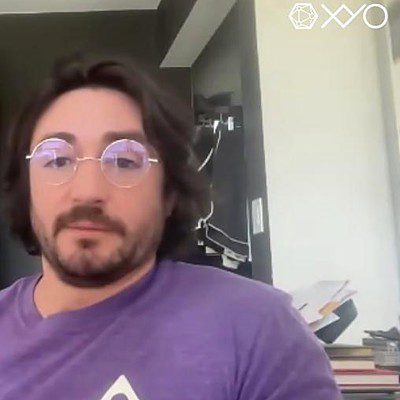
Billy Luedtke: It's aptly named Intuition because it's an attempt to give any entity, people or machines, better intuition in all of its interactions. You get good intuition by getting good data. If you spend every day with your wife, you collect data about her through personal experience, so you know how she'll respond when you say something specific. The question is how to scale that. Two things need solving. First, you have to get information out of people's heads, because a lot of it is unexpressed. I've never written an Amazon or Yelp review or done a LinkedIn endorsement, but if you ask me about something, I'll tell you. Second, the good information that does exist is scattered and monopolized by big tech, and people aren't capturing any value from it. So we want an open, permissionless, decentralized knowledge graph that is universally accessible, with the data cleaned up so you can see across platforms. Any decision you make, whether it's buying a product, doing a swap, hiring someone or investing in a project, needs information. We just want to help people make good decisions.
Ashton: How does AI fit into Intuition?▶ 03:59
Billy: I was a very early beta ChatGPT user, and I saw this coming earlier than most. If you view AI as a collective consciousness, it needs an intuition module, and the way it gets that is by crowdsourcing our intuition and giving it to the AI. That's where Intuition came from. AI also helps us in practice. On data creation, manually typing out a long review will probably feel primitive. It'll run in the background, interpret what you're doing and post it to the knowledge graph. One of our community developers built a tool called Sophia that lives in your browser. It turns your browsing activity into semantic triples you can post to the graph. It extracts the relevant semantics rather than taking all your data, which may include private things. On the reading side, the interface increasingly just looks like chat. If I ask an AI to book a dinner reservation, it can know I like sushi, whom I trust on sushi, and that I haven't had it in a while. That solves both the data-in and data-out problems for us.
Ashton: What are token-curated knowledge graphs, and how does data become organized and usable in the protocol?▶ 10:59
Billy: Knowledge graphs are what you're already using to interact with the internet. Google has a centralized one, and Facebook has social and interest graphs. Because they're centralized, they aren't interoperable. I can't take my Twitter following to Amazon and overlay reviews from people I trust. Tim Berners-Lee wanted the semantic web, the web as one big semantic graph, but it failed because the whole world had to agree on standards. With crypto we can use cryptoeconomic incentives to reach consensus on those standards. We already have consensus on the state of a ledger, but not on the state of the state: which standards and schemas structure the data. It's pretty much a language game. Let's use cryptoeconomics to all speak the same language on the internet, and then things can be interoperable. The other piece is breaking data into discrete, ownable units called atoms, each with a token. You compose them into higher-order structures, like molecules and compounds. As you contribute data you get tokens for it, so we know who owns what, and we can create programmatic value flows to the people who contributed the data in the first place.
Let's use cryptoeconomics to all speak the same language on the internet, and then things can be interoperable.
Getting paid for the signal you create
Ashton: If I'm a power user contributing data, passively or actively, how does that work and how does the value come back to me?▶ 15:03
Billy: It depends on the interface. Take one example: Intuition replaces the like button on YouTube, so a like becomes an attestation that you like the video. Say you're an early liker and a million people come in and like or watch it after you. You make money for having liked it early. You're providing signal to people and to YouTube that the video is worth consuming. There's inherent value in the data you're creating. You're just not seeing the value. Or take TikTok. I'm curating the algorithm for myself and everyone else by liking things, and TikTok captures all the money from that signal. Every action online can be treated as an attestation, which is just something claiming something about something. If I scroll a page or like a tweet, that's an attestation. So it can look like the internet today, except that at the end of the week or month you might see you've made $200 or $500 from your activity.
Ashton: What stops people from gaming the system by liking and commenting on everything to make money?▶ 18:49
Billy: Quality comes from two places. First, everything costs something, like a gas fee. If it were free, a permissionless, decentralized system would be hit by Sybil and DoS attacks and die on day one. You can also buy more than one like, so you can make speculative economic bets on the relevance of data. It doesn't have to be a frictionful experience. YouTube could offer a premium tier where you pay a monthly fee, and behind the scenes they use that money to buy the Trust token and place it on your actions. All the crypto is abstracted away. Second, once data is decoupled from platforms, you can overlay it with your own trust graphs. I might not know Dr. Huberman, but I trust him on supplements, and I trust Vitalik on crypto. Because you have verifiable attribution of who is saying what, you can ask for the YouTube videos that people you trust have liked, or people within three degrees of separation. That gets rid of the bots. It's web-of-trust search instead of generalized search.
Ashton: How does the Trust token work in the ecosystem?▶ 23:15
Billy: Every interaction in Intuition requires trust. To create or read data, you pay in Trust token. In the YouTube example, you're putting your trust into the video, but it could be a person, a product, a podcast or a book. As you trust things, you get ownership in them. When other people trust them too, or when people pay per query, say 10 cents for an AI prompt that traverses the data, we know who owns what and can flow that revenue to the owners. It's also the native gas token of our network. Every action carries a small protocol fee, which is how the protocol sustains itself. You can stake it to generate yield, and it's used for governance too. Developers in our ecosystem are also building oracles and lending protocols that adopt the Trust token for their own purposes.
From beta to mainnet and mass adoption
Ashton: How far have you come, and what can users do today or in the near future?▶ 08:25
Billy: We've come a long way from a crazy idea about crowdsourcing humanity's intuition to a protocol that is live, stable and has been used in production for a while. We ran a beta of the protocol on Base mainnet with real ETH, so it handled real economic value. Then some partners wanted to do things requiring tens of millions of transactions, which would have been cost-prohibitive on Base. So we prioritized our own network, a Base L3, which is on testnet now and will go to mainnet at the same time as our TGE. There's also off-chain backend architecture that combines the on-chain and off-chain data into one big knowledge graph. We've been working on this for three years and it's now becoming production ready. Right now we only have a very generalized explorer, not an application experience. Now we're going to lean into specific use cases, and I think it will start making sense to a lot of people very soon.
Ashton: How do you get people outside crypto involved, and how close is the abstraction to being ready?▶ 25:58
Billy: My goal is to give an Intuition app to my mom and have her use it without knowing anything about crypto. I think the infrastructure is almost at the point for mass adoption, but not quite. Maybe one more year of account abstraction, smart wallets, paymasters and meta-transactions. There are a lot of amazing teams working on it. My team from back in the day built the first self-sovereign identity system on Ethereum. Deploying a smart contract identity cost around $5, and we asked how we would onboard the world if the first step is paying $5. So we invented meta-transactions, with a server that paid people's transactions for them, and open-sourced it. That became a whole ecosystem of gas sponsorship, and a lot of today's account abstraction came from it.
Ashton: What's the plan for Q4 2025 and the launch?▶ 29:31
Billy: TGE is currently slated for October 15, but it's at the whim of the exchanges and others who help make it happen, so please don't hold us to that date. Coinciding with it will be the mainnet launch of our network, protocol and backend. After that, the work splits, much as the Ethereum Foundation and Consensys did in early Ethereum. Core contributors will maintain and evolve the protocol and the developer experience, and give developers the tools to integrate it into whatever they're building. We'll also focus on the application layer, because there are ideas we want to build ourselves. I've been in crypto since 2012 and I only use it once every couple of weeks, for a swap or lending and borrowing. That's insane. I want crypto-enabled apps I use daily, and I want to build the first one, which is information related. I want Intuition to help me search for things and keep track of what I come across.
There's inherent value in the data you're creating. You're just not seeing the value.
This interview has been edited for length and clarity. Recorded September 2025.