Crypto exchange supported by Tether suspends withdrawal capabilities after $7 million in custodial funds leaves platform
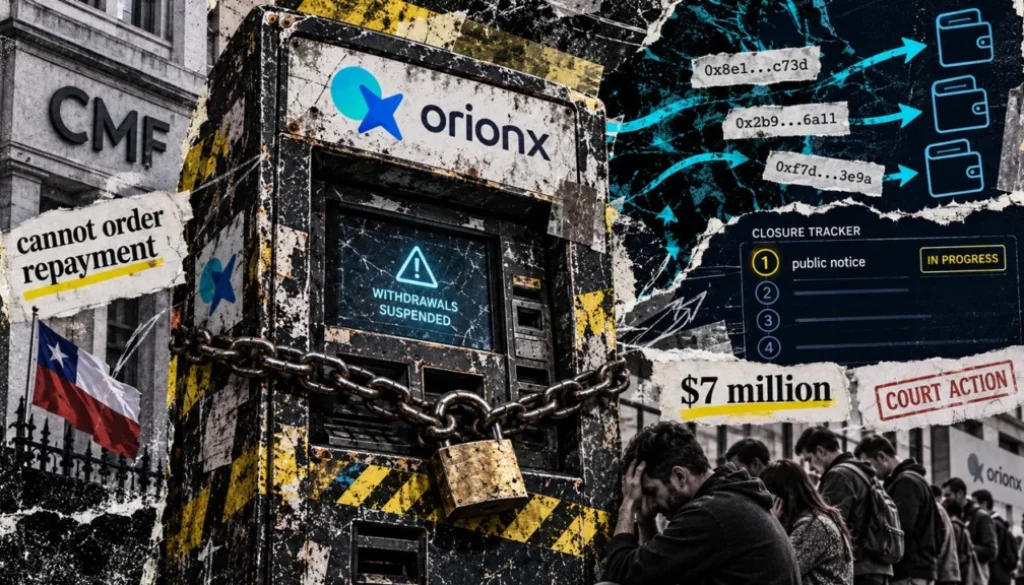
A Tether-backed cryptocurrency exchange in Chile has frozen all withdrawals and begun permanent closure after auditors discovered over $7 million in customer assets moved to external wallets. The collapse exposes regulatory gaps in Latin America’s cryptocurrency oversight and raises questions about investor due diligence by major industry players.
- Orionx discovered more than $7 million in customer assets transferred to wallets outside company control
- Chile’s financial regulator CMF rejected Orionx’s authorization application on June 19, leaving no regulatory backstop
- Exchange filed criminal complaint against former executives on September 2 with prosecutors now investigating
- $7M+ Customer assets transferred to external wallets by Orionx operators
- June 2025 Date Tether invested in Orionx, less than one year before closure
- June 19 Date CMF rejected Orionx’s registration application under Chile’s Fintech Act
- Stage 1 of 5 Current position in Orionx’s closure process tracker
Orionx, a Chilean cryptocurrency exchange backed by Tether and previously supported by Bitfinex, has initiated permanent closure after forensic auditors identified more than $7 million in customer assets transferred to wallets outside the company’s control. The exchange suspended all withdrawals and announced it would work to determine how much it can return to customers. Tether invested in Orionx in June 2025 as part of a broader strategy to build cryptocurrency infrastructure across Latin America, following an earlier investment from affiliated exchange Bitfinex in 2023.
Orionx had positioned itself as a bridge between traditional finance and cryptocurrency in Chile, serving as one of the few local on-ramps for residents seeking to convert fiat currency into digital assets. The exchange’s apparent failure represents a significant setback for cryptocurrency adoption efforts in the region, particularly given the high-profile backing from Tether and Bitfinex, two of the industry’s largest and most established players.
Regulatory vacuum leaves customers without protections
Chile’s financial regulator, the Comisión para el Mercado Financiero (CMF), has no authority to oversee Orionx’s wind-down or compel the return of customer assets. On June 19, the CMF rejected Orionx’s application for registration and authorization, determining that the exchange had failed to demonstrate it secured required collateral under Chile’s Fintech Act. This regulatory rejection leaves customers dependent solely on Orionx’s restitution efforts or recovery through the courts.
The situation exposes a significant regulatory gap in Chile’s cryptocurrency framework, where exchanges operate in a gray area between traditional financial supervision and emerging fintech regulations. Unlike traditional banks, which benefit from deposit insurance and regulatory oversight designed to protect consumer assets, cryptocurrency exchanges face minimal custody requirements or operational standards. Customers bear the full risk of exchange failure or mismanagement without institutional safeguards.
Across Latin America, regulatory approaches to cryptocurrency vary widely. While some countries have begun implementing licensing requirements and custody standards, others remain largely unregulated. Chile’s rejection of Orionx’s application suggests the country is attempting to establish higher standards for exchange operators, yet the timing of this rejection relative to the discovered asset transfers raises questions about the adequacy of pre-approval due diligence and oversight mechanisms.
Questions arise about tether’s investment due diligence
Tether’s decision to invest in Orionx less than one year before the exchange’s collapse has prompted scrutiny about the investment thesis and due diligence process behind the funding. As the operator of one of cryptocurrency’s largest stablecoins, Tether has substantial influence and resources to conduct comprehensive background checks on investment targets. The rapid timeline from investment to crisis suggests either that due diligence failed to identify red flags or that problems emerged after the investment was completed.
This situation parallels other high-profile cryptocurrency exchange failures where major industry players backed projects that subsequently collapsed or faced serious governance issues. Industry observers note that cryptocurrency investments often move faster than traditional venture capital, sometimes with less rigorous oversight of operational and compliance matters.
Five-Stage closure process now in earliest phase
Orionx froze withdrawals to prevent early withdrawals by some customers from depleting assets at the expense of others, implementing what the exchange termed a synchronized wind-down to treat all customers equitably. The company’s closure tracker shows it remains at stage one of five, with account reconciliation and approval of a restitution plan still pending before any funds are returned.
No repayment date has been announced.
The extended timeline for recovery is typical in exchange collapses, where forensic analysis must establish the true extent of losses and identify remaining recoverable assets. Customers face uncertainty about both when they may recover funds and what percentage of their holdings they will ultimately receive. Orionx said its priority is to return customer property “as quickly and fairly” as circumstances allow.
Criminal investigation into asset transfers underway
Orionx filed a criminal complaint dated September 2 against former executives and notified prosecutors about the asset transfers. The allegations have not yet established responsibility for the missing assets, and prosecutors must now determine whether the transfers constitute fraud, theft, or other criminal violations.
The investigation represents one potential avenue for customer recovery, as prosecutors may seek to freeze or recover assets if they identify specific individuals or entities responsible for the transfers. Chilean law provides mechanisms for asset recovery in fraud cases, though success depends on whether transferred funds remain traceable and accessible within jurisdictions willing to cooperate with local authorities.
Before customers receive any recovery, Orionx must complete individual balance reconciliation, determine what assets remain available, and obtain approval for a distribution plan. All of those steps remain pending according to the exchange’s closure tracker. The investigation may reveal additional details about how the assets were transferred and whether any portion can be recovered or frozen in third-party accounts, directly affecting the ultimate recovery amount available to customers. For Tether and Bitfinex, the Orionx collapse poses reputational and potentially financial consequences as questions mount about the adequacy of oversight mechanisms deployed by major cryptocurrency platforms when investing in regional infrastructure projects.
BlockWest is a news publication. Nothing here is investment advice. Read our disclaimer and editorial policy.