Prediction market Kalshi suspended Republican House candidate Laurie Buckhout for 3 years after finding that she had placed bets on her own race.
Buckhout is challenging Democratic Representative Don Davis in North Carolina’s 1st Congressional District.
The Fine Costs More Than the Wager
Buckhout bought less than $1,000 in contracts related to her own candidacy, according to the disciplinary notice Kalshi published. She agreed to pay a penalty of $2,589.96, more than the bet itself.
Kalshi rule 5.17(z) bars any trader with direct or indirect influence over an event from trading that contract. A candidate on the ballot meets that test.
The prediction market said Buckhout cooperated with its inquiry. She accepted the findings and also agreed to the ban and the penalty.
“I bet on myself. Literally. It was a dumb mistake, and as soon as I learned there was an issue, I worked to make it right. Safe to say my career as a Kalshi trader was short-lived,” Laurie Buckhout said.
Kalshi has moved repeatedly in recent days. It imposed a lifetime ban and a fine of over $70,000 on former congressman George Santos on Monday after he refused to cooperate with investigators.
Days earlier, the Commodity Futures Trading Commission (CFTC) and Kalshi acted against a White House teleprompter operator over bets on Trump’s speech text.
Kalshi has been working to curb insider trading on its platform. The exchange introduced three market integrity measures in June.
Congress may push further. Representative Bryan Steil filed a bill in June that would ban lawmakers from betting on political outcomes, with fines and forfeited gains attached.
Elon Musk needed one word for Europe’s loudest startup debate of the week. He posted “Wow.” The trigger was Stripe CEO Patrick Collison’s story of a German founder who paid a €30,000 German notary fee to hear a 90-page investment contract read aloud. German law required the session.
Collison asked the founder whether the horror stories about German startup bureaucracy were exaggerated. The answer was that they are understated. The founder’s first company paid the bill and lost the day. His second company was incorporated somewhere else.
Why a German Notary Fee Can Reach €30,000
The rule is real, with Collison’s account pointing to Section 13 of the Beurkundungsgesetz, Germany’s notarization law. The statute orders a notary to read the full deed aloud to everyone in the room.
Met a German founder this week and asked him if all the stories one reads about the challenges of startups in Germany are exaggerated. “No, they’re understated.” Proceeded to describe spending a full day having a 90-page investment contract read to him (mandatory under German…
The parties must then approve it and sign by hand. Startup funding rounds get caught because the standard German company, the GmbH, cannot transfer shares or raise capital without a notarized deed.
The price is set by the state, not the notary. A second law, the GNotKG, ties the fee to the value of the deal. The bigger the round, the bigger the bill. The hours spent reading do not matter.
A court has already blessed that math, seen with venture lawyer Wolfgang Weitnauer reporting a ruling by the Higher Regional Court of Karlsruhe on one German funding round.
Investors put about €7 million into a company valued at €21 million before the deal. Exit clauses in the contract counted toward the deed’s value too.
The notary therefore assessed the transaction at roughly €35 million. The reading alone cost €63,110.85. The full notary bill reached about €100,000. The court upheld every euro.
Crypto founders may know the pattern, seeing as Germany leads the EU in licenses under the Markets in Crypto-Assets (MiCA) framework.
Founders Pile On as Brussels Drafts an Alternative
Musk’s one-word reaction was the loudest megaphone. However, the sharpest contrast came from investors. Y Combinator co-founder Paul Graham replied that US investors close on the accelerator’s standardized SAFE, short for simple agreement for future equity, after checking only the names and the numbers.
Whereas in the US we can safely invest on a safe sent via the YC system without even looking at any part except the names and numbers, because we know the text will be the identical standard text.
“Our (Lieferando) contract was even longer, and the reading went on through the night, in German, mind you . I think it cost at least €200,000. The notary even stopped reading when I went to the bathroom. It was good fun, though,” added Just Eat Takeaway founder Jitse Groen.
His figure is an estimate, not an audited invoice.
Notwithstanding, the pain is seemingly not limited to Germany. Italian founder Stefano described a seed round that nearly died because Italian and Belgian notaries argued over a translated power of attorney. That standoff ended with a €21,000 invoice and mandatory in-person signatures.
Sharing our own horror story:
In December we’ve closed our Seed round with a UK lead investor. Since our company was incorporated in Italy and participated by a Belgium fund we had to translate a PoA in 3 languages and almost lost the deal because the Italian and Belgium notary…
Nevertheless, Brussels is already drafting a fix. In March, the European Commission proposed EU Inc., an optional EU-wide company form that promises fully digital formation within 48 hours.
One clause is now the flashpoint. Article 14 of the draft demands that company articles pass preventive administrative, judicial, or notarial control. Critics read that last word as a door for notary lobbies to walk back in.
Collison is not just posting either, seeing as five days earlier, he launched the Rhine Group with former European Central Bank President Mario Draghi.
An announcement: Under the leadership of Mario Draghi and @patrickc we have set up the Rhine Group: policymakers, economists, entrepreneurs and business people pushing European reforms and the Draghi agenda. https://t.co/ZtoW7Rb173
Strive, BitMine and MicroStrategy each disclosed fresh crypto purchases on Monday. The two Bitcoin buyers alone spent more than $500 million in a single week.
Buying high is the business model, not a failure of it. These firms turn share sales into coins, and shares sell best when coins are rising.
What the Three Firms Bought
Strive, run by chief executive Matt Cole, added 1,800 bitcoin (BTC) at an average of $79,431. Its stack reached 23,156 BTC, worth about $1.83 billion on Monday.
Strive acquired an additional 1,800 BTC for $143M at an average cost of $79,431 per bitcoin, bringing total holdings to ₿23,156.$ASST$SATApic.twitter.com/6ztKhC4PFF
The filing shows the mechanism plainly, after Strive issued 3,579,147 new Class A shares that week, and its cash still climbed $11.6 million to $183.5 million.
BitMine is playing a different game. Its 53,501 ether (ETH) marked a 65th consecutive week of buying, a streak running back to June 2025.
Yield is the distinction, given BitMine has staked 5,067,309 ETH, or 86% of the pile, through MAVAN, its American validator network.
Chairman Tom Lee projects $335 million to $390 million a year from that. The company now holds 4.9% of ether supply, leaving it 133,888 tokens short of the 5% target Lee set.
— Thomas (Tom) Lee (not drummer) FundstratDirect.com (@fundstrat) August 31, 2026
MicroStrategy was the third buyer. Its 4,603 coins ended a 10-week pause, and unlike BitMine it publishes an average cost per coin, currently $75,412.
ETF Money Turned Before the Treasuries Did
So why now? The answer starts with fund flows. US spot bitcoin funds absorbed more than $3.3 billion in August, according to SoSoValue data. In June they bled $4.5 billion.
That sequence is the engine, seeing as fund demand lifts coins, coins lift the treasury stocks, and selling those stocks buys more coins.
What Else Changed in August
Crypto funds drew $3.2 billion in inflows last week, marking their largest weekly intake since October 2025, according to Bank of America. This suggests growing optimism in the market.
BREAKING: Crypto funds attracted +$3.2 billion in inflows last week, their largest weekly intake since October 2025.
The largest crypto ETF, $IBIT, attracted +$928 million last week, following +$1.3 billion in the prior week, its biggest 2-week inflow since October 2025.
One popular story says money fled a wobbling AI bubble, but the calendar disagrees. July did that damage, where the Philadelphia Semiconductor Index fell 20.6% and Korea’s KOSPI shed 22%. August was kinder, with the Nasdaq 100 up 4.2%.
SOX, KOSPI, and NASDAQ Price Performance. Source: TradingView
The rotation shows elsewhere, as foreign investors pulled 10.17 trillion won from Korean equities in August. Volumes on Upbit, the country’s largest exchange, jumped roughly eightfold.
America also helped, after President Donald Trump pressed Congress on August 19 to pass the CLARITY Act, and a Senate vote is expected on September 15.
In tandem, the Treasury also widened long-dated bond buybacks that day, from $2 billion to at least $4 billion per operation. That relief proved thin. The 30-year yield dipped to 5.19% before settling back at 5.25%.
Bitcoin traded near $78,818 on Monday. What halts these companies is not a falling coin price. It is a closed financing window.
Dan Loeb’s Third Point has disclosed an equity position in Core Scientific, adding another institutional name to the growing trade around Bitcoin miners moving deeper into AI infrastructure.
The position appeared in Third Point’s Q2 13F filing, with the fund reporting 54,000 shares of Core Scientific. That is not the same as buying Bitcoin directly. It is equity exposure to a company that built its identity around Bitcoin mining infrastructure and has since become part of a wider market conversation around high-performance computing, data centers, and AI demand.
That distinction matters.
The trade is not simply “hedge fund buys Bitcoin.” It is more subtle: institutional capital is looking at parts of the old mining stack and asking whether those assets can be repurposed for the next compute cycle.
For more details, visit the official Sec platform.
TL;DR
Third Point disclosed a 54,000-share position in Core Scientific in its Q2 13F filing.
The position gives the fund equity exposure to a Bitcoin miner tied to the AI infrastructure theme.
This should not be described as direct Bitcoin accumulation by Third Point.
Why Bitcoin Miners Became AI Infrastructure Candidates
Bitcoin miners already own or lease large-scale energy and data-center infrastructure.
That made them natural candidates for AI compute pivots. The AI boom has created heavy demand for power, land, cooling, hosting, and high-density facilities. Some mining companies have been able to reposition part of their infrastructure for high-performance computing customers.
Core Scientific sits directly inside that market shift.
A company once valued mainly on Bitcoin production can now be assessed through a wider lens: power capacity, hosting contracts, data-center optionality, balance-sheet repair, and exposure to AI compute demand.
That changes how investors think about the sector.
Third Point’s Position Is A Signal, Not A Verdict
A 54,000-share position is not enough on its own to define the entire trade.
But Third Point is a well-known institutional investor, and its 13F disclosures are watched because they can show how sophisticated funds are positioning across changing themes.
The Core Scientific stake suggests that Bitcoin miner equities are no longer being viewed only as leveraged BTC proxies.
They may also be treated as infrastructure assets.
That matters because the mining sector has been volatile. Miners face Bitcoin price risk, energy costs, halving pressure, debt, hardware cycles, and operational competition. AI hosting offers a potential second business line that may be less directly tied to BTC price.
Not Direct Bitcoin Exposure
This point needs to stay clear.
Third Point’s filing does not show spot Bitcoin accumulation. It does not prove the fund is making a direct BTC treasury allocation. It shows a public-equity position in a company connected to Bitcoin mining and AI infrastructure.
That still matters for crypto markets, but for a different reason.
It shows institutional investors may be approaching Bitcoin-adjacent infrastructure through equities rather than coins. That can be attractive for funds that prefer regulated securities, public filings, and traditional portfolio frameworks.
Mining equities can offer crypto exposure without requiring custody of digital assets.
AI Could Reshape Miner Valuations
The biggest question is how durable the AI pivot becomes.
If miners can sign long-term compute or data-center contracts, their valuations may become less dependent on Bitcoin production alone. Investors may begin comparing them with infrastructure, power, or data-center companies rather than only with other miners.
But execution risk is high.
Mining facilities are not automatically AI data centers. AI workloads require different hardware, customer relationships, reliability standards, capital spending, and technical operations. Not every miner will successfully make that transition.
That is why institutional positions like Third Point’s are interesting. They show interest in the theme, but the winners still need to prove themselves.
The Market Read
The Core Scientific stake is another sign that the Bitcoin mining sector is changing.
The old story was simple: miners produced BTC and traded as leveraged proxies for Bitcoin. The new story is more complicated. Some miners are still BTC production businesses. Some are becoming energy infrastructure companies. Some are trying to become AI compute platforms.
Third Point’s filing adds weight to that second narrative.
For Bitcoin markets, this does not mean institutional investors are all buying BTC through mining equities. It means the infrastructure surrounding Bitcoin is becoming useful in other high-demand sectors.
That may make mining stocks more important to traditional investors, even when those investors are not directly buying the coin.
This article is based on Third Point’s Q2 13F filing and public disclosures relating to Core Scientific.
This article was written by the News Desk and edited by Samuel Rae.
This report is based on information released by Sec. at Sec
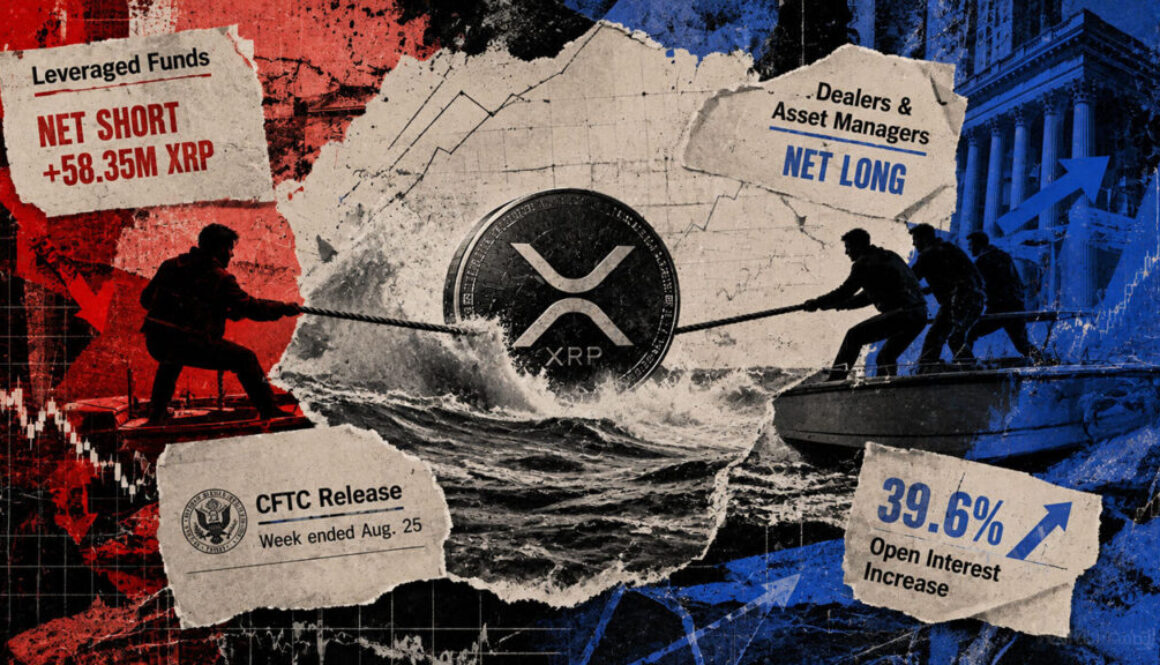
Leveraged funds more than doubled their CME XRP net short as open interest surged nearly 40% in one week.
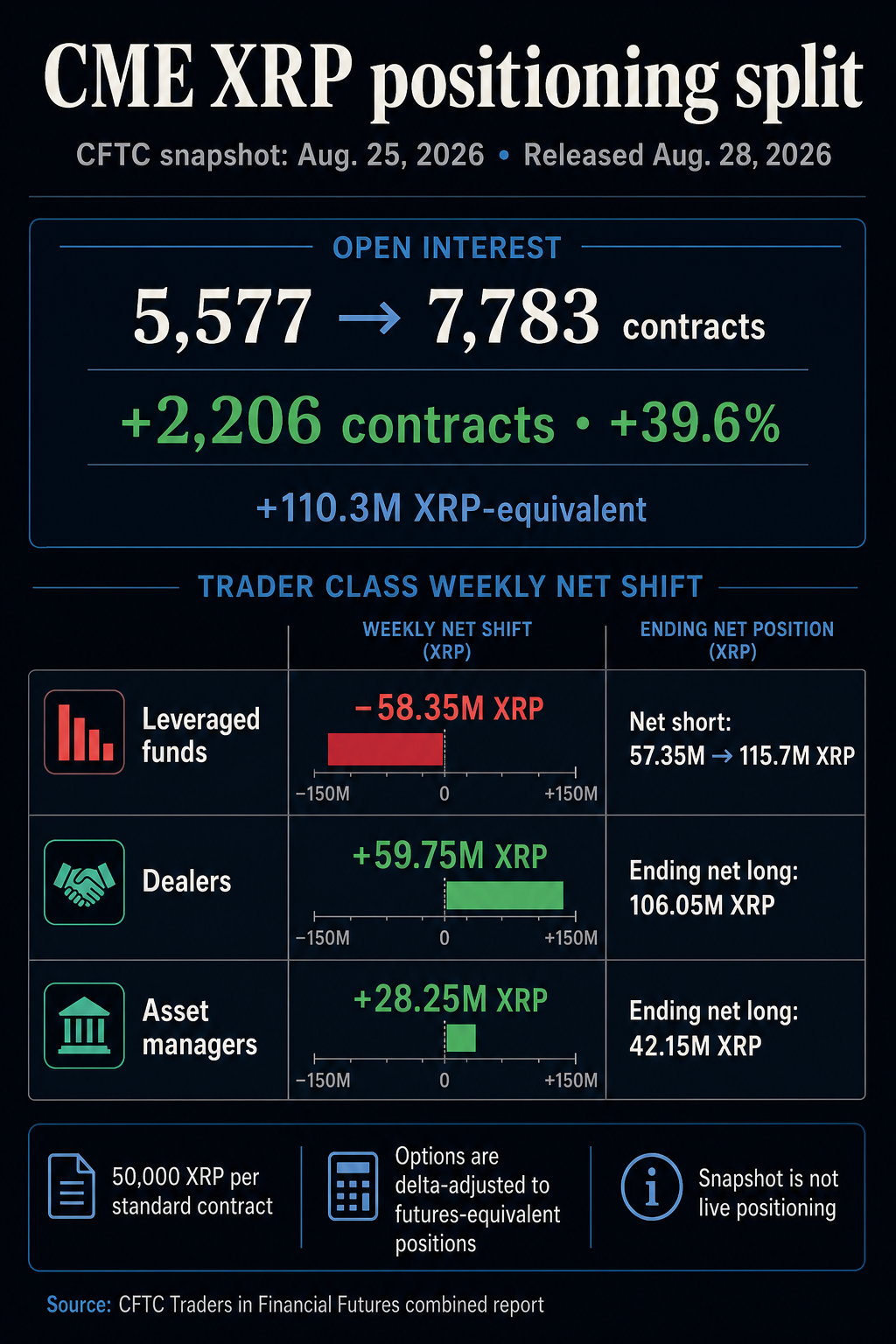
Last week, the Commodity Futures Trading Commission (CFTC) reported that XRP open interest increased by 2,206 from a week earlier, to 7,783 futures-equivalent contracts. At 50,000 XRP per standard contract, the increase represented about 110.3 million tokens and lifted total exposure to roughly 389.2 million XRP.
Leveraged funds moved against that momentum, holding 892 long contracts and 3,206 shorts. Their net short widened to 2,314 contracts, equivalent to about 115.7 million XRP, from 57.35 million XRP a week earlier.
The increase added 58.35 million XRP-equivalent of net short exposure and left leveraged funds with the largest directional short among the reportable CFTC categories.
Dealers and asset managers moved the other way.
Dealers increased their net-long position by 1,195 contracts, equivalent to 59.75 million XRP, ending at 2,121 contracts net long. Asset managers added 565 net contracts, or 28.25 million XRP-equivalent, to finish 843 contracts net long.
The positioning split shows CME’s rapidly expanding XRP market is producing sharply different institutional exposures rather than a uniform view on the token’s direction. The CFTC does not disclose whether leveraged-fund shorts are outright bearish bets or hedges against positions elsewhere.
Their growing exposure nevertheless leaves leveraged funds more vulnerable to another advance of the Ripple-linked token.
This is because the category added 58.35 million token net shorts during a week when the token was already recovering, while dealers and asset managers increased their net longs.
If XRP keeps rising while leveraged funds maintain or expand their short exposure, the gap between price momentum and institutional positioning will widen further. A retreat in those shorts would instead show that the rebound has begun forcing a change in how leveraged funds are positioned.
After jumping past $79,000 on Sunday evening, bitcoin entered the new business week on the wrong foot, slipping below $77,000 in an hour or so as geopolitical tensions returned to financial markets.
The decline came amid renewed fighting between the United States and Iran, following nearly a month of relative calm as the US reportedly focused only on increasing economic pressure. US Forces struck two Iranian launchers on the island of Larak on Sunday, while the latter retaliated with strikes against military targets stationed in Jordan.
US President Trump’s AI video of how Kharg Island, Iran’s key oil region, is being “blown to smithereens” didn’t help defuse the situation either.
Oil Up, Asian Markets Down
Brent crude reacted immediately with a near-3% surge to over $90 per barrel, reviving concerns about another energy-driven inflation shock. This is particularly worrisome following Fed Chair Kevin Warsh’s hawkish speech at Jackson Hole on Friday, as higher oil prices deteriorate the inflation picture.
In contrast to oil, Asian stock markets headed south after the attacks went public, with Japan’s Nikkei falling by roughly 2%. South Korea’s Kospi and Chinese equities also turned red, while US and European stock futures followed suit. The Japanese yen weakened beyond 160 against the greenback.
Bitcoin dipped below $77,000, losing over $2,000 of value. Additional pressure came from Wintermute, as on-chain data showed that the entity transferred 5,100 BTC, worth almost $400 million, to Binance over the past two days, likely intending to sell.
Although this transfer doesn’t guarantee that Wintermute has sold, recall that similar actions taken by the market maker last week resulted in another leg down for BTC and the alts.
Ethereum’s situation was even worse, as it plunged from over $2,500 to under $2,400 in an hour. Lookonchain reported that a whale or an institution had deposited almost 41,000 ETH (worth over $100 million) onto exchanges, a move typically made before selling.
Liquidations on the Rise
The sharp move south led to over $400 million in wrecked positions on a daily scale, with the lion’s share coming earlier this morning. Interestingly, ETH longs are responsible for almost $100 million, while BTC longs are just $62.60 million, according to CoinGlass.
The single-largest wrecked position also involved the leading altcoin, with a trader getting liquidated for $6.12 million on Aster. In total, more than 100,000 over-leveraged traders were wiped out in the past day.
The European Central Bank (ECB) wants to issue euros directly onto a blockchain. Executive Board member Isabel Schnabel made that case at the Jackson Hole symposium on Friday, and she was very clear about stablecoins.
She is talking about money that banks use to settle with each other, not the euros in your account. Tokenized markets, she argued, need an asset only a central bank can create.
Why Schnabel Rejects Stablecoins as Settlement Money
A stablecoin can be built to be almost perfectly safe, and Schnabel accepts that. Her objection is about what happens next.
In a panic, everyone wants cash at once. A central bank can create more of it. A stablecoin issuer cannot.
Her precedent is the banking panic of 1907. Money was tied to banks’ holdings of government bonds, so the money supply could not expand. The Federal Reserve Act of 1913 fixed that.
“Stablecoins are best understood as complements to central bank money, not substitutes for it,” read an excerpt in her speech.
The supply numbers explain Europe’s hurry. Dollar-pegged stablecoins circulate about $304 billion, DefiLlama data shows. Euro-pegged tokens hold under $1 billion.
Pontes goes live next month, linking TARGET Services, the eurozone’s settlement backbone, to market blockchain platforms.
BREAKING:🇪🇺ECB confirms Pontes will go live in September 2026, linking market DLT platforms to TARGET Services for atomic settlement in central-bank money
Europe is moving toward 24/7, programmable, multi-currency settlement
The pipes have been tested before, particularly from May to November 2024, when 64 institutions across nine jurisdictions ran 58 use cases. They settled nearly €1.6 billion in central bank money.
Cash finality remains within TARGET2 initially. Smart contracts and round-the-clock operation come later.
Schnabel weighed three routes:
Issue tokens directly
Bridge from today’s systems, or
Let a private firm tokenize reserves through an omnibus account.
She wants the first, while the other two leave the ECB watching from outside, unable to run repo operations in code.
A second project, Appia, is still deciding whether Europe needs one shared ledger or several. She cited France’s Lise, holder of Europe’s first tokenized exchange license, as evidence that tokenization opens markets to smaller firms.
DeFi tokens have climbed nearly 38% since August 17 as investors reassess how US crypto policy could affect protocol revenue and token value.
SoSoValue says the rally is moving DeFi closer to a market where fees, buybacks and on-chain activity can play a larger role in how tokens are valued.
Policy Shift and Protocol Revenue Behind the Rally
In a post on X, SoSoValue said its DeFi sector index, $DEFI.ssi, rose from 0.3616 on August 17 to around 0.498 after reaching 0.511, for a cumulative gain of about 37.7%.
The move came alongside Bitcoin and Ethereum’s recovery and broader short covering, but the research firm argues that investors are also reassessing whether mature DeFi protocols can return more of their revenue to tokenholders.
That issue has limited DeFi valuations for years. Protocols could generate substantial trading fees, lending income, and other revenue while tokenholders had little direct claim on those economics.
Fee distributions and buybacks could also create securities-law concerns in the US, leaving many protocols reluctant to activate mechanisms that tie revenue to their tokens. But that may be changing, considering that last week, the SEC proposed its “Regulation Crypto Assets” framework, which includes exemptions and a conditional safe harbor for certain crypto-asset offerings.
Under the proposal, once a project has completed or permanently stopped the essential managerial work it had promised, its token may no longer remain part of an investment contract.
The Senate’s CLARITY Act draft goes further for DeFi, with protections for noncontrolling developers, validators, node operators, oracle providers and self-custody wallet software.
That draft also leaves room for rewards linked to trading, staking, governance, and liquidity provision. However, it still needs 60 votes in the Senate, while the SEC proposal is subject to public comment, but according to SoSoValue, markets are already assigning more confidence to the direction of US policy, even though legal certainty is still not there.
Revenue and Buybacks Give DeFi Tokens a Different Valuation Case
When you consider protocol revenue, the case becomes even more interesting, with Uniswap generating about $7.18 million during the past 30 days, followed by PancakeSwap at $5.16 million, Jupiter at $4.69 million, Aave at $4.12 million, and Aerodrome at $4.11 million.
Several of these protocols now have mechanisms that connect those economics to their tokens. For example, Hyperliquid uses part of trading fees to buy HYPE, Uniswap has linked revenue to UNI burns, and Jupiter allocates 50% of protocol fees to JUP purchases. PancakeSwap also uses part of its fees for CAKE buybacks and burns.
Meanwhile, Ethena has proposed an even larger allocation. Once USDe reaches its stated supply threshold, 95% of net revenue paid to the foundation across its three core business lines would go towards ENA buybacks.
According to SoSoValue, the next phase depends on whether those protocol revenues keep rising and whether tokenholders can get a larger share of it.
Japan’s yen weakened again this week despite roughly $97 billion spent supporting it over the past month. Its slide puts renewed pressure on officials to act, with potential consequences for Bitcoin.
Why Japan’s Yen Rescue is Fading
The currency fell to 160.16 yen per dollar on Friday, 28 August, giving up more than half its gains since last month’s intervention. A weaker yen makes imports more expensive for Japanese households and businesses.
US interest rates remain higher than Japan’s, making dollar investments more attractive. The dollar gained further support this week when Federal Reserve chair Kevin Warsh pledged to bring inflation to target.
Japan’s Yen Evolution amid Intervention Spikes. Source: X/@GlobalMktObserv
Japan could add to that pressure. Some investors borrow yen cheaply and use the money to buy investments elsewhere. This is known as the carry trade.
If fresh intervention or higher Japanese interest rates push the yen sharply upwards, those loans become more expensive to repay in other currencies. Investors may sell assets to cover their debts, potentially dragging Bitcoin lower.
Bitcoin Price Over the Past Week. Source: CoinGecko
This has actually happened before. Back in August 2024, the reversal of yen-funded trades amplified selling. Bitcoin and Ethereum suffered losses of up to 20%.
His company buys and holds Bitcoin, giving him a financial stake in that outlook. Such demand could grow over time. Bitcoin remains vulnerable to sudden market sell-offs.
“The buyers arriving now aren’t going anywhere. I believe the bottom is in. And I’m expecting a much brighter rest of the year,” Metaplanet’s CEO said.
Circle’s wrapped Bitcoin product entered the market with unusually strong institutional credentials and almost no visible scale.
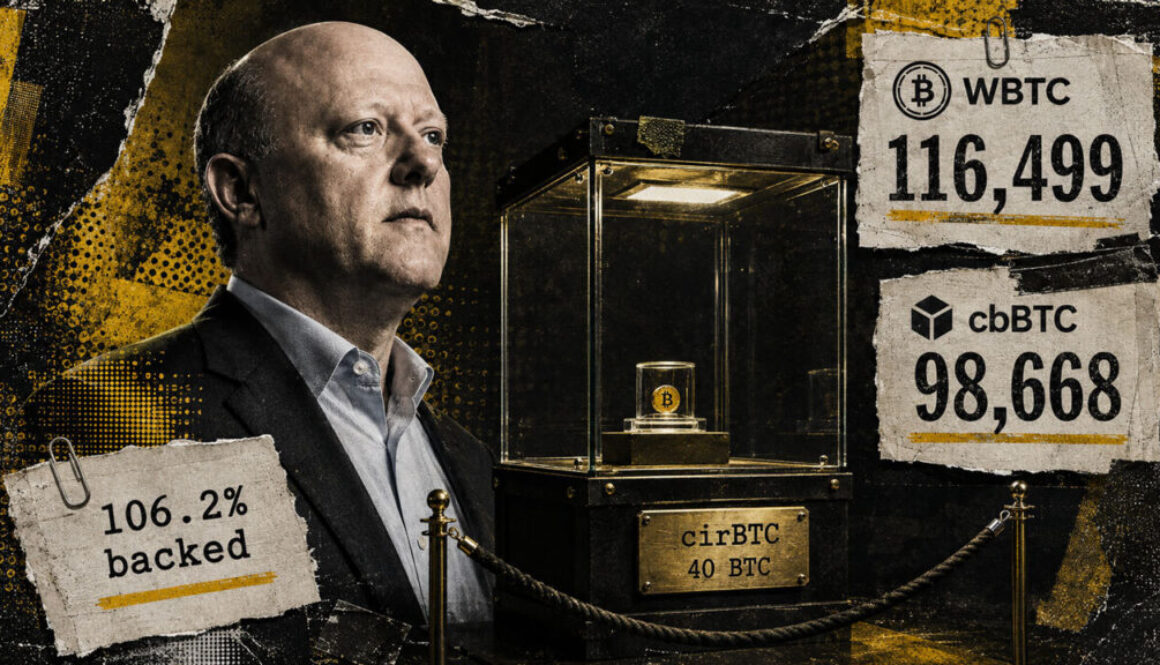
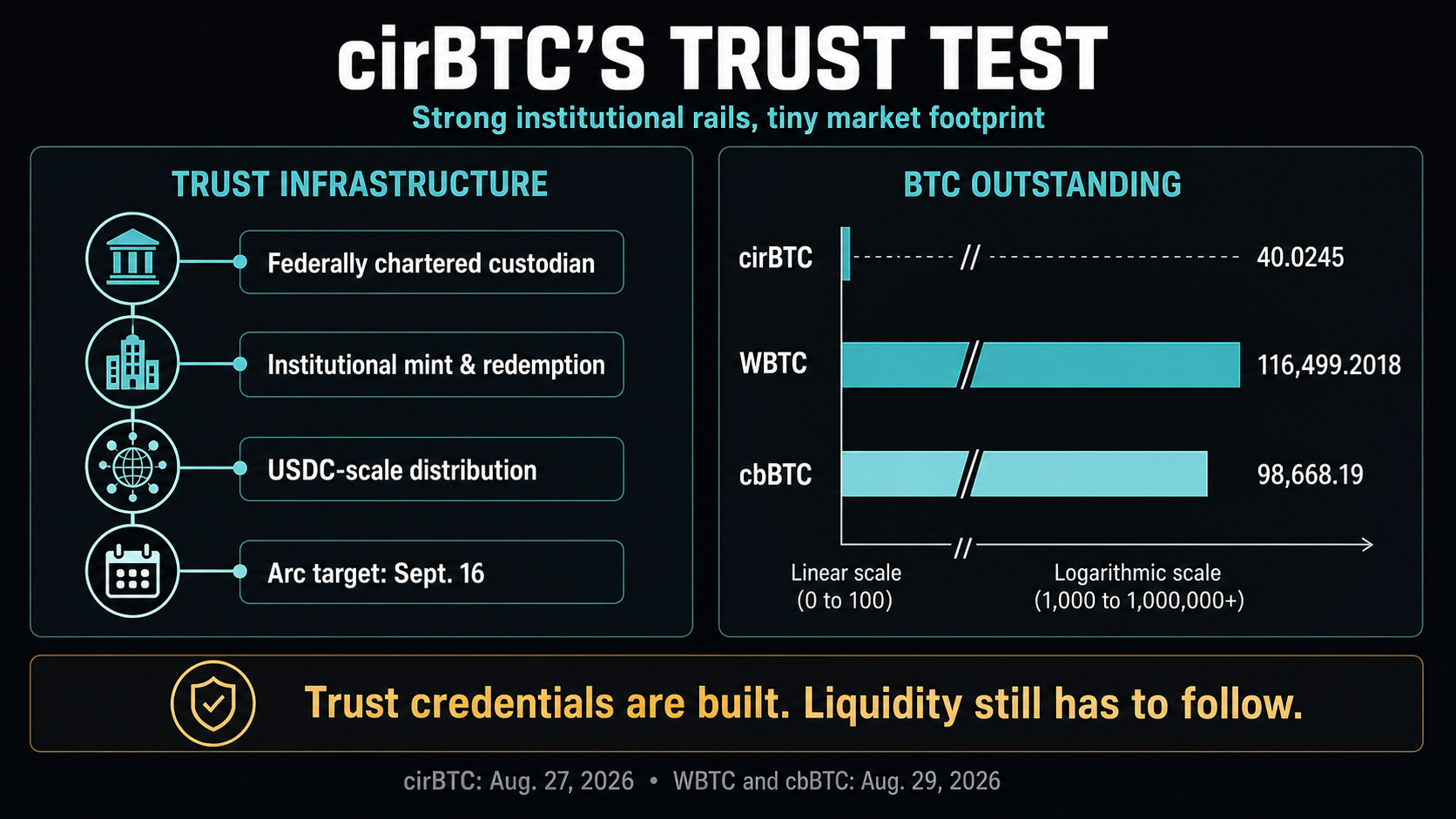
The company paired cirBTC with segregated reserves, a federally supervised custodian, direct minting and redemption for eligible businesses, and the distribution infrastructure behind USDC. Circle’s Aug. 27 reserve panel nevertheless showed just 40.02450077 cirBTC outstanding about 11 weeks after its Ethereum launch.
The same panel showed 42.5114162 BTC in reserve, equal to about 106.2% coverage and a 2.48691543 BTC cushion across 14 disclosed Bitcoin addresses. The reserve cushion settled the backing question at that snapshot. The 40-token float exposed the harder problem: Circle had built a credible institutional wrapper but had barely begun to build a market around it.
That gap turns cirBTC into a test of a broader Circle thesis. Jeremy Allaire said in the company’s second-quarter results that Circle had built “the platform for the internet financial system.” He was describing Circle’s larger platform, including its trust charter, USDC and planned Arc network. cirBTC now has to show whether that infrastructure can produce the liquidity and integrations that make wrapped Bitcoin useful as collateral.
A 40-BTC float enters a market measured in six figures
cirBTC is Circle’s tokenized representation of Bitcoin on Ethereum. WBTC and Coinbase’s cbBTC serve the same basic purpose, allowing Bitcoin value to move through smart-contract networks, but their scale makes the competitive gap stark.
Token
Outstanding supply at check
Underlying BTC reserves
Scale versus cirBTC
cirBTC
40.02450077
42.5114162
1x
WBTC
116,499.2018
116,512.0029
About 2,911x
cbBTC
98,668.19
98,678.96
About 2,465x
The cirBTC figures are from Aug. 27. The WBTC transparency dashboard and Coinbase’s cbBTC reserve page were checked Aug. 29, making this a close two-day comparison. Coinbase’s total covered cbBTC across Ethereum, Base, Solana and Arbitrum and was counted once, avoiding double-counting of its multichain representations.
Supply is only one measure of a wrapped token’s usefulness, but it is also evidence of distribution. Each token in circulation reflects demand to mint, acquire or deploy that representation of Bitcoin. The incumbents’ six-figure supplies give venues and protocols far larger pools from which to build trading and lending markets.
Public activity data reinforced the scale difference. At the Aug. 29 check, DefiLlama showed about $110.49 million in 24-hour WBTC trading volume and $3.12 billion in maximum observed lending exposure. Its cbBTC page showed about $338.55 million of volume and $2.817 billion in maximum observed lending exposure. Those exposure figures describe DefiLlama’s recorded maxima, rather than live lending balances or market share.
CoinGecko’s verified cirBTC contract page showed no tracked 24-hour trading volume, liquidity or transactions. CoinGecko captures public tracked activity, leaving private, over-the-counter or untracked flows outside that observation. Its empty market fields still showed that cirBTC had yet to develop visible liquidity on a major public tracker.
A public Aave governance proposal sought to onboard cirBTC. The proposal status meant live collateral support, borrowing demand and risk parameters remained pending. For institutions, prospective support becomes useful only when positions can be opened, financed and unwound through functioning markets.
Circle’s integrated stack combines trust with platform control
The adoption gap stands out because cirBTC arrived with a deliberately formal operating structure.
Circle’s whitepaper identifies Circle International Bermuda Limited as the legal issuer. Circle National Trust holds the underlying Bitcoin as custodian, while Circle Internet Financial, LLC provides Circle Mint and related distribution services. The Ethereum token is an eight-decimal ERC-20 at 0x72DFB2E44f59C5AD2bAFE84314E5b99a7cd5075E, an identity also reflected on Etherscan.
Circle National Trust received final approval from the Office of the Comptroller of the Currency in July. The approval applied to the national trust bank, not to cirBTC as a separately approved financial product. It gave Circle a recognizable custody credential: underlying Bitcoin held by a federally chartered trust bank, paired with an issuer-operated transparency panel and direct conversion for qualified customers.
Circle Mint is designed for eligible institutions and is unavailable to individuals. Secondary-market users can transfer the ERC-20 token, while direct issuance and redemption depend on institutional eligibility, supported jurisdictions and Circle’s compliance process.
That model may appeal to regulated funds and businesses that value a known redemption counterparty. It also creates a more selective path to primary-market access. WBTC and cbBTC already sit inside established exchange, wallet and lending networks. cirBTC needs dealers, market makers, protocols and custodial platforms to add another Bitcoin representation before its trust architecture can become useful collateral at scale.
Circle brings substantial distribution experience to that challenge. It reported $73.3 billion of USDC in circulation at the end of the second quarter and $14.8 trillion of USDC onchain transaction volume during the period. Those figures establish Circle’s ability to operate a large token network. Demand for cirBTC will depend on whether venues and customers find comparable utility in its Bitcoin product.
Circle argues that wrapped Bitcoin should be “strategically neutral.” In its Aug. 11 thesis, the company focused on conflicts that can arise when a wrapped asset is controlled by an operator with its own centralized exchange, decentralized exchange or lending protocol. Under that definition, Circle can pursue broad distribution without steering users toward an affiliated trading or lending venue.
The operating structure defines neutrality as a commercial rather than structural condition. Circle-affiliated entities occupy each major point in cirBTC’s design: issuance, custody, direct redemption and distribution. Circle also supplies USDC, the dollar liquidity that could pair with cirBTC, and is building Arc, a network that may become another venue for the token.
Circle can therefore claim commercial neutrality among third-party venues while retaining an integrated operating stack. Institutions may see that concentration as efficient accountability or as platform dependence. Adoption will decide which interpretation carries more weight.
The current numbers show that trust credentials have yet to overcome incumbent network effects. A reserve dashboard establishes backing. A collateral standard also needs broad acceptance, borrowing demand, deep trading and inexpensive redemption.
Arc gives Circle a future distribution checkpoint
Arc could connect Circle’s custody, stablecoin and wrapped Bitcoin products inside one settlement environment. Circle said the network’s public mainnet was on track for Sept. 16, with more than 100 builders and a validator cohort that included major financial and payments companies.
The Aug. 29 reporting cutoff came before that scheduled launch. Circle’s cirBTC documentation described Arc testnet support and broader Arc availability as forthcoming, leaving cirBTC’s day-one public-mainnet availability unconfirmed.
Arc is therefore a future checkpoint rather than evidence of present distribution. Live cirBTC support, USDC markets, institutional participants and borrowing or trading integrations would shorten the route from minting to utility. Continued supply near 40 BTC after those rails arrive would make the gap between Circle’s infrastructure and cirBTC adoption harder to explain as an early-launch condition.
For now, Circle’s reserve panel supports two simultaneous conclusions. cirBTC was backed by more Bitcoin than Circle had issued, validating the disclosed reserve position at that moment. Relative to the dominant alternatives, almost nobody had minted it.
Circle has built the institutional plumbing. cirBTC still has to prove that users, venues and protocols want to connect to it.