Crypto company BitGo has officially acquired NYDIG’s Bitcoin-focused institutional trading business. The deal was signed and completed on Thursday and reported on Friday, paying $7 million in cash and about $35.5 million in stock at closing, with up to $15 million more in cash tied to two revenue milestones.
The purchase brings NYDIG’s derivatives, structured products, financing, and capital markets operations to the custody company, along with roughly 30 employees.
NYDIG Turns to Power and Compute
Around 250 institutional client relationships were moved across, though they appear in the 8-K filed the same day, which also grants seller NYDIG IHC LLC earn-out shares on the second milestone and sets aside staff retention awards targeting $5 million each in stock and cash.
“Institutions increasingly want to work with a trusted partner that can support the full lifecycle of digital assets,” said Mike Belshe, CEO and Co-founder of BitGo. The firm went public on the NYSE at the start of the year and had a market value below $1 billion as of Thursday, per CNBC.
NYDIG, an affiliate of Stone Ridge Holdings Group, said the sale lets it concentrate on power generation, Bitcoin mining and high-performance computing data centers, a development pipeline it puts above 3 gigawatts, with more than 1 gigawatt deliverable in 2027 and 2028.
“Our team built NYDIG’s institutional trading business into something exceptional: proven execution expertise with derivatives and financing capabilities,” said Tejas Shah, CEO of NYDIG, adding that the data center business is “where we see one of the most significant opportunities ahead.”
Belshe Pushes Senators on CLARITY
Belshe went on CNBC’s Squawk Box on Friday, days after Bitcoin briefly topped $80,000. Asked about a crypto winter, he said the markets “have had high highs and low lows” while “the thesis behind Bitcoin continues to grow,” pointing to tokenized equity plans from Morgan Stanley, Charles Schwab and DTCC.
On the CLARITY Act, which faces a Senate cloture vote on September 15, Belshe said everyone should want the market structure bill to pass. “This is what gives a legislative path forward to help rein that in, prevent any FTX from ever happening again,” he said, estimating 12 to 18 months of rulemaking after passage and noting he was at the White House with President Trump last week.
Belshe confirmed BitGo runs infrastructure for USD1, the stablecoin behind the Trump family’s World Liberty Financial, and said BitGo just received a license in South Korea. “People don’t realize this, but America actually is behind,” he added.
Sberbank plans to accept Bitcoin (BTC), Ether (ETH) and Tether (USDT) as loan collateral, deputy chairman Anatoly Popov told TASS on Friday.
Russia’s largest lender wants the coins as security, not as money. Paying with crypto in Russia remains banned when the country’s digital currency law takes effect on September 1.
Collateral is Legal, but Spending is Not
A Russian company can pledge Bitcoin to a bank, but it still cannot buy a coffee with it. Popov said Sberbank prepared for the rule change early and already handles digital assets. However, he made the expansion conditional.
“We plan to accept not only Bitcoin but also Ethereum and the stablecoin Tether as collateral… after the Central Bank, of course, allows them for public circulation,” local media reported.
President Vladimir Putin signed the law on August 4. The Bank of Russia published its first approved list a week later. Only three coins cleared the screen.
Regulators wanted size, high daily turnover, and at least 5 years of price history on foreign exchanges. Bitcoin, ether and USDT passed. Nothing else did, and the regulator is clear about the rest.
Crypto cannot be used in payments within Russia. Only exporters and importers get a carve-out for crypto payments in foreign trade.
No Rate, No Date, No Term Sheet
With the key rate standing at 14% as of August 28, money is expensive in Russia, and that number explains the demand. A miner can sell coins and lose the upside, or pledge them and pay interest.
Meanwhile, ordinary Russians will not get the option. Russia’s new crypto law caps non-qualified investors at 300,000 rubles (roughly $3,632) of crypto per year per intermediary. Corporate borrowers face no such ceiling.
Popov disclosed no loan-to-value ratio, interest rate, or launch date. He tied everything to permissions the central bank has not yet issued.
What exists today is smaller. Sber closed a crypto-backed lending pilot in December 2025 and targets a digital depository by December 1.
Notably, however, USDT is the quiet outlier, sitting at $0.9999, while Bitcoin moves every day. One coin needs a thin haircut, the other a deep one.
If a borrower defaults, Sberbank must sell those coins inside a country where spending them is illegal.
Helium (HNT) jumped as much as 167% over the weekend, establishing an intra-day high of $0.989 as of this writing. Traders who arrived late are asking whether it is too late to buy HNT.
The rally was not built on buyers, but on sellers being forced out.
Helium runs a wireless network. Ordinary people host the hardware in their homes and shops. The industry calls this decentralized physical infrastructure, or DePIN.
The trigger was a Texas Wi-Fi deployment BeInCrypto reported on Saturday. The reaction dwarfed the news itself. HNT price, which had traded under $0.30 for most of the summer, surged by almost 170% in one weekend. Helium’s pitch has always been real customers.
In April 2025, developer Nova Labs paid $200,000 to settle SEC charges. Regulators said it wrongly claimed Lime, Nestle and Salesforce used the network. The case covered statements to stock investors, not the token.
What the Charts Actually Show
The HNT price did not climb in a straight line. It moved in two bursts, grounding from $0.33 up to $0.45 overnight. It then jumped to $0.70 by 09:00 and stalled for four hours. A second push from 15:00 carried it to $0.9782.
HNT Volume Outlook
During the pauses, forced buying ran out. Now volume. The daily bar is the tallest on Helium’s two-year chart. Earlier spikes topped out near $45 million. This one cleared $110 million, thresholds last tested in 2023.
In total, $248.26 million changed hands, while the whole token is worth only $154.8 million. So the token changed hands more than once in a single day. Most people holding HNT now bought it this weekend, near the top.
HNT Liquidations
Some traders had bet against HNT, borrow the token, sell it, and plan to buy it back cheaper. The price rose instead, and their losses grew with every tick. Exchanges liquidated them, closing those bets for them and bought the token back at market price.
Coinglass shows nearly $1.5 million worth of short positions were liquidated on Sunday alone and over $1.6 million across the weekend. There is almost nothing before it. Traders betting on a rise lost just $196,650.
Every forced closure is a purchase. That is how the price climbed without new buyers arriving. Traders call this a short squeeze.
HNT Funding Rates
Next comes the funding rate, the clearest chart of the five. On these markets, one side pays the other a small fee every few hours.
For eight months that fee sat flat at zero. This weekend it fell past minus 1.2% on a single payment. Traders betting against HNT now pay the ones betting on it.
“The funding rate on Bybit HNT-PERP was close to -1000% this last print. A $60m market cap token with real users, with a chart that has no resistance for another 150%, down 99% from ATH. Shorts are trapped paying crazy funding with no spot supply,” one trader observed.
Finally, open interest. This is the total money riding on these bets. It shows the number of all open long and short positions for HNT price.
It jumped 197.6% to $13.64 million, the highest in about a year. When those bets get closed out, this number falls. Here it nearly tripled instead.
They are not surrendering, with new money and fresh capital entering the futures market as new contracts are created for HNT. They are being replaced faster than they are cleared out.
As HNT price rises alongside rising open interest, it signals strong bullish momentum. It shows high-conviction, aggressive bullish breakout driven by explosive leveraged demand.
Is It Too Late to Buy HNT?
That squeeze is already cooling, as HNT peaked at $0.989 and now trades near $0.88. Forced buying has nearly stopped. Only $22,920 of bearish bets closed in the most recent hour (as of this writing), against $1.61 million across the day.
Traders watching this setup tend to treat a vertical spike in open interest as a warning rather than an entry. Positioning is stretched, and a sharp drop can trigger a chain of forced closures in the other direction.
The signal they wait for is open interest flattening, or easing slightly, while the price holds. That combination suggests the market has accepted the higher level rather than simply leveraged into it.
Funding is the second gauge, and HNT reads in reverse of the usual case. A crowded long market shows sharply positive funding. Here it is deeply negative, so the crowd is still short and paying to stay there.
A move back toward zero would mean those bets have been closed or abandoned. The buying that came from forced closures stops at that point, and the price has to hold on ordinary demand.
One supply point favors holders, but with a caveat. Every HNT minted so far is already trading, so no locked block is waiting to vest. Issuance continues toward a 223 million cap though, with about 37 million still to come.
Once funding returns to zero, ordinary demand must hold Helium price data alone. Anyone buying now is betting on a second squeeze, not the first.
Stablecoin demand is becoming consequential in the U.S. government debt market, but the maturity of that demand matters more than the headline total.
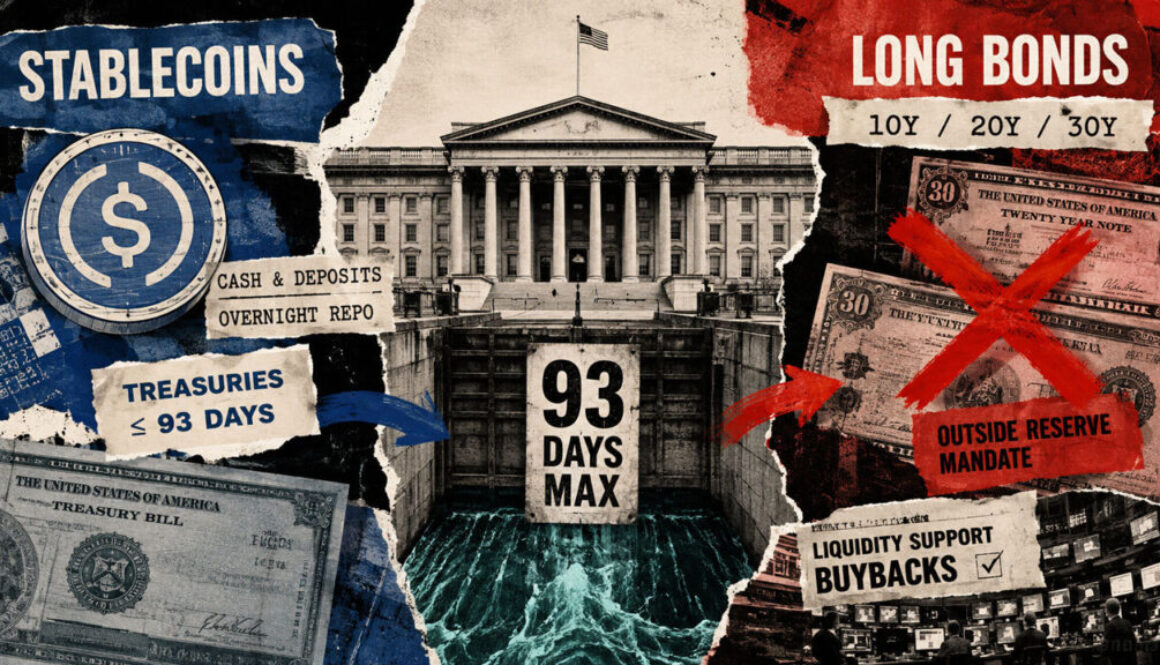
Washington now has two debt-market stories running at once. The federal framework for permitted payment stablecoins channels reserves into cash-like instruments and Treasuries with no more than 93 days remaining. Farther out on the curve, the Treasury Department said on Aug. 19 that it would at least double the maximum size of liquidity-support buybacks in the 10- to 20-year and 20- to 30-year nominal sectors beginning Sept. 9.
Together, those developments test a broad claim about digital dollars funding the United States. Stablecoin growth can reinforce demand for bills and overnight Treasury financing. Direct support for long-duration bonds remains outside the reserve mandate, while any connection to Bitcoin runs through wider financial conditions rather than a reserve trade.
The 93-day wall defines the stablecoin bid
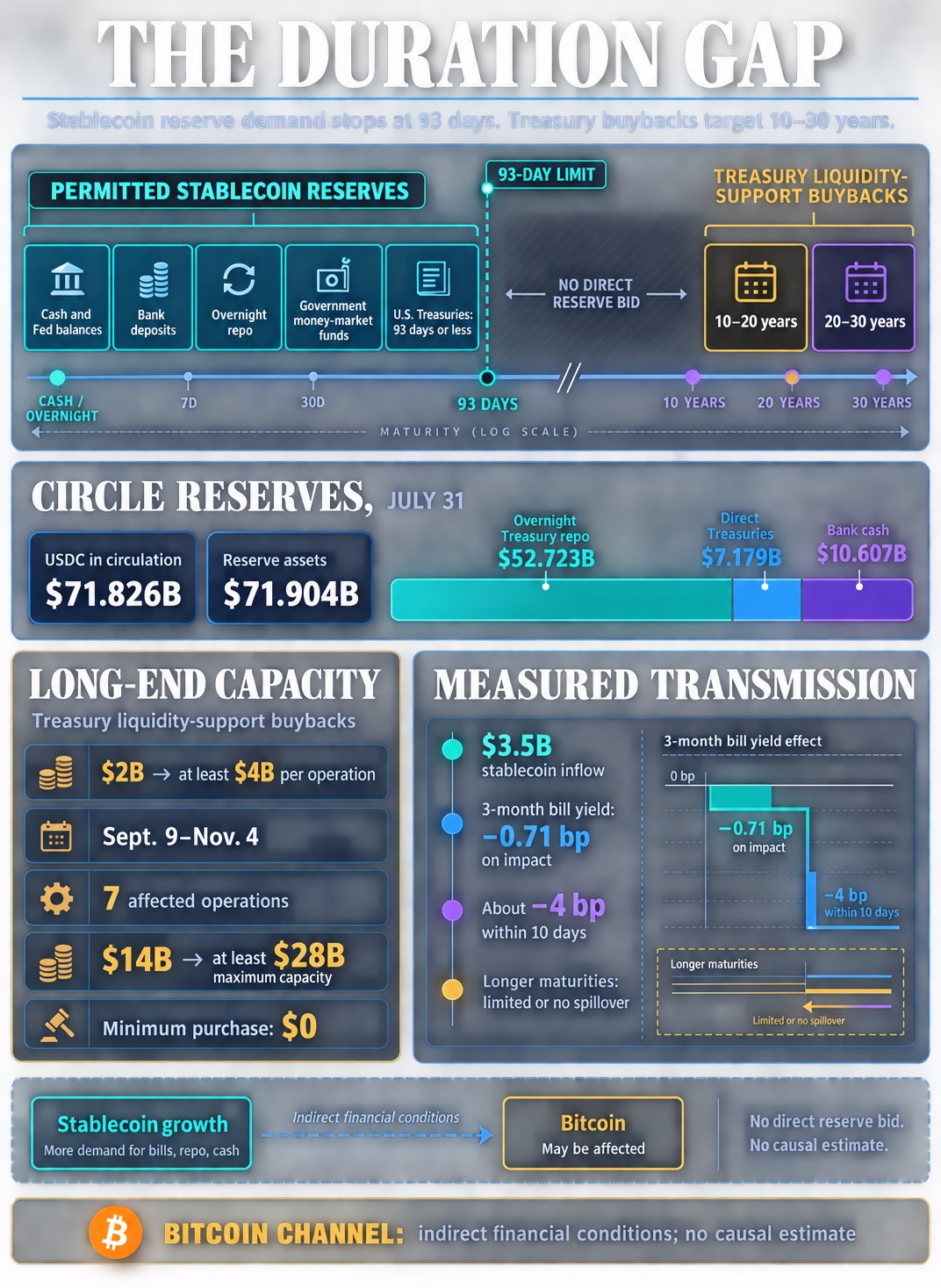
The GENIUS Act requires permitted issuers to maintain identifiable reserves of at least one dollar for every payment stablecoin outstanding. Eligible assets include U.S. currency and Federal Reserve balances, withdrawable bank deposits, Treasuries with an original or remaining maturity of 93 days or less, qualifying overnight repo and reverse repo, government money-market funds invested in those instruments, regulator-approved similarly liquid federal assets, and qualifying tokenized versions.
The menu extends beyond Treasury bills, yet it remains built around liquidity and short duration. A newly issued 10-year note or 30-year bond falls outside the direct Treasury reserve category.
Implementation is still in progress. The law was enacted in July 2025, but its general effective date is the earlier of Jan. 18, 2027, or 120 days after final implementing rules. The Office of the Comptroller of the Currency issued its framework as a proposal in February. On Aug. 19, the Comptroller said the final OCC rule was expected by November. Current issuer portfolios show how short-duration reserves work in practice; they do not establish that every issuer already operates under a completed federal regime.
Reliable transmission to longer maturities or Bitcoin
Circle provides a live example of short-duration reserve behavior rather than proof of systemwide demand. Its second-quarter filing put USDC circulation at $73.269 billion on June 30. A more detailed July assurance report) showed $71.826 billion in circulation and $71.904 billion of reserve assets on July 31.
Of that reserve, $60.717 billion sat in the Circle Reserve Fund, including $52.723 billion of overnight Treasury repo and $7.179 billion of Treasuries. Another $11.187 billion was held outside the fund, dominated by $10.607 billion of cash at regulated financial institutions. Every direct Treasury listed in the report matured by Sept. 22. The repo exposure involved lending cash against Treasury collateral. Both categories kept Circle’s duration close to the front end of the market.
Those balances show the scale and boundary of the bid. Additional USDC can direct more cash toward bills, repo or bank deposits. The destination depends on the issuer’s reserve allocation, and long coupons remain outside the direct channel.
The flow data add a second constraint: stablecoin market growth and fresh federal financing are different quantities. Circle customers minted $83.004 billion of USDC and redeemed $86.784 billion during the second quarter, leaving $3.780 billion of net redemptions. Quarter-end circulation was still 19% above a year earlier, but it stood about $2 billion below December. Gross issuance measures activity, and even net growth leaves the source of the dollars unknown.
The Treasury Borrowing Advisory Committee, a private-sector group that advises Treasury on debt management, has drawn the same distinction. Stablecoin issuance could add short-maturity Treasury demand. Part of that effect may be displaced when users move balances out of bank deposits, money-market funds or other cash-like instruments that already finance bills. Demand from new offshore dollar users would be more additive, but the official evidence does not quantify that share.
Stablecoins can therefore change which balance sheet holds a bill without giving Treasury a wholly new lender for every dollar of token growth.
Treasury’s planned operations target off-the-run nominal coupons in the 10- to 20-year and 20- to 30-year sectors. The department described the purpose as liquidity support: providing dealers and investors a predictable outlet for older securities that may trade less readily than the newest issue.
The tentative calendar lists seven affected long-end operations on Sept. 10, Sept. 24, Oct. 1, Oct. 8, Oct. 15, Oct. 27 and Nov. 4. Raising each maximum from $2 billion to at least $4 billion lifts aggregate capacity across those operations from $14 billion to at least $28 billion.
That figure is a ceiling. Treasury’s buyback guidance sets the minimum for an operation at zero and allows the department to accept less than the maximum when offers are unattractive.
The program also differs from quantitative easing. Treasury retires the securities it accepts and finances buybacks like other outlays. All else equal, each dollar bought back requires another dollar of Treasury issuance. The department can choose the mix of bills and coupons used to meet its overall financing needs. Stablecoin demand could absorb part of the bill component if that mix leans toward the front end, but the government’s borrowing requirement remains and stablecoin reserves never enter the long-bond buyback as direct purchasers.
Empirical work reinforces the maturity divide. A Bank for International Settlements working paper using data through March 2026 found that a $3.5 billion stablecoin inflow lowered three-month bill yields by 0.71 basis points on impact, about 4 basis points within 10 days and roughly 5 basis points at the estimated trough. The effect strengthened under some conditions of market stress and bill scarcity.
Longer maturities showed limited or no spillover in the same research. That pattern fits the assets issuers buy: cash placed into securities that mature within weeks can compress bill yields while leaving investors to bear the duration risk in 10-, 20- and 30-year debt.
The official yield curve offers current context rather than causal proof. On Aug. 28, Treasury data put the 10-year yield at 4.73%, the 20-year at 5.21% and the 30-year at 5.22%. Each maturity sits far beyond the GENIUS ceiling for direct Treasury reserve assets. The levels reflect many forces; they simply locate the part of the curve where a direct stablecoin bid is absent.
Bitcoin feels the curve only through indirect channels
For Bitcoin, the defensible mechanism begins with broad financial conditions. Long-term Treasury yields can influence credit costs, the discount rates applied to risky assets and investors’ appetite for volatile positions. Better trading conditions in older long bonds can improve market functioning, while a larger bill buyer base can support Treasury’s front-end financing.
Those links create a possible macro channel, not a mechanical price signal. A stablecoin inflow may compress bill yields without lowering long-term yields. A Treasury buyback may improve liquidity without reducing net borrowing. Bitcoin can respond to changes in rates, dollar liquidity and risk appetite while moving for many unrelated reasons at the same time.
The evidence here provides no causal estimate connecting stablecoin flows, long-end buybacks or long yields to the price of Bitcoin. It therefore supports no fixed prediction for BTC from either stablecoin growth or the expanded buyback schedule.
The measurable conclusion is narrower. Stablecoins can become a larger source of demand for Washington’s bills, especially when growth represents new dollar demand. The long-bond market still depends on investors willing to hold duration, leaving Treasury’s liquidity operations and Bitcoin’s financial-conditions channel separate from the regulated stablecoin reserve bid.
Crypto platforms have lost more than $3.63 billion to security incidents between January 2025 and July 2026. CoinGecko documented 245 attacks during the period.
The 10 largest incidents accounted for more than 72.5% of the total amount stolen, demonstrating that a relatively small number of major breaches drove most of the losses. Infrastructure and supply-chain vulnerabilities were the biggest sources of damage across both centralized exchanges and decentralized exchanges. Combined losses exceeded $1.8 billion.
Most Attacked Platforms Had Been Audited
Security failures involving Bybit and KelpDAO were notable examples. CoinGecko also found that the main weaknesses differ depending on how platforms are built.
For centralized exchanges, compromised private keys remained the most common point of failure, while decentralized applications lost $546 million through sophisticated smart contract exploits. Both centralized and decentralized platforms, however, remain exposed to oracle and market manipulation, with errors in internal mechanisms causing major losses for platforms including Bitget, Binance and Hyperliquid.
Upon examining the role of security checks, the report found that having an independent audit did not prevent many of the incidents. Of the 245 attacks recorded since early 2025, 147 involved protocols that had undergone audits before they were compromised. In fact, these audited platforms accounted for over 88% of the total capital drained during the 19-month period.
Conventional audits often do not cover the areas exploited in major attacks. Many incidents involved external infrastructure, unaudited code changes, or systemic features that were manipulated through governance attacks. Only about 11% of the incidents involving audited platforms were linked to smart contract vulnerabilities that fell within the audit scope, although those flaws still caused $396 million in losses.
CEXes generally do not use the same audit model as decentralized protocols and instead rely on compliance measures and financial attestations such as Proof-of-Reserve. However, CoinGecko said that such safeguards provide limited protection against social engineering and severe private-key security failures.
Crypto Insurance Is Shrinking
Even as exploits increased, active coverage across leading crypto insurance protocols has declined 20.2%, falling from $163.2 million to $130.2 million. Cumulative payouts have remained largely unchanged at $33 million. The report said high risks in the sector may have discouraged users from supplying capital or buying coverage at higher premium prices.
Crypto insurance can also have a narrow scope, as claims are often limited to verified smart contract exploits or infrastructure failures. Losses linked to human error, compromised private keys, or market volatility may not qualify.
As of August 2026, five of nine on-chain insurance protocols had become inactive or moved to other segments.
Sony Music Publishing and Warner Chappell Music sued Anthropic on Friday. They say the company used BitTorrent to take songbooks, then fed them to Claude.
While Anthropic has already admitted torrenting books, it has never conceded that music sat inside those files, hence the copyright case.
Anthropic Music Lawsuit Explained
The complaint names two hauls, both from shadow libraries and containing unlicensed copies of published works.
Roughly 5 million books came from Library Genesis in June 2021.
Another 2 million came from Pirate Library Mirror in July 2022.
According to the publishers, sheet music and songbooks sat in those collections. Torrenting is not the only route in the filing.
The publishers also say Anthropic scraped lyrics from Musixmatch and LyricFind. Both sites pay for the right to display them.
“…one of the largest and most blatant ongoing thefts of intellectual property in history,” the opening line of the complaint reads.
A judge has already drawn this line once. Buying books and scanning them leaned toward fair use. Taking them from pirate sites did not. The same judge described those downloads bluntly.
Torrenting sits on the wrong side of that line, and it carries a second problem. The software uploads while it downloads. Every copy taken is also a copy shared.
Two of the four counts rest on that point, with both naming Dario Amodei and Benjamin Mann as individuals, not as employees. Companies settle. People give depositions.
What It Could Cost
The publishers want up to $150,000 for each song a jury finds was knowingly infringed. The publishers say hundreds of their songs sat in those files. They put the wider training claim in the tens of thousands.
Notably, however, Anthropic has beaten these publishers before. It beat their bid to block Claude’s training in a 2023 case over lyrics. It agreed to run output guardrails instead.
It has not commented on this one.
Everything now turns on discovery. Did the songs reach Claude through a purchase, or through a swarm?
PowerCompute, a Bitcoin treasury and mining company, added $3.765 million to its debt after an early Bitcoin collar reset involving 307 BTC. The executed schedule records the unwind cost as added principal rather than cash or USDC.
The company’s Aug. 28 filing disclosed a $21,892,131.88 replacement 30-day collar balance with Arch Lending, up from $18,127,131.88. The facility remains secured by 307 BTC, but its annual interest rate rose from 2% to 6.5%.
PowerCompute’s borrowing subsidiary, US Digital Mining and Hosting Co., elected to add the unwind cost to the balance. The annex says the cost was agreed in place of any separate excess-appreciation settlement for the terminated period.
The prior collar began Aug. 3 and was due to reset Sept. 2. PowerCompute ended it Aug. 25, 22 days into the period, at a $78,500 reference price. That was above its always-on $66,370 ceiling, as shown in the prior reset confirmation. The original loan filing carried the $18.13 million balance and 2% rate.
The replacement loan’s full Aug. 25 to Sept. 24 interest bill is $118,582.38 under the contract’s 30/360 calculation. The annex governs the collar’s 30-day mechanics, while its reset schedule supplies the commercial figures despite longer-form language in the master agreement.
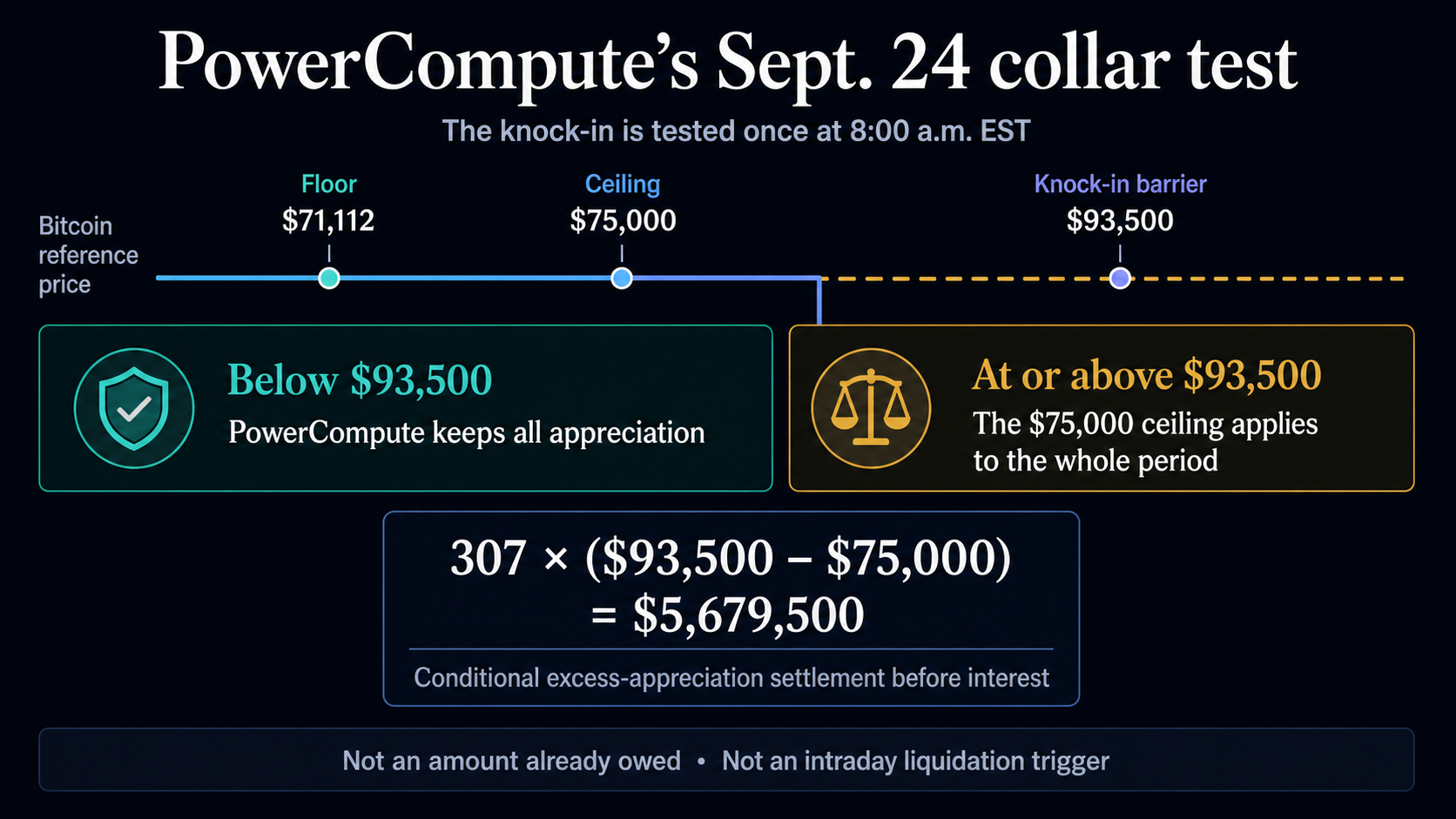
The new collar moves the next decision to Sept. 24. It sets a $71,112 floor, a $75,000 ceiling and a $93,500 knock-in barrier. Arch will test the reference price once, at 8:00 a.m. EST.
Below $93,500, the ceiling has no effect. PowerCompute keeps all Bitcoin appreciation, even if the reference price is above $75,000. At or above $93,500, however, the ceiling applies to the whole period.
Only if the Sept. 24 reference price reaches at least $93,500 does excess appreciation arise. At the barrier exactly, the formula is:
307 × ($93,500 − $75,000) = $5,679,500
That is conditional settlement arithmetic before interest, not an amount already owed. PowerCompute can settle it through retained BTC or USD/USDC. If it rolls the loan, it can instead add the amount to principal or incorporate it into the next ceiling and rate quote.
The barrier is not an intraday liquidation line. The annex bars ordinary margin calls and liquidations during the rolling period, limits ordinary recourse to the pledged Bitcoin subject to stated carve-outs and tests the collar only at reset. A voluntary mid-period exit would bring the test forward.
At 2:23 a.m. UTC on Aug. 29, CryptoSlate’s live Bitcoin page displayed $77,808.23, putting the barrier about 20.2% above that snapshot. The comparison is context, not a Sept. 24 price forecast.
CryptoSlate covered the initial collar after tracking PowerCompute’s earlier bridge-loan chain. The Aug. 28 filing converts the first structure’s modeled trade-off into a realized financing cost and starts a new 30-day test.
OCEAN Mining has completed a buyout of co-founder and 16-year veteran Bitcoin Core developer Luke Dashjr, ending his ownership and three leadership roles at the Bitcoin mining pool.
Dashjr resigned as chairman, chief technology officer and director, while OCEAN repurchased all of his equity, according to an Aug. 29 joint statement. Holding those board, technical and executive positions had placed him at the center of both OCEAN’s governance and its mining-policy decisions.
The private company did not disclose the repurchase price, its remaining ownership structure or successor appointments. OCEAN said it will continue operating its transparent, non-custodial pool, while Dashjr will pursue a new mining venture called CONVOY.
At the reporting cutoff, CONVOY had not published enough to verify an operating pool. Its public profile and the announcement disclosed no endpoint, codebase, participating miners, infrastructure, fees or block-template policy. They also disclosed no transfer of miners, staff other than Dashjr, or infrastructure from OCEAN.
A Mempool.space snapshot at 07:07 UTC on Aug. 30 attributed four of the previous 163 Bitcoin blocks to OCEAN, equal to 2.45%. Applying that share to the endpoint’s network hashrate estimate produced a block-share-derived estimate of about 24.57 exahashes per second.
The longer window was similar. Mempool.space attributed 29 of 1,007 trailing-week blocks to OCEAN, or 2.88%, while its latest weekly hashrate row put the pool at 25.33 EH/s and 2.86% of the network.
Across both windows, OCEAN remained within a broad 2.5% to 3% band that makes miner departures measurable without turning a single block into a trend.
Those figures describe hashpower directed to OCEAN, not mining machines owned by the company. A trailing 24-hour window can also move quickly as blocks enter and leave the sample, making it a snapshot rather than durable market share.
The joint statement said the separation reflected different visions following recent protocol developments, but it did not name BIP-110, Bitcoin Knots, a proof-of-work change or another proposal as the cause.
OCEAN added dedicated BIP-110 and no-signal endpoints in July, then returned its default endpoint to the non-BIP-110 chain on Aug. 9 while keeping both choices live. OCEAN said its DATUM system let participating miners control block construction. CryptoSlate’s earlier coverage detailed the surrounding fork and proof-of-work dispute, but the separation statement did not tie a specific development to the buyout.
A functioning CONVOY pool, published mining instructions or a sustained change in OCEAN’s share would provide the first measurable evidence that miners and template policy are moving. The corporate split alone does not.
Strategy’s co-founder and former CEO, Michael Saylor, took it to X earlier today to post another cryptic comment, which the community is trying to decipher.
Alongside a chart showing that the company’s over 110 BTC purchases made in the past six years, Saylor said, “We’re ₿ack.” Naturally, most comments below the post speculated that the firm has resumed its bitcoin accumulation spree after a two-month pause.
Recall that Strategy’s latest announced bitcoin purchase came on June 22, as it was completed in the week between June 15 and 21. It paused its BTC accumulation strategy for the following two months and even announced a couple of sales.
It focused primarily on rebuilding its USD reserve, which climbed above $6.5 billion last week after the latest initiatives. The second came in the form of establishing a new program, called USD Cash, which now consists of $1.59 billion, alongside its regular greenback reserve of $5.1 billion.
In addition, Strategy continued repurchasing its STRC shares. The high-yield variable-rate preferred stock slumped far away from its par price of $100 to $75 a few months ago, but it recovered significantly to over $97 last week.
While some users anticipate a new purchase to be announced on Monday, others warned that Saylor’s latest message refers to something else: his company’s position turning green.
Bitcoin’s price recovered significantly in the past week and a half, surging from under $65,000 to over $78,500 as of press time. Given Strategy’s average accumulation cost of $75,653 per BTC, this means that the firm is now in profit for the first time since May. Its position was deep in the red (on paper) of over $10 billion until several weeks ago.
On the topic of when Strategy will start buying bitcoin again, the current CEO, Phong Le, recently shed some light, indicating that this could occur by the end of the year, without providing more details.
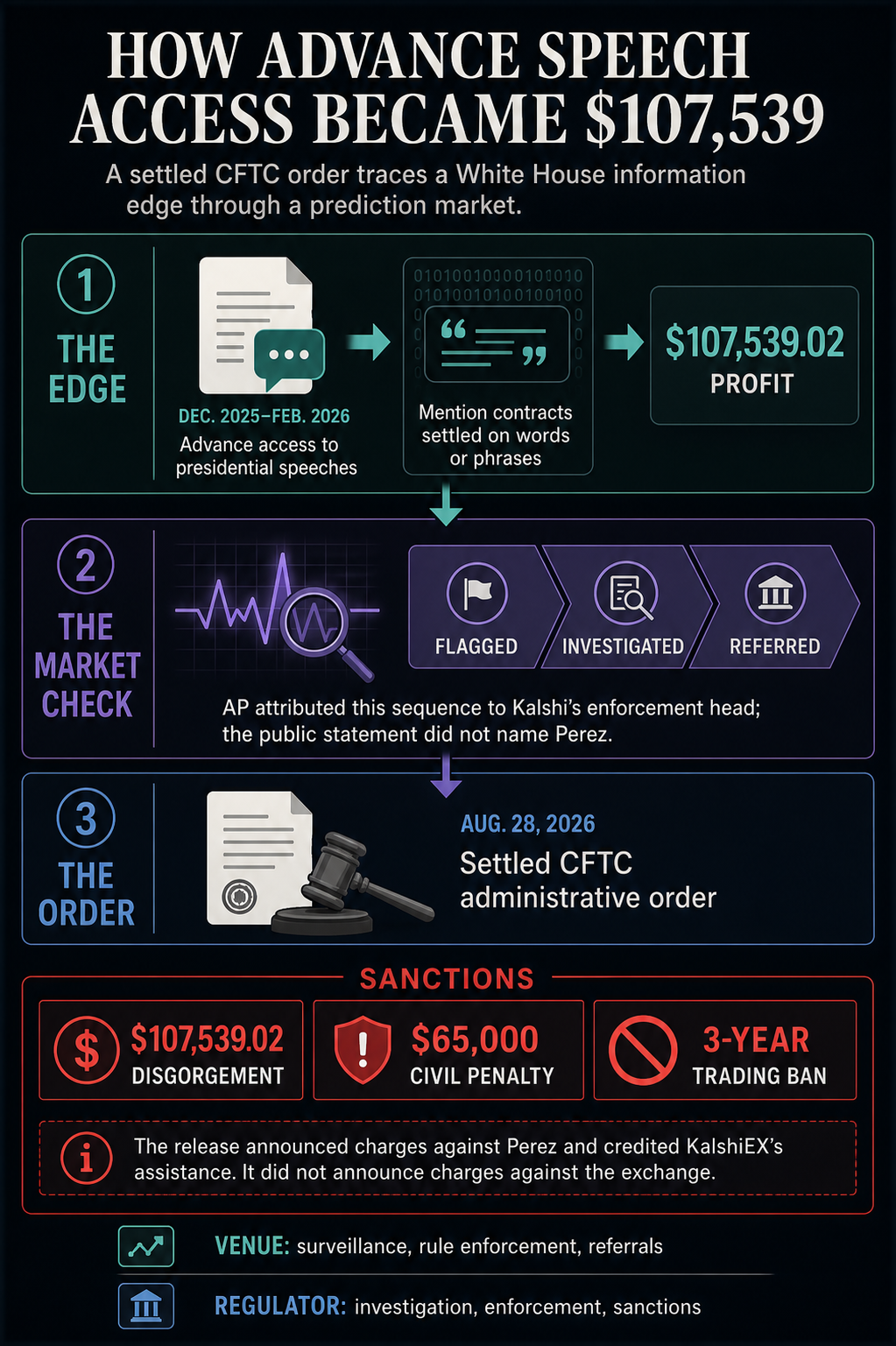
A White House speech insider who worked as a teleprompter operator must surrender $107,539.02 in prediction-market profits after the Commodity Futures Trading Commission found that he traded on advance access to presidential speeches.
The settled administrative order also requires Gabriel Perez to pay a $65,000 civil monetary penalty, cease and desist from further violations and accept a three-year trading ban. The CFTC said the penalty was substantially reduced because of Perez’s exemplary cooperation. The cited materials describe a civil regulatory settlement and do not report a criminal conviction.
How the White House speech insider gained a trading edge
The CFTC found that Perez traded presidential “mention market” contracts between December 2025 and February 2026 while working as a White House teleprompter operator. The event contracts, which the regulator describes as swaps, settled on whether the President would use particular words or phrases during speeches.
Perez saw the speeches before they were delivered, according to the order. The CFTC said he misappropriated that material nonpublic information in breach of a duty of trust and confidence, converting knowledge of the prepared text into more than $107,500 in profit.
Other traders were pricing the probability that a phrase would be spoken. Perez already had access to text that would help determine the outcome, giving him an information advantage built into the contract’s settlement question.
The CFTC release announces settled charges against Perez and separately says the agency appreciated KalshiEX’s assistance. It does not announce charges against the exchange or say the agency found a surveillance failure.
The Associated Press reported in July that Kalshi enforcement head Robert DeNault said the exchange’s surveillance team “promptly flagged, investigated and referred” the trades to the CFTC. AP noted that his public statement did not name Perez. The CFTC’s final release confirms assistance but does not disclose the detailed timing of Kalshi’s review or referral.
That record reflects two distinct policing roles. A February CFTC advisory says designated contract markets have an independent duty to maintain audit trails, conduct surveillance and enforce rules against prohibited practices. The CFTC retains authority to investigate and prosecute illegal trading and says it coordinates with exchanges on referrals.
Kalshi later added controls intended to move some policing ahead of the trade. In June, the exchange announced risk scoring for markets with heightened insider or manipulation risk, employment verification for some participants and expanded whistleblower tools. Those measures came after Perez’s December-to-February trading period, and the available sources do not establish whether they would have blocked his activity.
The settlement shows exchange referral and regulatory enforcement converging after the profits were made: Kalshi was credited with assistance, and the CFTC imposed disgorgement, a penalty and a market ban. It does not, by itself, show that the safeguards were timely or sufficient to prevent the trades.