Bitcoin’s price reacted immediately to the stronger-than-expected US jobs report on Friday, plunging from a multi-month high of over $82,000 to under $79,000 before it found some support.
Red dominates the larger-cap alts’ charts, with XRP dropping back to $1.40, ETH losing the $2,500 level, and XMR plunging by over 5%. BNB stands in the opposite corner with a 4.5% surge.
BTC Halted at $82K
The primary cryptocurrency faced a similar fate last Friday when it jumped to $81,500 only to be rejected and driven south to under $77,000 after the hawkish speech by Fed Chair Kevin Warsh at Jackson Hole. However, it rebounded during the weekend and even tapped $79,000 on Sunday.
The resumed military actions in the Middle East brought another leg down on Monday morning, with BTC slipping to $77,000 again. The bulls managed to defend that level again, and the cryptocurrency remained stuck between that lower boundary and the upper one at $79,000 for a few days.
The breakout began on Thursday when the asset surged past the latter level and kept climbing on Friday morning. The peak came at $82,400, which became BTC’s highest price tag in three and a half months. Although it was stopped there, it remained above $81,000 before the aforementioned jobs report went live and plunged immediately after it made the headlines to just under $79,000.
It has rebounded to $79,600 since then, with its market cap standing close to $1.6 trillion on CMC. Its dominance over the alts has retreated slightly to 59.45%.
BTCUSD September 5. Source: TradingView
PONS Keeps Rocking
The new rockstar of the altcoin space, PONS, is once again the top performer, surging by 30% in the past 24 hours to a new all-time high of almost $0.90. DASH follows suit, skyrocketing by 25% to over $65.
Binance Coin is up by 4.5%, being the biggest gainer among the larger caps, and now sits at $750. NEAR has gained 11% and is above $2.25. DOT, TAO, and LTC are also well in the green.
In contrast, ETH is down by 2.5% to $2,450, XRP has slipped by almost 3% to $1.40, and XMR is down by 5% to $525. RAIN, HYPE, and ADA are also in the red.
Cryptocurrency Market Overview September 5. Source: QuantifyCrypto
The Core Team behind the popular project rolled out three new capabilities designed to make its ecosystem more attractive to app developers. The project also overhauled its developer documentation as it continues its broader push toward real-world utility.
The team said this update comes after several months of releases focused on enhancing Pi beyond simple crypto transactions and creating more reasons for users to actually explore and utilize the ecosystem.
3 New Features
The three new developer capabilities are local storage, access to app-specific staking data, and file and video sharing. Perhaps the most interesting is the first one.
Selected whitelisted Pi Browser apps can now store certain information directly on a user’s device instead of requiring devs to maintain their own backend infrastructure. Preferences, session inflation, and other applicable data can consequently be stored on the device, which can reduce infrastructure costs and complexity while providing a consistent experience across Android and iOS, added the post.
It’s worth noting that the data is not uploaded to Pi Network’s servers, even though the feature currently has several limitations. Only whitelisted apps have access, as storage capability is limited, and old data can eventually be removed.
Staking Data API, the second release, allows eligible developers to see how much effective Pi a user has staked specifically for their application through Ecosystem Directory Staking. Devs could potentially use this info to build app-specific features around their most committed supporters.
The last one, called Pi.shareFile, allows apps to use a phone’s native sharing functionality for files, images, and videos. Some of the examples outlined in the blog post range from marketplace customers sharing receipts or photos to gaming and content apps allowing users to share clips directly.
More Devs Wanted
In addition to the three new features, Pi Network announced that it has consolidated previously fragmented dev resources into a single documentation platform, which now covers everything from app registration and sandbox development to authentication, Pi payments, Mainnet preparation, and launch.
It also introduces AI-assisted guidance for integrating authentication and payments. The idea is quite clear as it reduces the friction involved in building applications for Pi and fits into the project’s broader strategy.
The team said that these releases tackle a problem that could be very important for the project and the native token’s long-term prospects: giving developers more tools and fewer technical obstacles to continue building apps that people actually want to use.
All eyes on Friday were on the US jobs report, which actually showed that the US economy had added 162,000 jobs in August, almost triple expectations of roughly 55,000-58,000. The unemployment rate remained at 4.1%, while July’s initially reported loss of 23,000 jobs was revised to a gain of 21,000.
The reaction in financial markets was instant. Bitcoin dropped sharply below $79,000 after it was rejected at $82,400 earlier that day, and the US stock market joined the ride. In contrast, Treasury yields and the greenback jumped.
Good News Is Hurting Markets?
Although a strong labor market sounds positive at first glance for financial markets, there’s more to the story as it comes to monetary policy. Such a favorable labor environment gives the Federal Reserve more room to keep fighting inflation without worrying that higher borrowing costs will trigger a sharp deterioration in employment. Perhaps that’s why the rate hike odds immediately jumped to over 50% after the jobs report went live.
Consequently, strong economic data can become negative news for risk assets when inflation remains high. The analysts at the Kobeissi Letter determined that “the system is broken,” pointing to stocks falling despite the economy creating substantially more jobs than expected. Even US President Donald Trump was surprised by the initial market reaction.
The system is broken.
You know the system is broken when stocks FALL after the US unexpectedly adds +162,000 jobs in a month, TRIPLING expectations.
Why? Because a strong jobs report means a higher chance of rate hikes.
Expectations for higher interest rates typically push Treasury yields and the dollar north, while tightening financial conditions and reducing investors’ appetite for risk assets. That should explain BTC’s immediate reaction and price drop after the report went live.
Long-Term Bullish
Bitcoin analyst Adam Livingston outlined a different scenario beyond Friday’s reaction, arguing that persistent inflation, rising debt, and the monetary response ultimately required to sustain the financial system strengthen BTC’s long-term value proposition.
In that framework, higher rates can pressure the cryptocurrency in the short term, but they don’t solve the structural problems BTC was designed to hedge against.
The asset remains very sensitive to interest-rate expectations over shorter periods, but if inflation stays structurally elevated while governments continue running large deficits and debt burdens grow, the long-term argument for owning a scarce asset with a fixed supply could become much stronger.
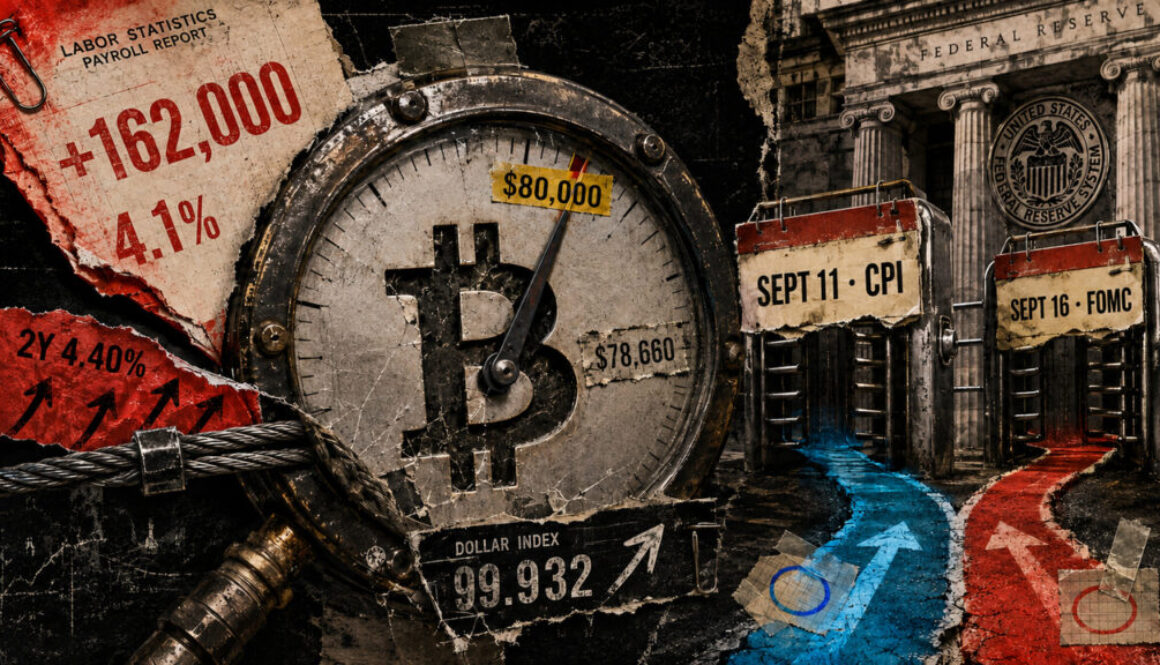
Bitcoin’s push above $80,000 lost an important policy cushion on Sept. 4, when the August jobs report came in far stronger than the recent hiring trend. The result made it harder for the Fed to justify holding rates steady on labor-market weakness alone.
Bitcoin registered an intraday low of $78,660, but recovered to stay close to $80,000.
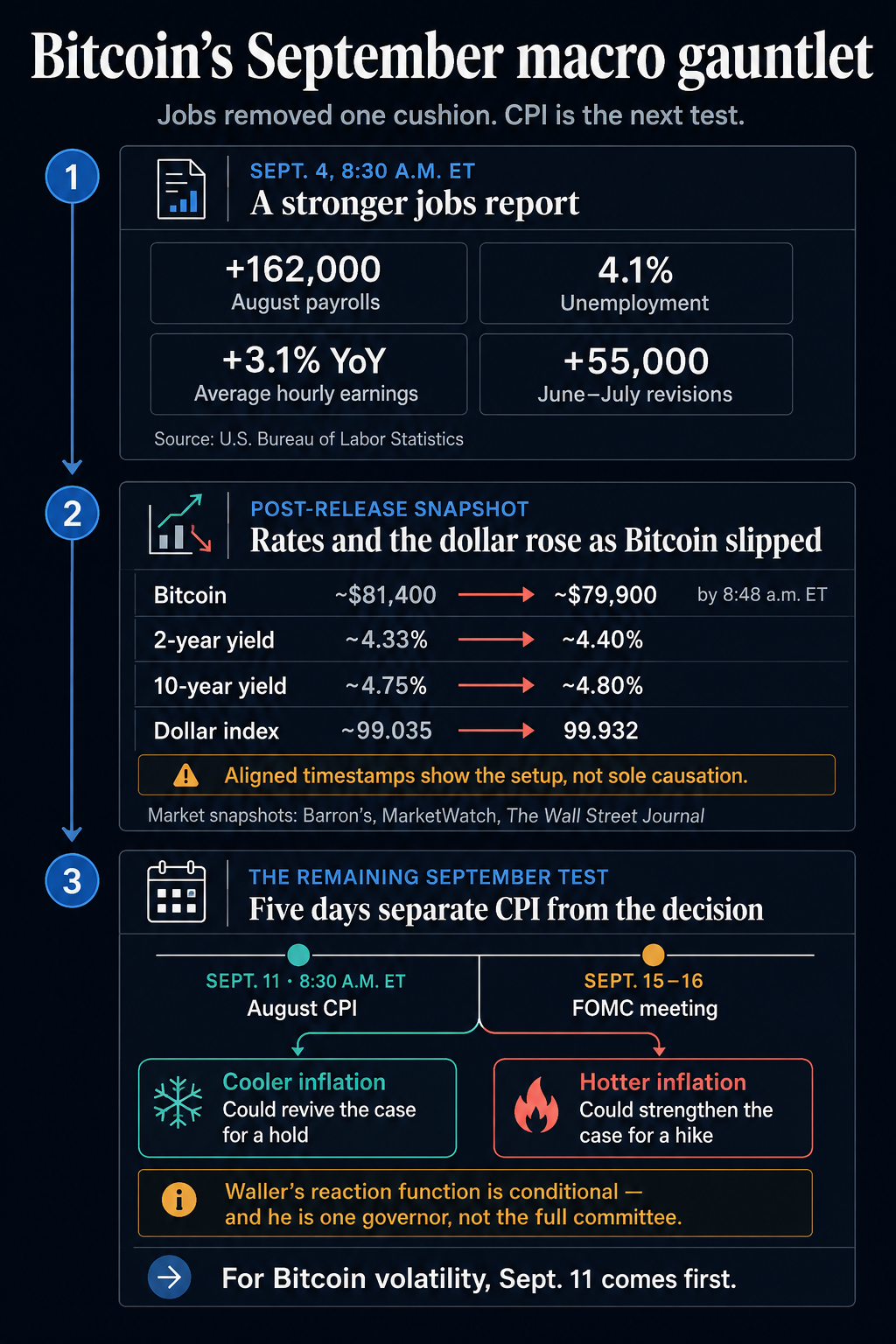
Within the same post-release window, MarketWatch reported the two-year Treasury yield near 4.40%, up from just above 4.33%, and the 10-year near 4.80%, up from just under 4.75%. The Wall Street Journal reported that the dollar index touched 99.932 from about 99.035 before the data.
Those aligned timestamps show that a more resilient labor market gave policymakers more room to focus on inflation, while higher short-term yields and a firmer dollar tightened the financial backdrop for a dollar-priced risk asset.
Payrolls narrowed the Fed question
The Bureau of Labor Statistics said nonfarm payrolls rose by 162,000 in August, more than five times the average monthly gain of 31,000 over the previous 12 months. The separately measured unemployment rate was unchanged at 4.1%.
BLS raised June payroll growth to 31,000 and July growth to 21,000, adding a combined 55,000 jobs to its earlier estimates.
Average hourly earnings for private nonfarm workers rose 0.3% in August to $37.75 and were 3.1% higher than a year earlier.
Food services and drinking places accounted for 59,000 jobs, and local government education added 42,000. Information employment fell by 23,000, while health care added 13,000, well below that sector’s 32,000 average monthly gain over the prior year.
The report weakened the labor-market argument for an immediate pause without establishing that every corner of the economy was overheating. Inflation now has more weight in determining whether the Fed can stay patient.
Fed Governor Christopher Waller had laid out one visible version of that tradeoff the day before the release. His view does not bind the full Federal Open Market Committee, but his published remarks offered a clear reaction function.
Waller described the labor market as satisfactory and stable, with employment near its maximum sustainable level, and said that August inflation would heavily influence his September stance.
Continued progress toward the Fed’s 2% goal would make him willing to hold the policy rate steady, while a hot reading, or evidence that progress had reversed, could make him consider a hike.
The payroll report removed the kind of obvious labor deterioration that could have outweighed an uncomfortable inflation print. September’s decision now turns more cleanly on whether price pressures continue to ease.
Infographic outlines Bitcoin’s September macro tests, including a stronger jobs report, post-release price decline, upcoming inflation data and a Federal Reserve meeting.
CPI becomes Bitcoin’s next September deadline
The BLS calendar schedules the August consumer price index for 8:30 a.m. ET on Sept. 11. The Federal Reserve calendar lists the FOMC meeting for Sept. 15-16, with decision-day events on Sept. 16.
The five-day gap makes CPI the last major scheduled inflation test before the meeting. For Bitcoin traders, Sept. 11 is when the September rate debate can absorb new evidence, rather than when policymakers formally settle it.
A cooler report would fit Waller’s condition for supporting a hold and could relieve pressure transmitted through short-term yields and the dollar. A hotter print would strengthen the case that inflation progress has stalled just as the labor market has shown renewed resilience.
Waller spoke only for himself, and one inflation report will not erase the other evidence policymakers weigh. CPI can nevertheless change the balance because payrolls have already answered the labor side of the debate more firmly than the recent trend suggested.
Bitcoin had rallied above $80,000 before the two closely spaced macro tests. After payrolls, the asset fell back below it while yields and the dollar rose.
A softer CPI reading could reopen the hold narrative and give the rally breathing room. A hotter one could leave Bitcoin approaching the Sept. 16 decision with both labor resilience and inflation pressure pointing toward tighter policy.
The Fed meeting remains the policy deadline, but Sept. 11 comes first for Bitcoin volatility.
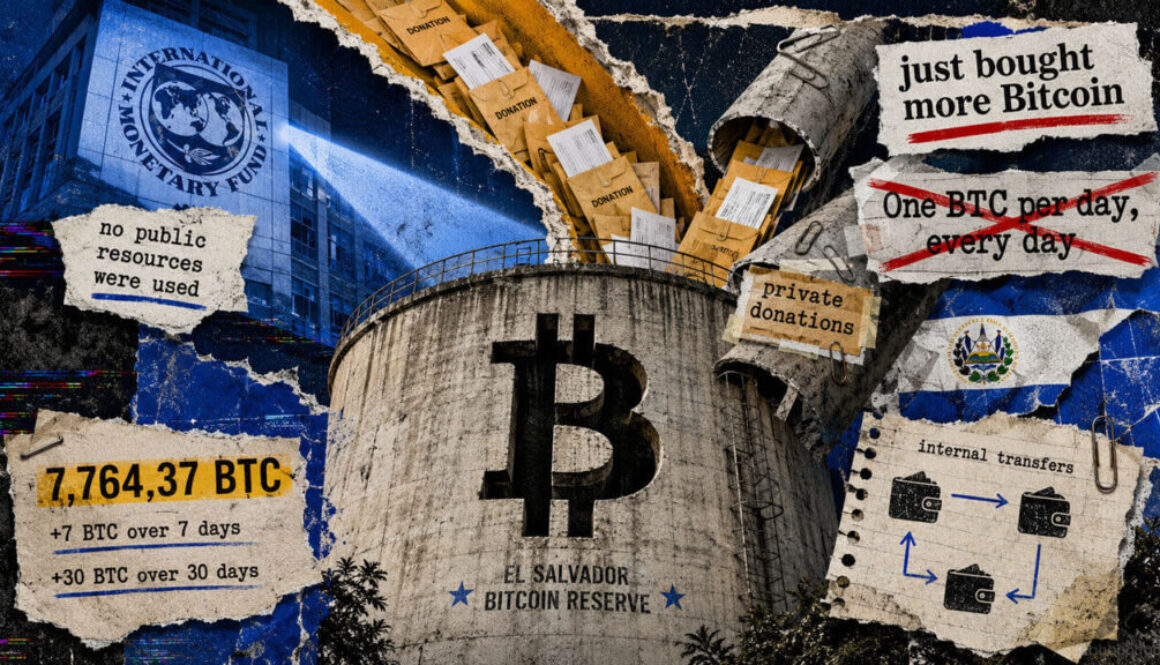
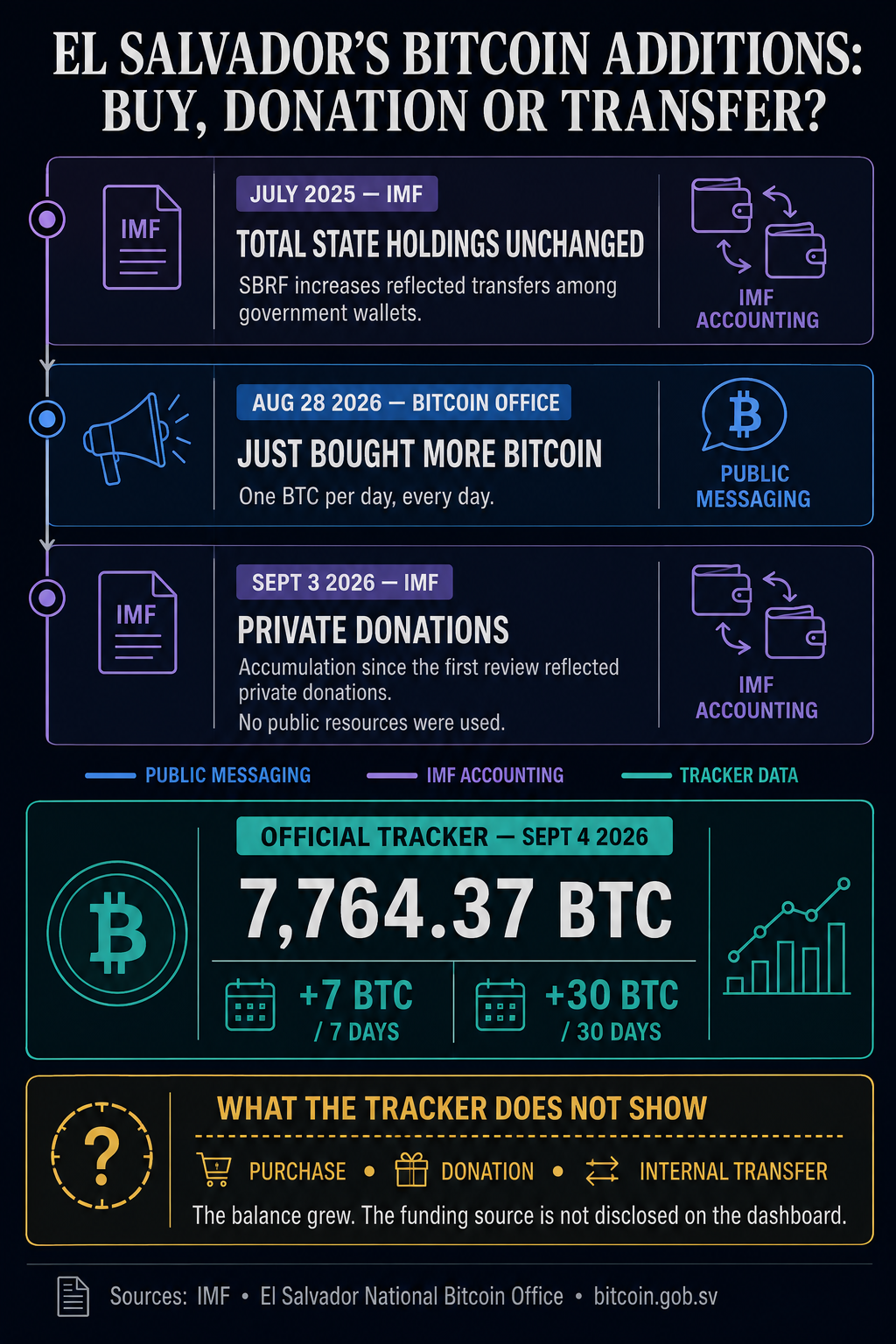
The International Monetary Fund (IMF) says El Salvador’s Bitcoin reserve growth over the past year came from private donations, not new government spending.
In its latest review of the country’s loan program, the global financial agency said documents supplied by El Salvador showed that Bitcoin accumulated since the previous review reflected private donations. It added that no public resources were used and said it expects no further accumulation beyond those documented contributions.
The Fund also reiterated that earlier changes in El Salvador’s BTC position had not necessarily represented new buying.
In previous reviews, it said increases in the Strategic Bitcoin Reserve reflected transfers among government-controlled wallets, while small fluctuations elsewhere were linked to Bitcoin-denominated deposits held through Chivo.
The IMF also noted that the Salvadoran government had “substantially unwound” its stakes in the Chivo e-wallet. It explained:
“Majority ownership and operational control have been transferred to a private operator, while a minority stake and custodial responsibilities for customer assets have been retained by the government.”
El Salvador’s Bitcoin push continues despite the IMF accounting
The IMF’s assessment sits uneasily beside both the size of El Salvador’s growing reserve and the government’s continued pro-Bitcoin messaging.
The country held about 6,224 BTC at the end of June 2025. Its official reserve tracker now shows more than 7,764 BTC, an increase of roughly 1,540 BTC.
If the IMF’s latest assessment is applied to that subsequent accumulation, much of the increase came from private donations rather than taxpayers funding new Bitcoin purchases.
As recently as Aug. 28, the National Bitcoin Office said the country had “just bought more Bitcoin” and repeated its longstanding message: “One BTC per day, every day.”
The government has also continued pushing BTC beyond the treasury. President Nayib Bukele has maintained his pro-Bitcoin stance, while El Salvador has kept expanding Bitcoin education initiatives and presenting the asset as part of its long-term economic strategy.
Last year, the country also overhauled its Bitcoin treasury structure, moving away from a single reused wallet and spreading its holdings across multiple addresses. Officials said the change followed digital-asset security best practices and reduced potential long-term exposure to quantum-computing threats.
The new structure keeps the addresses public, allowing observers to verify the reserve balance. However, it does not distinguish BTC bought with public money from private donations or transfers between government-controlled wallets.
That distinction now sits at the center of the disagreement. El Salvador’s reserve has grown by more than 1,500 BTC while the government continues to publicly promote daily purchases, but the IMF says the recent accumulation it verified did not require additional public spending.
The country clearly owns substantially more Bitcoin than it did a year ago. What remains unresolved is whether “one BTC per day” still describes government-funded purchases or simply the pace at which Bitcoin is entering the reserve.
Coinbase said this week it filed notice registrations with the US Securities and Exchange Commission (SEC) to offer single-stock perpetual futures domestically, according to a post from the company’s official account.
The move adds another regulated derivatives product to Coinbase’s US lineup and comes as regulators continue sorting out how perpetual contracts should be classified under American law.
Coinbase Files for US Single-Stock Perps
“We’re working to bring single stock perps to the US,” Coinbase wrote, adding that it plans to work with both the SEC and the CFTC to bring more major financial products onshore.
The company shared images of two filings, both submitted on September 1. The first is a Form 1-N from Coinbase Derivatives, LLC, the entity through which the exchange already offers other futures products. The second is a Form BD-N from Coinbase Financial Markets, Inc., registering as a security futures product broker-dealer under Section 15(b)(11) of the Securities Exchange Act of 1934.
Neither filing guarantees the product launches on any set timeline. Notice registrations open the door for a broker or exchange to offer a given product, while approval and any conditions attached to it still rest with regulators.
The filing also comes alongside a broader push into tokenized products, with Coinbase launching tokenized stock trading for customers outside the US in August, alongside options trading and real-world-asset perpetual futures tied to equity indices.
It also rolled out pre-IPO perpetual futures starting with SpaceX, with Anthropic and OpenAI contracts expected to follow, a corner of the market that grew more than tenfold in volume since May, to around $12 billion, according to CryptoQuant.
A Product Category Still Being Fought Over
Perpetual futures carry no expiration date, letting traders bet on an asset’s price without owning it, and the US market for them is new.
In May, the CFTC approved Kalshi to offer Bitcoin perpetual futures, the first time the product cleared for the US market, and a decision CME Group said it would challenge in court on the grounds that perpetuals should be regulated as swaps rather than futures.
At the time, CME CEO Terrence Duffy noted that the company spent eight months preparing the case and argued that its exclusive licensing deals with benchmark providers mean any perpetual contract tied to those benchmarks still has to run through CME.
CFTC Chair Michael Selig has defended the original approval as a way to bring regulated, expiration-free products onshore under US oversight.
Bitwise has given the market a rare look inside an institutional XRP carry trade.
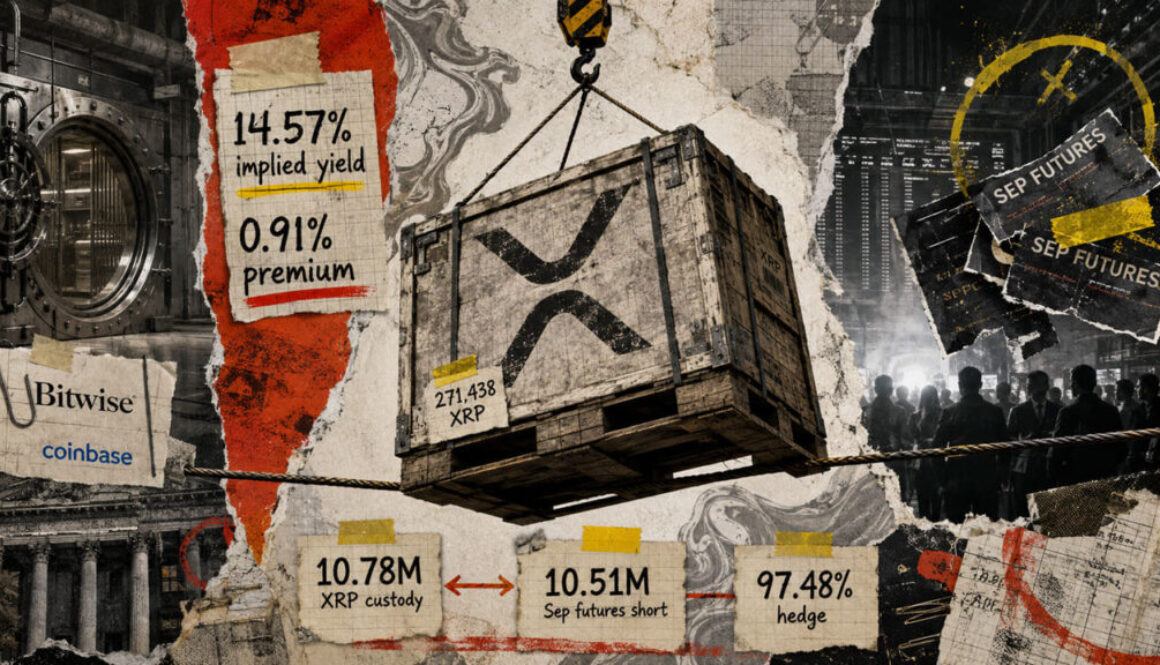
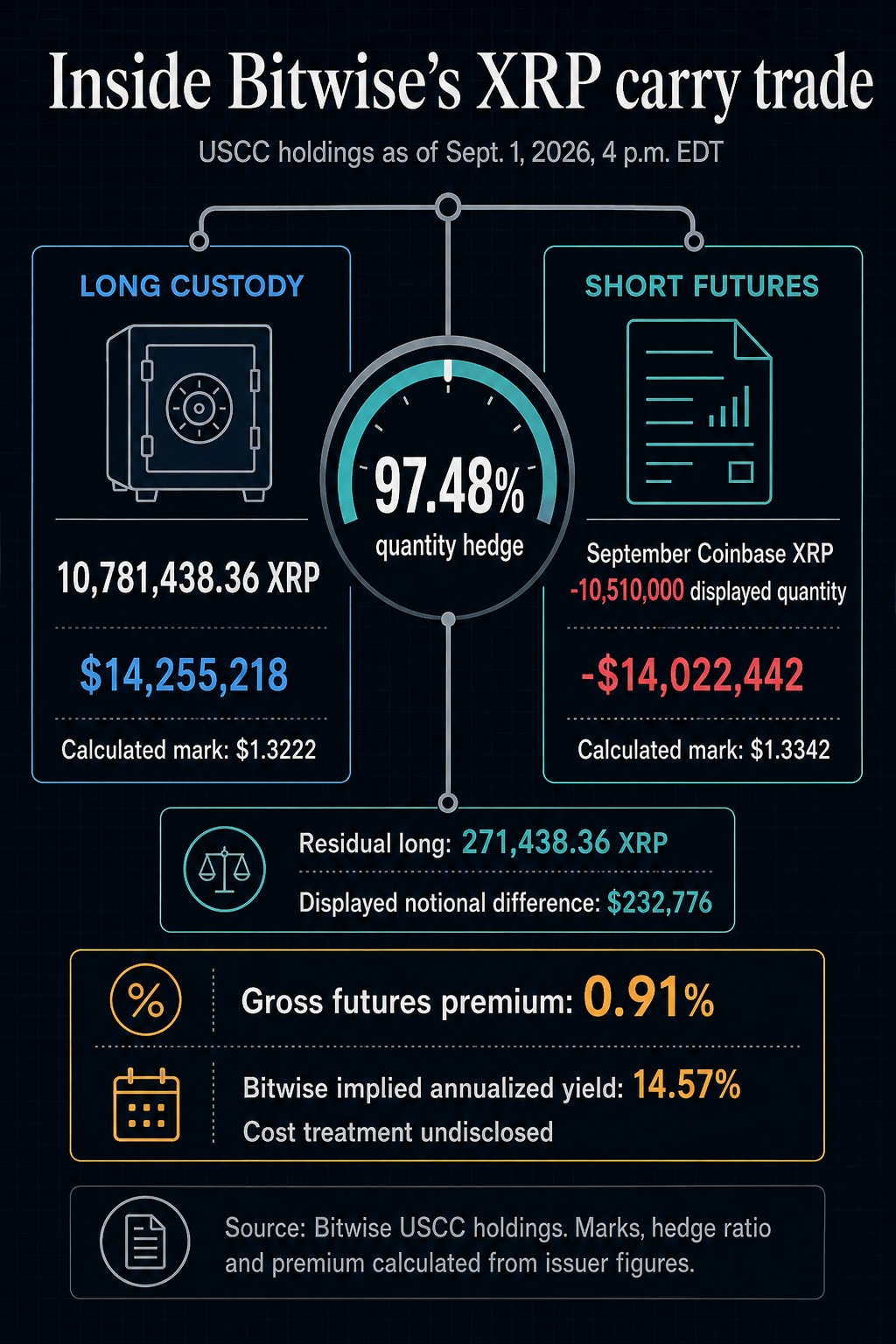
The Bitwise Crypto Carry Fund, or USCC, paired XRP held in custody with an almost equal short position in September Coinbase XRP futures. The structure was 97.48% matched by quantity, leaving limited exposure to a parallel move in XRP while positioning the fund to collect the premium between futures and spot.
At 4 p.m. EDT on Sept. 1, Bitwise’s holdings table showed 10,781,438.36 XRP in custody and a displayed futures quantity of negative 10,510,000. The futures row carried a 14.57% implied-yield label.
The disclosure supports a specific conclusion about one private fund: XRP was serving as inventory for a near-market-neutral basis trade. Broader institutional XRP demand, including demand for Bitwise’s separate spot product, remains outside the scope of this position.
How a 0.91% premium becomes a 14.57% annualized rate
The hedge coverage comes first. Dividing the futures quantity by the custody quantity produces a 97.48% offset and a residual long position of 271,438.36 XRP. The displayed notionals differ by $232,776.
USCC XRP leg
Displayed quantity
Notional value
Calculated unit mark
Custody
10,781,438.36
$14,255,218
$1.3222
September Coinbase futures short
-10,510,000
-$14,022,442
$1.3342
Calculated difference
271,438.36
$232,776
Not applicable
The spread is the second number. Dividing each notional by its displayed quantity produces a spot-equivalent mark of about $1.3222 and a futures-equivalent mark of $1.3342. The futures level was therefore roughly 1.2 cents, or 0.91%, above spot.
Cash-and-carry strategies seek to monetize that gap. A fund buys the asset and sells a future trading above it; convergence at settlement can lock in the premium while much of the asset’s directional move cancels between the two legs. Bitwise describes USCC as a qualified-purchaser fund built to capture futures premiums over spot across crypto markets.
Annualization produces the third, and largest, number. Bitwise defines holding-level implied yield as an annualized figure if the position is held to maturity or otherwise not sold. Its 14.57% label therefore expresses a short-term premium as a yearly rate. The two displayed XRP marks differ by 0.91%.
Realized investor returns use a separate measure. Bitwise reports the fund’s 30-day yield separately and lists a 0.75% management fee. The public methodology leaves the XRP line’s treatment of execution, financing, custody, margin and roll costs unspecified, so 14.57% is best read as Bitwise’s annualized implied rate for the displayed futures holding.
Residual risks remain even with a 97.48% quantity match. Spot and futures prices can move differently before settlement, the fund must maintain custody and margin, and the cash-settlement benchmark may differ from the price available for its custody inventory. The remaining 271,438.36 XRP also retains direct price exposure.
The public table supports the quantity comparison while leaving the contract count unresolved. A Coinbase Derivatives filing specifies 10,000 XRP for its standard monthly XRL future. Coinbase lists multiple XRP futures products, however, and Bitwise identifies the venue and month without publishing a product code. Any conversion of the displayed quantity into a number of contracts would therefore be conditional.
The economic source of a positive basis is the price that futures buyers accept above contemporaneous spot. Exchange clearing turns that premium into a market-level relationship, while public reports end at broad customer categories.
The CFTC’s Traders in Financial Futures report provides category-level context. As of Aug. 25, standard Coinbase XRP futures had 20,518 contracts of open interest. Dealer and intermediary accounts held 17,853 long contracts, and asset manager and institutional accounts held another 1,800 longs.
Leveraged funds sat on the other side of the popular narrative. They held 13,822 outright shorts and no outright longs in that category. Other reportable traders held 4,824 shorts, while nonreportable traders held 1,011.
That snapshot places leveraged funds predominantly on the short side, alongside the direction of USCC’s disclosed hedge. The category totals leave Bitwise’s identity, matched counterparties and September-specific positioning undisclosed. The CFTC figures cover listed maturities and predate the USCC holdings table by seven days.
The sharper institutional contrast appears within Bitwise’s own product range. The Bitwise XRP ETF reported 361,995,068.31 XRP in trust worth about $531.3 million as of Sept. 2. Its SEC filing defines the trust’s objective as exposure to the value of the XRP it holds, less expenses, and says XRP is its sole asset.
USCC displayed a paired spot-and-futures position. The XRP ETF displayed XRP held for spot exposure through a trust. The observable product designs show two different uses of the same asset under the Bitwise name. The ETF materials leave investor hedging unaddressed.
Bitwise’s 14.57% figure ultimately shows how attractive one XRP forward premium looked to one portfolio on one date. The holdings disclosure documents a substantial carry trade and quantifies how little directional XRP exposure remained after the hedge. The identities of the futures buyers remain private, and the institutional-wide mix between directional and basis demand remains unresolved beyond this named fund.
Hargreaves Lansdown now sells Bitcoin (BTC) to about 2 million clients. However, it arrives five months too late, given that the tax break its savers wanted was closed in April.
Buy Bitcoin through a rival last winter, and the profit is tax-free for life. Buy the same thing at HL today and the taxman takes a cut.
Hargreaves Lansdown’s Bitcoin is for £100,000 Earners
According to a report in the Financial Times, nine products went live, delivering notes that track the Bitcoin price, and run by firms like BlackRock, Invesco, and CoinShares. Fees range from 0% to 0.35% per year.
The UK’s largest investment platform, Hargreaves Lansdown (HL), will open crypto ETN trading to its approximately 2 million investors from September 3, initially offering 9 BTC and ETH ETNs issued by BlackRock’s iShares, WisdomTree, 21Shares, Invesco, CoinShares and Bitwise, with…
HL was the last big British platform to say yes, waiting 330 days after the rules changed. However, on closer inspection, you notice that it only changed its shelf, not its mind, since they still label these products as high risk.
Most clients cannot buy them anyway, as HL requires £100,000 in yearly income or £250,000 in savings. Buyers also sit a short test and wait a day.
There is a catch in the product too. You never own any Bitcoin. Instead, you own a promise from the firm behind the note.
That makes 2 million the client list, not the buyer list, and anyone who qualifies must use a taxed account, or a pension they cannot touch until 55.
“After an appropriateness test and a 24-hour wait, a SIPP or Fund and Share account on HL can take listed Bitcoin exposure, even though you still do not hold the coins and a standard Stocks and Shares ISA remains closed to new buys,” one user noted.
That taxed account is the whole problem because savers once had a better option, and now it has gone. Britain barred ordinary savers from these products for years. The Financial Conduct Authority lifted that ban on 8 October 2025.
For a while, savers could hold Bitcoin inside an ISA. That is the tax-free account millions of Britons already use. Money made inside one is never taxed.
The tax office shut that door on 6 April 2026. The window had been open for 180 days. HL now turns up 150 days after it closed.
15 million UK retail investors are losing access to crypto ETNs in their ISAs from Monday.
In October, the UK opened the door to crypto ETNs through Stocks & Shares ISAs. Now, the tax system is closing it.
Savers who moved in time keep the tax break for good. The tax office left their holdings in place. HL’s clients get nothing.
Here is what that is worth. Put £20,000 in an ISA, double it, and you owe zero. Double it in a normal account, and the tax bill is about £4,080.
BeInCrypto called the reopening a symbolic step when Bitcoin ETNs returned to Britain. That reading holds up. The firm that said Bitcoin was no asset class now sells it. Just to the rich and in the wrong account.
Ministers say ordinary ISAs may get these notes back later.
The Guiding and Establishing National Innovation for U.S. Stablecoins Act, or GENIUS Act, is the new federal framework for payment stablecoin issuers. Its reserve rules aim to make each token a safer dollar claim, while the public blockchains moving those tokens retain their own fee markets and capacity limits.
A Federal Reserve staff paper, first dated June 2, 2026, and updated Aug. 31, 2026, models how transaction congestion can destabilize even a perfectly backed digital dollar. The authors are Federal Reserve economists, and the paper carries the standard disclaimer that their views do not necessarily represent the Federal Reserve Board or Federal Reserve System.
When fees climb far enough, small payments become uneconomic and a token’s usefulness can fall. The model predicts that weak payment-network effects can then turn individual exits into coordinated redemptions. In the paper’s empirical work, however, “redemption” means a drop in Ethereum circulation and can include either a cash-out to fiat or migration to another blockchain.
The paper presents a latent mechanism, not a forecast of a current run. It sharpens an unresolved question as Treasury implements GENIUS: the law gives regulators broad tools for policing issuers, reserves and redemption promises, while its explicit reserve provisions and Treasury’s current section 3 proposal set no price or capacity standard for a public blockchain.
How congestion can trigger a run without bad reserves
Traditional stablecoin analysis starts with the issuer’s assets. If a token promises one dollar but its reserves lose value or cannot be sold quickly, holders have a reason to redeem before others do.
The Fed economists deliberately remove that problem from their model. The stablecoin is fully and safely backed. The source of fragility is instead the interaction between transaction fees and payment-network effects: people value a payment asset partly because other people accept and use it.
Under low congestion, that network can absorb a shock. Under high congestion and weak network effects, the paper finds a threshold beyond which redemptions can become coordinated and abrupt. Higher fees reduce use; reduced use makes the token less attractive; the weaker network then gives more holders a reason to leave.
“Redemption” needs care here. In the paper’s main empirical panel, it is measured as a negative change in a stablecoin’s Ethereum circulation. That can represent redemption for fiat, but it can also represent migration to another blockchain. The data therefore capture pressure on Ethereum-based circulation, not a clean count of customers cashing out at an issuer.
The study uses an unbalanced weekly panel of five stablecoins from November 2017 through December 2025 where data are available. Its starkest distributional result comes from 2021 through 2025: for below-median USDC transfers, the fee-to-value ratio at the 75th percentile frequently exceeded 100%. For above-median transfers, it was almost never more than 5%.
The statistic describes the distribution of attempted and completed transfer economics rather than a claim that users routinely paid more in fees than they sent. During expensive periods, a representative network fee could exceed the value of many small transfers. A holder can avoid completing such a transfer, wait, batch activity or move through a custodian. The pattern shows how congestion can ration access by transfer size even while the token remains redeemable.
What the evidence establishes
The paper combines a theoretical model with several empirical tests. Those pieces answer different questions and should not be collapsed into one causal claim.
Evidence
Result
What it supports
Limit
Weekly stablecoin panel
A one-standard-deviation, $10.83 increase in gas was associated with a roughly 0.9 percentage-point rise in weekly redemptions when network effects were low
Fee sensitivity is strongest when a token’s payment network is weak
Gas alone was insignificant, and the result applies to the low-network-effects state
Ethereum empty-slot design
The raw empty-slot rate averaged 0.7%; a one-standard-deviation increase of 0.004 corresponded to about $0.77 more gas
A plausibly exogenous congestion shock raises fees
The design identifies the capacity-to-fee link, not the later redemption response
1,230 matched ETH-Tron USDT transfers
From May 2020 through December 2025, the average matched transfer was about $176 million; $1 more in lagged, demeaned gas was associated with 3% to 4% more net matched value moving from Ethereum to Tron
Higher Ethereum fees coincide with cross-chain reallocation
The association cannot identify every owner or establish the motive behind every transfer
Gas by itself was statistically insignificant in the weekly panel. The reported 0.9-point effect appeared only when high fees interacted with weak network effects, a state covering roughly 7% to 7.5% of observations. The pattern is consistent with the model’s threshold logic, while remaining a historical association rather than a universal causal estimate.
The empty-slot exercise offers a stronger causal design for the first link in the chain. Empty Ethereum blocks are plausibly unrelated to stablecoin demand but reduce capacity and push up gas. The design helps establish that a capacity shock can raise fees. It does not directly establish that the same shock caused every later redemption.
The matched-transfer analysis is an association as well. It links transfers of identical USDT amounts on Ethereum and Tron within a 60-minute window, consistent with a chain switch. The method cannot observe the beneficial owner behind every pair, establish the motive for each move or exclude every alternative explanation.
Together, the findings support a conditional warning, not a forecast: congestion can create an exit incentive, and some historical activity moved toward a cheaper rail when Ethereum became more expensive.
GENIUS protects the token, not every rail
The GENIUS Act requires permitted payment stablecoin issuers to maintain reserves at least one-to-one in specified liquid assets. It also requires public redemption procedures, disclosure of issuer purchase and redemption fees, monthly reporting, examination and certification, and regulatory standards covering capital, liquidity, diversification, operations and information technology.
Those rules address important failure modes: weak assets, opaque redemption promises, undercapitalized issuers and poor operational controls. They also give regulators a clearer path to supervise the entity that creates the dollar token.
Treasury’s Aug. 17 implementation proposal, published in the Federal Register on Aug. 18, focuses on section 3’s restrictions on offering or selling payment stablecoins in the United States. Comments are due Oct. 19. Treasury says the expected effective date for the issuer licensing framework is Jan. 18, 2027, with the broader digital asset service provider restriction expected July 18, 2028.
The proposed rule distinguishes direct transfers between two people acting on their own behalf, including self-custody transactions, from compensated services such as exchanges, transfer businesses and custodians that can qualify as digital asset service providers.
That division affects who carries compliance duties. The economics of a congested base layer persist across the categories. A reserve can remain liquid while a user still confronts a transaction fee larger than the intended payment.
The distinction is narrow. Issuer purchase and redemption fee disclosure covers different charges from blockchain gas and exchange withdrawal fees. The text now on the table leaves base-layer pricing and capacity outside its explicit stablecoin rules, while GENIUS also gives supervisors broad authority over an issuer’s operational and technological risks. Regulators could therefore scrutinize how an issuer manages rail exposure even though they do not control public blockspace. Treasury’s process remains open, and implementation choices can still change before the rules take effect.
That leaves two safety tests operating at once. Supervisors can examine whether an issuer can honor the dollar claim and manage its operations. Users also experience whether the chosen network can carry that claim at a price proportionate to the payment.
Calm fees show who would feel congestion first
Stablecoins are already spread across rails with different fee markets. A snapshot taken shortly before drafting from DefiLlama’s chain dashboard and API put stablecoin supply at roughly $147.3 billion on Ethereum, $93.2 billion on Tron and $15.7 billion on Solana. The dashboard’s displayed totals were slightly higher, at about $148.0 billion, $93.6 billion and $15.8 billion respectively, reflecting timing and methodology differences.
Ethereum was not congested in the snapshot. Etherscan showed roughly 0.127 to 0.128 gwei gas, while ETH traded near $2,404. Using an illustrative 65,000 gas units for an ERC-20 transfer, that implies a network cost around two cents. Actual gas use and wallet estimates vary.
Costs on the other two chains are structured differently. Tron charges 100 sun per Energy unit; a third-party estimator placed an unstaked USDT transfer around 65,000 Energy to an existing account and 131,000 to a new account, or roughly 6.5 and 13.1 TRX before staking or rented Energy. Solana’s base fee is 5,000 lamports per signature, while a recent analytics snapshot showed a median total fee near 5,800 lamports and a 99th-percentile fee of about 651,400 lamports.
A direct dollar-price comparison would be misleading because each network uses a different fee system and observation method, and all of the figures can change quickly. The useful comparison is structural: a “stablecoin fee” varies by rail and transaction conditions. Network charges also differ from exchange withdrawal or platform fees, which an intermediary sets separately.
The first direct effect of congestion falls on the transaction with the least value to absorb a fixed network charge. A small self-custody user may delay a payment, combine transfers, move to an exchange or stop using the chain. That response can be economically forced even if the token remains redeemable at par.
The visible balance movement is more likely to come next from larger intermediaries. Exchanges, market makers, bridges, issuers and corporate treasury desks can move enough liquidity to alter chain-level circulation or restore inventory where users want to transact. That ordering is an inference from how the market operates, not an owner-level finding in the Fed paper.
Destination chains can inherit both activity and pressure. A surge may deepen their stablecoin liquidity while testing the routes and intermediaries that rebalance inventory. Those second-order effects are analytical inferences rather than findings identified in the paper’s owner-level data. The policy question is broader than whether an issuer holds enough Treasury bills: users also need a tolerably priced route to the redeemable dollar claim when a rail is under stress.
The Sept. 3 snapshot establishes only that Ethereum fees were calm at the observation time; it does not measure systemwide redemption pressure. The paper turns the rail-safety gap into a monitorable risk rather than evidence of an imminent event. Regulators and market operators can watch fee-to-transfer-value ratios by transaction size, abrupt changes in chain-level stablecoin circulation, matched cross-chain flows and exchange wallet imbalances.
GENIUS can make a stablecoin safer without making every route to that stablecoin resilient. If implementation treats reserve quality as the full definition of safety, the next stress episode may reveal that the dollar token was sound while access to it was not.
Bitcoin (BTC) and Ethereum (ETH) climbed to multi-month highs again this week, but prediction market traders still assign low odds to either asset approaching record territory in 2026.
Polymarket traders give Bitcoin a 32% chance of touching $100,000 this year. Ethereum traders price a move to $3,500 at just 31%.
Rate Pause Signals and ETF Inflows Lift Crypto
Bitcoin rose 4.62% over 24 hours to $80,861, while Ethereum gained 4.85% to $2,501, according to BeInCrypto Markets data.
The rally follows reports suggesting the war in Iran could be over. In addition, Federal Reserve Governor Christopher Waller said he could support holding rates steady.
Weak labor data reinforced the move. ADP reported that US private employers added 38,000 jobs in August. That fell short of expectations, near 47,000, and marked the weakest increase since January.
Institutional demand also returned. Spot Bitcoin exchange-traded funds (ETFs) drew about $101.1 million in net inflows, led by the iShares Bitcoin Trust.
Polymarket traders moved aggressively on the near end of the curve. The $85,000 Bitcoin contract jumped 43 points to 81%, while odds of a drop to $70,000 fell 28 points to 48%.
Higher targets stayed put. The $95,000, $100,000, $110,000, and $120,000 contracts showed no 24-hour change, holding at 44%, 32%, 20%, and 12%. The $90,000 line slipped 2 points to 61%.
Polymarket Odds for Bitcoin Price Levels in 2026, Source: Polymarket
Ethereum shows the same pattern. The $2,750 contract climbed 25 points to 75%, and the $3,000 contract added 4 points to 54%. However, $3,500 and $4,000 held flat at 31% and 17%.
Downside bets have not disappeared. Traders still give 72% odds that Bitcoin will revisit $75,000 and 56% odds that Ethereum will slip to $2,250.
Friday’s US jobs report will test whether the rate-pause trade holds. For now, positioning treats the move as a range shift rather than a path back toward the records of $126,080 and $4,946.