Monad, an EVM-compatible blockchain, activated its MonadTen revision on mainnet at 14:30 UTC on Sept. 2. The MIP-8 upgrade changes how the network charges contracts for reading storage, replacing slot-by-slot warming with groups of 128 consecutive slots.
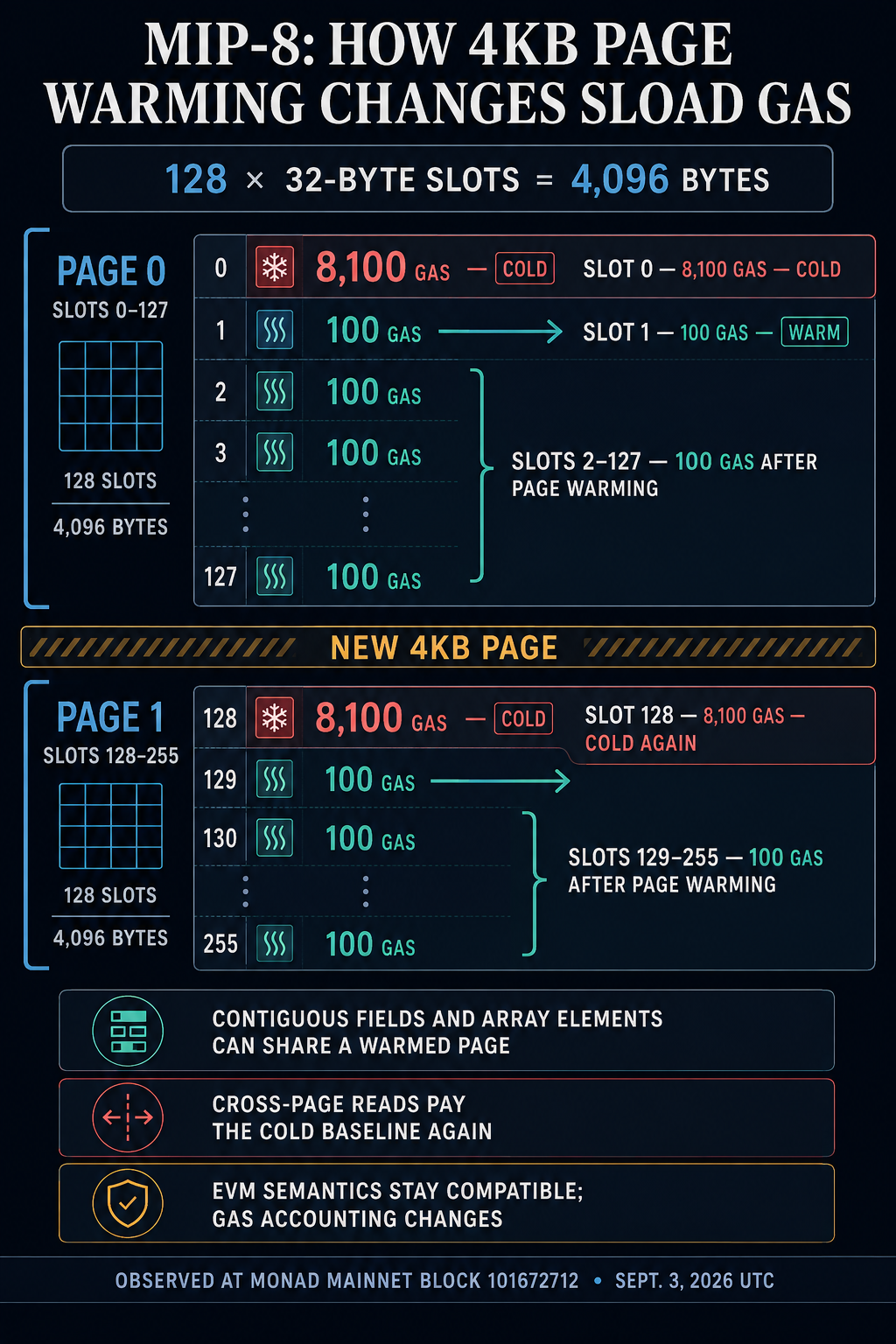
Monad’s mainnet block 101672712 measured 8,100 gas to read slot 0, 100 gas to read slot 1 on the same page, and 8,100 gas again at slot 128, the first slot of the next page.
The official MonadTen release record sets activation at Unix timestamp 1788359400. Below that timestamp, MonadNine rules remained in force.
Storage layout now changes the bill
The final MIP-8 specification defines a storage page as 128 words of 32 bytes each, or 4,096 bytes. The first SLOAD anywhere on a page costs 8,100 gas. Later reads anywhere inside that warmed page cost 100 gas for the rest of the transaction, subject to rollback when a call frame reverts.
Under Monad’s prior schedule, two previously untouched slots each cost 8,100 gas even when they sat next to each other. Under the new opcode pricing, the same pair costs 8,100 gas and then 100 gas if both fall within one page.
Diagram shows MIP-8 charging 8,100 gas for each new 4KB page’s first SLOAD, while subsequent warmed slots cost 100 gas.
Common Solidity layouts can inherit that discount automatically. Sequential state variables, struct fields, and array elements occupy consecutive slots, so repeated reads are more likely to stay inside a warmed page.
A mapping key generally resolves to a separate, dispersed page, but fields inside a struct stored under that key remain contiguous and can share the page-level discount.
Hashed or unaligned storage keeps Monad’s existing cold baseline. Reads that cross page boundaries still cost 8,100 gas each, while savings depend on how many slots a transaction touches and whether those slots cluster within the same 128-slot boundary.
MIP-8 preserves EVM execution semantics while changing the assumptions used by tooling that builds access lists, storage proofs, or gas estimates. EIP-2930 entries now warm pages, and proof formats must represent the page model. The specification identifies contracts that hardcode storage-opcode gas costs as the main compatibility-risk class.
For developers, the incentive is that data read together is cheaper when it is stored close together.
Odds of a September Federal Reserve rate hike fell back to a coin-flip on Friday, a sharp reversal after the probability touched 70% just a day earlier and sat as low as 37% a week before that.
The swing tracks a rally that has pushed Bitcoin (BTC) toward $82,000.
Rate Bets Whipsaw Ahead of the September Meeting
The CME Group (Chicago Mercantile Exchange) FedWatch tool now shows the September 16 meeting split almost evenly between holding the benchmark rate at 3.50-3.75% and lifting it a quarter point to 3.75-4.00%.
Odds of a rate hike in September dropped today, returning to a 50/50 split. The second expected rate hike is now not fully priced in until March rather than December.
This represents a notable shift away from the strong hawkishness expressed by the markets earlier this week. pic.twitter.com/VVuLawauDt
The tool had assigned the hike a 70% probability as recently as Thursday.
The FedWatch data also pushed back the timeline for a second hike. A move to the 4.00-4.25% range isn’t priced as the most likely outcome until the March 2027 meeting. Rather than December 2026 as futures had implied earlier in the week.
Bitcoin has moved in step with the shifting rate outlook. The asset blasted past $80,000 this week as talk of an end to the Iran war spread, and traded near $81,000 on Friday, up roughly 5% over 24 hours.
Bitcoin has broken above $80,000 for the first time this week. Image Source: BeInCrypto
A lower hike probability typically eases pressure on Treasury yields and the dollar. These are both tailwinds for Bitcoin’s price action this week.
Whether that holds through the September 16 decision may depend on how the Iran situation, and the next inflation print, develop in the coming days.
Palantir Technologies’ stock jumped approximately 8% on Thursday, recovering from the previous session’s nearly 6% decline and trading near $183.
The rebound came even as prominent short-seller Michael Burry, known for his role in “The Big Short,” renewed his long-standing bearish critique of the company.
In a detailed post on X early Thursday, Burry reiterated that Palantir is back in the stratosphere and that the facts have not changed. He described the firm as a consultant riding a bubble of AI FOMO demand and warned that its market cap could eventually fall well below $100 billion.
Burry focused on accounts receivable trends, noting that receivables had grown faster than revenue in 9 of the last 12 quarters, with one customer accounting for about 25% of receivables while contributing less than 10% of revenue.
He also highlighted rising days sales outstanding, deferred revenue patterns resembling those of consulting firms like Accenture rather than pure SaaS peers, elevated stock-based compensation, and large net operating losses. Burry disclosed that he remains short the stock and holds put options.
“…Any way I slice it, Palantir is losing either bargaining power or it is channel stuffing, or both. The former is a weak business position, and the latter a crime. Do not laugh. That latter possibility is actually not so far out there. The pattern supports potential channel stuffing, perhaps even more than a loss of bargaining position, and again they are not mutually exclusive…,” Michael Burry said on X.
Why the PwC Deal Sent the Stock Higher, at Least for a Day
Despite the high-profile criticism, investors largely shrugged it off. The primary catalyst for the sharp rebound was the announcement of an expanded strategic alliance between Palantir and PwC US.
The collaboration combines Palantir’s Foundry and Artificial Intelligence Platform with PwC’s industry expertise, engineering capabilities, and managed services.
The main focus of this deal is an AI-native deals platform. It’s designed to execute transactions up to 50% faster while reducing one-time costs by up to 45%.
That momentum held through the close. PLTR finished the session at $183.03, up 8.01%, or $13.57, from the previous close of $169.46, according to TradingView data.
Over a longer horizon, the stock is down 1.36% over the past five days but remains up 25.69% for the month and 21.27% over six months. Year-to-date, shares sit modestly positive, up 0.63%, a far cry from the essentially flat picture seen just weeks earlier.
The SEC has approved a Cboe Options Exchange rule amendment allowing listed options on the WisdomTree Bitcoin Fund, opening another regulated derivatives route around a U.S. spot Bitcoin ETF.
The approval applies to options on BTCW, not to the underlying spot Bitcoin ETF itself. That difference matters because the fund already exists; the new development concerns options tied to the ETF.
For institutional traders, listed options can be useful. They allow hedging, yield strategies, volatility positioning, and more precise risk management without moving directly through spot Bitcoin markets.
For more details, visit the official Sec platform.
TL;DR
The SEC approved a Cboe rule amendment for options on the WisdomTree Bitcoin Fund.
The approval concerns listed options on BTCW.
It does not mean spot Bitcoin ETF approval itself is new.
Why ETF Options Matter
Spot Bitcoin ETFs opened the door for traditional investors to access BTC through familiar brokerage and fund infrastructure.
Options add another layer.
They give traders tools to manage exposure around those ETFs. Investors can hedge downside risk, sell covered calls, express volatility views, or build more complex strategies around Bitcoin-linked products.
That is especially important for institutions.
Large investors often need derivatives to manage risk. A spot product may provide exposure, but options can make that exposure easier to handle inside portfolio frameworks.
BTCW Gets A Broader Market Toolkit
The WisdomTree Bitcoin Fund now sits inside that expanding ETF derivatives market.
Approval for listed options can help make the product more useful to traders who need more than simple long exposure. It may also support liquidity around the fund by attracting market makers and options traders.
But the impact depends on actual trading.
Regulatory approval allows the exchange to list the product under the approved framework, but the start of trading depends on exchange and clearing readiness.
That means investors should not assume options are live until the exchange confirms launch details.
Not A New Spot ETF Approval
The headline needs precision.
This is not the SEC approving a new spot Bitcoin ETF. It is not a new ruling on Bitcoin’s status. It is an approval related to options trading on an existing ETF product.
That may sound technical, but the distinction matters.
Crypto coverage often compresses ETF developments into one simple narrative. In reality, there are multiple layers: fund approval, exchange listing, options approval, clearing, market maker participation, and investor access.
This development sits in the options layer.
What It Means For Bitcoin Markets
More ETF options can deepen Bitcoin’s market structure.
As more spot Bitcoin ETFs gain listed options, institutions have more ways to trade volatility and hedge exposure. That can attract additional capital, but it can also make market behavior more complex.
Options markets can influence dealer hedging, volatility, and short-term price dynamics.
They do not automatically push Bitcoin higher. But they can make the market more mature and more attractive to professional traders.
The Market Signal
The SEC’s approval for WisdomTree Bitcoin Fund options is another step in the normalization of Bitcoin-linked products.
The spot ETF era is no longer only about whether investors can buy fund shares. It is increasingly about whether those products develop the surrounding tools that traditional markets expect.
Options are part of that toolkit.
For BTCW, the approval may improve trading flexibility. For Bitcoin more broadly, it shows the regulated product stack is still expanding.
This article draws on the SEC approval order for Cboe Options Exchange listed options on the WisdomTree Bitcoin Fund.
This article was written by the News Desk and edited by Samuel Rae.
This report is based on information released by Sec. at Sec
The SEC’s Division of Corporation Finance has issued updated staff guidance on public reporting expectations for digital asset depositories and crypto custody arrangements.
The guidance centers on how public companies disclose balance sheet treatment and risk factors when they hold crypto assets on behalf of third-party customers. That makes it important for custodians, exchanges, digital asset platforms, and any public company handling customer crypto.
This is staff guidance, not formal Commission rulemaking.
That distinction matters. The SEC is not creating a new law through the document. But staff guidance can still influence how companies prepare filings, describe risk, and answer regulator comments.
For more details, visit the official Sec platform.
TL;DR
SEC staff issued updated guidance for digital asset depositories.
The guidance addresses public-company reporting around custody and customer crypto assets.
It should be treated as staff guidance, not a new binding Commission rule.
Why Reporting Guidance Matters
Crypto custody is not just a technical issue.
It is also an accounting, disclosure, and investor-protection issue. When a public company holds digital assets for customers, investors need to understand what is on the balance sheet, what is off the balance sheet, what risks exist, and how those assets are protected.
That is not always simple.
Digital assets can involve private keys, third-party custodians, insurance limits, wallet architecture, legal title questions, bankruptcy risk, cybersecurity controls, and changing regulatory expectations.
SEC staff guidance helps companies understand what information may need to be disclosed.
Custody Risk Became A Central Issue
The industry learned the hard way that custody structure matters.
After major exchange failures and platform collapses, investors became more alert to questions around customer asset segregation, corporate control, rehypothecation, wallet access, and bankruptcy treatment.
Public companies cannot simply say they hold crypto safely and leave it there.
They need to explain the risks clearly. They may need to describe how assets are held, who controls private keys, whether customer assets are commingled, what happens if a custodian fails, and whether legal protections are clear.
That is why reporting guidance in this area carries weight.
Staff Guidance Is Not A Rulebook
The SEC’s document should not be overstated.
Staff guidance does not have the same legal force as a formal rule adopted by the Commission. It also does not replace statutes, court decisions, or accounting standards. Companies still need legal and accounting advice for their specific facts.
But guidance can still matter in practice.
It tells issuers what SEC staff may ask about during filing reviews. It can shape disclosure norms. It can also signal which risks regulators believe investors need to see more clearly.
What Companies May Need To Clarify
The guidance points toward more precise disclosure around crypto custody.
That may include the nature of assets held, customer rights, custody controls, risk exposure, insurance arrangements, third-party service providers, cybersecurity risks, and balance sheet presentation.
For companies in the digital asset depository business, vague language is becoming harder to defend.
Investors want to know what the company actually controls and what obligations it has to customers.
The Market Impact
This is not a market-moving crypto rule by itself.
But it is part of a wider tightening around disclosure. As more companies hold, custody, or service digital assets, regulators are pushing for clearer reporting. That can make the sector more transparent, but it may also increase compliance costs.
For investors, that is probably healthy.
Crypto custody risk is not going away. Better disclosure makes it easier to compare companies and understand where the real exposure sits.
The SEC’s latest staff guidance adds another layer to that process.
This article draws on SEC Division of Corporation Finance staff guidance relating to digital asset reporting and custody disclosures.
This article was written by the News Desk and edited by Samuel Rae.
This report is based on information released by Sec. at Sec
Bitcoin trades near $77,381, and Glassnode says 68% of circulating supply now sits in profit at this level, up from 65% when BTC traded here in May.
That three-point gap works out to roughly 600,000 additional BTC, an estimate worth about $47 billion at current prices, that could be sold for a gain before Bitcoin even reaches its next major resistance band.
Bitcoin summer accumulation built the floor and the overhang at once
The short-term holder cost basis now sits near $71,000, reset lower by months of trading through the June-to-August range. Buyers who accumulated during that stretch are already profitable at today’s price, well before Bitcoin revisits its highs.
The same accumulation that steadied Bitcoin’s floor through the drawdown also built a larger pool of holders with real gains to protect as it moves back up.
Glassnode’s latest report identifies heavy long-term holder supply concentrated between $83,000 and $86,000, and the firm’s prior research quantified that band at roughly 1.05 million BTC.
Those coins belong to holders who sat through the entire drawdown without selling, and a return to that zone would make them whole for the first time since the correction began.
Bitcoin’s path to a real breakout runs through two distinct seller types in sequence: newly profitable buyers near current prices first, then patient long-term holders approaching breakeven higher up.
Coins sitting in profit represent potential supply, and Bitcoin now needs fresh demand large enough to absorb both cohorts if either one starts distributing into strength.
Price zone
Seller cohort
Size / signal
Why it matters
~$77K–$78K
Recently accumulated BTC now in profit
68% of supply in profit, up from 65% in May
Roughly 600K more BTC can now be sold at a gain
~$71K
Short-term holder cost basis
Current STH cost basis
Break below here risks turning recent buyers defensive
$83K–$86K
Long-term holders nearing breakeven
Roughly 1.05M BTC in the band
Patient holders get a chance to exit whole
$62K–$65K
Deeper accumulation floor
Glassnode lower support zone
Bear-case retest if demand fails
Bitcoin ETFs funded the squeeze at limited trading depth
US-traded spot Bitcoin ETFs pulled in a seven-day average of $290 million per day during August’s rally, real capital that helped drive Bitcoin’s move toward $80,000.
Secondary-market turnover on those same ETFs stayed closer to $3 billion per day throughout, a level Glassnode describes as well below prior expansionary phases.
What remains for this rally is broad trading activity that typically accompanies a durable move higher.
US spot Bitcoin ETFs posted roughly $236 million of outflows this week, led mostly by IBIT, as Bitcoin slid back toward $77,000. One outflow day marks the first live test of whether ETF demand can keep absorbing supply now that the profit overhang has expanded.
ETF metric
Figure
Read-through
Peak seven-day average intake during August rally
$290M/day
Real spot demand helped fund the move
Secondary-market ETF turnover
~$3B/day
Below prior expansionary phases
Latest reported ETF flow
~$236M outflow
First sign demand is being tested again
Key market question
Can ETFs absorb profitable supply?
Flows need to offset selling from both recent buyers and LTHs
The macro backdrop that fueled August has inverted
Treasury’s Aug. 19 buyback announcement briefly pulled the 10-year yield toward 4.6%, part of the relief that helped launch Bitcoin’s move.
The yield sat back near 4.8% eight trading sessions later, erasing that relief. Brent crude has since settled around $95.63 as fighting between the US and Iran resumes.
A global bond selloff has pushed sovereign yields broadly higher, and futures markets now assign roughly two-thirds odds to a September Fed rate hike. Higher yields and oil prices raise the bar for whatever buyer shows up next to absorb the supply already sitting in profit.
The August jobs report lands on Sept. 4, followed by CPI on Sept. 11 and the Fed’s meeting Sept. 15 to 16. A quarterly options expiry follows on Sept. 25, carrying roughly $14 billion of open interest across Deribit and IBIT, with a meaningful share of that positioning clustered above $80,000.
Bitcoin enters that sequence with more profitable supply above the current price than the last time it traded at this level.
It all comes down to fresh demand
The bull case has the jobs report and easing CPI lower the odds of a Fed hike, while ETF flows turn positive again, letting Bitcoin close above the $83,000 to $86,000 long-term holder band.
Under that path, the profit overhang gets absorbed cleanly, and Bitcoin opens a path toward the upper end of the options-implied range near $89,700, with September’s four tests read afterward as confirmation.
The bear case has stronger jobs or inflation data reinforcing hike expectations while ETF outflows continue, leaving recent buyers more inclined to defend their gains than add fresh capital.
Scenario
Macro setup
Demand signal
BTC implication
Bull case
Jobs/CPI cool hike risk; yields ease
ETF flows turn positive and turnover expands
BTC clears $83K–$86K and targets the options-implied upper range near $89.7K
Base case
Macro remains tight but not worse
ETFs alternate between inflows and outflows
BTC ranges between $71K and $83K–$86K
Bear case
Jobs/inflation reinforce hike risk; yields stay high
ETF outflows persist; recent buyers protect gains
BTC loses $71K and retests $62K–$65K
Core variable
Higher oil, higher yields, Fed risk
Fresh marginal buyer
Determines whether profitable holders sell or stay put
In that scenario, Bitcoin loses the $71,000 short-term holder cost basis and tests Glassnode’s deeper accumulation floor near $62,000 to $65,000. The same summer buyers who steadied the market become the ones selling into any bounce.
Bitcoin needs enough new buyers to show up so people already sitting on gains can stay put.
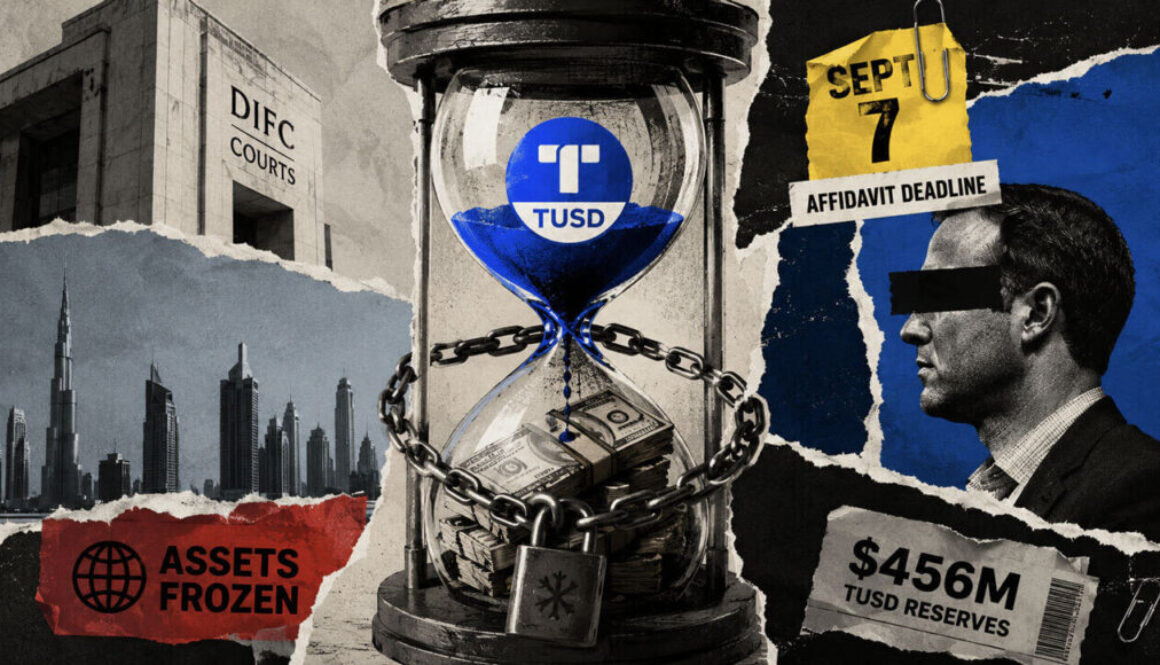
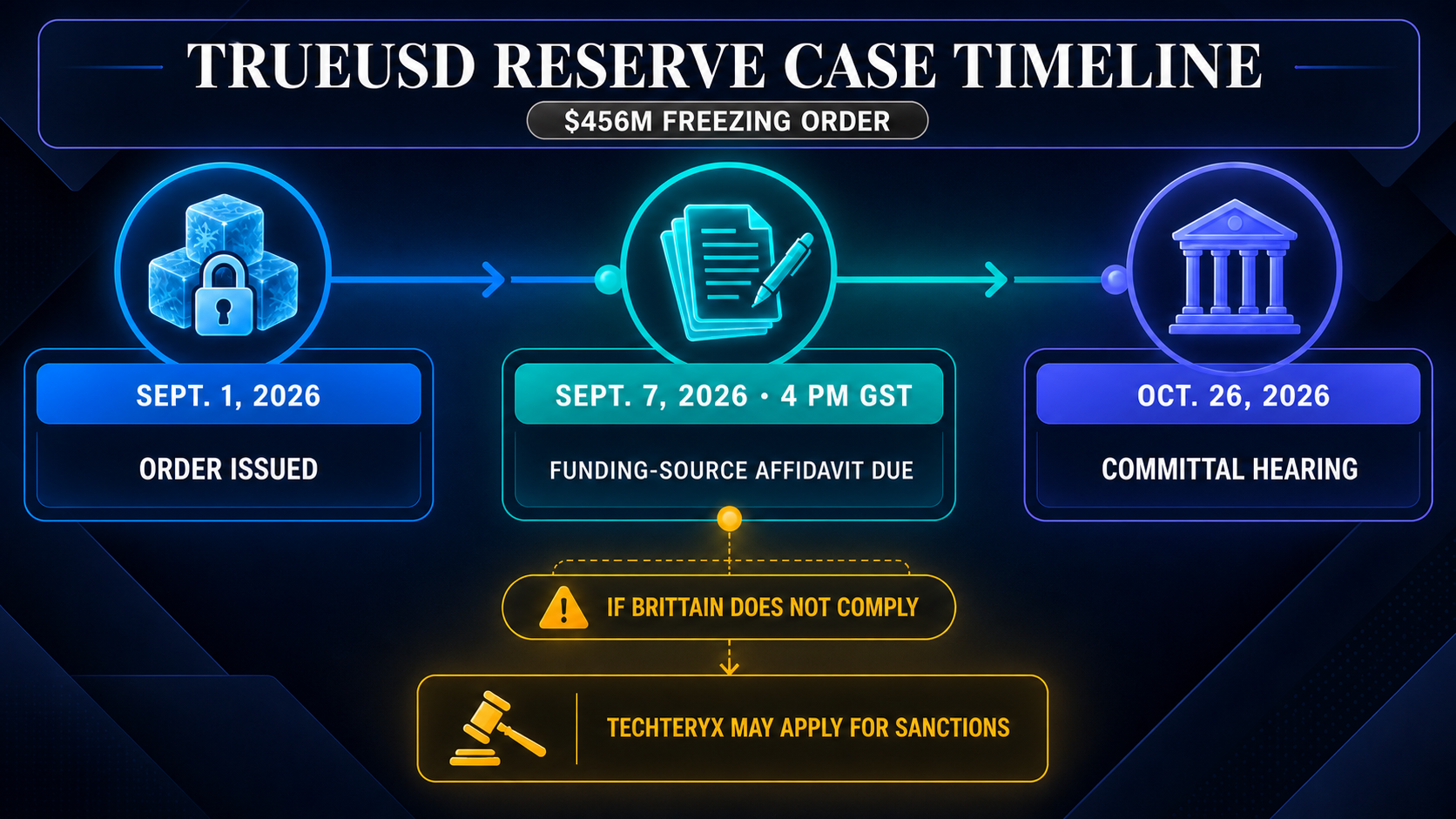
A Dubai court has given Matthew William Brittain until Sept. 7 to explain where money used for legal and advisory bills ultimately came from in a dispute over $456 million connected to TrueUSD reserves.
The Sept. 1 order adds a near-term disclosure deadline to proceedings in the Dubai International Financial Centre Courts. Techteryx, the claimant seeking the information, has obtained a proprietary injunction and worldwide freeze against Aria Commodities DMCC covering $456 million transferred from Legacy Trust and First Digital Trust, along with traceable proceeds.
Earlier DIFC court reasons for the freeze identify the money as part of the reserves backing TrueUSD, or TUSD. The injunction supports litigation in Hong Kong over what happened to the funds, but it does not decide who ultimately owns them.
Brittain must swear and serve an affidavit by 4 p.m. Gulf Standard Time on Sept. 7, acting “to the best of his ability.” For money paid to Quinn Emanuel, Horizons, Gall, Campbells and FTI Consulting, he must list amounts, payment dates and bank accounts. He must also identify the original sources and ultimate beneficial owners, explain how the accounts were funded and provide supporting documents.
The order separately requires an explanation of $1,083,912.49 paid by Aria Bio Industries FZE, another respondent in the case, on Oct. 31, 2025 toward Aria Commodities’ legal costs. The same funding details are required for that payment and for any further legal advice or representation costs incurred since a May 13 remedy application.
If Brittain does not comply, Techteryx may apply for sanctions. A penalty is not automatic: the court would still have to consider the further application.
The court also moved the committal hearing to Oct. 26 for an estimated four days, marking its third adjournment. It is scheduled to take place in person at the DIFC Courts, with remote attendance allowed for Techteryx’s lead counsel.
In the reasons, Justice Michael Black said another adjournment would require “the most extreme circumstances” supported by strong evidence. The Sept. 7 disclosure deadline is distinct from the October committal hearing, which will address the pending committal application.
The Dubai proceeding is also separate from the underlying Hong Kong case. Techteryx alleges there that the transfers formed part of a fraud and that Aria holds the money or its proceeds on constructive trust. Those allegations remain disputed. At the interim stage, the DIFC court described key merits and ownership questions, including whether Techteryx had a proprietary interest in the reserves, as unresolved.
Thailand’s Securities and Exchange Commission has issued a Travel Rule that will require supervised crypto platforms to collect and transmit information identifying the people or entities behind coin transfers.
The regulator announced the rule on Sept. 2, and an associated notification is dated Aug. 25. It takes effect Feb. 27, 2027, after a 180-day implementation period from publication in the Royal Gazette.
The lead time lets operators prepare systems for exchanging transfer data, checking transactions, and requesting required information from customers, according to the SEC’s customer-facing Q&A.
How crypto transfers will change
SEC-supervised digital-asset operators must collect information on customers and their counterparties when coins are transferred. They must also check counterparties and verify the qualifications of digital-asset service providers or intermediaries in the transfer route.
An operator sending a transfer instruction must pass originator and beneficiary information to the operator receiving it. Transfer-related records must be kept for at least five years.
Customers will face different information requests based on transfer size. When sending coins from a wallet held with a regulated platform, a customer must identify the recipient even when the transfer is no more than 30,000 baht.
For transfers over 30,000 baht, the customer must also provide the recipient’s province or city and country. If the recipient is a legal entity, the customer must also provide its registration number. Smaller transfers require basic recipient identification, while larger ones require additional location or entity details.
Thailand’s Travel Rule will require licensed crypto platforms to collect transfer identities, with added checks above 30,000 baht from Feb. 27, 2027.
On incoming transfers between regulated operators, the recipient’s platform must collect information from the sender’s operator before allowing the recipient to move the coins out of the wallet.
The process becomes more specific when coins arrive at a regulated-platform wallet from a self-hosted wallet. The platform must collect sender information as it would for another transfer. If the transaction exceeds 30,000 baht, it must also verify that the user owns or controls the wallet by confirming the person can control or access it.
The obligation falls on supervised operators when a transfer touches their services, and the Q&A does not state that every coin transfer requires proof of wallet ownership.
The rule also stops short of extending the new data checks across all platform activity. It does not apply to trades on an operator’s order book or to transfers and withdrawals of Thai baht because it governs coin transfers.
The SEC said most transfers should continue through normal processes when customers provide complete information and platforms are ready. High-value transfers, cases with missing data, or transactions requiring added wallet checks may take longer.
Gabriela Santos, J.P. Morgan Asset Management’s chief market strategist for the Americas, said true diversification from the artificial intelligence (AI) trade is now hard to find.
Speaking on CNBC’s “Closing Bell Overtime,” Santos said the AI capital expenditure buildout has grown so large that its effects now touch nearly every asset class, from equities to fixed income and private markets.
A Summer of Hard Lessons
Santos said the summer’s momentum unwind hit AI-linked stocks hardest in July and continued into August. The episode underscored a key lesson for AI-bullish investors.
“You can be really really bullish AI and still need to think really really carefully about portfolio construction.”
She said that means paying closer attention to position sizing, leverage, and diversification. That holds even for investors who remain convinced AI will keep driving an extended earnings cycle.
Santos added that the AI buildout keeps shifting shape, making old sector groupings less reliable. Hyperscalers, chipmakers, and software companies increasingly diverge within their own groups, rather than moving as one block.
The concern echoes warnings elsewhere on Wall Street. One prominent investor has said the market now behaves like a single AI trade.
Where Diversification Still Works
J.P. Morgan built an AI factor basket to test how closely assets and portfolios track the broader AI trade. Santos said the results show most assets now moving together.
Genuine diversification is mostly limited to treasuries, gold, core real estate, and European equities. That scarcity echoes recent warnings about a broader stock-bond diversification collapse.
Historically, bonds reliably cushioned portfolios whenever a recession hit. For two decades after the financial crisis, low yields meant bonds alone did the job.
However, Santos said that dynamic has changed. Competition for capital has returned alongside supply shocks, inflation, and rate volatility. She said investors now need additional inflation-resistant assets to round out their positioning.
Whether that mix holds may depend on how AI-related capital spending evolves through the rest of the year.
Circle president Heath Tarbert told Congress on Sept. 2 that placing digital-dollar infrastructure under US rules could reinforce the network effects that support the currency’s global role. The testimony framed stablecoin and digital asset legislation as a tool of dollar statecraft.
US rules can strengthen private dollar-token rails, while official reserve share remains a separate contest. Regulated stablecoins can spread private use of dollar-denominated tokens, change how issuers hold reserves, and add demand for short-term Treasuries.
Central banks remain responsible for deciding which currencies they hold. Tarbert acknowledged the boundary, arguing that payment technology cannot substitute for sound economic policy and that digital infrastructure cannot preserve dollar primacy on its own.
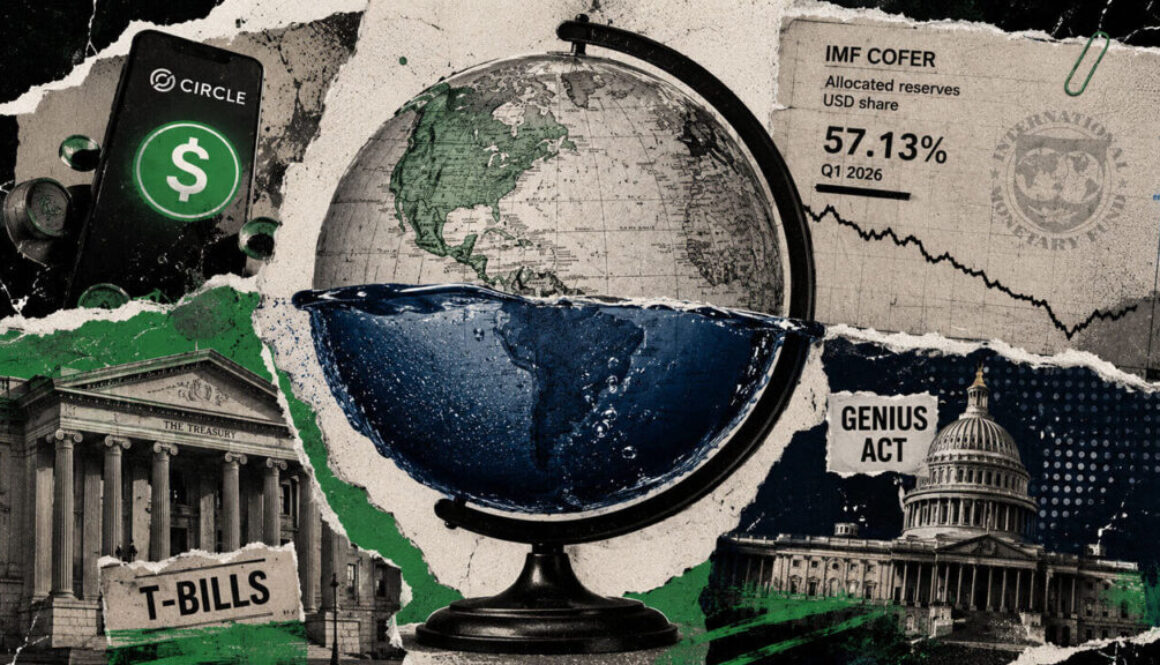
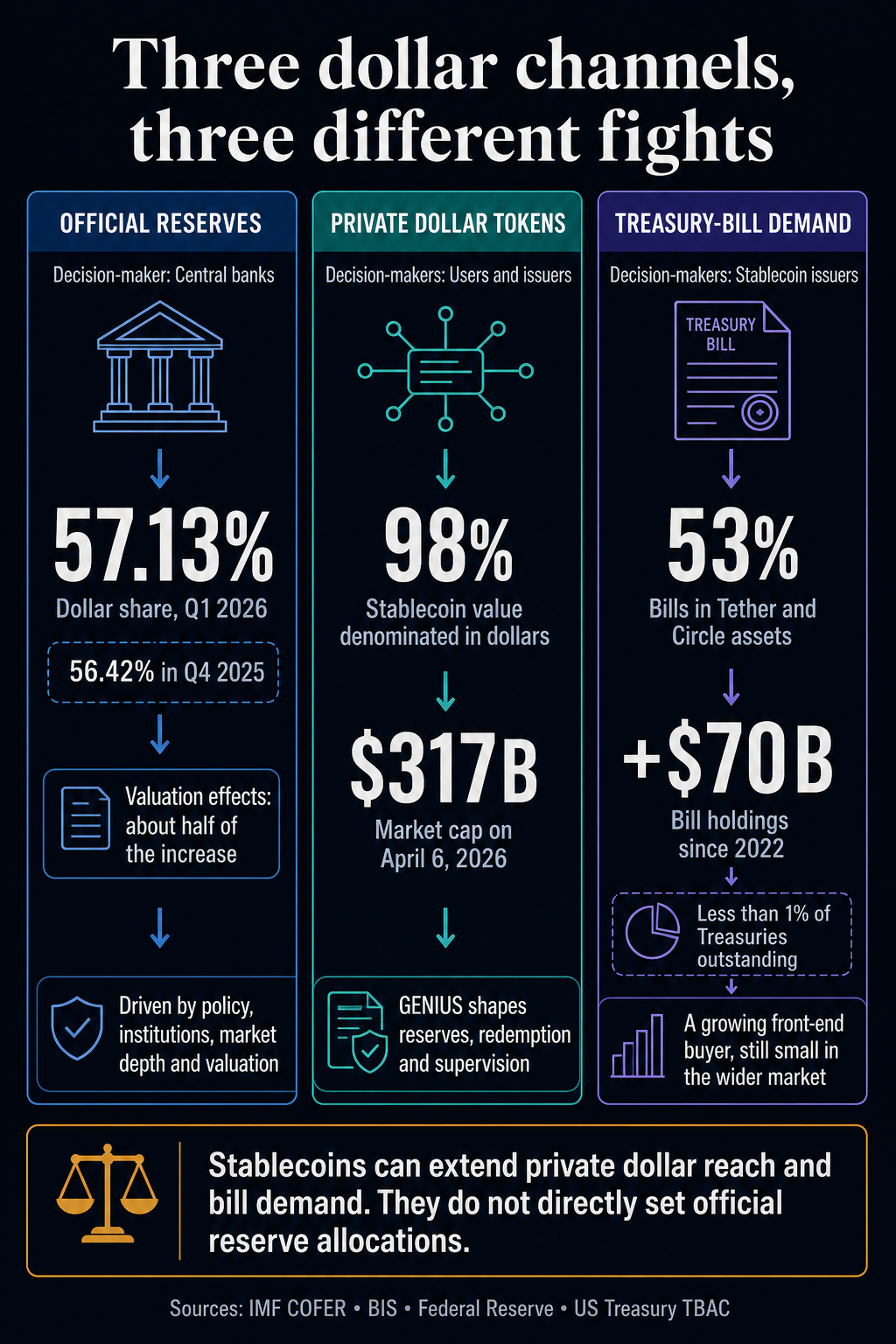
The dollar accounted for 57.13% of allocated global foreign exchange reserves in the first quarter of 2026, up from 56.42% in the fourth quarter of 2025, according to the International Monetary Fund’s latest COFER brief. Exchange-rate valuation effects accounted for around half of that quarterly increase.
The latest move was an increase, even against a longer-term decline in the dollar’s official reserve share. The valuation adjustment also prevents crediting the change to stablecoin adoption. A central bank’s reported reserve mix can shift when exchange rates move, even without an equivalent portfolio decision.
COFER tracks reserve assets reported by monetary authorities, and stablecoin market capitalization measures liabilities issued by private companies to token holders.
The Bank for International Settlements estimated that roughly 98% of stablecoin value is denominated in dollars. That shows the dollar’s dominance in private token markets.
BIS researchers nevertheless expect the near-term effects to appear mainly in private stores of value and means of payment, rather than in the official reserve, intervention or anchor-currency functions of central banks.
Stablecoins can consequently expand the dollar’s digital reach while fiscal credibility, institutions, market depth, and valuation forces continue to shape official reserve demand. This distinction separates consumers and businesses choosing a digital payment instrument from monetary authorities choosing a reserve portfolio.
What regulated stablecoins can change
The GENIUS Act issuer framework requires one-to-one permitted reserves, redemption at par, disclosures, supervision, and financial-crime compliance.
Those rules can improve reserve quality, influence where issuers locate, shape whether unlicensed issuers can offer stablecoins in the US, and steer more issuer assets toward short-term safe instruments.
GENIUS was enacted in July 2025, but its main requirements were not yet generally effective on the date of Tarbert’s testimony. Treasury’s August rulemaking notice said the general effective date was expected to be Jan. 18, 2027, unless final implementing rules made the law effective 120 days after their issuance.
A broader restriction on offering payment stablecoins from unlicensed issuers is scheduled to begin July 18, 2028.
Once it takes effect, the framework can govern backing, redemption, and supervision, leaving central bank currency allocations outside.
CLARITY addresses the trading and intermediary layer above stablecoins. The House passed the measure, the Senate Banking Committee advanced its portion 15-9, and the updated merged Senate text was released July 22.
The proposal’s principal function is to allocate jurisdiction between the Securities and Exchange Commission and the Commodity Futures Trading Commission and set rules for digital-asset intermediaries and markets.
If enacted, those rules could make US digital asset markets easier to operate in and extend the reach of regulated dollar tokens. Its effect would run through market structure rather than official reserve allocation.
Stablecoin issuers need liquid assets to support redemptions, and Treasury bills can satisfy that need. A Treasury Borrowing Advisory Committee analysis, using major-issuer data through September 2025, found that bills represented 53% of Tether and Circle assets. Their bill holdings had increased by $70 billion since 2022.
Even after that growth, stablecoin issuers held less than 1% of Treasuries outstanding. Their demand can affect the bill market at the margin, while broader demand for Treasury debt and official dollar reserves responds to other forces.
The Federal Reserve staff estimated stablecoin market capitalization at $317 billion on April 6, 2026, more than 50% above its level in early 2025. The date is essential because market capitalization moves continuously, and the figure should not be placed beside official reserves as if the series were equivalent.
Official reserves, stablecoin supply and Treasury-bill demand show three distinct channels shaping dollar liquidity and financial markets.
The Fed analysis found USDC had high-quality reserves equal to its stablecoin liabilities. USDT reported total reserves at about 1.04 times liabilities, but higher-quality reserves at roughly 0.74 times liabilities.
Regulation can narrow those differences and make redemption promises more credible, a concrete way GENIUS could strengthen private dollar infrastructure.
Fed staff warned that complex intermediation, vertical integration and deeper links to traditional finance can increase opacity and contagion, amplifying operational or liquidity failures. Those dependencies can transmit problems further as adoption grows.
BIS researchers warn that broad adoption of dollar stablecoins could accelerate private currency substitution, weaken domestic monetary-policy traction and capital controls, and redirect emerging markets’ savings toward US Treasury bills. A run on a major issuer could then transmit stress into local financial systems and short-term dollar markets.
Migration from bank deposits toward stablecoins can also shift funding and intermediation outside familiar channels, even when issuer reserves ultimately flow back into government securities.
Tarbert’s case is strongest on these private rails. US rules can help determine whether dollar stablecoins grow within a supervised system, what backs them, and which markets they connect. Greater reach also enlarges the channels through which runs, operational failures and currency substitution can spread.
The IMF’s 57.13% figure records the separate decisions of official reserve managers, whose allocations respond to economic credibility, liquid market depth, institutions, policy, and valuation effects.
Stablecoins can extend the dollar’s private reach and create demand for its shortest-dated government debt. Official reserve share still turns on the policies that sustain confidence in the dollar itself.