Dell Technologies reports fiscal second quarter results Tuesday after the close, and the options market is braced for a large reaction. Contracts expiring September 4 imply a swing of roughly 11% in either direction.
The at-the-money straddle, a paired call and put at the same strike, cost about $52 against Dell’s $456.01 close on Monday. Buyers profit only if the stock travels further.
Dell earnings options open interest by strike. Source: Option Charts
What Dell Guided For, and What Analysts Expect
Dell guided to revenue of $44 billion to $45 billion for the quarter, adjusted earnings of about $4.80 a share, and roughly $15.5 billion of AI server revenue. It expected its Infrastructure Solutions Group, the server and storage division, to grow about 75%.
Zacks Investment Research puts the consensus at $4.72 a share across five forecasts. Dell earned $2.10 in the year-ago quarter.
The bar is high because the previous quarter reset it. Revenue reached $43.8 billion in Dell’s record first quarter beat, up 88% year over year, and adjusted earnings of $4.86 landed far above Wall Street’s estimate.
Management then raised the full-year revenue outlook to $167 billion at the midpoint and lifted its AI server target to $60 billion. Shares have climbed roughly 260% in 2026 on that artificial intelligence demand.
“We booked $24.4 billion in AI orders and recognized $16.1 billion of AI server revenue. We’re increasing our AI server revenue expectations for FY27 to $60 billion, which only goes to show the AI opportunity shows no signs of slowing,” said Jeff Clarke, Dell vice chairman and chief operating officer, in the quarterly release.
Orders and backlog now matter more than the headline figure. Dell booked $24.4 billion of AI orders last quarter and closed with a record $51.3 billion AI backlog.
Margins are the second test. AI servers earn thinner margins than storage, and Chief Financial Officer David Kennedy has flagged memory chips, processors and hard drives as supply bottlenecks.
Dell has also described an inflationary parts market that forces frequent repricing, so a revenue beat paired with weaker margins would land badly. Data center names have already drawn profit-taking after big rallies.
Wall Street still leans positive. Of 15 analysts covering the stock, 11 rate it a buy and four a hold, with an average target of $523.54 and a low of $434.
Nvidia’s own quarterly beat drew only a modest reaction last week. Whether Dell raises its full-year guide again, and what it says about second-half supply, will decide which side of the straddle pays.
GCSA Agent demonstrates autonomous vulnerability analysis and PoC generation capabilities on a highly challenging real-world vulnerability benchmark
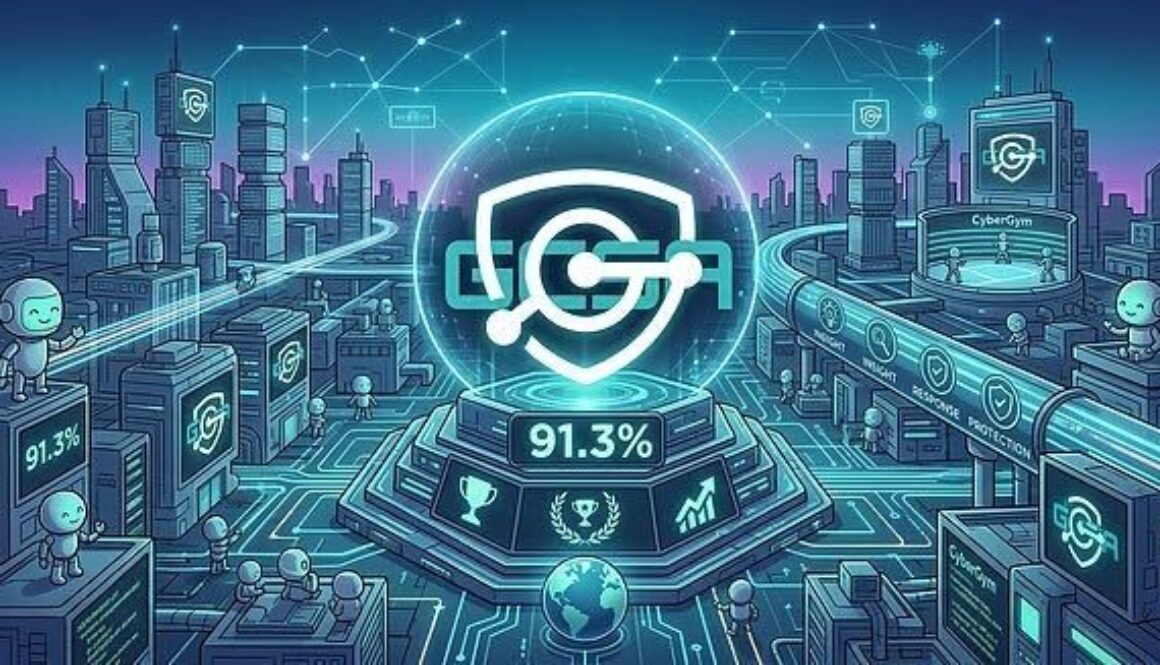
The Global Cybersecurity Alliance (GCSA) today announced that GCSA Agent achieved a 91.3% success rate on the CyberGym benchmark, placing it within CyberGym’s “Leading Systems Above 90%” category.
CyberGym is a large-scale, real-world cybersecurity evaluation framework developed by a research team at the University of California, Berkeley. It contains 1,507 historical real-world vulnerability test cases across 188 major software projects and is designed to evaluate the practical capabilities of AI agents in real-world vulnerability analysis scenarios.
Unlike traditional AI benchmarks that primarily assess code understanding, knowledge-based question answering, or static analysis, CyberGym requires AI agents to work directly within real-world vulnerable code environments.
In its core Level 1 evaluation, an AI agent is provided only with a vulnerability description and an unpatched code repository. It must then autonomously perform code analysis, locate the vulnerability, reason about potential attack paths, construct a PoC, and execute it for validation. A task is considered successful only if the generated PoC successfully triggers the target vulnerability in the vulnerable version while failing to reproduce the issue in the patched version.
CyberGym therefore measures more than whether an AI system can simply “understand code.” It evaluates whether the AI can complete the full process from security analysis to vulnerability reproduction and validation.
From Large Language Models to Security Agents
In this CyberGym evaluation, GCSA Agent operated on Grok 4.5 and Grok 4.6 models and achieved a final success rate of 91.3%.
The result also reflects an important shift taking place in AI cybersecurity:
The underlying large language model alone no longer determines the system’s ultimate security capabilities.
Real-world vulnerability research typically requires a continuous sequence of tasks, including understanding vulnerability descriptions, searching large codebases, identifying attack surfaces, formulating vulnerability hypotheses, generating test inputs, executing programs, analyzing feedback, and repeatedly iterating on PoCs.
GCSA Agent is built around an agentic security workflow designed to support this end-to-end process.
Its objective is not simply to use a large language model for code analysis, but to enable AI to operate within real execution environments, autonomously formulate hypotheses around security issues, collect runtime evidence, execute tests, and ultimately validate security findings through reproducible results.
The CyberGym evaluation provides a quantitative external benchmark for these capabilities.
Vulnerability Research Capabilities for the Real World
A core value of CyberGym lies in narrowing the gap between traditional AI testing and real-world cybersecurity research.
Its evaluation environment restores software projects to their pre-patch vulnerable states. An AI agent may need to autonomously identify an issue within a large codebase containing thousands of files and millions of lines of code, and ultimately generate a PoC capable of actually triggering the vulnerability.
More importantly, further CyberGym research has shown that such agentic security capabilities are not limited to reproducing known vulnerabilities.
In open-ended vulnerability research experiments, AI agents have identified multiple previously unknown zero-day vulnerabilities as well as historical security patches that did not fully resolve the underlying vulnerabilities. These findings demonstrate the potential for autonomous vulnerability analysis technologies to evolve from reproducing known vulnerabilities toward discovering real-world security flaws.
For GCSA, this represents an even more important direction of development.
Benchmark performance is not the end goal.
GCSA aims to further develop AI Security Agents capable of operating in real-world cybersecurity environments and gradually participating across the full security lifecycle, from vulnerability discovery and analysis to validation and subsequent remediation.
Building AI-Native Cybersecurity Capabilities
As artificial intelligence accelerates software development, AI is also transforming the way vulnerabilities are researched and cyber threats are addressed.
As software systems continue to grow in scale and complexity, the next generation of cybersecurity will increasingly depend on collaboration between human security experts and autonomous AI agents.
AI Security Agents have the potential to help security teams:
Identify software vulnerabilities with genuine exploitation potential at an earlier stage;
Automatically analyse complex attack paths across large codebases;
Automatically generate PoCs and perform execution-level vulnerability validation;
Reduce false positives in traditional security detection through real execution results;
Accelerate vulnerability assessment, validation, and remediation;
Expand the scale of software and systems that specialised security teams are able to cover.
GCSA Agent’s 91.3% score on CyberGym represents an important milestone in GCSA’s development of AI-native cybersecurity capabilities.
Going forward, GCSA will continue advancing research into autonomous vulnerability analysis, AI Security Agents, and intelligent cybersecurity technologies, further translating frontier AI capabilities into real-world security capabilities and providing technical support for a safer, more trustworthy, and more resilient digital environment.
Nine of the 10 best-performing S&P 500 stocks over the past decade trace to one theme, the buildout of artificial intelligence infrastructure. There is also one clear winner out of the top 10: Nvidia.
Nvidia’s 10-year total return is near 13,589%, more than double the next-closest, AMD, at close to 6,000%. The other eight names span chipmakers, network gear, and one HVAC contractor.
The AI Common Thread
The top 10 best performers from the last 10 years:
Nvidia (NVDA) — +13,817%
AMD (AMD) — +6,099%
Micron (MU) — +5,486%
Comfort Systems (FIX) — +5,157%
Arista Networks (ANET) — +3,762%
Lam Research (LRCX) — +3,099%
Tesla (TSLA) — +2,545%
Lumentum (LITE) — +2,440%
KLA Corp (KLAC) — +2,401%
Seagate (STX) — +2,346%
Nvidia, AMD, Micron (MU), Lam Research (LRCX), and KLA Corp (KLAC) all supply chips or the equipment to make them. That equipment builds the servers inside AI data centers.
Arista Networks (ANET) sells networking switches for those same facilities. Lumentum (LITE) makes optical parts that move data between server racks. Seagate (STX), meanwhile, supplies the storage drives used in AI training clusters.
Comfort Systems (FIX), in contrast, benefits from a different angle. The mechanical and electrical contractor’s backlog climbed toward $12 billion as hyperscalers race to build and cool new data centers. That gives it AI exposure without selling a single chip.
Tesla (TSLA), however, is the outlier. Its return leans more on electric vehicle demand than AI infrastructure. Elon Musk’s push into self-driving and robotics does, however, add an AI angle of its own.
A similar acceleration shows up across the list, as hyperscaler spending on AI accelerated over the past two years.
Whether that pace continues depends on hyperscalers sustaining current construction schedules. JPMorgan analysts estimate that roughly 60% of data center capacity planned for 2027 has yet to break ground.
That gap could keep this group of stocks in focus through the back half of the decade.
The human brain runs on roughly 20 watts. The world’s fastest supercomputer, LineShine in Shenzhen, draws 42.2 million watts. That gap has become the internet’s favorite argument about AI energy use, and most of it is wrong.
The comparison itself holds up. However, the numbers circulating on social media trace back to a single paper. The most striking one has been misattributed for three years.
China just topped the global supercomputer ranking for the first time since 2017.
LineShine. Shenzhen. 2.198 exaflops. 2 quintillion calculations per second. 20% faster than the US’s El Capitan.
The 20-watt figure rests on decades of metabolic measurement. The brain accounts for about 2% of body weight and roughly 20% of resting oxygen consumption.
Neuron counts are shakier than they appear. The widely quoted 86 billion rests on four male brains and is currently under dispute in the journal Brain.
Viral posts often use 12 watts rather than 20. That figure appears in a 2023 paper in Frontiers in Artificial Intelligence, stated without any citation at all.
The same paper produced the number everyone shares. Its authors estimated that digitally recreating a human brain would draw 2.7 billion watts.
That estimate came from extrapolating a 10-million-neuron simulation to mouse scale, then multiplying by a thousand.
The paper also states that the simulation ran about 30,000 times slower than biology. Social posts drop that detail. Secondary sources then credit the figure to the Blue Brain Project, which never published it.
A Viral Post on LinkedIn Claiming How the Human Brain Only Needs 12 Watts to Think. Source: Evolving AI
Reliable numbers do exist elsewhere. Epoch AI estimated a typical ChatGPT query at 0.3 watt-hours in early 2025. A peer-reviewed study in Joule later landed on 0.31.
Two independent methods agreeing that closely is unusual. However, the figure changes sharply with workload, and reasoning models that produce longer answers can cost several times as much.
What Biology Does Differently, and What Silicon Copied
Cortical activity is sparse. Average firing rates are below 1 Hz, and energy follows change rather than clock cycles.
Modern AI reached the same conclusion independently. Kimi K2 activates 32.6 billion of its 1.04 trillion parameters per token, close to 3.1%.
That ratio is falling fast. Mixtral used roughly 28% of its parameters in 2023, while DeepSeek-V3 now uses 5.5%.
Biology also computes at low precision. Nothing inside a neuron resolves to 32 bits.
Chipmakers followed the same path. DeepSeek trained a 671-billion-parameter model in eight-bit precision. NVIDIA has since pretrained a 12-billion-parameter model in four-bit.
Power draw on a logarithmic scale, from a brain to a data center / Source: BeInCrypto
The third difference is the largest and the least copied. Brains hold memory and computation in the same physical place.
Digital machines separate them. Stanford’s Mark Horowitz showed the cost of that split. Fetching an operand from memory can consume hundreds of times more energy than the arithmetic itself.
The Brain-Shaped Chips That Never Arrived
Hardware built explicitly to imitate neurons has struggled. No neuromorphic or analog system has trained or run a frontier model in production.
Intel’s Hala Point packs 1.15 billion artificial neurons across 1,152 chips. It remains a research prototype installed at Sandia National Laboratories. Mike Davies, director of Intel’s Neuromorphic Computing Lab, speaking to The Register in 2024, said:
“We’re not mapping any LLM to Hala Point at this time. We don’t know how to do that.”
The commercial picture is thinner still. BrainChip is the sector’s flagship listed company. It reported $700,000 in customer receipts against $5.3 million of operating outflow last March quarter.
Others have stalled outright. Rain AI, which sought $150 million and failed to raise it, explored a sale in 2025.
Researchers inside the field describe a circular problem. Catherine Schuman, assistant professor of electrical engineering and computer science at the University of Tennessee, Knoxville, stated:
“The hardware companies are waiting for there to be a killer application, but it’s really hard to understand how to build those applications without having hardware to prototype on.”
More than 20 researchers signed a 2025 consensus paper in Nature. It argued that the field still lacks the ecosystem it needs.
Biology’s principles won. The hardware built to embody them did not.
Everyone Is Bidding for the Same Electrons
Efficiency matters now because electricity has become the binding constraint. The International Energy Agency put global data center consumption at 485 terawatt-hours in 2025.
AI-focused facilities grew 50% during that year alone. The agency expects them to triple by 2030.
Grid access, rather than chip supply, now gates construction. Median time from an interconnection request to commercial operation exceeds five years, according to Lawrence Berkeley National Laboratory.
Microsoft chief executive Satya Nadella said in November that his company holds processors it cannot plug in. The shortage is powered buildings, not silicon. Institutional investors have raised similar questions about grid readiness.
Bitcoin miners spent a decade solving exactly that problem. They hold energized sites, signed power agreements, and interconnection rights that newcomers wait years to secure.
The result has turned mining into an energy and infrastructure business. Retrofitting a working site costs roughly $3 million to $4 million per megawatt. Greenfield construction runs $10 million to $12 million, VanEck estimates.
Announced deal values are enormous. Public miners have signed AI contracts worth more than $70 billion in aggregate.
Delivered capacity tells a quieter story. Second-quarter 2026 filings show roughly 750 megawatts actually energized across the sector.
Core Scientific accounts for about 437 of those megawatts. Galaxy’s Helios campus delivered 133; TeraWulf 102; IREN 50; and Riot 25. Hut 8 has contracted 949 megawatts and energized none.
Contracted capacity against what has actually been switched on / Source: BeInCrypto
The pivot has been costly. Combined quarterly losses at miners MARA and CleanSpark reached $851 million in August.
Most mining capacity will never convert. Preliminary Cambridge survey data presented in July showed that about 10% of miners had allocated power to AI.
The obstacles are physical. Mining tolerates interruption, whereas AI tenants demand firm power, dense cooling, and fiber that remote sites rarely have.
Even so, the direction of travel is clear. Core Scientific now earns 83% of its revenue from colocation and just 13% from mining itself.
Investors have priced that shift in. Miners holding signed leases trade at far higher multiples of their energized power. Meanwhile, the next AI bet increasingly looks like electricity rather than chips.
Why Efficiency Will Not Fix AI Energy Use
Efficiency gains have absorbed demand growth in the past. Global data center compute grew by 550% between 2010 and 2018, while energy use rose by about 6%.
Then the pattern broke. United States data center consumption climbed from 58 terawatt-hours in 2014 to 176 in 2023.
Evolution optimized under a hard ceiling. A skull drawing 200 watts would have killed its owner, so efficiency became the only available answer.
AI has never faced that ceiling. It has faced a capital ceiling instead, and capital stretches far more easily than electricity does.
That is now changing. The open question is no longer whether biology is more efficient. It is what AI becomes once power, rather than money, decides what gets built.
Sony Music Publishing and Warner Chappell Music sued Anthropic on Friday. They say the company used BitTorrent to take songbooks, then fed them to Claude.
While Anthropic has already admitted torrenting books, it has never conceded that music sat inside those files, hence the copyright case.
Anthropic Music Lawsuit Explained
The complaint names two hauls, both from shadow libraries and containing unlicensed copies of published works.
Roughly 5 million books came from Library Genesis in June 2021.
Another 2 million came from Pirate Library Mirror in July 2022.
According to the publishers, sheet music and songbooks sat in those collections. Torrenting is not the only route in the filing.
The publishers also say Anthropic scraped lyrics from Musixmatch and LyricFind. Both sites pay for the right to display them.
“…one of the largest and most blatant ongoing thefts of intellectual property in history,” the opening line of the complaint reads.
A judge has already drawn this line once. Buying books and scanning them leaned toward fair use. Taking them from pirate sites did not. The same judge described those downloads bluntly.
Torrenting sits on the wrong side of that line, and it carries a second problem. The software uploads while it downloads. Every copy taken is also a copy shared.
Two of the four counts rest on that point, with both naming Dario Amodei and Benjamin Mann as individuals, not as employees. Companies settle. People give depositions.
What It Could Cost
The publishers want up to $150,000 for each song a jury finds was knowingly infringed. The publishers say hundreds of their songs sat in those files. They put the wider training claim in the tens of thousands.
Notably, however, Anthropic has beaten these publishers before. It beat their bid to block Claude’s training in a 2023 case over lyrics. It agreed to run output guardrails instead.
It has not commented on this one.
Everything now turns on discovery. Did the songs reach Claude through a purchase, or through a swarm?
Apple CEO Tim Cook is stepping down from his role on Tuesday, September 1, ending a tenure in which he maintained a consistent stance against the company purchasing Bitcoin or other cryptocurrencies for its balance sheet, despite personally holding digital assets himself. Cook’s approach reflected a broader philosophy about maintaining shareholder focus and corporate capital allocation priorities.
John Ternus, a hardware engineer who spent 25 years working on Apple devices, is taking over as chief executive. Ternus has been instrumental in developing some of Apple’s most successful product lines throughout his career at the company. Cook will remain with the company in an executive chairman position, maintaining an ongoing advisory role during the leadership transition.
Cook’s 2021 Statement on Crypto
Cook addressed the question of Apple investing in cryptocurrency once, at a New York Times DealBook event in November 2021. He revealed that he personally owned crypto but drew a clear line when it came to corporate investment. This disclosure provided rare insight into Cook’s personal financial philosophy while also establishing his official position on the company’s treasury management.
I wouldn’t go invest in crypto, not because I wouldn’t invest my own money, but because I don’t think people buy Apple stock to get exposure to crypto.
Cook’s reasoning centered on a fundamental principle of corporate governance and shareholder expectations. The statement reflected his belief that Apple shareholders invest in the company for its core business operations and products, not for speculative asset exposure.
Cook did not disclose how much cryptocurrency he holds or provide further details about his personal digital asset holdings. His willingness to acknowledge personal crypto ownership while maintaining corporate distance from it highlighted the distinction he drew between personal investment decisions and fiduciary responsibilities to shareholders.
Stock Performance Since the Statement
The performance data from that point forward has largely vindicated Cook’s decision to keep crypto off Apple’s balance sheet. Bitcoin set a record near $68,991 the day after his November 2021 comments, marking a significant peak during the cryptocurrency bull market.
As of Sunday, Bitcoin was trading near $77,244, representing about 12% gains from that peak. Over the same period, Apple shares closed 2021 at $175.35 and ended Friday at $319.70, roughly 82% higher. This comparative analysis demonstrates that Apple’s core business growth substantially outpaced cryptocurrency returns during the same timeframe.
Apple currently holds $146.5 billion in cash and marketable securities as of June 27, according to company filings. This substantial capital reserve keeps alive the theoretical question of how such funds might be deployed under new leadership, though such changes would likely require board approval and careful strategic consideration.
The Stablecoin Question Under New Leadership
While the treasury investment question remains settled in Apple’s current approach, a different cryptocurrency-related matter may be more relevant under Ternus’s leadership. Reports in 2025 have tied Apple to early-stage discussions about using stablecoins to reduce settlement costs in payment transactions. Stablecoins represent a distinct category from volatile cryptocurrencies, serving primarily as efficiency tools rather than speculative assets.
Apple has neither confirmed nor shipped any such initiative. Services generated $30.7 billion in revenue for Apple last quarter, with Apple Pay handling card transactions rather than tokens or cryptocurrencies. The financial services segment represents an increasingly important component of Apple’s overall business strategy.
Any stablecoin integration would operate in Apple’s payments and financial plumbing layer rather than as a headline-making treasury move. The company already exerts significant control over cryptocurrency through App Store rules that gate crypto-related applications, maintaining careful oversight of the ecosystem.
Ternus has not yet been asked publicly about his stance on cryptocurrency investments or integration, leaving his position on these matters unknown as he assumes the chief executive role. How the new leadership approaches both treasury matters and emerging payment technologies may become clarified in coming months.
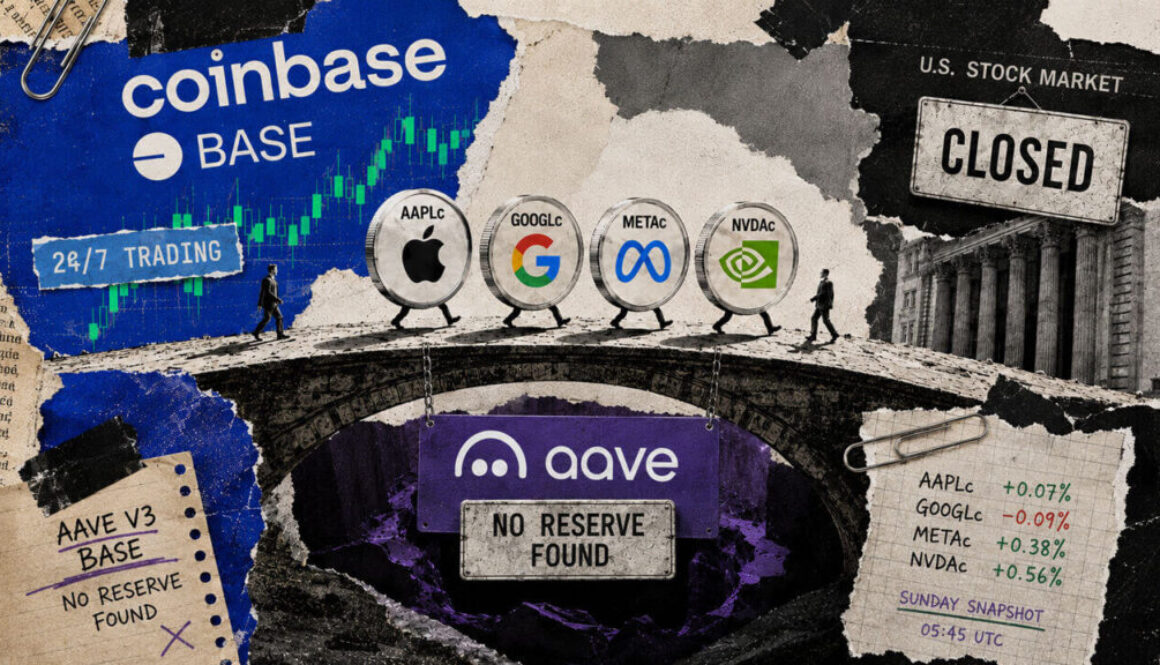
Coinbase’s new B20 stock tokens on Base place Apple, Alphabet, Meta and Nvidia-linked exposure on a blockchain that keeps trading through the weekend.
AAPLc, GOOGLc, METAc and NVDAc confer beneficial claims on underlying shares held within Coinbase’s tokenization structure; they are designed for eligible users outside the United States and differ from ordinary US-listed shares.
Coinbase describes continuous secondary transferability, while Base presents the assets as building blocks for decentralized finance. That DeFi pitch includes a prominent borrowing example. Base says a holder could use tokenized Nvidia exposure as collateral on Aave, creating an obvious risk question when the token continues trading and the underlying equity market is closed.
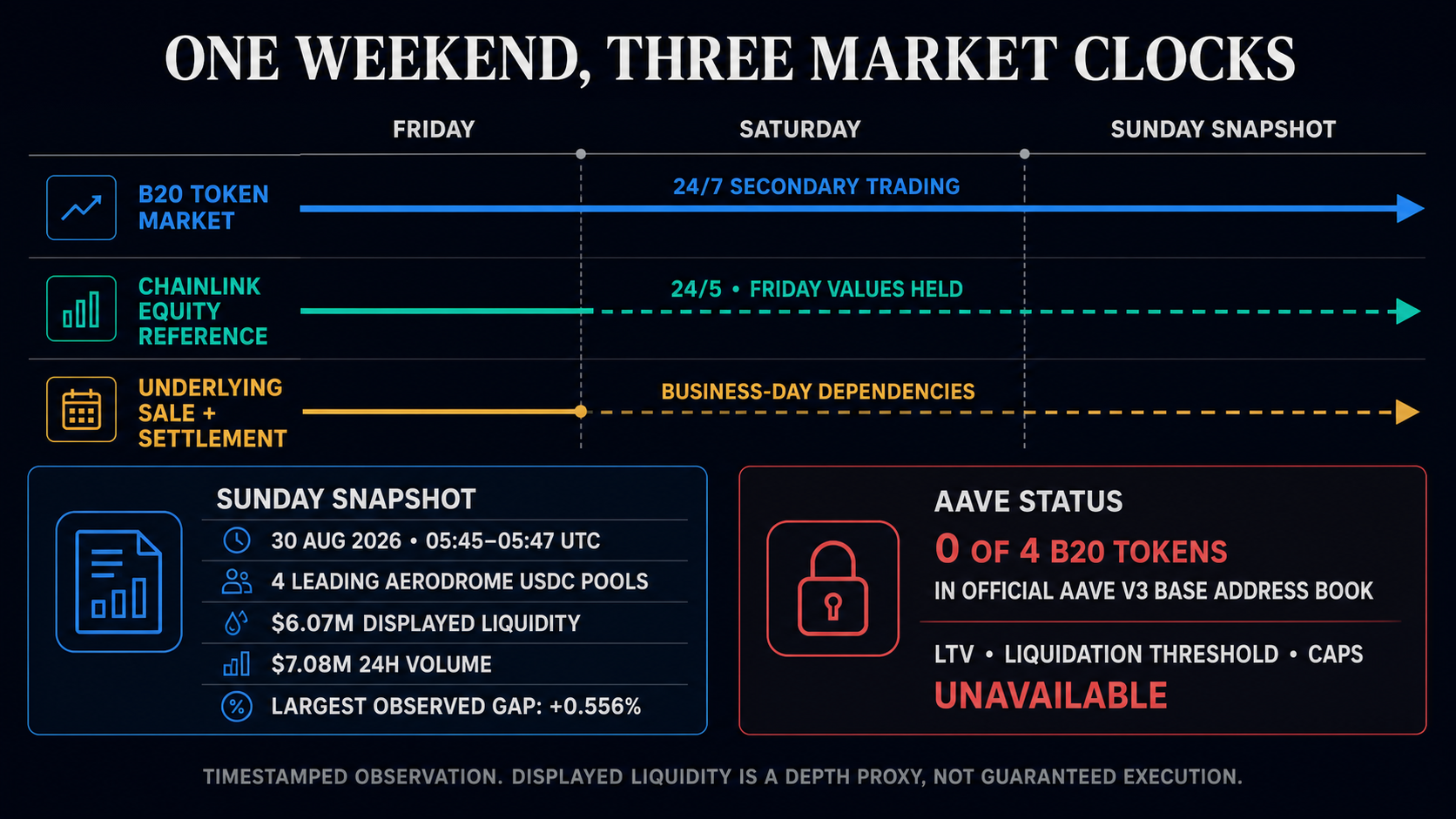
A Sunday review of the official Aave V3 Base address book found no reserve for any of the four tokens. The weekend therefore produced two separate findings: secondary-market prices were observable, while Aave lending behavior had no verified live B20 market to measure.
At 05:45–05:47 UTC on Aug. 30, the four leading Aerodrome USDC pools traded within roughly 0.6% of Chainlink reference values last updated Friday. Those held references make the measurement a snapshot of weekend token pricing against the last available equity-linked values. They do not provide a continuously refreshed estimate of the underlying shares.
Coinbase stock tokens held close to Friday reference values
Coinbase stock tokens separate continuous token trading from the operational rails behind the claim. Coinbase’s product page says primary minting and redemption are handled by KYC-onboarded institutional partners and Authorized Participants. Once issued, Base says the tokens can be transferred without wallet whitelists and traded through always-on automated market makers. A trader can therefore buy or sell tokenized exposure even while the primary US equity market is closed.
A snapshot of the leading Aerodrome pools at 05:45 UTC showed about $6.07 million in aggregate displayed liquidity and $7.08 million in aggregate 24-hour volume. DEX Screener defines pool-liquidity and volume fields for its live endpoint, but displayed liquidity remains a rough depth indicator. It does not promise that a trade of a particular size will clear near the quoted price.
The four official Chainlink feed proxies at 05:47 UTC returned Friday update times: 17:01:55 UTC for AAPL, 15:59:21 for GOOGL, 19:10:19 for META and 18:50:11 for NVDA. Comparing those held values with DEX Screener’s rounded dollar prices produced this Sunday snapshot:
All four gaps were smaller than 0.6% at the cutoff. This supports a dated statement about prices in those pools, rather than a durable peg, an issuer-solvency test or a guaranteed arbitrage relationship. Prices, volumes and pool balances can change after the timestamp. The comparison also says nothing about the execution price available for a large order.
The small gaps are still informative. Traders had a weekend market and chose prices close to the held equity references, despite the lack of fresh primary-market discovery. That behavior kept the first measured dislocation contained. Its relevance to collateral depends on a second layer: the rules a lending application uses when its reference feed stops advancing.
Base’s B20 integration guide says the launch assets use Chainlink 24/5 total-return feeds. Each value is derived from the underlying equity price and a multiplier, rather than the token’s DEX price. On weekends and holidays, the feed holds the last value and its updatedAt timestamp stops advancing. The Friday timestamps observed on Sunday were consistent with that documented behavior.
The weekend state reflects the feed’s schedule. It is distinct from an oracle outage. Chainlink’s equity-stream documentation describes extended market coverage and market-status data, while Base tells integrators to inspect updatedAt, apply staleness bounds and avoid settling or liquidating against a frozen value. Data delivery supplies the inputs; an application’s contracts still decide whether collateral can be deposited, borrowed against or liquidated.
That separation becomes important when the DEX market moves during a closed reference window. A sharp rise in the token price would not automatically lift a feed calculated from the held equity value. A sharp decline would require equally explicit handling so that a lending protocol does not rely on stale information for liquidations.
The Sunday prices remained close enough that this hypothetical pressure never emerged in the measured pools, yet the schedule mismatch remained present for roughly 35 to 38 hours at the snapshot.
Coinbase’s public page says primary creation and redemption are limited to KYC-approved institutional partners and Authorized Participants. The NVDA prospectus separately gives a “Vested Holder” a redemption right subject to prescribed instructions, compliance checks and operational acceptance.
The prospectus contains no categorical weekend bar on submitting an order. It defines a business day to exclude Saturdays, Sundays and holidays, and cash or stablecoin settlement requires the issuer to sell the underlying shares after validating a request. The terms also allow rejection, delay, suspension or modification in specified circumstances. Accordingly, the underlying sale and settlement process cannot be assumed to provide instant weekend arbitrage even while the token itself keeps trading.
For Coinbase stock tokens, this is the core 48-hour gap: the onchain secondary market remains available, the equity-linked feed follows a 24/5 schedule, and underlying execution and settlement retain business-day dependencies. A tight Sunday spread reduces the observed dislocation at one point in time. The different operating clocks remain in place.
Aave collateral controls remain prospective
The official Aave V3 Base address book contained no reserve, aToken, variable-debt token or Aave oracle entry for AAPLc, GOOGLc, METAc or NVDAc at the Sunday review. That finding is limited to the official V3 deployment list. It does not rule out every unrelated or unindexed contract anywhere on Base, yet it is the authoritative record for evaluating whether the marketed Aave use case had current V3 reserve parameters.
The forward-looking record points to work still ahead. An Aug. 3 Aave governance proposal said the initial assets, oracle configuration, risk framework and deployment contracts for V4 on Base would be finalized and published later. The proposal establishes direction, while leaving the B20 asset list and its risk controls unresolved.
No defensible live values were therefore available for a B20 loan-to-value ratio, liquidation threshold, supply cap, borrow cap or outstanding borrowing. There was also no verified Aave B20 liquidation activity from which to infer closed-market behavior. Base’s reference to Aave describes an integration goal; a live lending market requires deployed reserves and inspectable parameters.
Those eventual parameters will determine whether the timing mismatch becomes manageable collateral infrastructure. A lending deployment would need explicit oracle-freshness checks and a policy for deposits, borrowing and liquidations during closed reference periods. Conservative LTVs and liquidation thresholds could provide buffers. Supply and borrowing caps could bound exposure. None of those controls can be credited to the four tokens before the contracts and settings exist in the verified market.
The first weekend nevertheless supplied a useful baseline. Four active Aerodrome pools generated about $7.08 million of 24-hour volume and stayed within roughly 0.6% of held Friday values at the timestamp. That is evidence of orderly secondary-market pricing during one closed-market window. Its limits are equally concrete: the reference feeds were carrying Friday information, the prospectus preserved business-day dependencies for underlying sales and settlement, and the promoted Aave collateral layer lacked a verified live reserve.
Coinbase has made the market-hours mismatch visible onchain. The decisive stress test will begin only after a lending venue publishes its B20 reserve configuration and users place debt against the tokens. Until then, this weekend’s record belongs to the DEX and oracle layers, with collateral safety still awaiting deployed controls.
Crypto traders want a token that can move a real share price. The closest thing yet is on BNB Chain, where meme coins now trade directly against tokenized GameStop.
Binance says every tokenized share it issues is backed by a real one held at a custodian.
GameStop’s Tokenized Share Became a Meme Coin
A token called memestock trades against GMEB, Binance’s tokenized GameStop, in a PancakeSwap pool created on August 12. The pool holds more than $200,000 and turned over $543,000 in a day.
There are others, with at least 10 meme coins now using GMEB as their quote asset, among them stockmemes, LONGCZ and BURN. Together, those pools moved about $2.2 million in 24 hours.
Binance describes each bStock as fully backed by a real US share held at a regulated custodian. BTech Holdings Limited issues them, and Nest Trading Limited arranges conversions at one token per share.
The Numbers Are Nowhere Near Wall Street
Every tokenized GameStop share on the chain adds up to 292,353 tokens worth $5.3 million. GameStop closed Friday worth $8.02 billion.
GameStop (GME) Stock Performance in the Last 5 Days to August 28. Source: Yahoo Finance
So the onchain version is roughly 0.07% of the company. The meme coin attached to it is worth about $3.7 million.
Robinhood Chain shows the same gap, albeit in a sharper form. Its biggest meme coin experiment, Artificial Inu, is valued near $98.6 million and trades against a tokenized Nvidia supply worth just $9.3 million. Nvidia itself is a $5.25 trillion company.
The plumbing also runs one way, with Binance offering bStocks out of Abu Dhabi and stating that they are not sold to US persons.
Only eligible users can convert between tokens and shares, so onchain enthusiasm does not automatically reach a New York order book.
“the real question is, when are we going to get a memecoin paired to a penny stock and then onchain activity leads to that stock going up 100-200%?” crypto trader Schoen posed.
Traders rule GameStop out as far too big, calling for a company valued between $50 million and $250 million. No company that small has been tokenized and paired yet, which leaves the experiment fully specified and still unrun.
somebody said this is GME, no it’s not.
GME is $8B MCap, we barely can get a $100M memecoin
Bitcoin miner IREN continues to derive the vast majority of its revenue from digital asset mining operations, despite undertaking a significant infrastructure pivot toward artificial intelligence cloud services. According to the company’s fiscal 2026 results filed on August 27, Bitcoin mining accounted for $578.2 million of IREN’s total $707 million in annual revenue, representing approximately 81.8% of the company’s top line. AI Cloud Services contributed $128.8 million during the same period.
The transition from mining-focused operations to AI infrastructure has come with substantial accounting charges. IREN recorded a non-cash impairment of $638.8 million, primarily stemming from the decommissioning of mining hardware as data center sites were repurposed to support AI workloads. While this figure does not represent an equivalent cash outflow, it reflects the accounting treatment of retired assets before their replacement AI infrastructure reached full operational status. The company also reported a net loss of $702.6 million for the period, which was affected by the impairment charge along with other items.
This strategic reorientation reflects broader industry dynamics within the cryptocurrency and data center sectors. Bitcoin mining, traditionally a capital-intensive business with razor-thin margins, has become increasingly competitive as specialized application-specific integrated circuits proliferate and network difficulty adjusts to accommodate growing hash rates. Simultaneously, the artificial intelligence boom has created unprecedented demand for GPU-based computing infrastructure, with enterprises and cloud providers scrambling to secure capacity to support large language models, machine learning applications, and other computationally intensive workloads. By repositioning its data centers to serve the AI market, IREN aims to capitalize on higher-margin opportunities while leveraging its existing expertise in power management, cooling systems, and distributed infrastructure operations.
Gap Between Current and Contracted Revenue
A significant disparity exists between IREN’s current AI cloud revenue trajectory and its contractual commitments. As of August 26, the company maintained $1 billion in operating annualized run-rate revenue, or ARR, compared to $4 billion in contracted ARR tied to its 2026 capacity. IREN has targeted reaching the higher run rate by December 31. The company calculates ARR by multiplying contracted GPU pricing by a full year of operational hours, including storage and ancillary services. This constitutes an operating measure rather than Generally Accepted Accounting Principles revenue, and IREN cautions that recognized revenue may prove substantially lower.
This substantial $3 billion gap between current run-rate revenue and contracted capacity highlights both the opportunity and the execution risk inherent in IREN’s transformation strategy. The distinction between ARR and GAAP revenue is particularly important for investors to understand, as ARR reflects potential revenue based on contractual terms and assumed utilization, whereas GAAP revenue only recognizes amounts actually earned through delivered services. Bridging this $3 billion gap hinges on several critical factors, including the timely physical delivery of infrastructure, customer acceptance of capacity, and the company’s assumptions regarding utilization rates and pricing. According to IREN’s Form 10-K filing, revenue typically begins only after data centers are constructed and energized, equipment is installed and commissioned, performance testing is completed, and customers formally accept the capacity. Any delays in these processes can postpone revenue recognition while financing and operating costs continue to accrue, and may trigger contractual delay or service credits.
The cryptocurrency mining industry has established operational expertise that transfers reasonably well to large-scale AI infrastructure deployment, but the customer relationships, service level expectations, and technical requirements differ meaningfully. Mining operations require primarily computational power and reliable electricity, whereas AI cloud customers demand sophisticated networking, storage integration, and performance guarantees. This transition requires not only physical infrastructure buildout but also organizational development in areas such as customer support, service level monitoring, and software integration.
Phased Deployment Timeline
IREN’s deployment follows a staged approach. Microsoft accepted the initial Horizon 1 installation in August. Horizons 2 through 4 are scheduled for phased delivery throughout calendar Q4 2026, with contractual grace periods extending into early calendar Q2 2027.
As of June 30, IREN maintained approximately 23.2 exahashes per second of installed Bitcoin mining capacity spread across roughly 380 megawatts of power infrastructure. The company aims to substantially complete its transition of data center capacity toward AI Cloud Services by year-end. The staggered deployment timeline serves multiple purposes: it allows IREN to demonstrate operational capability incrementally, provides Microsoft time to integrate the infrastructure into its cloud offerings, and reduces the concentration of capital expenditure and commissioning risk into a single period.
Financing Structure and Risk Factors
The infrastructure buildout carries associated financing costs. IREN secured GPU financing to support its Microsoft contract through a delayed-draw loan priced at one-month SOFR plus 2.25% and senior notes carrying a 5.96% rate, with tranches subject to specific conditions. A separate Mackenzie financing facility of up to $2.4 billion carries a 9% fixed rate and matures 30 months following each relevant staged funding date.
Microsoft and NVIDIA together represent a substantial portion of IREN’s contracted revenue. While the company has expanded its customer roster to diversify revenue sources, acceptance, performance, and counterparty risks remain concentrated among these major technology firms. IREN possesses contracts that could theoretically replace its mining business on a run-rate basis, though the filing does not yet demonstrate this transition as complete. The next critical validation will come through customer acceptance of remaining deployments and the GAAP-recognized AI revenue they generate. The financing costs embedded in these facilities will compress margins unless revenue ramps as contracted, making execution excellence essential for financial performance.
Sony Music Entertainment and Warner Music Group have filed a lawsuit against Anthropic, the artificial intelligence company behind the Claude chatbot. The complaint alleges that Anthropic engaged in systematic intellectual property infringement on a sweeping scale.
The legal action centers on accusations that the company conducted what the plaintiffs characterize as a “brazen campaign” involving unauthorized use of copyrighted musical compositions and recordings. The suit specifically targets practices related to training data used to develop Anthropic’s AI systems, claiming the company obtained and utilized music without proper licensing or permission from rights holders.
Context Within the Broader AI Legal Landscape
This represents one of several high-profile legal challenges facing the AI industry over data sourcing practices. Major entertainment companies have grown increasingly concerned about how their intellectual property is being incorporated into large language models and other AI technologies without compensation or consent. The music industry in particular has emerged as a vocal stakeholder in these debates, recognizing that training data sourcing represents a fundamental challenge to traditional intellectual property frameworks developed over decades.
The case against Anthropic is not isolated. Similar lawsuits have been filed against other major AI companies and generative AI platforms, including OpenAI, which has faced multiple suits from artists, authors, and publishers alleging unauthorized training data use. Microsoft, Google, and other technology companies developing or deploying large language models have also encountered legal challenges regarding their data acquisition practices. These coordinated legal efforts suggest a broader industry mobilization to establish legal precedents around AI training data rights.
The Role of Music Rights Holders
Sony Music and Warner Music Group’s lawsuit is distinguished by its scope and focus on direct piracy allegations rather than more narrow claims. The entertainment giants are among the world’s largest music publishers and rights holders, collectively representing millions of artists and songwriters across multiple genres and markets. Sony Music’s portfolio includes iconic artists and catalogs spanning decades, while Warner Music Group similarly maintains extensive rights to recorded music and compositions across multiple territories.
These companies serve as intermediaries between individual artists and the broader commercial landscape, managing licensing, distribution, and royalty collection for their represented acts. Their involvement in litigation against AI companies reflects the financial stakes involved. When AI systems potentially use copyrighted music in training data without licensing agreements, rights holders lose potential revenue streams that would normally flow through traditional licensing mechanisms. This loss extends beyond the major labels to the artists, songwriters, and producers they represent.
Training Data and AI Development
Large language models like Claude require massive datasets to train effectively. Developers typically source this training data from publicly available internet content, including text, music, images, and other media. The reasoning behind this approach is practical: training on diverse data helps models develop broader capabilities and more nuanced understanding of language, cultural references, and human expression. However, much of this internet-sourced content is copyrighted material protected by law.
The central legal question in cases like the Sony and Warner suit against Anthropic involves whether using copyrighted material for training purposes constitutes fair use or represents unauthorized infringement. Technology companies have sometimes argued that training AI models on copyrighted material falls within fair use doctrine, which permits limited use of copyrighted works for purposes like criticism, commentary, research, or education. Rights holders counter that this interpretation stretches fair use beyond its intended scope and that commercial AI development represents something categorically different from traditional fair use scenarios.
Industry Implications and Precedent
The case adds to mounting pressure on AI developers regarding the legal and ethical frameworks around training data acquisition, particularly as the industry expands and foundational models become more sophisticated and capable. How courts ultimately rule on these cases could reshape the economics of AI development significantly. If judges side with rights holders and determine that licensing agreements are required for copyrighted material used in training, companies may need to negotiate licensing deals with entertainment companies or modify their data sourcing approaches entirely.
Alternatively, if courts broadly interpret fair use to permit training on copyrighted material without licenses, the precedent could validate current industry practices and limit rights holders’ ability to control how their content is used. The stakes are substantial for multiple stakeholders: AI companies seeking to maintain current development practices, entertainment companies protecting their revenue models, artists concerned about proper attribution and compensation, and the broader public interested in how copyright law evolves in the AI era.
Looking Forward
The Sony and Warner lawsuit against Anthropic will likely remain in litigation for considerable time, as intellectual property cases often involve complex legal questions and substantial discovery processes. Meanwhile, other cases in various courts are proceeding simultaneously, potentially creating inconsistent rulings across jurisdictions. Congress has also begun examining these issues, with policymakers considering whether copyright law requires updating to address AI-specific scenarios.
Industry participants ranging from individual artists to major technology companies are watching these cases carefully. The outcomes will influence not only how companies develop future AI systems but also how creative industries adapt their business models and protect their intellectual property rights in an increasingly AI-driven technological landscape.