Gabriela Santos, J.P. Morgan Asset Management’s chief market strategist for the Americas, said true diversification from the artificial intelligence (AI) trade is now hard to find.
Speaking on CNBC’s “Closing Bell Overtime,” Santos said the AI capital expenditure buildout has grown so large that its effects now touch nearly every asset class, from equities to fixed income and private markets.
A Summer of Hard Lessons
Santos said the summer’s momentum unwind hit AI-linked stocks hardest in July and continued into August. The episode underscored a key lesson for AI-bullish investors.
“You can be really really bullish AI and still need to think really really carefully about portfolio construction.”
She said that means paying closer attention to position sizing, leverage, and diversification. That holds even for investors who remain convinced AI will keep driving an extended earnings cycle.
Santos added that the AI buildout keeps shifting shape, making old sector groupings less reliable. Hyperscalers, chipmakers, and software companies increasingly diverge within their own groups, rather than moving as one block.
The concern echoes warnings elsewhere on Wall Street. One prominent investor has said the market now behaves like a single AI trade.
Where Diversification Still Works
J.P. Morgan built an AI factor basket to test how closely assets and portfolios track the broader AI trade. Santos said the results show most assets now moving together.
Genuine diversification is mostly limited to treasuries, gold, core real estate, and European equities. That scarcity echoes recent warnings about a broader stock-bond diversification collapse.
Historically, bonds reliably cushioned portfolios whenever a recession hit. For two decades after the financial crisis, low yields meant bonds alone did the job.
However, Santos said that dynamic has changed. Competition for capital has returned alongside supply shocks, inflation, and rate volatility. She said investors now need additional inflation-resistant assets to round out their positioning.
Whether that mix holds may depend on how AI-related capital spending evolves through the rest of the year.
Google is entering a multi-year partnership with Beast Industries. The deal brings Gemini and Google Health into Jimmy Donaldson’s MrBeast videos starting September 5.
Donaldson’s crew will lean on the AI assistant to navigate the jungle, desert, and Arctic in a survival challenge. Beast Industries CEO Jeff Housenbold calls it a bet on AI as both a creative engine and a business tool.
A Survival Challenge Built Around Gemini
Donaldson, the first creator to pass 500 million YouTube subscribers, already runs one of the best-funded operations in online video. The new deal extends that reach into Google’s consumer AI push.
Teams in the September 5 video will race through the jungle, desert, and Arctic. Gemini will help them flag dangers and track sudden weather changes.
A separate Gemini ad campaign will show Donaldson using the app to plan the logistics behind his stunts. Google’s new Fitbit Air will appear in a later challenge.
How Much of This Is Actually AI
Housenbold was more measured off camera about what Gemini actually does. Asked directly whether AI drives the video production itself, he drew a clear line.
“What we’re not doing is using it to make the content.”
He said Gemini instead supports research and feasibility work, like figuring out how to pull off stunts. Humans still write, shoot, and edit every video. That is a narrower role than Google’s campaign language implies.
It also echoes how Google is folding AI into other consumer platforms, mostly behind the scenes rather than on screen. Housenbold declined to disclose financial terms. He did note the partnership had sign-off from Google CEO Sundar Pichai.
For now, viewers get a demonstration of Gemini’s planning ability, framed as a survival story. That is a smaller claim than the creative partnership Google’s campaign describes.
The wallet makes USDT and TON spendable through familiar bank QR codes. The shortcut is genuinely useful, but users give up self-custody and accept opaque third-party settlement.
At a café in Bangkok or Hanoi, the merchant sees a familiar local bank QR code. The customer sees a crypto balance. Antarctic Wallet is built to make both sides of that checkout work without asking the merchant to learn anything about USDT, TON, wallets, or blockchains.
That is the product’s sharpest idea. The merchant still receives fiat through the payment rail it already uses. The customer scans the code, approves an amount, and the equivalent crypto leaves an Antarctic balance. The complexity moves out of the checkout and into the settlement layer.
The convenience is real. So is the trade-off.
Antarctic is not a self-custody wallet, the merchant is not receiving crypto, and a payment can depend on the wallet, an unnamed service provider, a local payment system, and the underlying blockchain all working at once.
Key features in the Antarctic Wallet
Is Antarctic Wallet Any Different?
Antarctic describes the service as a direct crypto payment. There are no P2P transfers, and only direct QR payments. After a user scans a QR code, a request goes to a verified counterparty, that counterparty pays the fiat invoice, and Antarctic deducts crypto from the user.
The company calls this P2C and defines service providers as third parties that make fiat payments to sellers in exchange for a user’s digital currency. For a virtual card, a partner bank issues the card and the merchant again receives fiat.
Antarctic provides the interface and technical connection; it does not issue the card.
This structure is why Antarctic can work with QR systems that were never designed for crypto. The customer gets a familiar checkout while the merchant continues to receive fiat through its normal payment rail.
Note: Antarctic does not make a merchant accept crypto. It coordinates a crypto sale and a third-party fiat payment behind an ordinary merchant QR code. That distinction matters for fees, failures, disputes, and regulatory responsibility.
Why the Model Fits its First Markets
Antarctic says the service is available across a CIS grouping, Vietnam, and Thailand, with 12 more markets planned. The choice of Southeast Asia is logical because users and merchants are already trained to scan. Bank of Thailand data recorded 2.53 billion PromptPay transactions worth THB 4.66 trillion in May 2026.
In Vietnam, official figures show QR transaction volume rose 61.63% and value 150.67% in the first nine months of 2025.
Vietnam’s regulatory direction is tightening, though: Reuters reported in March 2026 that authorities were preparing locally licensed exchanges and rules that would prohibit nationals from trading on overseas platforms. Digital assets are not recognized as money or legal tender there.
Our card has already been used in 77 countries 🌏
From Turkey, the UAE to Japan, the Maldives, South Africa, and Paraguay – our card is accepted for: ➖ cafes and restaurants ➖ clothing and souvenir shops ➖ duty-free shops ➖ hotels, booking services, and transportation pic.twitter.com/mLUuuhODMU
The wallet supports USDT and TON over TON and TRC20, with access through the web, mobile apps, and a Telegram Mini App. Its wider menu includes card top-ups and withdrawals, virtual cards, AliPay, Steam and mobile top-ups, mass transfers, AML checks, and a referral program.
There are positive controls on paper. Antarctic requires KYC, names Sumsub as its verification provider, screens deposits and withdrawals under its AML policy, and offers passcode and two-factor protections.
There are visible signs of usage. Google Play showed more than 50,000 downloads at review time. Telegram displayed roughly 148,000 monthly users. The Apple App Store showed a 4.6 rating, but from only 10 ratings.
BeInCrypto confirmed that the public web onboarding loaded and offered email and Telegram sign-in. It did not complete account creation, KYC, or a funded payment.
Google Play Store Shows 50k+ Downloads for Antarctic Wallet
The five-second figure, live exchange rate, checkout fee, and end-to-end settlement therefore remain company-reported rather than independently reproduced in this review.
Custody is the Biggest Trade-Off
Antarctic’s company page says users control their assets and that the company has no access to their funds. The terms say the opposite in an operational sense. They describe an omnibus wallet controlled by Antarctic and state that the company manages and retains control of private keys to transact on a user’s instructions.
For risk assessment, the terms should prevail. Users own a contractual balance, but Antarctic controls the keys and can suspend access, freeze assets, reject deposits, or request enhanced due diligence.
A Telegram-only account carries an additional warning: the terms say deleting the linked Telegram account can cause irreversible loss of access if no email was attached.
Who the Antarctic Wallet is Best For — and Who It Is Not
BEST SUITED TO
NOT IDEAL FOR
Stablecoin holders making small, routine purchases through local QR rails
Anyone storing savings or keeping a large balance
Users in supported markets who already pay merchants by bank QR code
Users who require self-custody and direct control of private keys
Users comfortable with KYC and a custodial spending account
Privacy-sensitive users or anyone who needs audited reserves and clearer local authorization
The Verdict: Useful Spending Wallet, Lacks Maturity
Antarctic Wallet addresses a real gap. Many crypto users can hold USDT more easily than they can spend it, while merchants have little reason to add a crypto checkout. Antarctic connects those worlds through payment behavior that already exists. That is a more practical proposition than asking every café, shop, or online seller to adopt a new rail.
For small, routine purchases in a supported market, the convenience may justify the KYC, custody, and partner risk. The interface is accessible across web, mobile, and Telegram; the asset and network choices are focused; and the official Kyrgyz license is verifiable.
The wallet is harder to recommend for savings, large balances, or users who expect self-custody.
Antarctic needs to reconcile its custody language, name or clearly classify settlement and card partners, publish a fee schedule and service-level data, align its privacy labels, and release a credible security audit. It should also distinguish a Kyrgyz VASP license from authorization or partnership arrangements in each market where it operates.
Bottom Line: Interested users should consider Antarctic Wallet like a funded spending account: keep only what you expect to spend, verify the rate and fee before each transaction, attach an email recovery method, and withdraw surplus funds. The product’s idea is stronger than its present disclosure layer.
Antarctic Wallet FAQ
Is Antarctic Wallet self-custodial?
No. Antarctic’s terms define custodial wallet services and say the company controls the private keys and omnibus wallet infrastructure. Users instruct transactions but do not hold the keys themselves.
Which assets and networks does Antarctic Wallet support?
The public FAQ lists USDT and TON, using the TON and TRC20 networks. Supported assets, limits, and services can vary by jurisdiction, so users should confirm the current in-app route before sending funds.
How fast are Antarctic QR payments?
Antarctic advertises a five-second average, while its FAQ says a payment takes about eight seconds. BeInCrypto did not execute a funded payment, and the company has not published an independently audited latency or success-rate report.
Is Antarctic Wallet licensed?
Yes, Antarctic Wallet LLC holds an active license as a virtual-asset exchange operator in the Kyrgyz Republic. The official registry limits the license territory to Kyrgyzstan. That should not be read as proof of local authorization in every market the product serves; availability and legal treatment depend on local rules and partner arrangements.
Strategy is buying Bitcoin (BTC) again, but according to President and CEO Phong Le, the decision has little to do with where Bitcoin’s price sits.
Le said the math behind Strategy’s renewed purchases comes down to cost of capital, not market timing.
Why Bitcoin Buying Comes Down to Capital Costs
Strategy’s resumed Bitcoin purchases followed a 10-week pause spent shoring up its balance sheet. Le compared the underlying calculation to financing a data center buildout.
Land and energy costs have climbed, he said, even as the cost of raising capital stayed low.
“We don’t really make decisions on Bitcoin specific to Bitcoin price.”
I joined Bloomberg @crypto to discuss Strategy’s return to buying Bitcoin, building a fortress balance sheet, MSCI’s index proposal, and equity market demand for Bitcoin. $MSTR
00:24 – Back to buying bitcoin:native and why the decision was not price-driven 00:43 – Fortress… pic.twitter.com/YoO8U5FIvf
He said the trade only works when selling shares or debt costs less than Bitcoin’s expected return. Strategy ranked fourth among public companies for equity capital raised this year, behind only SpaceX, Google, and Intel, Le said.
Why Strategy Still Sells, Occasionally
Le rejected the idea that Strategy only accumulates Bitcoin, calling it a “two way strategy” instead. Earlier this year, the company sold about 7,000 BTC, under 1% of holdings, to fund dividends and buybacks.
He said debt holders and ratings agencies expect a company willing to sell assets when needed. A firm that never sells, he argued, is not a “fully operating” company.
Betting on a Sustained Bull Market
Le’s comments suggest he expects Bitcoin’s rally to continue well beyond current levels. He said Strategy would keep buying at $80,000, $90,000, or $100,000, and even at a $130,000 all-time high, arguing today’s purchases would look justified if Bitcoin later climbs to $260,000.
“I don’t foresee us holding Bitcoin as we enter into what I consider a heavy bull market.”
Phong Le, President and CEO, Strategy
That conviction also sits behind Strategy’s fight against an MSCI index removal proposal. MSCI is an index provider whose benchmarks guide passive fund flows.
The proposal would exclude companies with large Bitcoin treasuries, and Le has called it discriminatory.
He argues Bitcoin functions as an operating asset on Strategy’s balance sheet, not a passive holding. That distinction could decide whether Strategy stays in MSCI’s indexes when a ruling arrives October 16.
Wall Street logged its third consecutive losing session Tuesday. Fresh U.S. strikes on Iran sent oil surging, and CNBC’s Jim Cramer says three forces now keep the market, including Bitcoin, volatile.
The Dow fell 419 points and the Nasdaq dropped 1%. Both slides reflect geopolitical shocks, bond market stress, and a hawkish new Fed chair. The 10-year Treasury yield climbed to 4.79%.
Three Forces Rattling Wall Street
The first of the three factors is Iran. Renewed U.S. strikes near the Strait of Hormuz pushed Brent crude up 4.6% to $95.70 a barrel Tuesday evening. U.S. crude closed above $90 for the first time in over a month.
The second factor is the Federal Reserve. Federal Reserve Chair Kevin Warsh has signaled he would raise rates even at the cost of a recession.
Cramer compares him to former Fed Chair Paul Volcker, another inflation hawk. Traders now put the odds of a September rate hike at 66%, up from about 40% a week earlier.
The third is the president himself. Cramer estimates a provocative post on Iran shaves about a quarter point off major indexes. An actual strike can cut markets by half a percent and add two percentage points to oil. He calls it a volatility premium with no fixed expiration.
Cramer’s team also trimmed data center exposure ahead of the November election, wary of political risk to AI names. They kept core holdings in Nvidia and Apple.
Bitcoin has slipped below $77,000 briefly. Image Source: BeInCrypto
Investors trimmed exposure across both stocks and crypto. Ether slid alongside bitcoin as traders cut risk broadly across the sector. Cramer’s investing club raised cash to more than 15%, the highest level in its 25-year history.
He is betting the whipsaw continues until Iran’s conflict eases or the Fed’s path becomes clearer. The next test arrives Friday, when the August jobs report could reshape rate-hike expectations further.
The anonymous leaker behind CyberLeek has reportedly pocketed roughly $350,000, according to on-chain analyst Conor Grogan. The funds allegedly came entirely from liquidity fees rather than direct sales.
The withdrawal coincided with a sharp price decline for the CYBERLEEK meme coin.
The Mastermind Strategy Behind CyberLeek
Grogan stated on September 1 that the person behind CyberLeek withdrew the funds through various OTC providers, a route that converts digital assets into conventional money without requiring large open-market token sales.
That structure differs meaningfully from a typical launch-and-dump scheme. Rather than offloading large CYBERLEEK holdings directly, the wallet tied to the project reportedly profited by collecting fees whenever other traders transacted in its liquidity pool.
The GTA 6 hacker, responsible for the Cyberleek coin, has cashed out about $350k, entirely from LP fees. They have washed funds through a variety of OTC providers
This mechanism depends entirely on sustained trading activity. The viral GTA VI leaks appeared to provide exactly that fuel, drawing in buyers and speculators with each new clip, even as rising volume exposed participants to greater volatility and potential losses.
CyberLeek Launch Timeline
Blockchain researchers traced the CYBERLEEK token’s launch to August 15. The Solana-based asset accompanied each new leak as part of a broader campaign, though the identity behind the controlling wallets remains publicly unconfirmed.
Rockstar Games acknowledged the leaks on August 26, calling the situation heartbreaking, but did not publicly name CyberLeek or draw a definitive conclusion about the leaks’ origin. The studio has since filed federal subpoenas targeting Microsoft and Discord to further the case.
As of the latest reading, CYBERLEEK traded near $0.002959, down 25.6% over 24 hours, according to CoinGecko data, with a market cap of $2.17 million and 24-hour trading volume of $2.69 million.
The token’s price has swung sharply in a single day, ranging from $0.0024 to $0.0041. It now trades roughly 91% below its all-time high, reached on August 23.
Artificial intelligence could usher in a new wave of concern over financial privacy, according to a Grayscale research report. The firm’s Head of Research, Zach Pandl, expects AI to create new privacy threats and drive demand for new solutions.
He sees Zcash as one potential option.
Zcash For Blockchain Privacy
Public attention to financial privacy has historically increased alongside major technological changes. The first wave came in the 1970s, when computers enabled the digitization and automation of financial record-keeping. A second wave followed in the 1990s with the expansion of the Internet and growing concerns over online privacy.
Grayscale believes a third wave has now begun as AI becomes more widely used. Pandl said AI tools are likely to create new privacy challenges across the economy, and the issue is particularly pressing for public blockchains that are transparent by default.
For instance, on the Bitcoin network, every transaction is recorded on a public ledger and can be viewed by anyone. When blockchain activity is linked with off-chain information, user addresses could potentially be de-anonymized, a risk also noted in the Bitcoin white paper.
While that risk existed before AI, Grayscale said advances in the technology could make blockchain address labeling more effective and widely available, increasing the need for privacy protection. Unlike Bitcoin, Zcash offers additional privacy features through shielded transactions, which use zero-knowledge cryptography to conceal both the addresses involved in a transaction and the amount being transferred. Grayscale said this privacy feature could become a “must-have” for users who prioritize financial privacy.
Grayscale had made a similar point earlier, while noting that ZEC had surged about 20 times in the past year but was still worth less than 1% of Bitcoin’s market cap. The firm said Zcash’s privacy features and other advantages may not be fully reflected in its current valuation, which leaves room for further gains.
The comments come days after Grayscale converted its Zcash Trust, launched in 2017, into a spot ZEC ETF. The fund began trading on the NYSE Arca on August 25.
$1,800 Target
ZEC has posted a strong performance. The privacy-focused crypto asset gained nearly 80% over the past month alone. Following the sharp rally, ZEC is trading around $850, but crypto analyst Ali Martinez is betting on further upside.
He said that “Zcash is about to melt faces,” while identifying $1,800 as the “first stop.”
Prediction-market exchange Kalshi has permanently banned former US Rep. George Santos from accessing the platform after its Compliance Department found “reasonable cause to believe” that he engaged in insider trading and market manipulation.
The lifetime ban, effective August 28, 2026, is the first permanent penalty of its kind imposed by Kalshi on a user.
Penalty and Lifetime Ban
According to the official compliance document, Santos traded in markets linked to whether he would attend the State of the Union address on February 24, despite being prohibited from trading in those markets because he was capable of influencing the outcome of the underlying event. Kalshi said Santos placed a series of large trades between February 2 and February 25 in contracts whose results depended on his own attendance.
The platform said Santos materially benefited from the activity and earned $17,839.57 from the targeted markets. Alongside the permanent suspension of direct and indirect access to the exchange, the Compliance Department has also imposed a $71,356 penalty.
In response to the development, Santos took to X to attack Kalshi and accused the latter of violating its own notices and deadlines. He said that the August 7 notice allegedly gave his side 30 days before the latest action, as he questioned why the exchange had announced “frivolous nonsense” before that period was over.
“Leaking and attention seeking seem to be the M/O of this organization. Pathetic!”
The action comes after a settlement Santos reached last month with the Commodity Futures Trading Commission, which has said it has jurisdiction over prediction markets. He agreed to pay $35,000 under the settlement but did not admit or deny the agency’s findings. His counsel, Joseph W. Murray, said Santos cooperated with the CFTC.
The former congressman was expelled from the House of Representatives in 2023 after facing federal charges. In April 2025, he was sentenced to more than seven years in prison after pleading guilty to wire fraud and identity theft. In October of that year, Trump announced that he had commuted the sentence, and Santos was released after serving less than three months.
Kalshi had previously suspended three US political candidates after finding they bet on election outcomes they were directly involved in, while calling the activity “political insider trading.”
More Heat on Prediction Markets
Prediction-market platforms face growing scrutiny from regulators and lawmakers. Last month, Baltimore officials sued Kalshi and Polymarket, alleging that their sports prediction contracts amount to unlicensed sports betting and can mislead consumers about their legal and regulatory status.
Meanwhile, Kalshi is also fighting a lawsuit from New York Attorney General Letitia James. The exchange has separately faced a lawsuit from FlightAware over flight-related markets, although that case was withdrawn shortly after being filed.
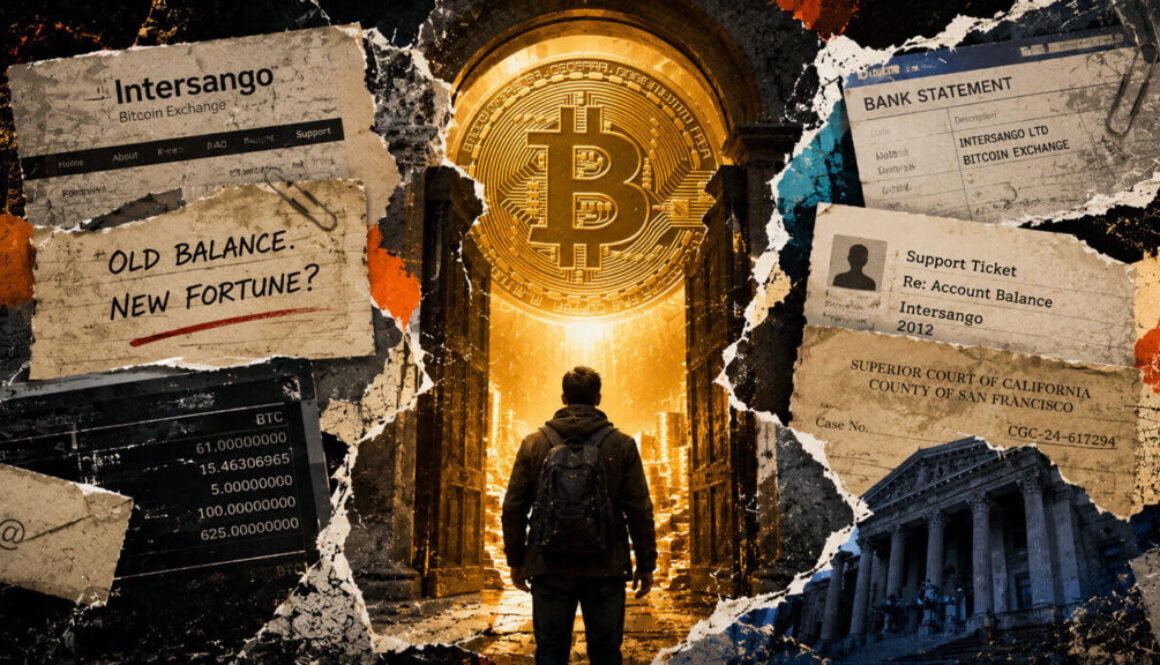
CEL Solicitors says it has traced more than 5,500 BTC that it believes belong to former users of Intersango, an early Bitcoin exchange that disappeared more than a decade ago.
At Bitcoin’s current price near $78,824, those coins carry a value of roughly $433.5 million.
One former UK customer has already recovered 61 BTC from the exchange’s remains, giving other users a concrete example of an old balance turning into a successful ownership claim.
The investor instructed CEL on Jan. 20, and the case settled on May 28, returning all 61 coins, now worth about $4.81 million.
CEL says former Intersango users may have claims against the more than 5,500 BTC it has traced, and each claimant needs evidence connecting an old account balance to the assets.
That requirement places unusual value on records created during Bitcoin’s earliest years. Emails, bank statements, support tickets, and account records that once documented balances worth a few dollars can now support claims worth millions.
Claim / balance
BTC amount
Approx. value at $78,824 BTC
Why it matters
CEL traced pool
5,500 BTC
~$433.5M
Potential scale of unresolved Intersango user claims
Successful UK recovery
61 BTC
~$4.81M
Proof that an old balance can become a successful claim
Separate alleged court balance
15.463 BTC
~$1.22M
Shows another identifiable balance exists in legal records
2012 Intersango sale batch
625 BTC
~$49.3M
Shows how tiny 2012 values became major claims
Bitcoin turned forgotten balances into fortunes
Intersango operated when Bitcoin still traded in the low double digits. In October 2012, the exchange planned to close its US-dollar market because trading activity had become too thin to justify keeping it open.
The exchange offered 625 BTC for $12.10 each, valuing the entire batch at roughly $7,563 at the time. Those same 625 BTC are worth about $49.3 million at today’s price.
One Bitcoin now represents almost $79,000, while a 10 BTC balance would be worth about $788,000 and 100 BTC would approach $7.9 million.
Old Intersango balance
Value at $12.10 BTC in 2012
Value at $78,824 BTC today
Increase
1 BTC
$12.10
~$78,824
~6,514x
5 BTC
$60.50
~$394,120
~6,514x
10 BTC
$121
~$788,240
~6,514x
61 BTC
~$738
~$4.81M
~6,514x
100 BTC
$1,210
~$7.88M
~6,514x
625 BTC
~$7,563
~$49.3M
~6,514x
CEL says Intersango began winding down during late 2012 as GBP and USD trading ended. The website had gone dark by early 2014, and Companies House records show Intersango Ltd ceased to exist on March 22, 2016.
CEL says useful evidence can include the email address attached to an account, correspondence with Intersango and bank statements documenting transfers to the exchange.
The firm also said obtaining bank records from almost 15 years earlier became a major hurdle in establishing ownership in the 61 BTC case.
California court records place those recovery efforts inside a wider dispute over customer Bitcoin connected to Intersango. A 2025 Court of Appeal opinion in Norman v. Strateman describes allegations that Patrick Strateman closed the exchange, retained Intersango assets, and refused to return customer Bitcoin.
The litigation also involved a settlement intended to protect and return customer assets. The appellate ruling sent that settlement back for judicial review of its fairness, establishing a documented legal framework around unresolved Intersango property claims.
A separate 2025 filing describes another alleged customer balance of 15.46306965 BTC. The filing says Intersango’s customer ticketing system confirmed the balance before the platform disappeared, putting its current value near $1.22 million.
The 61-BTC recovery and the 15.46-BTC court claim show that identifiable balances survived in records long enough to support ownership claims more than a decade later.
The bull case depends on former users finding the evidence
Higher Bitcoin prices give former customers stronger financial incentives to search old inboxes, request archived bank statements, and fund legal work around balances they may have written off years ago.
At $100,000 per Bitcoin, the 61-BTC recovery would be worth $6.1 million. The alleged 15.46-BTC balance would reach about $1.55 million, and CEL’s traced 5,500-BTC pool would reach $550 million.
Even relatively small balances can justify extensive document searches once each Bitcoin carries a six-figure value. A customer who left 5 BTC on Intersango would be pursuing $500,000 at that price.
Modern blockchain tracing adds another layer to the recovery process because investigators can reconstruct asset movements across a public ledger that has preserved transactions since Intersango operated.
Personal ownership still requires records connecting an individual to an exchange account and a specific balance.
That puts users with surviving documentation in the strongest position to test claims against the traced assets. The 61-BTC settlement provides a working example of how that process can reach a resolution even when the exchange disappeared more than a decade earlier.
The bear case is an evidence problem
Bitcoin could fall to $50,000 and still leave CEL’s traced pool worth about $275 million. The 61-BTC recovery would be worth $3.05 million at that price, and the alleged 15.46-BTC balance would remain worth roughly $773,000.
Large balances would still justify expensive recovery work, while smaller claims could become less attractive once legal costs, record retrieval and cross-border proceedings consume a greater share of the potential payout.
BTC price scenario
15.463 BTC alleged balance
61 BTC recovery
5 BTC old balance
5,500 BTC traced pool
$50,000 bear case
~$773K
~$3.05M
$250K
$275M
$78,824 current zone
~$1.22M
~$4.81M
~$394K
~$433.5M
$100,000 bull case
~$1.55M
$6.1M
$500K
$550M
$150,000 extreme bull case
~$2.32M
$9.15M
$750K
$825M
The bigger obstacle is the age of the records. Former users may have lost access to old email accounts, discarded bank statements or deleted exchange correspondence during years when their balances carried little economic value.
Blockchain records can trace coins through wallets and transactions, while ownership claims require evidence tying those assets to a particular user. Customer interests may also intersect with shareholder disputes, procedural rulings and competing claims over assets connected to the former exchange.
CEL’s 5,500-BTC figure defines the potential scale of the property it says it has traced, while the amount that former users recover will depend on how much of that pool can be tied to provable balances.
Thousands of Bitcoin may depend on whether early Intersango users still possess an email, support ticket, or bank statement created when Bitcoin traded for little more than $12.
Anthropic released Claude Fable 5.1 on Tuesday, and the model ships with a lock on its own reasoning. New developer accounts can no longer rewrite a conversation’s history while keeping Claude’s stored thinking in place.
The company calls Fable 5.1 and its restricted sibling Mythos 5.1 the world’s most advanced models for coding and knowledge work. Both went live across Anthropic’s platform, Amazon Bedrock, Google Cloud and Microsoft Foundry.
We’re introducing Claude Fable 5.1 and Claude Mythos 5.1.
Headline pricing has not moved. Fable 5.1 still costs $10 per million input tokens and $50 per million output.
The savings sit elsewhere. Cache reads fall 75% to $0.25 per million. Anthropic puts typical workloads 25% cheaper, and complex agent tasks up to 45% cheaper.
Anthropic’s own scorecard shows the sharpest gain in agentic science work. Fable 5.1 hit 52.6% on Terminal-Bench-Science 0.1, more than double Fable 5’s 24.7%.
The coding lead is narrower. Fable 5.1 took 55.8% on Terminal-Bench 4.0, ahead of Opus 5 at 52.3% and OpenAI’s GPT-5.6 Sol at 37.3%.
Business workflow scores nearly doubled to 31.4% on AutomationBench. Knowledge now runs to June 2026, five months later than Fable 5.
Why the copying protection matters
The quieter change targets rivals. Anthropic stated it plainly in its launch post.
“It is no longer possible for new API accounts to manually edit Claude’s prior context in a multi-turn conversation while preserving the transcript of Claude’s prior thinking.”
That edit trick is a known route into distillation, or training a cheap model on an expensive one’s answers.
Anthropic put hard numbers on the threat in February. It traced over 16 million Claude exchanges to distillation campaigns run through roughly 24,000 fake accounts.
The company named three Chinese labs, DeepSeek, Moonshot AI and MiniMax. Moonshot alone accounted for 3.4 million exchanges.
White House science adviser Michael Kratsios went further in July. He accused Moonshot of copying Anthropic’s flagship model to build its Kimi K3 system. Moonshot has not answered publicly.
The restriction applies only to accounts opened on or after August 31. Older accounts stay exempt, and Claude Code, Cowork and Claude.ai users notice nothing.
Anthropic says every account will face the check on future models. Fable 5.1 retires no sooner than September 1, 2027.