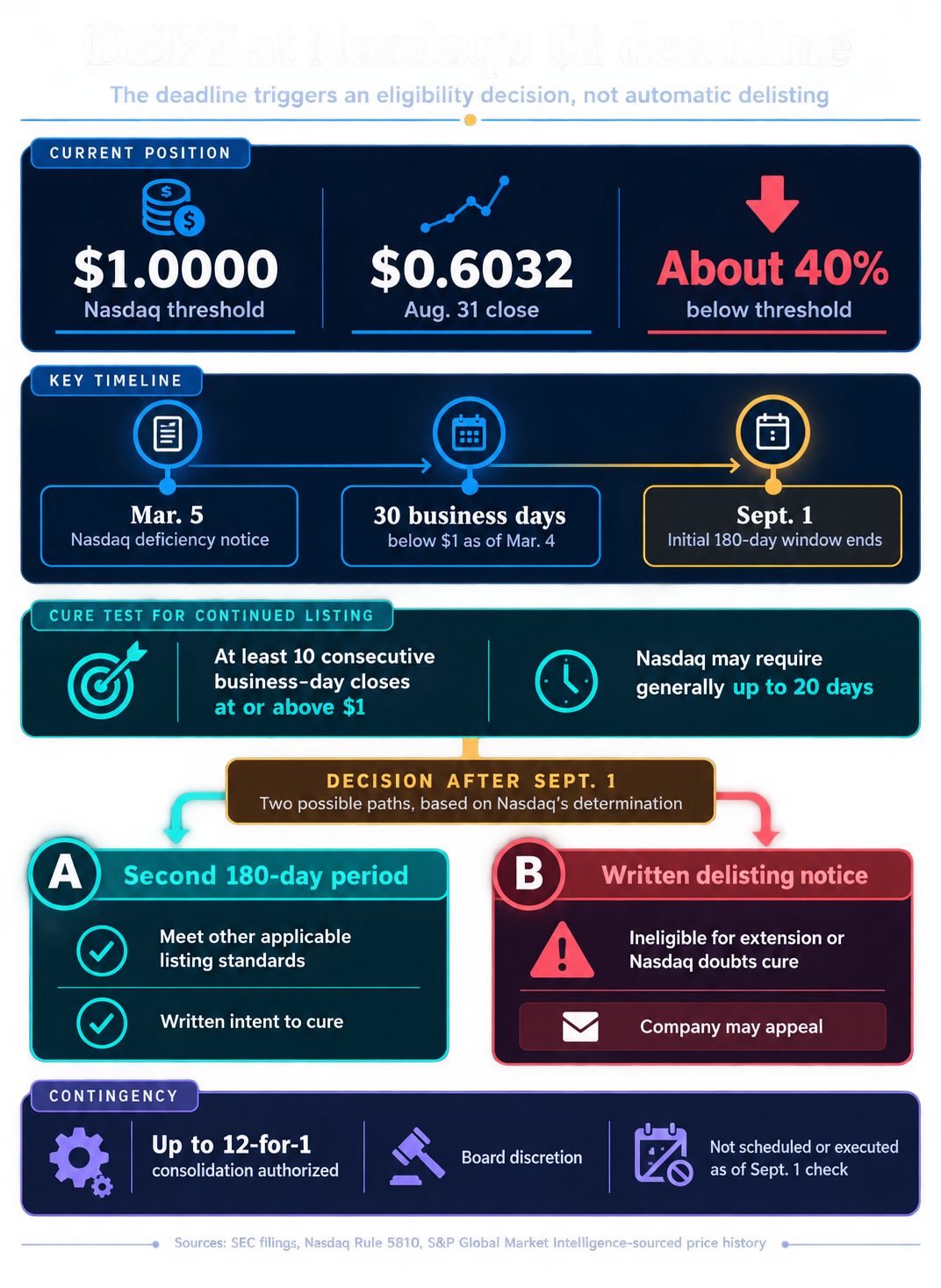
DeFi Technologies reached its Sept. 1 Nasdaq minimum-bid deadline after its US-listed DEFT shares closed Aug. 31 at $0.6032, making it impossible to complete the required 10-business-day streak at or above $1.
The threshold miss moves the company into an eligibility review, with either a second compliance window or a written delisting determination as the next formal outcome.
The stock’s daily history through Aug. 31 showed every August close below $1, so a move above the threshold during the Sept. 1 session could not produce the required consecutive closing-price streak in time.
Nasdaq’s test uses consecutive closing prices. DEFT entered the final day without an active qualifying streak, and the Aug. 31 close was about 40% below the $1 threshold. The company’s March filing also said Nasdaq staff can require generally up to 20 consecutive business days before confirming compliance.
Graphic shows Nasdaq’s $1 threshold, Sept. 1 deadline, cure requirements, and two possible paths for continued listing or delisting.
Extension or delisting notice
Nasdaq can grant a second 180-calendar-day period if DeFi Technologies satisfies the continued-listing requirement for the market value of publicly held shares and all other applicable initial standards for the Nasdaq Capital Market, apart from the bid-price rule.
The company must also notify Nasdaq in writing that it intends to cure the deficiency during the additional period.
If DeFi Technologies does not qualify, or Nasdaq staff concludes it cannot cure the deficiency during a second window, Nasdaq would issue written notice that the shares are subject to delisting. The company could appeal that determination to a Nasdaq hearings panel.
Shareholders have already authorized the board to conduct a share consolidation of up to 12-for-1. The annual meeting circular left the board to decide whether and when to use that authority, making the consolidation a contingency rather than a committed corporate action.
The authorization allows the board to choose a consolidation ratio up to the approved limit before the next annual meeting, or to take no action. That flexibility gives DeFi Technologies a mechanism for addressing the per-share requirement while leaving the decision dependent on its Nasdaq compliance path.
DeFi Technologies’ Aug. 13 management filing still described the company as noncompliant and identified the authorized consolidation as a mechanism available to address the bid-price requirement. Company materials through Sept. 1 showed no scheduled or executed consolidation.
At 11:19 UTC on Sept. 1, the company’s public newsroom and SEC submissions contained no announcement of a second compliance period, a delisting determination, regained compliance, or an executed consolidation.
OKX is cracking down on gambling-linked crypto deposits, founder and CEO Star Xu said. Deposits from high-risk addresses can now trigger anti-money laundering (AML) reviews lasting 15 days or longer.
During that window, account functions and funds may be restricted. OKX will cut off users entirely if their activity is confirmed illicit, Xu added.
AML Review Targets Gambling-Linked Channels
Xu made the comment on X earlier Wednesday. He was responding to a user question about how OKX handles betting platforms that send funds directly into exchange wallets.
Xu flagged transactions tied to “guaranteed” escrow services run through Telegram groups, along with a network he called Huiwang. Huiwang is the pinyin name for Huione Guarantee. The Telegram marketplace processed more than $27 billion in transactions before regulators moved against it in 2025.
Successor platforms, including Tudou Guarantee, have since absorbed much of that volume, according to reports on Chinese-language laundering networks.
“Funds obtained through channels including but not limited to guaranteed transactions in TG groups, Huiwang and its variants, etc., may carry higher source-of-funds risks.”
– Star Xu,
OKX flagged wallets tied to the Huione Guarantee marketplace for compliance checks last year, after US authorities moved against it.
It said at the time it could freeze funds or deactivate accounts confirmed to be linked to the network. The US Treasury’s FinCEN cut the network off from the US financial system in October 2025.
Part of a Wider Compliance Push
The crackdown follows a CertiK finding that AML enforcement now outranks securities cases as crypto’s top regulatory risk. OKX itself paid more than $500 million in AML-related penalties in the United States last year.
Xu has also acknowledged that a small share of legitimate users get flagged by the platform’s fraud checks. OKX faced public backlash in July 2025 after users reported accounts frozen over false fraud flags.
MultiversX has given node operators nine days to prepare for an upgrade designed to make its blockchain 10 times faster.
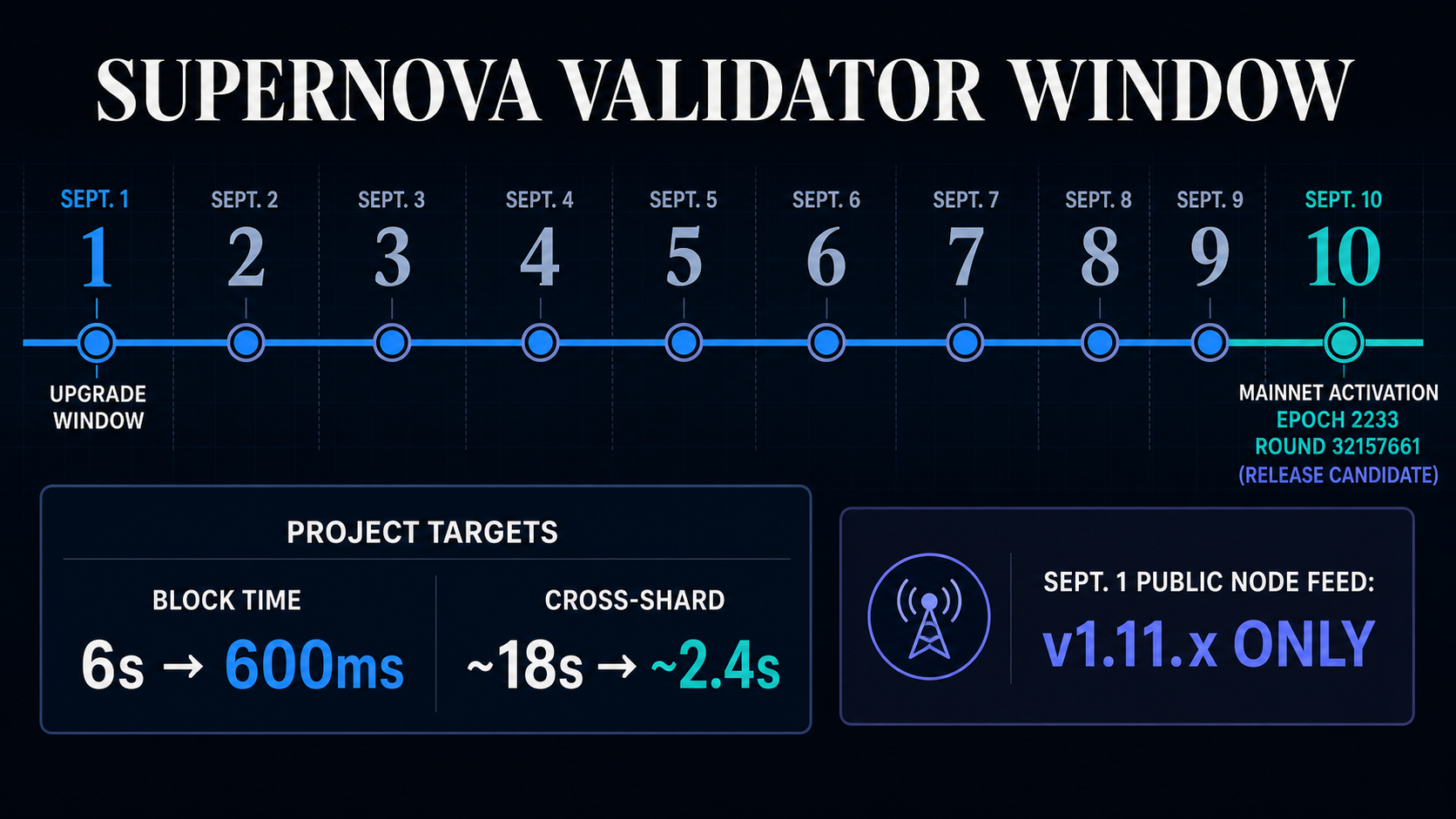
The Supernova upgrade is scheduled to activate Sept. 10 during epoch 2233, cutting block times to 600 milliseconds from six seconds and forcing more than 5,000 nodes to migrate onto software capable of processing the new rules.
The upgrade goes beyond shorter block intervals. Supernova restructures MultiversX’s consensus pipeline so validators can vote on a block while execution proceeds in parallel, removing transaction execution from the critical path that previously constrained block production.
The design is also intended to preserve deterministic finality while pushing intra-shard finality below 250 milliseconds and cutting cross-shard settlement from about 18 seconds to roughly 2.4 seconds.
Meanwhile, MultiversX is keeping its epoch length unchanged and maintaining backward compatibility for addresses, keys, and balances.
The countdown begins as MultiversX’s EGLD token shows renewed momentum. Data from CryptoSlate showed that EGLD crossed $4 over the weekend for the first time since May, reaching about $4.05 before pulling back below the threshold.
Most MultiversX nodes are still on the old software
Early indications show validators are still preparing for the switch.
A mainnet configuration release candidate published Aug. 31 identified round 32157661 as the planned activation point, setting up a coordinated transition during the Sept. 1 to Sept. 10 migration window.
A Sept. 1 check of MultiversX’s public network data showed no visible Supernova migration yet, with 95.35% of its 5,171 nodes still running v1.11.11.0.
That does not indicate the network is behind schedule at the start of a nine-day window. However, it establishes the baseline against which the migration can now be measured.
The stakes rise once Supernova activates.
MultiversX’s validator guidance says processing changes require operators to upgrade so nodes continue interpreting transactions the same way. Old and new binaries can coexist before activation, but once the new rules take effect, an outdated node could produce a different transaction result and lose synchronization with the majority chain.
The transition will also include a temporary slowdown before the faster network takes over.
MultiversX expects mainnet to stop accepting new pool transactions for roughly 240 rounds under the existing six-second clock, equivalent to about 24 minutes, while clearing transactions already in flight. New transactions submitted during that period are expected to remain queued until Supernova begins processing them.
The immediate benchmark is therefore visible before Sept. 10: whether the network’s version mix shifts decisively toward Supernova ahead of round 32157661.
If that coordination arrives on schedule, attention will move to whether the upgrade can deliver its promised speed on mainnet. If a meaningful number of operators remain behind, MultiversX will have to manage the consequences of introducing substantially faster processing across a network that has not fully moved in sync.
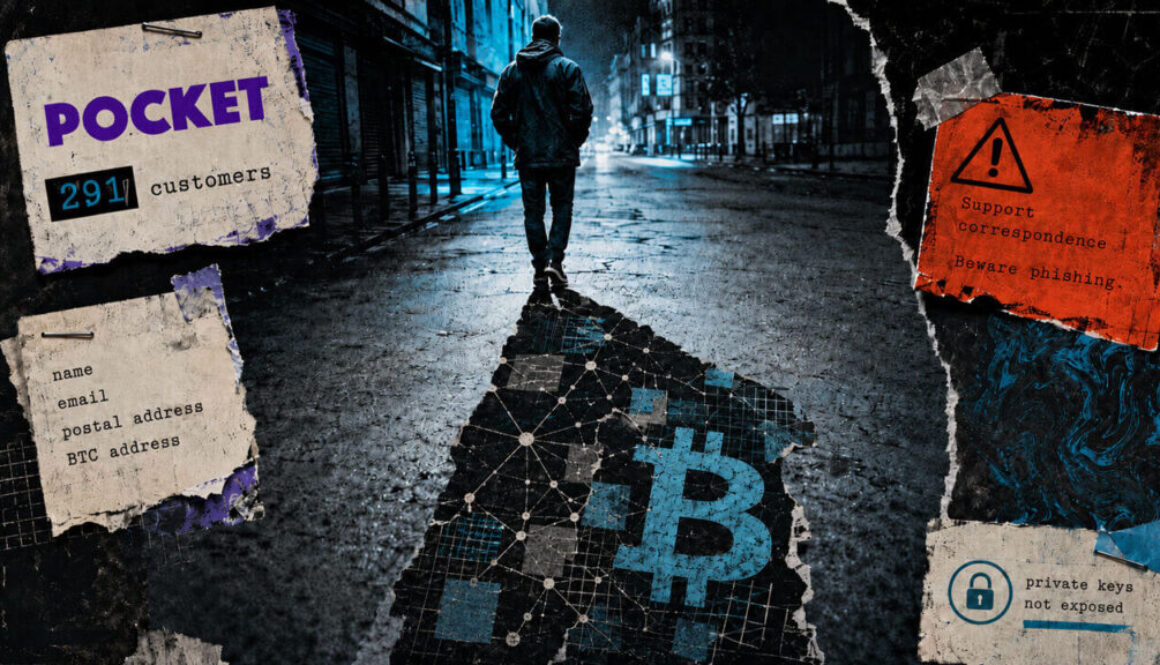
The Pocket Bitcoin breach exposed more than email addresses and support conversations for 291 customers, the company said. Some copied records linked real-world identities to public Bitcoin activity.
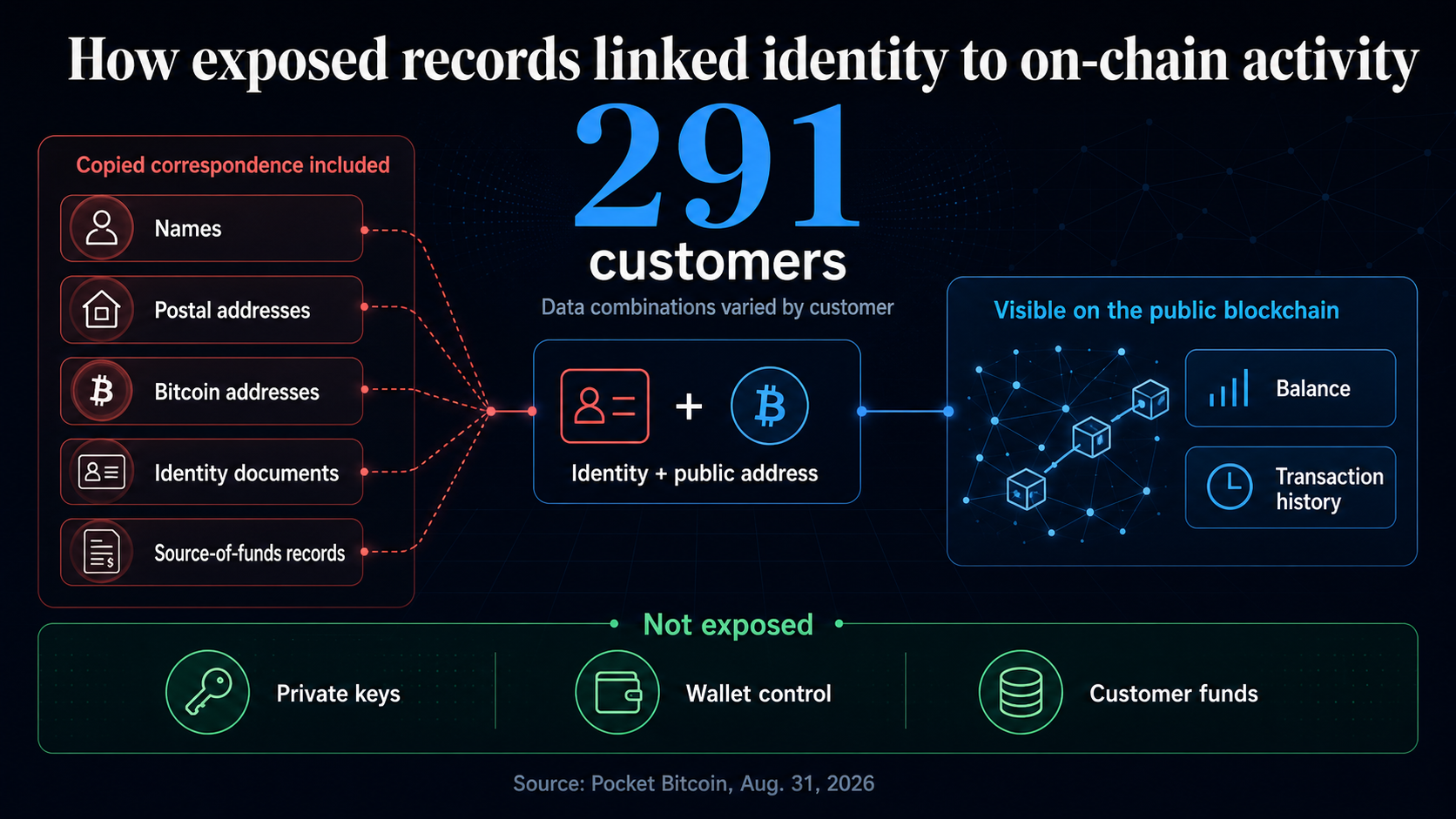
The finding expands the scope described in the Swiss non-custodial Bitcoin service’s Aug. 21 disclosure. In an Aug. 31 update, Pocket Bitcoin said correspondence with partner banks contained varying combinations of names, postal addresses, Bitcoin addresses used for transactions, identity-document copies and source-of-funds records. Most people in the cohort had only some of those fields exposed, the company said.
The distinction creates a privacy and phishing risk without giving an attacker control of anyone’s wallet.
Bitcoin addresses are public. Anyone with an address can inspect its balance and transaction history on the blockchain, as Bitcoin.org’s privacy guidance explains. Connecting an address to a name and, for some customers, a postal address or payment amount removes a layer of separation between a person’s offline identity and public on-chain activity.
The exposed information cannot, by itself, move Bitcoin. Spending requires a valid signature made with the corresponding private key, according to the Bitcoin developer guide. Pocket Bitcoin said it is non-custodial, never held customers’ private keys and saw no risk to customer funds.
The more immediate concern is deception. Pocket Bitcoin warned that details from copied support correspondence could make emails, calls or messages about the incident look more credible. Separately, Switzerland’s National Cyber Security Centre has documented scams and threats that use a recipient’s real home address to increase pressure. That guidance illustrates the broader danger of exposed location data but is not evidence that Pocket Bitcoin customers have been targeted.
How the Pocket Bitcoin breach changed the disclosure
Pocket Bitcoin’s initial disclosure said Bitcoin addresses, its customer database containing know-your-customer data and transaction history were not affected. The company later said that wording was too broad.
Pocket Bitcoin said neither the customer database nor the transaction database was compromised. However, related information was included in some correspondence stored in the affected support system. Payment amounts were often present when exposed records involved source-of-funds documents or discussions of a payment, the company said.
The company said every customer in the 291-person cohort received an individual notice listing the data affected in that person’s case. It also said the forensic investigation and its review of the relevant partner-bank correspondence were complete, the vulnerability had been closed, the incident had been reported to the Swiss Federal Data Protection and Information Commissioner, and a police report had been filed.
Pocket Bitcoin said it had no indication that the copied information had been misused, adding that its current visibility was not a guarantee.
Strategy is buying Bitcoin (BTC) again, but according to President and CEO Phong Le, the decision has little to do with where Bitcoin’s price sits.
Le said the math behind Strategy’s renewed purchases comes down to cost of capital, not market timing.
Why Bitcoin Buying Comes Down to Capital Costs
Strategy’s resumed Bitcoin purchases followed a 10-week pause spent shoring up its balance sheet. Le compared the underlying calculation to financing a data center buildout.
Land and energy costs have climbed, he said, even as the cost of raising capital stayed low.
“We don’t really make decisions on Bitcoin specific to Bitcoin price.”
I joined Bloomberg @crypto to discuss Strategy’s return to buying Bitcoin, building a fortress balance sheet, MSCI’s index proposal, and equity market demand for Bitcoin. $MSTR
00:24 – Back to buying bitcoin:native and why the decision was not price-driven 00:43 – Fortress… pic.twitter.com/YoO8U5FIvf
He said the trade only works when selling shares or debt costs less than Bitcoin’s expected return. Strategy ranked fourth among public companies for equity capital raised this year, behind only SpaceX, Google, and Intel, Le said.
Why Strategy Still Sells, Occasionally
Le rejected the idea that Strategy only accumulates Bitcoin, calling it a “two way strategy” instead. Earlier this year, the company sold about 7,000 BTC, under 1% of holdings, to fund dividends and buybacks.
He said debt holders and ratings agencies expect a company willing to sell assets when needed. A firm that never sells, he argued, is not a “fully operating” company.
Betting on a Sustained Bull Market
Le’s comments suggest he expects Bitcoin’s rally to continue well beyond current levels. He said Strategy would keep buying at $80,000, $90,000, or $100,000, and even at a $130,000 all-time high, arguing today’s purchases would look justified if Bitcoin later climbs to $260,000.
“I don’t foresee us holding Bitcoin as we enter into what I consider a heavy bull market.”
Phong Le, President and CEO, Strategy
That conviction also sits behind Strategy’s fight against an MSCI index removal proposal. MSCI is an index provider whose benchmarks guide passive fund flows.
The proposal would exclude companies with large Bitcoin treasuries, and Le has called it discriminatory.
He argues Bitcoin functions as an operating asset on Strategy’s balance sheet, not a passive holding. That distinction could decide whether Strategy stays in MSCI’s indexes when a ruling arrives October 16.
Wall Street logged its third consecutive losing session Tuesday. Fresh U.S. strikes on Iran sent oil surging, and CNBC’s Jim Cramer says three forces now keep the market, including Bitcoin, volatile.
The Dow fell 419 points and the Nasdaq dropped 1%. Both slides reflect geopolitical shocks, bond market stress, and a hawkish new Fed chair. The 10-year Treasury yield climbed to 4.79%.
Three Forces Rattling Wall Street
The first of the three factors is Iran. Renewed U.S. strikes near the Strait of Hormuz pushed Brent crude up 4.6% to $95.70 a barrel Tuesday evening. U.S. crude closed above $90 for the first time in over a month.
The second factor is the Federal Reserve. Federal Reserve Chair Kevin Warsh has signaled he would raise rates even at the cost of a recession.
Cramer compares him to former Fed Chair Paul Volcker, another inflation hawk. Traders now put the odds of a September rate hike at 66%, up from about 40% a week earlier.
The third is the president himself. Cramer estimates a provocative post on Iran shaves about a quarter point off major indexes. An actual strike can cut markets by half a percent and add two percentage points to oil. He calls it a volatility premium with no fixed expiration.
Cramer’s team also trimmed data center exposure ahead of the November election, wary of political risk to AI names. They kept core holdings in Nvidia and Apple.
Bitcoin has slipped below $77,000 briefly. Image Source: BeInCrypto
Investors trimmed exposure across both stocks and crypto. Ether slid alongside bitcoin as traders cut risk broadly across the sector. Cramer’s investing club raised cash to more than 15%, the highest level in its 25-year history.
He is betting the whipsaw continues until Iran’s conflict eases or the Fed’s path becomes clearer. The next test arrives Friday, when the August jobs report could reshape rate-hike expectations further.
At three in the morning, an AI system can evaluate a trade flow, verify a contract and trigger a cross-border payout in seconds. The payment may still sit in a correspondent bank queue for days. Corporate software now operates at machine speed, while the financial infrastructure beneath it still keeps banking hours.
That timing gap is the structural challenge. The financial architecture underneath these autonomous workflows has failed to experience a corresponding modernization.
Sophisticated, automated software layers now sit on top of traditional banking rails that remain bound by manual processes, legacy clearing schedules, regional banking hours and standard multi-day settlement timelines. This systemic divergence creates an immediate operational mismatch.
An enterprise cannot maximize continuous, automated commerce when its settlement infrastructure relies on decades-old technology designs.
Deconstructing the Multi-Intermediary Chain in Global Commerce
To understand why traditional clearing mechanisms introduce severe latency, it is necessary to examine the specific structural plumbing of international trade finance. Legacy institutional settlement networks do not transfer value natively; instead, they pass transactional instructions across sequential databases.
When a global payment moves across traditional banking channels, the underlying instruction must migrate through a fragmented array of payment gateways, domestic clearing houses, central banking networks, and multiple intermediary correspondent institutions.
Each individual leg of this journey introduces an additional layer of ledger reconciliation, manual compliance verification, localized operational hours, and distinct fee structures.
For instance, an international payment initiated late on a Friday afternoon from a financial hub in Singapore may not achieve final settlement at its destination bank in São Paulo until the following Wednesday.
The software system determines the optimal allocation of capital and fires the transaction instruction in milliseconds, yet the financial infrastructure requires five business days to clear the funds.
This prolonged processing latency introduces counterparty risk and ties up critical corporate liquidity. For international trading firms, working capital remains locked in transit and unavailable for deployment.
The resulting operational friction forces human intervention back into workflows designed for automation, creating a structural drag on global capital velocity.
Solving this infrastructure deficit requires moving away from fragmented vendor arrangements. When institutions attempt to stitch together separate partners for execution, asset storage, and fiat connectivity, they merely replicate the inefficiency of the legacy banking system.
Software agents requiring instant settlement cannot be delayed by internal transfers between an isolated over-the-counter desk, a third-party custodian, and an external payment gateway. True efficiency demands one platform where money moves.
SCRYPT follows this integrated model, combining execution, segregated custody and multi-currency settlement on one platform. Keeping the transaction lifecycle in one place reduces internal hand-offs and can limit reconciliation delays and vendor counterparty exposure.
Recent findings from the Bank for International Settlements highlight that stablecoins do not operate as uniform instruments across networks. The same stablecoin issued on two blockchains exists on separate ledgers; bridging capital between them introduces costs, settlement delays and operational exposure.
When trading, custody and payment rails span providers and chains, reconciliation failures and counterparty exposure compound. Overcoming this fragmentation requires an integrated framework capable of handling cross-chain settlement as one connected system.
Figure 1. Stablecoin fragmentation across blockchains. Source: BIS Annual Economic Report 2026, Graph 3 (published June 23, 2026; data through 2025).
The Technical Bottleneck: Protocol Performance vs. Settlement Plumbing
As institutional developers seek to resolve this settlement bottleneck, the nature of digital asset networks is undergoing a fundamental shift. With the deployment of high-performance blockchain protocols capable of processing massive transaction volumes, technical transaction throughput is no longer the primary constraint for institutional adoption. The core operational bottleneck has migrated entirely from protocol engineering down to the underlying custody and settlement plumbing.
True institutional integration relies on agnostic infrastructure. This requires the implementation of management platforms that allow corporate treasuries to clear and settle value across stablecoin rails seamlessly, without requiring institutions to alter their day-to-day corporate financial workflows or interface directly with the complex technical elements of public ledgers.
The enterprise at the end of the chain should experience settlement that completes in real time, without changing how it already works.
Structural Exhaustion and Emerging Market Infrastructure
This operational reality is already dictating corporate behavior within emerging markets, where the adoption narrative has completely moved past speculative retail trading. In economic regions characterized by persistent foreign exchange shortages, systemic currency devaluation, and fragmented local banking systems, enterprise treasury teams are turning to digital settlement rails out of absolute necessity.
In liquidity corridors across Sub-Saharan Africa and Latin America, businesses encounter friction when accessing international clearing currencies through correspondent banks. Local currency conversion adds costs, delays supplier payments and exposes companies to volatility during multi-day clearing cycles. Some enterprises are using reserve-backed stablecoins to execute faster cross-border settlements.
Cross-border settlement across East Africa, without the dollar detour:
Local currency in (KES, TZS, RWF or UGX), through a local partner.
One licensed transaction. Stablecoin out. Ready to settle.
No queuing for scarce bank dollars. No stacked FX spreads. Corridors are live… pic.twitter.com/SxubsHIHQZ
This paradigm shift represents a clear structural exhaustion with legacy infrastructure that fails to satisfy modern commercial requirements. Emerging market businesses use real-time T+0 settlement to rotate working capital efficiently, manage foreign exchange risk, and protect tight operating margins. In these environments, stablecoins are no longer viewed as alternative financial assets; they are functioning as essential infrastructure for daily commercial survival.
SCRYPT applies this model through multi-currency settlement infrastructure that connects local market exposure with reserve-backed stablecoins and major fiat currencies. For businesses in volatile economies, such platforms can support real-time pricing and faster international B2B payments while reducing reliance on correspondent banking.
Jurisdiction as Architecture
The expansion of digital settlement infrastructure has created another operational challenge: navigating a fragmented regulatory landscape. With major economies enforcing distinct frameworks, compliance has become an exercise in structural architecture.
A stablecoin authorised under one jurisdiction’s regime may require separate authorisation under another’s before it can be used the same way. Cross-border tax reporting initiatives such as the European Union’s DAC8 framework and the OECD’s Crypto-Asset Reporting Framework (CARF) are also turning compliance into an infrastructure problem. Audit controls, automatic reporting and verification mechanisms must sit within the settlement plumbing. Jurisdictional choices lock in banking relationships, asset segregation standards and supervisory obligations that are costly to alter later.
This environment puts a premium on jurisdictions with mature, substantive financial oversight and long experience of supervising digital assets. Switzerland is one of them. Its principles-based approach accommodates new transactional structures while holding institutional-grade compliance standards, which is part of why it has become a base for firms building settlement infrastructure.
Because a principles-based model focuses on substantive risk management, it travels well. Infrastructure anchored to a FINMA portfolio manager licence alongside VQF supervisory membership can work with counterparties across regions, provided each market’s framework is addressed separately. That is deliberate, institutional-grade architecture.
Building for the Permanent Design Constraints of Global Commerce
The friction between regional regulatory frameworks and fragmented legacy clearing chains is a permanent condition of the global economy. Institutions and enterprises must treat it as a design constraint and build their infrastructure accordingly.
The broader market trajectory reinforces this structural migration. Stablecoins have evolved from niche digital assets into an increasingly important layer of global financial infrastructure, with growing adoption across enterprise treasury, cross-border payments, and institutional settlement. This trajectory indicates that the migration of enterprise treasury operations onto digital asset rails represents a lasting shift in global finance rather than a temporary market cycle.
Figure 2. Stablecoin market capitalization remains concentrated in USDT and USDC. Source: BIS Annual Economic Report 2026, Graph 2 (market data as of May 29, 2026).
To scale securely within this framework, global institutions must replace vendor fragmentation with an integrated platform design. Utilizing multiple disparate counterparties for trading, custody, and stablecoin execution introduces unacceptable operational risk and reconciliation overhead. Enterprises require a single point of access, where trading, custody and settlement sit on one platform rather than across three vendors reconciled after the fact.
Execution quality determines whether institutional digital asset infrastructure can support global enterprise operations. Anchoring a technology stack within Switzerland’s regulatory environment enables providers like SCRYPT to combine deep liquidity, segregated multi-party computation (MPC) custody and instant automated clearing. This lets enterprises deploy capital without carrying the operational burden of fragmented infrastructure.
Software automation can complete financial and operational analysis at machine speed. The infrastructure used to settle those outcomes must align with that velocity. Automated commercial networks already operate around the clock. Institutional capital must follow. The standard is one platform, where money moves.
The anonymous leaker behind CyberLeek has reportedly pocketed roughly $350,000, according to on-chain analyst Conor Grogan. The funds allegedly came entirely from liquidity fees rather than direct sales.
The withdrawal coincided with a sharp price decline for the CYBERLEEK meme coin.
The Mastermind Strategy Behind CyberLeek
Grogan stated on September 1 that the person behind CyberLeek withdrew the funds through various OTC providers, a route that converts digital assets into conventional money without requiring large open-market token sales.
That structure differs meaningfully from a typical launch-and-dump scheme. Rather than offloading large CYBERLEEK holdings directly, the wallet tied to the project reportedly profited by collecting fees whenever other traders transacted in its liquidity pool.
The GTA 6 hacker, responsible for the Cyberleek coin, has cashed out about $350k, entirely from LP fees. They have washed funds through a variety of OTC providers
This mechanism depends entirely on sustained trading activity. The viral GTA VI leaks appeared to provide exactly that fuel, drawing in buyers and speculators with each new clip, even as rising volume exposed participants to greater volatility and potential losses.
CyberLeek Launch Timeline
Blockchain researchers traced the CYBERLEEK token’s launch to August 15. The Solana-based asset accompanied each new leak as part of a broader campaign, though the identity behind the controlling wallets remains publicly unconfirmed.
Rockstar Games acknowledged the leaks on August 26, calling the situation heartbreaking, but did not publicly name CyberLeek or draw a definitive conclusion about the leaks’ origin. The studio has since filed federal subpoenas targeting Microsoft and Discord to further the case.
As of the latest reading, CYBERLEEK traded near $0.002959, down 25.6% over 24 hours, according to CoinGecko data, with a market cap of $2.17 million and 24-hour trading volume of $2.69 million.
The token’s price has swung sharply in a single day, ranging from $0.0024 to $0.0041. It now trades roughly 91% below its all-time high, reached on August 23.
Artificial intelligence could usher in a new wave of concern over financial privacy, according to a Grayscale research report. The firm’s Head of Research, Zach Pandl, expects AI to create new privacy threats and drive demand for new solutions.
He sees Zcash as one potential option.
Zcash For Blockchain Privacy
Public attention to financial privacy has historically increased alongside major technological changes. The first wave came in the 1970s, when computers enabled the digitization and automation of financial record-keeping. A second wave followed in the 1990s with the expansion of the Internet and growing concerns over online privacy.
Grayscale believes a third wave has now begun as AI becomes more widely used. Pandl said AI tools are likely to create new privacy challenges across the economy, and the issue is particularly pressing for public blockchains that are transparent by default.
For instance, on the Bitcoin network, every transaction is recorded on a public ledger and can be viewed by anyone. When blockchain activity is linked with off-chain information, user addresses could potentially be de-anonymized, a risk also noted in the Bitcoin white paper.
While that risk existed before AI, Grayscale said advances in the technology could make blockchain address labeling more effective and widely available, increasing the need for privacy protection. Unlike Bitcoin, Zcash offers additional privacy features through shielded transactions, which use zero-knowledge cryptography to conceal both the addresses involved in a transaction and the amount being transferred. Grayscale said this privacy feature could become a “must-have” for users who prioritize financial privacy.
Grayscale had made a similar point earlier, while noting that ZEC had surged about 20 times in the past year but was still worth less than 1% of Bitcoin’s market cap. The firm said Zcash’s privacy features and other advantages may not be fully reflected in its current valuation, which leaves room for further gains.
The comments come days after Grayscale converted its Zcash Trust, launched in 2017, into a spot ZEC ETF. The fund began trading on the NYSE Arca on August 25.
$1,800 Target
ZEC has posted a strong performance. The privacy-focused crypto asset gained nearly 80% over the past month alone. Following the sharp rally, ZEC is trading around $850, but crypto analyst Ali Martinez is betting on further upside.
He said that “Zcash is about to melt faces,” while identifying $1,800 as the “first stop.”
Prediction-market exchange Kalshi has permanently banned former US Rep. George Santos from accessing the platform after its Compliance Department found “reasonable cause to believe” that he engaged in insider trading and market manipulation.
The lifetime ban, effective August 28, 2026, is the first permanent penalty of its kind imposed by Kalshi on a user.
Penalty and Lifetime Ban
According to the official compliance document, Santos traded in markets linked to whether he would attend the State of the Union address on February 24, despite being prohibited from trading in those markets because he was capable of influencing the outcome of the underlying event. Kalshi said Santos placed a series of large trades between February 2 and February 25 in contracts whose results depended on his own attendance.
The platform said Santos materially benefited from the activity and earned $17,839.57 from the targeted markets. Alongside the permanent suspension of direct and indirect access to the exchange, the Compliance Department has also imposed a $71,356 penalty.
In response to the development, Santos took to X to attack Kalshi and accused the latter of violating its own notices and deadlines. He said that the August 7 notice allegedly gave his side 30 days before the latest action, as he questioned why the exchange had announced “frivolous nonsense” before that period was over.
“Leaking and attention seeking seem to be the M/O of this organization. Pathetic!”
The action comes after a settlement Santos reached last month with the Commodity Futures Trading Commission, which has said it has jurisdiction over prediction markets. He agreed to pay $35,000 under the settlement but did not admit or deny the agency’s findings. His counsel, Joseph W. Murray, said Santos cooperated with the CFTC.
The former congressman was expelled from the House of Representatives in 2023 after facing federal charges. In April 2025, he was sentenced to more than seven years in prison after pleading guilty to wire fraud and identity theft. In October of that year, Trump announced that he had commuted the sentence, and Santos was released after serving less than three months.
Kalshi had previously suspended three US political candidates after finding they bet on election outcomes they were directly involved in, while calling the activity “political insider trading.”
More Heat on Prediction Markets
Prediction-market platforms face growing scrutiny from regulators and lawmakers. Last month, Baltimore officials sued Kalshi and Polymarket, alleging that their sports prediction contracts amount to unlicensed sports betting and can mislead consumers about their legal and regulatory status.
Meanwhile, Kalshi is also fighting a lawsuit from New York Attorney General Letitia James. The exchange has separately faced a lawsuit from FlightAware over flight-related markets, although that case was withdrawn shortly after being filed.