Bitcoin falls 4% as crypto researchers debate quantum computing threats
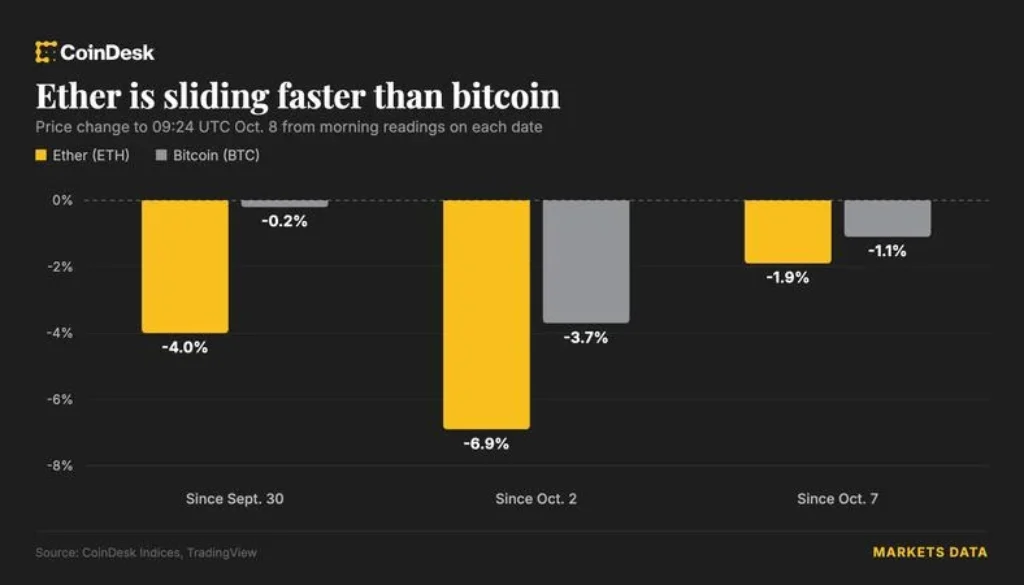
Bitcoin has retreated nearly 4% from this week’s highs as crypto researchers clash over the urgency of preparing for potential quantum computing threats to wallet security. The divergence in expert opinion reflects broader uncertainty about both the timeline and appropriate response to AI-driven cryptographic risks.
- Bitcoin dipped to $82,300 before recovering to $82,800, down 4% from Tuesday’s peak near $86,600.
- Ethereum Foundation researcher Justin Drake’s X post on quantum threats received nearly 4 million views and urged “bunker mode” planning.
- Vitalik Buterin acknowledged the AI-math risk as real but advised against panic, while Samson Mow dismissed the warning as unfounded.
- $82,800 Bitcoin’s price following Asian trading decline from Tuesday high
- 5.71% 30-year Treasury yield ahead of $22 billion bond auction
- 722 Mathematical results released by OpenAI this week, cited as evidence
- 9% Algorand’s gain following quantum-resistant cryptography focus
Bitcoin extended losses during Asian trading on Thursday (October 8), dipping to approximately $82,300 before recovering to around $82,800, roughly 4% below Tuesday’s (October 6) high near $86,600, according to CoinDesk reporting. The CoinDesk 100 index fell close to 2% over the preceding 24 hours. The price movement coincided with intensifying debate within the crypto industry over how to respond to potential quantum computing threats to cryptographic security protocols.
Drake’s quantum risk warning sparks contrasting reactions from industry figures
Ethereum Foundation researcher Justin Drake posted on X, attracting nearly 4 million views, calling for the industry to prepare for what he termed “bunker mode” in response to AI-driven advances in mathematics. Drake argued that the elliptic-curve signatures securing bitcoin and ether wallets face potential compromise within “months not years” and recommended a gradual migration of funds to new addresses whose public keys have never been exposed. He cited OpenAI’s release of 722 mathematical results this week as evidence supporting the urgency of preparing defenses.
The warning did not achieve consensus. Ethereum co-founder Vitalik Buterin acknowledged that AI-accelerated math poses a real risk but advised holders against scrambling to move funds, suggesting the threat warrants attention without warranting panic-driven action.
Jan3 CEO Samson Mow took a harder line, dismissing the concern outright and telling followers there was no need to panic “because an Ethereum researcher is saying silly things.”
Treasury yields and Fed rate expectations add to market pressure on risk assets
Concurrent pressure from bond markets has weighed on digital assets alongside the debate over quantum risks. The 30-year Treasury yield climbed 4 basis points to 5.71%, while the 10-year rose to 5.32%, according to CNBC reporting, ahead of a $22 billion 30-year bond auction scheduled for Thursday afternoon.
Minutes from the Federal Reserve’s September meeting, released Wednesday (October 7), showed all 19 officials backed the previous month’s interest-rate increase, with most viewing another rate increase as appropriate by year-end.
The September consumer price index, due October 14, represents the final inflation data before the Fed’s October 28 decision on rates. Bitcoin’s sensitivity to interest-rate expectations has tied its recent weakness partly to rising Treasury yields and the prospect of persistent rate pressure through year-end.
Quantum-resistant token valuations surge while AI-linked assets decline
Market movements in individual crypto assets reflected investor positioning around the quantum computing debate. Algorand led the CoinDesk 100 with a 9% gain since midnight, benefiting from network promotion of post-quantum Falcon signatures for state proofs. Starknet, whose proofs rely on hash-based cryptography, added 4%. By contrast, privacy-focused tokens fell, with Zcash dropping 6% to around $1,240 and midnight losing 8%, while Monero edged up 0.5%.
DeFi tokens showed mixed signals absent a clear bullish catalyst. Solana-linked tokens rebounded from Wednesday’s selloff, with jupiter gaining 15% over 24 hours, raydium rising 14%, and jito advancing 10%, each having fallen 6% to 8% a day earlier. AI-focused tokens extended their losses, with bittensor down 6%, venice falling 7%, and grass also dropping 7%.
The BlockWest read. We’re watching whether Drake’s framing of quantum risk as imminent changes institutional custody practices or merely prompts security audit upgrades. The disagreement between serious researchers like Buterin and alarmists like Drake matters less than whether exchanges and custody providers treat this as a timeline-specific migration need or a longer-term engineering problem requiring post-quantum signature standards, not emergency fund movements.
The market will track Fed speakers and rate-decision expectations between now and October 28, when the central bank announces its next move, while security researchers monitor whether major wallet and exchange providers adopt Drake’s migration framework or Buterin’s measured approach to quantum-resistant cryptography implementation.
BlockWest is a news publication. Nothing here is investment advice. Read our disclaimer and editorial policy.