Bitcoin’s one-year HODL wave reaches 63.3% but doesn’t prove accumulation alone
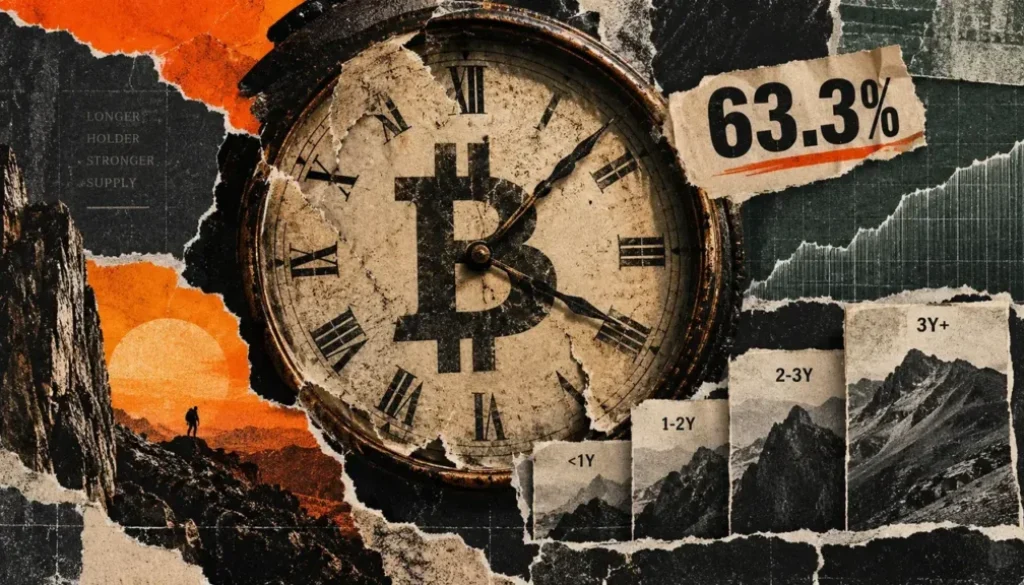
Bitcoin’s one-year HODL wave reached 63.3% of supply this month, but the metric alone does not prove accumulation or bullish intent. On-chain age distribution can shift for reasons unrelated to fresh buying, including wallet transfers and natural boundary crossings, making it essential to cross-check this signal against exchange flows and spending patterns.
- Bitcoin supply that last moved at least one year ago rose to 63.3% on September 18, up 0.98 percentage points from August 18.
- The one-to-two-year band grew to 14.57% from 13.52% while the six-to-twelve-month band fell to 17.53% from 19.10% over the same period.
- The metric shows aging but not necessarily new accumulation, requiring corroboration from exchange flows and entity-adjusted balance data.
- 63.3% Bitcoin supply with last on-chain movement one year ago or longer
- 1.05pp Growth in one-to-two-year HODL band from August to September
- 7.03% Supply moved within the last month, down from 7.30% a month prior
- 1.57pp Decline in six-to-twelve-month band over the same measurement period
Bitcoin’s HODL waves have drawn attention as a potential indicator of on-chain supply dynamics, with the one-year threshold reaching its highest share in recent months. HODL waves, measured by Maketo and Glassnode, group Bitcoin’s unspent transaction outputs into age bands based on when they last moved on-chain. The rise to 63.3% on Friday (September 18) from 62.32% the prior month might appear bullish at first glance, but the underlying data tells a more nuanced story about supply dynamics. The story was first reported by CryptoSlate.
The boundary crossing effect masks true Supply movement
The paired shifts between adjacent bands reveal a mechanical explanation for the rising one-year share. The one-to-two-year band increased 1.05 percentage points while the six-to-twelve-month band fell 1.57 percentage points, a near-perfect offset that points to coins simply aging across the one-year threshold through inactivity rather than fresh buying decisions. Under HODL wave methodology, any output that remains unmoved automatically advances into older cohorts as it crosses each age boundary, independent of whether that output represents deliberate accumulation or passive neglect.
Coins that last moved roughly a year ago need only remain still to cross into the one-to-two-year bracket, creating the appearance of supply concentration without any new capital entering the market.
Wallet transfers and lost coins create attribution uncertainty
The HODL wave metric does not distinguish between intentional holding and forced immobility or internal transfers. A transfer between wallets controlled by the same entity, such as a custodian moving funds internally, resets an output’s age clock and makes it appear young despite unchanged beneficial ownership. Conversely, lost coins remain in the oldest bands indefinitely without representing any conscious decision to hold.
Coinbase provided a concrete example of this problem in November 2025 when it executed an internal wallet migration for fund management purposes. The firm warned that the on-chain volumes generated by that migration would dwarf normal market activity, creating misleading signals about investor selling or buying behavior unrelated to any actual change in market conditions. That episode, while not identified as the cause of the current shift, illustrates why on-chain age metrics alone cannot resolve whether supply is genuinely accumulating or simply being reshuffled within institutional custody.
Fresh accumulation requires corroboration beyond age data
The September 18 readings show that Bitcoin’s on-chain age distribution grew older and that supply moved within a month declined to 7.03% from 7.30%. These facts establish an aging signal but do not prove that new demand has emerged or that accumulation is occurring. Available-for-sale supply, liquid-supply tightening, entity-adjusted balance changes, exchange inflows and outflows, and spending behavior across wallets all remain unmeasured by HODL waves alone.
Until metrics tracking exchange flows, entity-level balance changes, and spending patterns align with the rising one-year wave, the aging signal cannot be interpreted as proof of fresh accumulation or bullish positioning.
The BlockWest read. The rising HODL wave suggests tighter on-chain supply, but tightness is not the same as demand. Large holders or custodians may simply be keeping coins offline for security or operational reasons, rather than entering a fresh buying phase. For institutions evaluating accumulation narratives, the metric flags that fewer coins are moving monthly, yet that stillness must be paired with evidence that new capital drove the hoarding rather than inertia or institutional consolidation.
Watch for the next reporting of exchange inflows and entity-adjusted balance sheet data from firms including Glassnode and CryptoQuant. Those metrics will determine whether Bitcoin’s aging supply reflects genuine fresh demand or merely coins crossing calendar thresholds while ownership remains unchanged.
BlockWest is a news publication. Nothing here is investment advice. Read our disclaimer and editorial policy.