
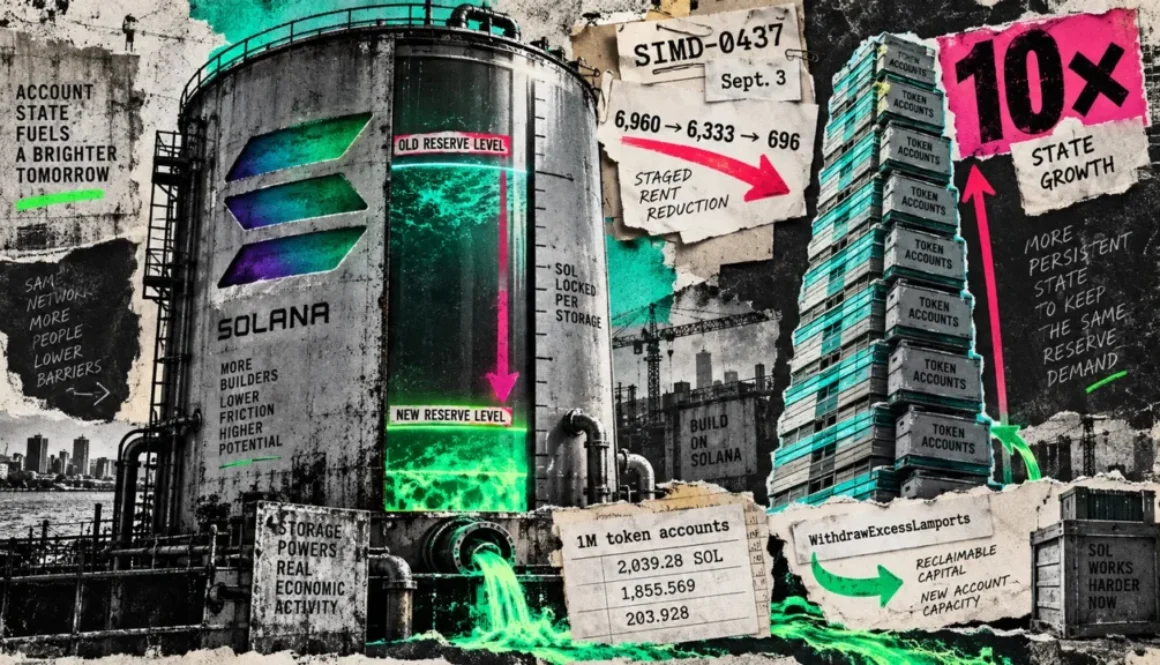
Solana’s plan to cut account deposits to 10% of current levels could weaken a major reason investors hold SOL tokens
Solana’s phased rent reduction plan could free up significant SOL reserves currently locked in account storage, but the changes also reduce a meaningful economic incentive for holding the token. How developers and users redeploy this capital will shape whether the network gains competitive advantage or simply redistributes existing value.
- Solana implemented a 9% rent reduction on September 3, with a full 90% reduction planned across five stages through November.
- A hypothetical one million standard token accounts would require 203.928 SOL in reserves after all reductions, freeing approximately 1,835.352 SOL from current lockup.
- The freed capital represents only 0.000314% of circulating supply, but behavioral shifts in how developers allocate capital could drive larger indirect effects.
- 9% Rent reduction implemented on mainnet September 3 against full planned 90% reduction
- 696 Target lamports-per-byte parameter under SIMD-0437 specification versus 6,960 baseline
- 1,835.352 SOL Capital freed in one-million-account scenario after all reductions versus current lockup
- 0.000314% Freed reserves as share of 585.36 million SOL circulating supply
Solana activated the first phase of its rent reduction initiative on September 3 at epoch 1028, lowering the reserve parameter from 6,960 to 6,333 lamports per byte. The change allows existing account holders to recover excess SOL previously required for storage maintenance and reduces the upfront capital developers and service providers must commit to create new accounts on the network. The Solana Foundation’s complete five-stage plan targets a 90% reduction in account storage costs, with final reductions scheduled to arrive alongside Agave 4.4 in November, subject to network monitoring and validation.
The rent reduction initiative reflects broader industry conversations around blockchain economics and user experience. As Solana has scaled, the minimum balance requirements for creating token accounts and other on-chain entities have presented friction for developers building consumer applications, particularly in emerging markets where SOL holdings may represent meaningful capital expenditure. By reducing these barriers, Solana aims to improve developer onboarding and reduce the capital requirements for building at scale on the network.
How Account Reserves Function Under the New Structure
Solana’s “rent” system maintains a recoverable balance against account storage rather than functioning as an ongoing fee to validators. Under the SIMD-0437 specification governing the reduction, the final target is 696 lamports per byte. The minimum reserve requirement is calculated by multiplying an account’s data size plus 128 bytes of overhead by the current lamports-per-byte parameter.
A standard token account containing 165 data bytes results in an effective size of 293 bytes. At the baseline before any changes, one million such accounts would require 2,039.28 SOL in total reserves. After the September 3 reduction, that figure dropped to 1,855.569 SOL. If all five planned reductions activate as scheduled, the requirement would fall to 203.928 SOL, translating into approximately 1,835.352 SOL freed from locked reserves.
This calculation illustrates fixed account populations; a broader inventory with varying sizes and balances would produce different aggregate totals.
Capital Recovery Rights and Behavioral Incentives
Existing token accounts with balances above the current minimum can access reclaimed capital through an instruction called WithdrawExcessLamports, which recovers excess SOL without closing the account or modifying its token balance. However, authorization rights vary by account type. For standard token accounts, the account owner must approve withdrawal. For mints, authorization comes from the mint authority or from the mint account itself if that authority has been revoked. Accounts owned by custom programs require the owning program to provide withdrawal logic and verify the relevant authority.
This distinction carries economic significance. A payments provider that funded a customer’s token account cannot automatically reclaim the deposit surplus, even though it supplied the original SOL. The provider must execute an authorized transaction that maintains the minimum balance intact. The more direct benefit applies to future account creation, where whoever funds a new account needs less upfront capital, potentially allowing providers to support more customer accounts with the same working capital even if customers do not purchase SOL themselves.
Service providers ranging from decentralized exchanges to wallet applications represent primary beneficiaries of the rent reduction. These platforms typically create and maintain accounts on behalf of users, absorbing the reserve costs as part of their operating expenses. Lower reserve requirements directly improve unit economics for user onboarding and allow platforms to serve more customers without proportionally increasing their SOL capital commitments.
Modest Macroeconomic Impact With Uncertain Behavioral Effects
The conditional final reduction of 1,835.352 SOL in the million-account example represents roughly 0.000314% of circulating supply as of September 5, a marginal impact on SOL’s overall token dynamics.
However, the psychological and behavioral effects may prove more significant than the raw numeric impact. Reduced onboarding costs could materially shift developer incentives and adoption patterns over time. How freed capital flows across SOL’s competing use cases will shape the rent reduction’s net effect on token economics. Reclaimed reserves could be staked to earn validator rewards, deployed toward transaction fee payments, or redeployed into additional account creation. The cited materials do not establish any particular outcome as a direct consequence of the rent cut.
The rent reduction also eliminates a source of SOL “sink” that previously removed tokens from circulation. Under the old system, SOL locked in minimum balances represented capital that was economically committed to the network but unavailable for other uses. This created a subtle but persistent incentive for holding SOL across the Solana ecosystem. As these reserves release and redeploy, the network loses this binding mechanism unless developers and users choose to stake or otherwise commit the freed capital.
Solana Foundation researcher Umberto Natale’s July analysis found that 75.5% of account-creation events in the analyzed cohort closed within the same transaction. The research was not deduplicated by address, meaning repeated creation and closure could register as separate events. Such workflows can generate measurable activity while leaving minimal persistent account storage on-chain, making account-creation counts a less meaningful measure of actual storage demand than tracking persistent account bytes and associated minimum reserves.
The timing of the rent reduction coincides with broader competitive pressures in the blockchain ecosystem. Alternative platforms and Layer 2 solutions continue advancing their respective developer tooling and cost structures. By lowering barriers to Solana development, the foundation signals commitment to maintaining Solana’s competitive positioning for cost-sensitive applications and emerging market use cases.
The second reduction to 5,080 lamports per byte is currently on testnet with mainnet deployment expected in mid-September, followed by the final three reductions anticipated with Agave 4.4 in November. Each activation remains subject to review of state growth metrics, and a fallback mechanism exists to restore the original parameter if rapid account proliferation creates unexpected state management challenges.