
Robinhood introduces stock trading on decentralized blockchain platform while memecoin investors venture into new markets
Robinhood’s blockchain-based stock settlement layer has become a venue for memecoin speculation that dwarfs legitimate tokenized equity trading, raising unresolved questions about market integrity and regulatory liability. The divergence between derivative and direct stock token volumes signals a critical test for whether on-chain securities settlement can mature into institutional infrastructure or remains primarily a platform for financial manipulation.
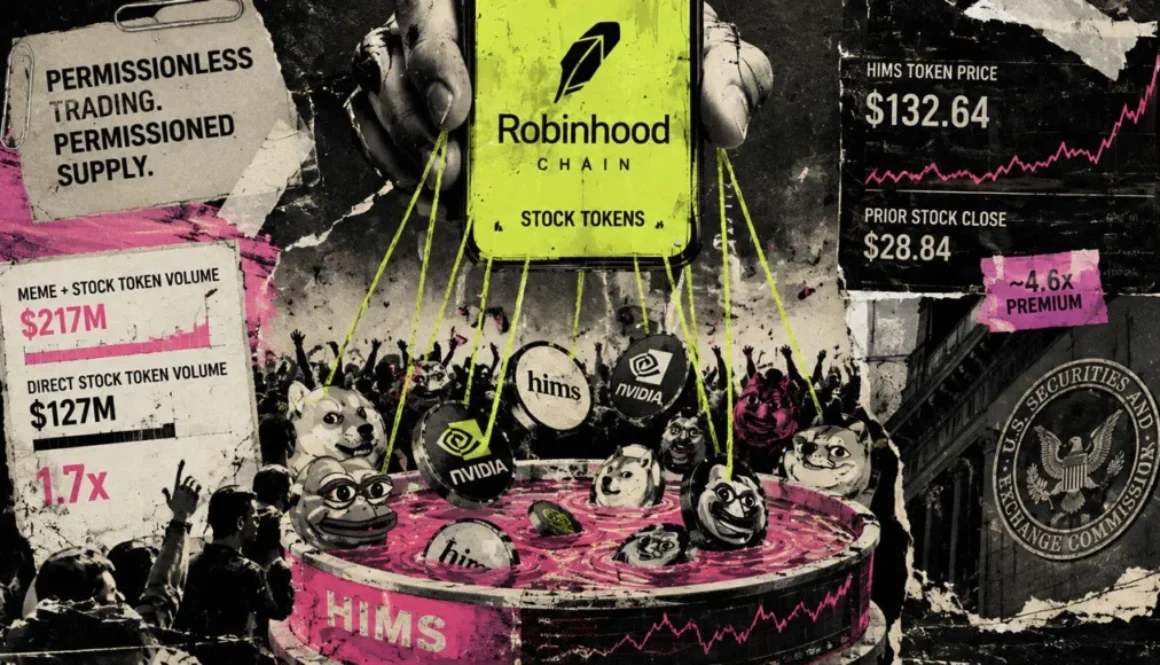
- Memecoin pairs tied to tokenized stocks generated $217 million in volume on September 2, exceeding direct stock token trading by 71% at $127 million.
- A single memecoin called BONER accumulated 53% of all tokenized HIMS shares, pushing the token to $132.64, roughly 4.6 times the stock’s $28.84 closing price.
- Robinhood disclaims control over third-party developers while acknowledging potential legal and reputational consequences from activities on its chain.
- $217M Memecoin-stock-token trading volume versus $127M direct stock token market volume
- 53% Share of HIMS tokenized supply held by single memecoin pool BONER
- 4.6x Peak token print at $132.64 relative to $28.84 stock close
- 0.025% Tokenized HIMS float as percentage of actual equity shares outstanding
Robinhood Chain, launched in April 2024 as a blockchain settlement layer for securities trading, has rapidly become infrastructure for speculation far beyond its original purpose. The platform was designed to enable faster, cheaper settlement of equity trades through distributed ledger technology, positioning itself as a credible alternative to traditional clearinghouses and custody networks. Yet on-chain data from September 2 reveals memecoin pairs tied to tokenized Nvidia and Hims & Hers shares generated substantially more trading volume than direct stock token markets operating on the same network.
The appeal of blockchain-based settlement reflects decades of frustration with the traditional equity market infrastructure inherited from the pre-digital era. Traditional clearing and settlement still require multiple intermediaries, take up to two business days to finalize, and create friction for institutional investors seeking faster capital deployment. Robinhood positioned its chain as addressing these inefficiencies by enabling near-instant settlement and reducing custody costs through cryptographic ownership verification rather than custodian-mediated record-keeping.
However, the speed and permissionless nature of blockchain settlement also created conditions for rapid financialization and abstraction from the underlying equity reference point. Because tokenized securities can be freely paired with any other token in automated market makers and liquidity pools, developers quickly created derivative markets that bore only loose relationship to the underlying stocks. This mirrored patterns already familiar from decentralized finance, where permissionless protocol design frequently enables leverage, speculation, and gaming dynamics that overwhelm legitimate utility.
Memecoin BONER Creates Extreme Price Dislocations in HIMS Tokens
The scarcity dynamic triggering extreme price dislocations emerged when a memecoin named BONER accumulated 31,198 of the 58,714 HIMS stock tokens then outstanding, representing 53% of the entire tokenized supply. That concentration, combined with additional tokens sitting in separate meme pools, left only about 20,303 tokens available for conventional trading against stablecoins and ETH, creating a thin market unable to discover price normally.
When the underlying NYSE sat closed for the weekend, the tokenized HIMS instrument printed as high as $132.64, a premium of roughly 4.6 times the stock’s previous Friday close of $28.84. The episode exposed a structural gap in how tokenized securities behave when detached from their reference markets and unable to arbitrage against them during extended trading windows. The 58,714 tokenized HIMS tokens equal roughly 0.025% of Hims & Hers’ 233.3 million shares outstanding, meaning the entire tokenized float represented only a fraction of already-short positions of 58.7 million shares.
The BONER incident demonstrated how easy it became for speculators to accumulate majority control of tokenized supply, then use that position to manipulate prices in downstream derivative markets. Unlike traditional equity markets, where regulators enforce position limits, short-sale circuit breakers, and manipulation prohibitions, Robinhood Chain operated without equivalent guardrails. The permissionless architecture meant anyone could accumulate tokens and deploy them into liquidity pools without notification or approval from Robinhood or any regulator.
Once the underlying market reopened on Monday, BBVI, the authorized participant controlling token minting, injected roughly 4,000 new HIMS stock tokens, which proved sufficient to pull the token price back toward the stock’s underlying value.
Robinhood’s Permissionless Design Separates Minting Control From Trading Authority
The architecture enabling memecoin-driven speculation reflects deliberate design choices by Robinhood. A single authorized participant identified as BBVI controls new token minting, while everyone else trades, pools, and develops with existing tokens in circulation without Robinhood’s direct involvement. This separation between mint control and trading freedom creates a permissionless ecosystem where third-party developers can deploy stock tokens into liquidity pools, collateral systems, and derivative markets that Robinhood cannot directly monitor or approve.
This design represented a philosophical stance that blockchain settlement should operate more like public infrastructure than a controlled private network. Rather than Robinhood maintaining centralized authority over what trades were permitted or which applications could be built, the company chose to distribute that authority and responsibility to market participants themselves. Proponents argued this approach would accelerate innovation and reduce the costs of regulatory compliance and centralized governance.
Robinhood’s filings position the company as unable and unwilling to police what third parties build on its chain. The company states it does not control what developers construct using stock tokens and cannot reverse transactions once submitted. However, Robinhood separately warns in its securities filings that third-party activity may prove difficult or impossible to monitor, influence, or prevent, even though the company could still face reputational, legal, or regulatory consequences from whatever occurs on the network.
This liability structure differs sharply from traditional markets, where brokers retain responsibility for instrument integrity and trading fairness.
Regulatory Ambiguity Around Market Manipulation and Securities Law Enforcement
The SEC addressed tokenized securities in January, stating that representing a security through a crypto network does not change which federal securities laws apply. The World Federation of Exchanges has separately warned regulators that tokenized equities raise genuine issues around market integrity, disclosure, and post-trade standards. Nasdaq’s approved tokenization framework and the DTCC’s tokenization service both keep tokenized securities on the same order books and under the same controls as conventional shares, creating a regulatory contrast that remains unresolved.
Robinhood has chosen a different path: distribute the token, disclaim direct control, and rely on market participants to obey existing securities rules in an environment where enforcement visibility remains limited. This approach creates ambiguity about whether traditional market-manipulation prohibitions, insider-trading rules, and disclosure requirements actually apply to activity on Robinhood Chain, or whether the permissionless nature of blockchain settlement creates safe harbors for conduct that would violate securities law in traditional venues.
The regulatory uncertainty partly reflects fundamental questions about how securities law applies to infrastructure operated by technology companies rather than traditional financial intermediaries. The SEC and FINRA have limited history enforcing against conduct on blockchain networks, and the technical barriers to identifying and prosecuting manipulation are substantially higher than in traditional venues where trades flow through regulated brokers and exchanges. Robinhood’s disclaimer that it cannot reverse transactions creates an additional enforcement challenge, since regulators accustomed to working with traditional venues to unwind problematic trades lack leverage over a chain operator claiming inability to intervene.
Regulators and major equity issuers will likely focus next on disclosure and market-integrity standards governing how tokenized securities can be used in permissionless DeFi pools, particularly where weekend trading and thin token floats create pricing dislocations that underlying equity markets cannot arbitrage. Whether Robinhood Chain evolves into productive infrastructure or becomes defined by liability hinges on whether regulators move to restrict memecoin pairing with security-linked tokens before direct stock-token trading and legitimate collateral use can establish themselves as the dominant form of activity.