
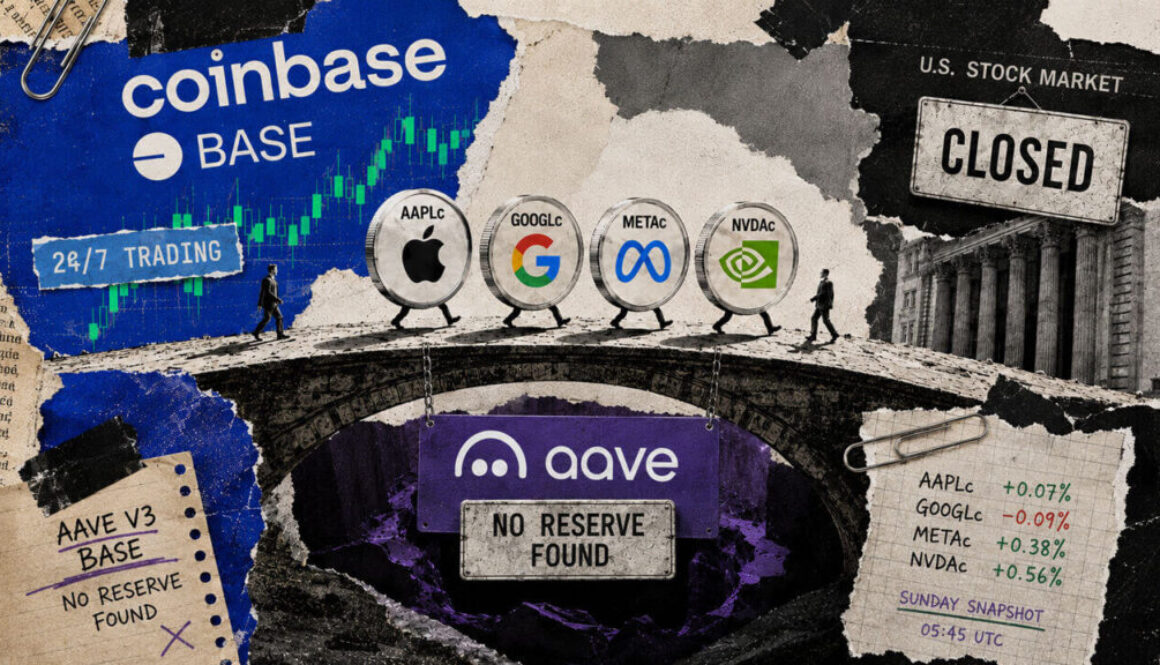
Digital asset equities show minimal price fluctuation during weekend trading as liquidity dries up without institutional participation
Coinbase’s tokenized stock offerings on Base can trade around the clock, but their underlying equities and lending infrastructure remain tethered to traditional market hours, creating a structural mismatch that weekend trading volume has yet to stress-test. The tokens stayed within 0.6% of Friday’s prices over the weekend, but that stability masks unresolved risks for DeFi collateral use.
- Four Coinbase B20 tokens (AAPLc, GOOGLc, METAc, NVDAc) traded within 0.6% of Friday equity reference prices on Sunday despite closed primary markets.
- Chainlink’s 24/5 equity feeds held stale Friday timestamps through the weekend, with no automatic price updates during market closure.
- Aave V3 on Base contained no active reserves or collateral parameters for any of the four tokens as of the Sunday review.
- $7.08M 24-hour volume across four Aerodrome USDC pools, split among the four tokens
- 0.6% Maximum price deviation from held equity values observed in weekend DEX trading
- 35-38 hours Duration of the schedule mismatch between frozen reference feeds and active token trading
Coinbase launched four blockchain-based stock tokens on Base, enabling users outside the United States to gain exposure to Apple, Alphabet, Meta and Nvidia through onchain assets that trade continuously, even when the US equity market closes. The tokens confer beneficial ownership claims on underlying shares held within Coinbase’s tokenization structure and are marketed as building blocks for decentralized finance applications, particularly as collateral on lending protocols like Aave. A technical review over the weekend of August 30 revealed the first concrete evidence of how these products behave when primary markets are offline, alongside critical gaps in their supporting infrastructure.
The launch reflects a broader industry trend of bridging traditional equity markets and blockchain infrastructure. Tokenized equities allow institutional and retail investors to access fractional ownership with the settlement speed and interoperability benefits of blockchain networks. Coinbase’s approach uses Ethereum’s Base network, a Layer 2 scaling solution, to minimize transaction costs while maintaining composability with existing DeFi ecosystems. However, this innovation introduces timing asymmetries that conventional equity markets have never required infrastructure to handle.
Weekend Token Prices Hovered Near Stale Equity Benchmarks
At 05:45 to 05:47 UTC on Sunday, August 30, the four leading Aerodrome automated market maker pools on Base showed approximately $6.07 million in displayed liquidity and $7.08 million in 24-hour trading volume. Comparing the DEX prices against Chainlink’s official reference feeds, which had last updated on Friday, revealed tight spreads: AAPLc traded at $320.52 versus a held Friday value of $320.31 (a 0.067% gap), GOOGLc at $346.42 versus $346.73 (a 0.090% gap), METAc at $579.76 versus $577.54 (a 0.384% gap), and NVDAc at $218.98 versus $217.77 (a 0.556% gap).
The small observed dislocations suggest orderly market behavior during the closure window, with traders choosing prices close to the last available equity benchmarks despite the absence of fresh primary-market discovery. The price discipline likely reflects the relatively modest liquidity depth and the short duration of the weekend window, which does not yet test scenarios where material external news or market sentiment shifts occur after Friday’s close. However, the tight spreads carry important limitations: they represent a single point-in-time snapshot against information that stopped updating on Friday, do not guarantee execution quality for larger orders, and provide no information about what happens if token prices move sharply in either direction while reference feeds remain frozen.
The stability during this initial weekend period demonstrates that spot market arbitrage mechanisms can function without continuous price feeds, provided trading volumes remain modest and sentiment stays aligned with the last-known equity values. Market-making algorithms on Aerodrome appear to have weighted historical equity data and available order flow equally, resulting in prices that drifted minimally from stale benchmarks. This behavior may not persist as trading volumes increase or as real news events occur between Friday close and Monday open.
Chainlink Feeds Locked in Friday Prices Through Weekend Hours
Coinbase’s B20 tokens use Chainlink’s 24/5 total-return feeds, which derive from the underlying equity price multiplied by a specified multiplier rather than from the token’s onchain DEX price. On weekends and holidays, these feeds hold their last update and stop advancing the updatedAt timestamp, maintaining the Friday close information through the entire closure window. The official Chainlink documentation describes this scheduled behavior and instructs protocol developers to inspect staleness bounds, avoid relying on frozen data for liquidations, and apply explicit staleness checks in their contract logic.
The schedule mismatch between continuous token trading and halted reference updates remained present for roughly 35 to 38 hours at the Sunday snapshot.
This separation becomes material if the DEX market experiences sharp price movement during a closed reference window. A rise in the token price would not automatically lift the feed calculated from the held equity value, while a decline would require equally explicit contract-level handling to prevent a lending protocol from relying on stale data to trigger liquidations. Coinbase’s prospectus for the NVDA token preserves business-day dependencies for underlying settlement, stating that cash or stablecoin settlement requires the issuer to sell shares after validating a redemption request, meaning instant weekend arbitrage cannot be assumed even while the token trades continuously.
The risk architecture here differs fundamentally from traditional equity indices or ETFs, which close their own trading windows in sync with primary market hours. Tokenized equities create a new category of assets where settlement constraints and trading availability operate on misaligned clocks. Over longer periods, geopolitical events, earnings surprises or macroeconomic data released outside US market hours could cause the onchain market price to diverge materially from the held reference feed, creating opportunities for arbitrage or liquidation cascades depending on how lending protocols are configured.
Aave Integration Remains Unrealized, Leaving Collateral Safety Unresolved
A review of the official Aave V3 Base deployment list on Sunday found no active reserves, aTokens, debt tokens or oracle entries for any of the four Coinbase stock tokens. Base’s integration guide describes Aave as a use case for the tokens, citing a borrowing example prominently, yet the actual collateral layer does not exist in live form. An August 3 Aave governance proposal indicated that initial assets, oracle configuration, risk framework and deployment contracts for Aave V4 on Base would be finalized and published at a later date, establishing direction without resolving B20 asset parameters.
Base’s reference to Aave describes an integration goal; a live lending market requires deployed reserves and inspectable parameters.
Technical analysis of B20 collateral infrastructure
Until Aave publishes reserve configuration for the four tokens, no defensible loan-to-value ratio, liquidation threshold, supply cap, borrow cap or liquidation activity can be assessed. Any eventual lending deployment would need explicit oracle-freshness checks and policies for managing deposits, borrowing and liquidations during the closed reference periods, supported by conservative LTV settings and supply caps that could buffer the timing mismatch. The weekend trading record demonstrates orderly secondary-market pricing, but collateral safety depends on infrastructure that exists only as a stated integration goal.
The absence of live Aave integration also reflects a measured approach by the DeFi protocol, which has developed a reputation for conservative risk management following the market stress events of 2022 and 2023. Deploying tokenized equities as collateral requires novel safeguards that traditional lending markets never confronted, including explicit handling of market-hours mismatches, settlement delays and regulatory dependencies that could affect the underlying equity positions themselves.
Coinbase has made the market-hours mismatch visible onchain through live trading data; the decisive test of whether this structural gap becomes a real collateral risk will begin only after Aave publishes its B20 reserve parameters and users begin posting debt against the tokens.