Key takeaways
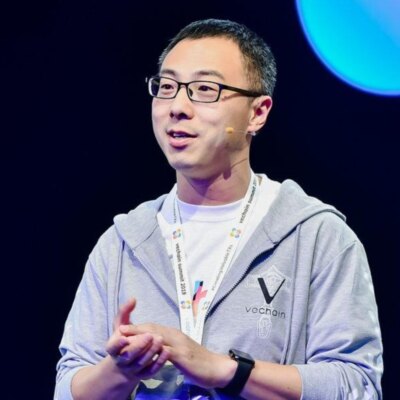
- Sunny Lu has been in crypto for over 10 years, starting with Bitcoin in 2012 after learning about it through an online gaming transaction.
- 2023 marked a significant shift from bear market conditions, with Bitcoin and crypto markets up over 100% and conference attendance reaching 10,000 participants.
- Bitcoin ETF approval is expected imminently and will enable major institutional investors to enter crypto markets with unprecedented fund sizes.
- Institutional adoption following ETF approval will shift focus from price speculation to long-term technological value creation and real-world blockchain applications.
- The bear market period of 2022-2023 served as a critical building phase where blockchain development and infrastructure improvements were prioritized over hype.
From World of Warcraft to VeChain
Ashton Addison: What is your background in blockchain, and how did you get started?▶ 00:47
Sunny Lu: I started my career as a Cisco certified engineer, building networks from the early 2000s, so I'm really old in the crypto space. That journey made decentralized networks one of my great interests. Before VeChain I worked for multinational companies, and my last job was Chief Information Officer at Louis Vuitton China. I just passed my 10-year anniversary in crypto. I first learned about Bitcoin around 2012 or 2013, when I was playing World of Warcraft and somebody offered me a deal to buy some game coins in Bitcoin. That drew my attention immediately. I went to Bitcointalk.org and asked questions as a newbie, joined meetups on my travels, and read the Bitcoin white paper over and over again. It blew my mind, and I became fascinated by the technology.
People know the bear market, the so-called winter, is really a building time.
2023 and the ETF decision
Ashton: How did 2023 go for Bitcoin and blockchain adoption?▶ 03:23
Sunny: I've been in this space more than 10 years, so I've been through three cycles. Bitcoin typically hits an all-time high in years like 2013, 2017 and 2021. The following year, 2018 or 2022, everything collapses, and recently we had bad events like Luna and FTX. The second and third years after a high are usually a slow, progressive uptrend, up by around 30 to 50 percent. But 2023 was a blast. The market was up more than 100 percent, almost 200 percent. It also doesn't feel like a winter or bear market anymore. At Token2049 in Singapore we had around 10,000 participants. Even in the previous bull market, 4,000 or 5,000 was an amazing number. People now know the bear market, the so-called winter, is really a building time. Whatever you build then decides how high you can go later.
Ashton: The SEC decision could come within days, with another deadline in March. How concerned are you?▶ 07:11
Sunny: I feel the trend is inevitable. Either this time or next time, it's just a matter of time, and I don't really worry about it. The market is right on the edge, waiting for that final moment to light up.
Ashton: What happens in traditional and Bitcoin markets once the ETF is approved?▶ 08:26
Sunny: The ETF will open the door for the world's biggest, most reputable institutional investors to enter the crypto space. Major regulatory progress, like MiCA in Europe, will also pave the way for mass adoption. And don't forget the Bitcoin futures ETF approved in 2021. Together with a spot ETF, that gives institutional investors a complete set, with funds of unprecedented size. There could still be short-term fluctuation, but it's very bullish in the long term: more attention and much bigger funds, which will boost the development of the whole technology. When mainstream money comes in, it won't be only about Bitcoin or price. It will be about long-term value, and about what applications can make the world better in daily life, like the internet did over the last 20 to 30 years.
Enterprises and the token barrier
Ashton: Will the ETF and the new accounting standard change how companies hold Bitcoin and use blockchain?▶ 10:38
Sunny: Definitely, yes. Along my journey, the enterprises and institutional investors I've talked to have faced a regulatory challenge, or even the simple question of how to book Bitcoin or any other crypto in a company ledger. Regulatory progress paves the way for them. We've also talked to many enterprises, since building enterprise-level applications is one of our focuses. They want to explore more, but because of the challenge of how to process and use a token, they often step back. They build a database-type blockchain application that basically replaces an existing database. There are good benefits, like transparency and immutability, but I'd say that reveals only 10 or 15 percent of the potential of the technology. The ETF approval will be a milestone, not only for enterprise users but for regulators around the world. It gives enterprises the courage to explore deeper applications with token utilities, and I believe that will be the main theme of the next adoption wave. We already have hundreds of enterprise applications, so I can easily pick up the phone and say, let's explore more possibilities.
Ashton: How far along is business adoption of blockchain compared with the Bitcoin adoption that makes the news?▶ 14:27
Sunny: I think it's not that far away. The main theme for 2024 and beyond will be mass adoption, linking the technology to real-world applications. That comes down to two things. One is regulation from major regimes, like MiCA in Europe or the ETF approval. The other is use cases and applications that bring not only crypto people but normal people onto blockchain. Enterprises already understand what blockchain can do and are willing to build token-based applications, but the lack of regulation blocked them from going beyond the first step or two. Our new global partner BCG is excited about this. The question now is how to use a token to connect with new customers and incentivize individuals, in a more decentralized, Web3 style. I believe blockchain is like internet 2.0. New business models will appear in every industry, and new products will come very quickly. Regulated providers like Coinbase also make the infrastructure super easy for enterprises, Web2 companies and normal people to build on.
I'd say that reveals only 10 or 15 percent of the potential of the technology.
Enterprise blockchain in practice
Ashton: Which real-world companies that aren't blockchain companies have used VeChain, and what did they gain?▶ 19:28
Sunny: When you build business applications on blockchain, you have to go to the business users first, not to blockchain companies, which are mostly technology providers. We want business users to be the owners of the future applications. We provide the technology, and they provide the business innovation. That's why we partner with firms like DNV and PwC, and from 2023 with BCG. Our best-known case is the food safety platform we built with PwC for Walmart China. Just yesterday it hit a milestone of 2 million transactions in a day from one single smart contract. It is meant to grow from hundreds of suppliers to 20,000. A 2019 study by Walmart's food safety labs found the platform cut the time to trace problematic food from more than 10 hours to less than 10 seconds. That is a real motivation to keep building and scaling. We also did a sustainability use case for H&M, showing consumers where recycled material comes from, and we onboarded H&M's suppliers as VeChain business users too. Enterprises take time. They go step by step from proof of concept to production and then scale up. It isn't the day-one overhaul that some people in crypto predict.
Ashton: If a startup sees the ETF approval and wants to integrate blockchain, how easy is it to work with VeChain?▶ 29:04
Sunny: There are several aspects. On the technical side we have tools. In 2023 we released a new, very user-friendly version of our wallet, and we have a one-click way to build your own smart contract. We've also just integrated with Ledger Live. More important is building your use case and deciding what change you can make in your business to get real benefits, as Walmart did. We now have more than 100 enterprise-level applications, so companies can search online, see what we've done and set up a conversation. In March 2023 we released a new white paper, co-authored with BCG, that sets our strategy to focus on building a sustainability ecosystem. From our experience with hundreds of enterprise applications, we believe that's the low-hanging fruit for traditional enterprises embracing Web3. It means a new way to engage with consumers and build something better together with them, which requires a token to incentivize individuals and give them more power.
This interview has been edited for length and clarity. Recorded January 2024.