
Shresth Agrawal / Pod Network
Shresth Agrawal on fairness and speed in crypto markets
In this episode
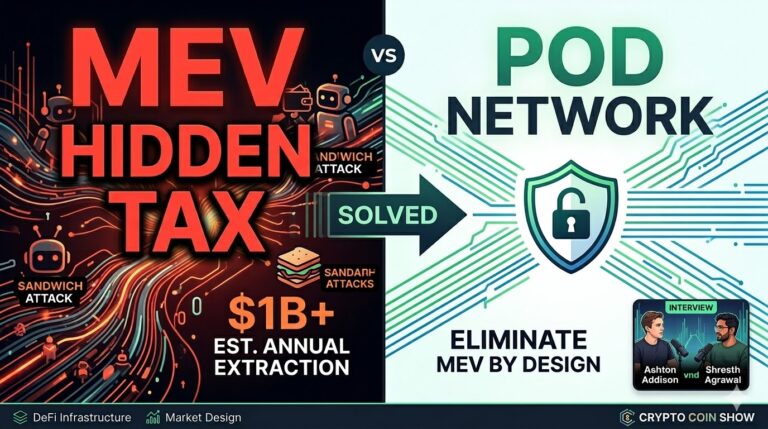
We speak with Shresth Agrawal, CEO and Co-Founder of Pod Network, about building fair, high-performance decentralized markets. Today’s prediction markets and on-chain trading systems often suffer from latency, MEV extraction, and information asymmetry that can disadvantage retail traders. Shresth explains how Pod Network is approaching market design differently to create systems that are faster, fairer, and capable of reaching NASDAQ-scale performance while remaining decentralized. We explore what’s broken in current prediction markets like Polymarket and other on-chain trading venues, why latency and finality are critical to fair trading, and how Pod’s architecture aims to eliminate structural advantages that sophisticated players exploit today. From the role of MEV in market outcomes to the technical roadmap for 200ms finality and institutional-grade infrastructure, this conversation looks at what it will take for decentralized markets to compete with traditional financial exchanges.
pod.network · @poddotnetwork on X · Watch on Refinitiv
- Centralized and decentralized exchanges both have single points of control—servers in traditional markets and sequencers in blockchain—that enable unfair order flow manipulation.
- MEV extraction and front-running are more damaging in illiquid exotic markets where sophisticated players can snipe retail orders at disadvantageous prices.
- Pod Network uses batch auction protocols to redirect excess value created by user order flow back to traders rather than extracting it as negative expected value.
- Pod functions as a matching layer that can work across multiple chains without requiring liquidity to bridge, while native markets on Pod enable composability with other protocols.
- Early liquidity challenges require selective pair launches and strategic partnerships, with execution quality advantages for smaller orders helping bootstrap network adoption over time.
Chapters
Related coverage
More interviews
 Quantum computers could crack Bitcoin keys by 2028, says Postquant Labs CEONov 24, 2026
 0G Labs' Michael Heinrich on cheaper open AI modelsNov 19, 2026
 Why Wall Street is moving toward 24/7 trading in 2026Nov 13, 2026
 How Wallet V is letting AI agents trade while keeping your keysNov 10, 2026
 How Silent Payments Keep Your Bitcoin PrivateNov 9, 2026
 How XYO is building proof in a world of AI fakesNov 5, 2026