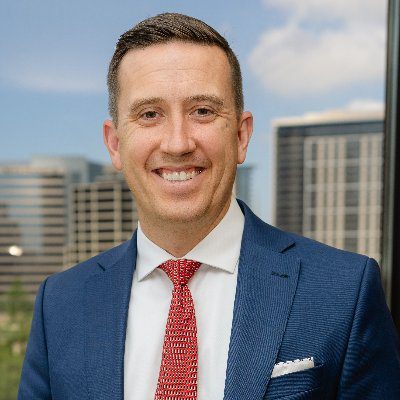
Key takeaways
- Texas offers favorable tax environment and business-friendly policies that make it the top-rated state for blockchain companies to establish operations.
- The Trump Administration is expected to pass market structure legislation in 2025 clarifying SEC and CFTC jurisdiction over digital assets.
- Stablecoins could extend the US dollar's status as world reserve currency by forcing purchases of US treasuries at massive scale.
- Bitcoin mining represents 40% of global mining activity with approximately half of US mining operations located in Texas.
- Texas Blockchain Council advocates for digital assets industry at state and federal levels while helping companies relocate from overseas.
Why Texas wins founders
Ashton Addison: What got you personally interested in this work?▶ 01:09
Lee Bratcher: Before I founded the council, I was a political science professor and my research area was property rights. Then I discovered the Bitcoin white paper and digital property rights, and I thought, I want to bet the rest of my career on this. I just didn't know how. So I took skills from my previous life as a military officer and political science professor and applied them to helping the digital assets industry engage with regulators, policymakers and elected officials.
Ashton: Why should a founder starting a blockchain company choose Texas over any other state?▶ 02:22
Lee: It's pretty simple. Texas is consistently rated the number one state in the US to do business, and that goes beyond crypto to any business. The tax environment is also much more favorable. A few other states, like Tennessee, are similar. On the crypto side, we've passed Uniform Commercial Code legislation that recognizes you can perfect your security interest in digital assets through possession of cryptographic keys. We also passed proof of reserves legislation, which requires exchanges and other virtual asset service providers to keep a clear accounting of their liabilities and assets. For companies doing things the right way, that's a good thing. We want to be regulated as an industry. What we don't want is the uncertainty the SEC has imposed on us for years.
We need to end the turf war between the SEC and CFTC. That's not helpful for anyone.
What Washington could deliver in 2025
Ashton: How do you expect the incoming Trump administration to affect policy and innovation starting in 2025?▶ 04:15
Lee: It's pretty clear we're going to get market structure legislation in 2025, probably something similar to the FIT21 Act. That act calls out the SEC and the CFTC to delineate who has jurisdiction over assets, whether commodities or securities. It also creates a spectrum of decentralization, so an asset can move from being a security to a commodity later. We need to end the turf war between the SEC and CFTC. That's not helpful for anyone. Gary Gensler departing the SEC, which I'm sure will happen in the next 45 days or so, is a positive step too. We're also going to get stablecoin legislation in 2025. That matters for the US dollar, because stablecoins are a forced buyer of US Treasuries and 99% of them are denominated in dollars. Without stablecoins, we're probably looking at the dollar becoming just part of a basket of world reserve currencies, even in the next decade. With them, it could prolong the dollar's reserve status for many decades. Stablecoins buy more US Treasuries than Saudi Arabia.
Ashton: A few years ago, no one would have guessed stablecoins could help the dollar stay the world's reserve currency. Will that idea gain traction?▶ 06:16
Lee: Absolutely. I think more people will give that theory credence as stablecoins grow. They're in the multiple hundreds of billions now, and I think soon they'll be a trillion-dollar asset. Crypto as a whole is a three-trillion-dollar asset class. When stablecoins hit that kind of velocity and volume, everybody from the Fed to the Department of Treasury will be looking at this.
Ashton: Donald Trump has talked about making Bitcoin in America. Do you expect a US strategic Bitcoin reserve soon?▶ 07:04
Lee: A Bitcoin strategic reserve for the United States would be a great step forward. I don't know if it will happen in 2025. I think Polymarket odds put it at about 35%. But I would imagine we see something to that effect in the next five or six years. Bitcoin mining is flourishing in the US. About 40% of all mining globally is here, and about half of the mining that takes place in the US is in Texas. I also think the industry will greatly benefit from President Trump's appointments, including Treasury Secretary. I think Howard Lutnick may be the front runner there. He's the CEO of Cantor Fitzgerald and very bullish on Bitcoin.
Mining, and a Texas Bitcoin reserve
Ashton: How much of the council's work is focused on mining compared with other use cases and financial applications?▶ 08:42
Lee: A large portion of our membership is in Bitcoin mining, energy and data centers. So we have to staff up in a unique way. We need expertise on the energy grid, data centers and energy policy, and we also need expertise on financial services. It's really two distinct areas of work. Bitcoin mining is our deepest area of expertise, and we definitely have more members in that vertical than in any other.
Ashton: Should Texas, or other states, adopt Bitcoin reserves?▶ 09:35
Lee: This is a little bit of a selfish answer, because I want Texas to beat the federal government to having a Bitcoin reserve. I think the earliest we could see that pass in Texas is May 2025, so if the federal government does it before then, they'll beat us. Legislation is very difficult to pass. Less than 2% of bills filed federally pass, and between 4% and 8% of bills filed at the state level in Texas pass. It's an uphill battle, but we have a pretty good track record. In our first session we passed 50% of our bills, and in our second I believe it was 25%. That's much higher than the average.
I want Texas to beat the federal government to having a Bitcoin reserve.
ETFs, DAOs and the North American Blockchain Summit
Ashton: How have the spot ETF launches changed the policy and regulatory conversation?▶ 10:46
Lee: It's been very helpful. Elected officials and regulators are very familiar with names like BlackRock and Fidelity. We needed that brand protection from large names so legislators and elected officials could feel a little safer. A lot of them were already bullish, but for those who weren't yet comfortable with a very new industry, they needed a bit of top cover from brands like those. It does help in the halls of the legislature.
Ashton: What do you think of organizations like the council moving to a DAO format?▶ 12:06
Lee: We're working on DAO legislation for Texas. DAOs can already be formed here, but this would be DAO-specific legislation. I think it's a great entity formation tool, but it doesn't work for every company. You don't want a three-member LLC forming a DAO. You need a real community, it has to be decentralized, and there has to be transparency in governance, which DAOs provide through code and smart contracts. The council can't become a DAO because we're a 501(c)(6) trade association, and it's unclear whether we could. But for large communities, like ATX DAO in Austin, it's a good structure. DAOs can also come alongside and handle things the government doesn't handle well, like mental health and other societal challenges. I think they're a really good structure for those collective action problems.
Ashton: What is the council focusing on at the North American Blockchain Summit in Dallas, and who is speaking?▶ 14:32
Lee: We're hosting it alongside many of our sponsors. We changed the name a couple of years ago from the Texas Blockchain Summit because we're incorporating model policy and input from other states, and we also have a lot of thoughts on DC policy. You'll hear from Majority Whip Tom Emmer, former House Speaker Paul Ryan, former Secretary of State Mike Pompeo, and crypto executives from exchanges like Coinbase and Blockchain.com. Key focus areas include Bitcoin mining, energy and data centers, but also tokenization of real-world assets, payments and DeFi. There are also panels on institutional involvement, with folks from Invesco, Bitwise and some of the ETF issuers.
This interview has been edited for length and clarity. Recorded November 2024.