Key takeaways
- Wallet V is a self-custody mobile wallet where AI agents can trade while users retain private keys and full control of funds.
- AI agents have built-in risk controls that stop trading automatically if losses reach 20% to protect user accounts.
- Wallet V integrates native DeFi protocols like Hyperliquid and Aster Swap with gasless transactions to reduce entry barriers for users.
- AI agent trading is positioned as a tool to help users execute their trading vision, not a guaranteed path to profits in complex markets.
- Token launch is planned for early 2027 with Phase 3 campaign offering up to 14,000 USDC rewards for recruiting top traders.
From exchange to AI-first wallet
Ashton Addison: What is Wallet V today, and who is it built for?▶ 01:13
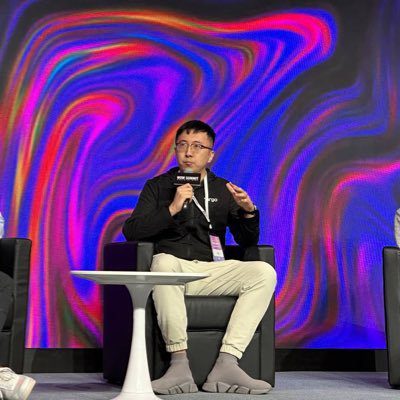
Adam Cai: We're seeing a strong trend of users wanting to control their own keys. They also want a DeFi experience that is native, user-friendly and simple to understand, and many want it on mobile. So the first reason we built Wallet V was to offer that native DeFi experience, a kind of DeFi super app. Users control their own keys and get easy access to things they love, like Hyperliquid, Polymarket and Aster. We did a lot of homework to bring top-quality protocols into the app, so users don't have to work out which is best. The entry barrier to DeFi, and to trading in general, is very high. Users don't understand gas fees, or what USDC means on different chains. So we built features like gasless transactions. We cover a certain number of transactions, and swaps over $5 are free of gas. AI helps on several fronts too, from a chatbot that answers questions, to technical analysis of charts, to autopilot trading connected with Hyperliquid and Aster, using either prompt-based models or an AI framework.
Ashton: You started with Virgo CX, a traditional exchange, and have moved to self-custody and AI. Why?▶ 05:00
Adam: I'm always trying to bring a product that makes an impact on the industry. We started Virgo CX as a Canadian trading platform on a fiat ramp, and in 2019 people needed that, because they had to be able to buy and sell crypto. But looking at 2024 and 2025, I saw that the infrastructure for crypto on-ramps and off-ramps was very mature. There isn't much innovation left to do. It's really about compliance and banking access. I wanted to do something more exciting that brings substantial value to users. So I asked what the future of a mobile wallet is. A crypto wallet won't just be storage, like a hardware wallet. It will be a super terminal for global users to access digital assets: not only crypto but also stocks, commodities, yield farming, everything about finance, following the Hyperliquid vision. A wallet is very flexible and compatible with how DeFi and tokens are designed, so the speed of iteration is a power I have never seen with a central exchange. We can connect directly to excellent protocols through smart contract APIs, without even talking to them, and pick the best one for users.
When AI starts to trade for you, the AI does not have the private key. The private key is still owned by the user.
What AI trading can and can't do
Ashton: AI agent trading is called the future, but it's very early. How big a bet is this, and is being too early the same as being wrong?▶ 08:26
Adam: You're 100% right that AI agent trading is at a very early stage. Capital markets, whether stocks or crypto, are the most difficult and complex markets out there. There's no fixed set of winning rules, because if there were, we wouldn't have to do anything else. So AI agent trading is by no means a guarantee of winning for users. Instead, it helps users realize their own vision of their trading style, understand their risk management and avoid emotional trading. Today an agent is more of an assistant, working from a user's plan and preset rules. If someone is bad at trading, AI can help them see whether their trades make sense and what the logic behind them is. It can also help them control risk, so they can learn from mistakes instead of getting wiped out and leaving the industry. AI is a buddy. It's actually very difficult, because there are hallucinations and technical details that can go wrong.
Ashton: There are frontier, Chinese and open-source models, all with different levels of hallucination. How do you decide which AI models to use for trading?▶ 13:02
Adam: We don't decide. We give all the models to users and let them choose. We have free models, which we subsidize because they're cheap, so users can get a taste. We also have the advanced models, the latest releases from ChatGPT and Codex, which users load AI credits to use. We published a small performance report based on the five to six thousand agents we've run so far, using a similar prompt across models. The sample isn't big, but it gives early signs of which model performs better under which market conditions. Each model has different strengths and weaknesses, so users should pick the right model, prompt and settings for the market conditions. Some users have made 100% in three days. Others say a model sucks and they lost a good amount. In the end, it's not what we provide, it's empowering users to make their own choice.
Ashton: In two years, how much of Web3 trading do you expect AI agents to handle compared with people trading manually?▶ 27:31
Adam: That's still a long way to go, to be honest. From our data, out of the billion dollars of trading volume, probably only 5% is from AI. At this stage I'm already calling that a pretty good success. Most people put in $100 up to $1,000. The most I've seen is $50,000. People are learning, and it's a lot of trial and error. Ultimately, everybody wants AI to be their true money manager, but it's a very complex pathway. Because AI is developing so fast, I don't really know. Maybe it's a long way, maybe it's not.
Keeping the keys: the safeguards
Ashton: If AI agents trade on your behalf, what are the risks of fund loss or bad trades, and should I trust an agent with my funds?▶ 22:23
Adam: First, when AI starts to trade for you, the AI does not have the private key. The private key is still owned by the user. What the AI has is just an API key managed by Hyperliquid or Aster, so all it can do is trade. It cannot move your funds anywhere else. Second, even if an AI hallucinates and messes up, we always require users to set a hard risk limit. No matter what you put in the prompt, if your total loss hits 20%, for example, the AI stops and the whole system stops. We've built several risk parameters to monitor that. Third, we want the AI's thinking to be as transparent as possible. We generate an abstract for every single AI decision. It has to show its thinking process and why it clicked buy or sell. If it loses money, you can see the reason, and if it makes money, you can see that too. Every decision is transparent.
AI agent trading is by no means a guarantee of winning for users.
Rewards, whales and the road to the token
Ashton: What are early traders actually doing in the phase three campaign, and how are they rewarded?▶ 18:20
Adam: We've launched two campaigns already. The first brought more users in to create wallets and try them out. The second had people refer others to trade and earn commissions and V points, plus complete daily tasks to stay active. The third campaign targets onchain whales. If you can identify which address is associated with a whale and invite them to Wallet V to make some trades, you can earn up to 14,000 USDC plus some V points. The goal is to let influential people know about Wallet V and understand what we offer. We've had more than 250,000 wallets created in the past two months and over a billion dollars in trading volume. Now we want to make a bigger impact.
Ashton: Why target whale traders rather than everyday small fund managers?▶ 20:28
Adam: Crypto is a lot about influence. Wherever big whales make recommendations, people listen. We want a shortcut to people knowing about Wallet V. We're trying to get the right people backing us and get into the right circle without spending millions of dollars. If you already do a lot of trading on Hyperliquid or Polymarket, try it on Wallet V. It's the same feeling, the same taste. We're not building a new DEX or a new prediction market. We hope for endorsements that increase legitimacy and trustworthiness, which is very important now. Recent hacks have hit hardware wallets like Ledger, so people are starting to worry that any wallet could be hacked.
Ashton: What do V points do inside Wallet V?▶ 25:32
Adam: V points are a loyalty point system. Every time users create a revenue-generating event for us, we grant them V points. In the future, V points will be converted to another token that will be deeply integrated with Wallet V to empower the ecosystem. Users are excited to earn V points, and they hope for an airdrop of the token down the line. What we want to encourage is positive activity, real user activity where people try the different functions we've built. They're rewarded because they're early adopters.
Ashton: Some points campaigns run for years with no end in sight. Is there a timeline for the end of this one and the token launch?▶ 26:49
Adam: The first season is coming to an end soon. By December 3rd, the first three months of the campaign will be done, and you will potentially be eligible for the first airdrop. We're going to launch a second, third and fourth season, but each season will probably last only a quarter or so. Our campaigns are very short in general, because we want people to see the results and do more, creating a really positive feedback loop.
This interview has been edited for length and clarity. Recorded November 2026.