Key takeaways
- RPC (Remote Procedure Call) is a critical but centralized infrastructure layer that most blockchain applications rely on to fetch data and send transactions.
- Current RPC providers operate as centralized middlemen similar to Web 2 solutions, creating single points of failure and privacy concerns despite blockchain's decentralization promises.
- Lava Network is a decentralized L1 protocol where RPC providers stake tokens to guarantee service quality and compete on price and performance metrics.
- The network enables automatic failover between providers, eliminating the need for dApps to manually implement load balancing and backup infrastructure.
- Ethereum currently has the highest RPC volume demand among all blockchain networks.
Why web3 isn't as decentralized as it claims
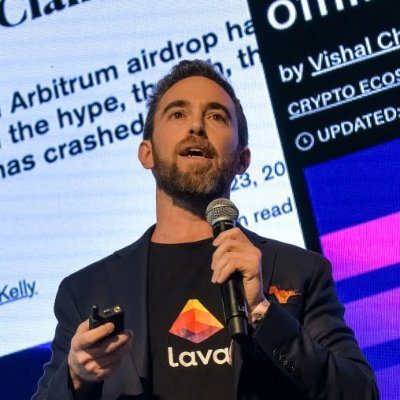
Ashton Addison: How did your background lead you to start Lava Network?▶ 00:21
Yair Cleper: My background is technical. I studied computer engineering in a special program in the army, and entrepreneurship has been in my blood since I was young. I founded several startups and had two exits. I was always skeptical about crypto. Cryptography and the future of finance interested me, but the earlier applications looked like fake currencies and pump and dumps. I had really strong friends in the space, though, and I kept hearing good stories. So about a year and a half ago I stepped in with my co-founder Gil, and we started with NFT sniping and MEV. We both have strong cyber security backgrounds, and we realized that web3 was not as decentralized as it claimed to be. It also has a lot of problems around performance and infrastructure. That brought me to build Lava. We asked how the core infrastructure could be centralized, and what we could bring from our background to build something that scales the ecosystem.
Ashton: What exactly is the centralization problem, and where does Lava come in?▶ 02:15
Yair: Most things today are not decentralized, and that is what I've learned on this journey. The main centralization point is RPC. It's the communication protocol you need to fetch data and to send reads, writes and transactions on the blockchain. You need it for the most basic actions: getting an account balance, deploying a smart contract, checking gas prices. At the beginning of crypto it was simple because everyone ran their own node. As adoption grew, that became impractical, so people started relying on centralized providers who said, you don't need to run a node, you can trust us to fetch the data. To us that felt like patching a web 2 solution onto web3, and it creates new gaps. What about privacy, middlemen, single points of failure, censorship? At the end of the day, if you trust a middleman, you don't know the data is yours, and you don't know it actually comes from the blockchain.
Ashton: Is RPC essentially a relay for information from nodes that other people run?▶ 06:17
Yair: Almost. RPC stands for remote procedure call, and it's a simple API used to interact with the network. Running a node means reaching consensus and handling infrastructure that takes a lot of resources and time. Most teams want to focus on their business, not on maintaining infrastructure. Two trends are happening right now. First, RPC is becoming a commodity. Two years ago there were five big providers, and now there are hundreds. Second, dapps no longer trust a single piece of infrastructure. They run several providers in parallel, benchmark them, load balance, and keep backups for when a centralized provider goes down. If you can't give users good service, they won't use you. That is the gap we believe Lava solves.
If you trust a middleman, you don't know the data is yours, and you don't know it actually comes from the blockchain.
A decentralized network of RPC providers
Ashton: What happens when a developer starts using Lava, and how does that increase decentralization and trust?▶ 08:08
Yair: We see Lava as a decentralized network of top-tier RPC and API providers. Developers subscribe and get access to any top provider, which means access to any blockchain, as a one-stop shop. We are an L1 that anyone can join permissionlessly, and providers have to stake Lava. For the first time they are held accountable for the infrastructure and for not manipulating data. That brings several benefits. One is high network redundancy, which means almost 100% uptime. If one provider goes down, the dapp is automatically paired with a new one, so developers don't have to build that into their own infrastructure. Another is market dynamics. Providers compete to offer the best service and price, and they know they are constantly scored and that their service is transparent. Users get the best price without doing their own market research.
Ashton: Which blockchains are most in demand, and how many does Lava support?▶ 10:58
Yair: Ethereum has the highest volume right now, but we see a lot of activity on other EVM-based chains and L2s, and there's hype around several other blockchains. Lava is built on Cosmos SDK and Tendermint, which is our home. We started by supporting the chains and projects on Cosmos, who also invested in us, and then we said we would support any EVM-based chain. Since we launched we've seen huge demand from everywhere, including non-EVM chains and L2s. Wherever a dapp wants to find a home, we want to let it get there without spinning up a node. Think about us as the Uber for nodes. We're connecting dapps, the passengers, to the taxis, the node providers, and constantly scoring the service. Lava supports 20 chains today, and a dapp can expand to other chains with the same subscription. In the future we want to support all of web3.
Roadmap, community and key message
Ashton: Where is Lava now, and what comes next?▶ 13:40
Yair: We launched our testnet and a production-ready service one month ago. We're onboarding dapps to test, and we're paying dapps that want to experience the high reliability we offer. The team is 38 people, 25 of them engineers, and it's the best team I've ever worked with. We're building around the clock toward the Lava SDK. On the roadmap, the first item is on-chain subscription, which brings the SaaS model from web2 to web3 as a one-stop shop. Decentralization is seen as hard to use and people don't always want to use a token, so we let any currency be used to pay for a decentralized service. Next are rich APIs. We started with RPC because it's the core element, but there's demand for caching, indexing and NFT APIs. The third is the SDK. Imagine a dapp doesn't need a system that connects it to the driver. Its own browser connects directly to all the best providers on all the best chains. I think that's the real vision of Lava.
Ashton: How can developers and the community get involved?▶ 17:03
Yair: We have a community of more than 10,000 members, and people have translated our materials into more than 11 languages. We're mainly on Discord, and we try to be available 24/7 because the team is spread around the world. We'll soon announce a Voyager program to support dapps as they grow from small projects, with developer support, better CU pricing and co-marketing. We'll also announce bounties for developers who want to submit pull requests and help build the vision. Lava is a community-led protocol and a public good, and everyone can contribute. That's the paradigm shift we're making.
Ashton: What is the key message you want readers to take away?▶ 19:12
Yair: What we're building at Lava is the most reliable provider on the market, using decentralization and aligned incentives. We're not just an RPC. We're open source and can support any API. We're building multi-chain support so that everyone can use one standard to build on any chain.
Think about us as the Uber for nodes. We're connecting dapps, the passengers, to the taxis, the node providers.
This interview has been edited for length and clarity. Recorded March 2023.