Key takeaways
- DAOSYS proposes a self-sovereign treasury management system based on interest-bearing LP tokens rather than traditional shareholder voting models.
- The system eliminates counterparty risk by allowing users to create one-to-one debt against their own positions with self-repaying interest from DeFi markets.
- DAOs should remove economic philosophy debates by creating decentralized systems where individuals control their own capital without government dictation.
- Blockchain infrastructure could eventually replace traditional corporate and governmental financial structures by enabling autonomous lending, borrowing, and work marketplaces.
- The opportunity cost becomes the only risk factor in DAOSYS, as users retain their principal while choosing between investment opportunities.
Rethinking the DAO
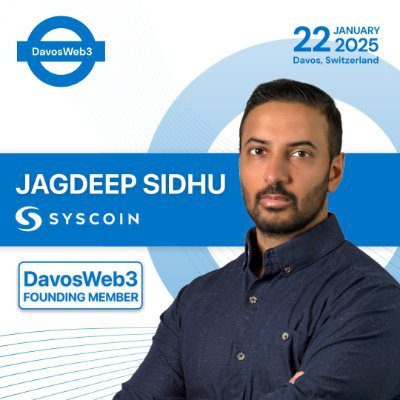
Ashton Addison: Where are DAOs today, and what's wrong with how they're being built?▶ 00:44
Jag Sidhu: The concept of the DAO started right around when Ethereum came out. People saw that you could do Turing-complete finance, which meant you could have autonomous companies and not need companies anymore. Obviously that goes a little too far. The current iteration of DAOs is modeled after companies, with shareholder voting. But voting is unregulated and anonymous, so you don't know how many shares one person owns. It only works if it sits in a compliant layer where every user counts as one vote and you can check them. There is no sense in mimicking companies that way.
Ashton: So what is Syscoin building instead?▶ 01:10
Jag: We started from a clean slate, with no crazy speculative Pokémon-style tokens. We're creating a self-sovereign treasury management system and building a DAO off that. Every DeFi project has some sort of treasury or financial management system, and this will be the Lego blocks for all of it. When you use Uniswap, you create an LP token, which is an interest-bearing position. If you store that position in the DAO, it gives you a receipt, and you can create a one-to-one debt against it. The interest on your positions is used to pay off your loan, so the loans are self-repaying. The only risk is opportunity cost. If you fund Joe or Bob and that person runs off, you lose the opportunity, but you still get your money back over time. You take your own money and become a bank yourself. I also see this as part of what I call the knowledge economy, where IoT, AI and robotics take over manual labor and what's left is domain knowledge that can't be replaced. It's like Fiverr on steroids: global, fully autonomous and governed by smart contracts. It may not happen right away, maybe not even in our lifetime, but we're laying out the ground rules for these building blocks.
you get 10 to 50x new hacks, because there's no barrier to entry to this stuff
Hacks, security and the Bitcoin view
Ashton: DAOs have suffered from collusion, anonymity and hacks. What needs to change?▶ 12:22
Jag: Smart contracts are still very early. Solidity has captured the market for general-purpose smart contracts, and universities now teach it. The problem is that the Lego blocks that have been built aren't adequately secured. As we get layer twos and modular designs, we'll see 10 to 50x more use cases. But then you get 10 to 50x new hacks, because there's no barrier to entry to this stuff. As a Bitcoin fundamentalist, I'd say that's why Ethereum doesn't work: there's always a new use case that funnels money out. But I come from both sides now. That's true today, but I don't think it will be true in the future. That's why we start with treasury management and nothing else, not GameFi or NFT markets. Smart contracts are usually hacked right in the treasury. If we create treasury building blocks that have been audited and secured, everything built on top has a solid foundation. Then the Bitcoin fundamentalists have no choice but to acknowledge it's real innovation. Compliance is necessary right now as a stepping stone to get average people in. They can't audit the code, and they need assurance that an attacker won't come in and pull the liquidity. The open, permissionless stuff can come once the foundation is solid and there have been no hacks for many years.
Ethereum's shifting narratives and the Merge
Ashton: Ethereum's main narrative keeps shifting, from ICOs to DeFi to NFTs. Does that concern you?▶ 18:12
Jag: The Ethereum Foundation hasn't taken a stance on any of these narratives. They came up on their own, because blockchain wasn't used at scale. The seven-transactions-a-second limit wasn't really hit until CryptoKitties. Before that, people realized they could raise money with a token instead of creating a blockchain, then they started building apps. Every time you enable scale, you get all sorts of use cases. With proof of stake and sharding, we could potentially get another 50 to 100x scale, and who knows what will come out of that. These are usually students with really good imagination, and we're not going to dictate it. My concern is that proof of stake moves away from the secure elements of the system. Ethereum people say it's much more secure, but I'd argue there are situations where technically it can't be, like hyperinflation or state-driven attacks. The cost of mining Bitcoin only goes up during inflation, because you can't inflate energy. On paper, data availability sampling and sharding look great, but externalities are where those systems can break.
Ashton: What happens if the switch to proof of stake goes wrong?▶ 24:45
Jag: There's a lot of risk in that sort of system, but they're spending a lot of time to make sure it won't happen. If anything could go wrong, it probably will. I hope not, because if something does go wrong, it will be bad for everybody. It will shake the tree, and Bitcoin won't be excluded from that. We're still rooting for Ethereum, because without them these innovations wouldn't have happened. The EVM is well designed, it has done its job and it has gotten traction. If the Merge works, the industry could do a 10x. Academics get excited, new research happens, and things like digital identity start to come to life. We'll be in the trenches, offering our solution.
Compliance is necessary right now as a stepping stone to get average people in.
What's next for the project
Ashton: Where can people learn more, and how does it differ from similar protocols?▶ 27:29
Jag: There's a live paper on the project's website. It's a work in progress, and we'll be updating it or making an official white paper, with some modeling on the science side. It's similar to Alchemix V2, but ours is a unified treasury management system across all debt, whereas Alchemix has isolated debt markets for specific tokens. Other systems can plug into ours. We can help Alchemix, Aave, Balancer and Curve use our code. We're also working on upgrading smart contracts without anyone holding control of them. A lot of upgradeability today works because you own a proxy with authority to change the contract, which means complete custody over everything in it. Instead, our Lego blocks are built from factories, and contracts can check whether another contract came from the same factory. If it did, they can trust each other. An upgrade is a copy of the contract with a new feature, registered in the same factory. Users can stay on the old one or move their value to the new one, and the original contract is never changed.
This interview has been edited for length and clarity. Recorded May 2022.