Key takeaways
- Syscoin released a Layer Two solution called Rollux that uses Bitcoin security and data availability for scaling without sacrificing decentralization.
- The protocol focuses on three main verticals: tokenized on-chain securities, social finance applications with AI integration, and decentralized finance economics.
- Syscoin's modular blockchain architecture separates consensus, data availability, and execution layers similar to web 2 separation of concerns principles.
- Security tokenization on blockchain represents a ten trillion dollar market opportunity by bringing traditional financial assets on-chain in a decentralized manner.
- Social super apps built with AI and LLMs are positioned as the primary user interface for mainstream adoption of blockchain technology.
Rollux and the modular design
Ashton Addison: What has Syscoin focused on so far in 2023?▶ 00:44
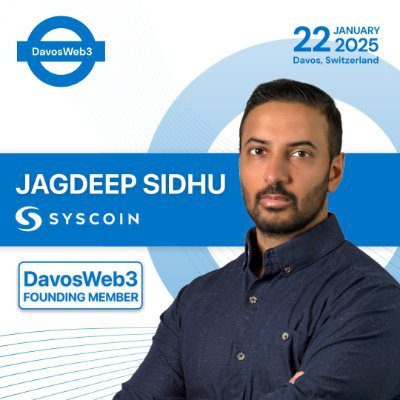
Jag Sidhu: We've released our layer two, Rollux. We started with a monolithic infrastructure based on Bitcoin and merge mining. Smart contracts didn't scale at the time, so we did some hard-coded smart contracts with assets. That evolved into an EVM, and then we discovered the data availability problem and created our own solution for it, distinct from what proto-danksharding is doing on Ethereum. We're more flexible than Ethereum because it has such a big community that changes take longer to get through, so we can be nimble and get things implemented quickly. The infrastructure is live, there has been no downtime, and the launch has been pretty successful. It uses Bitcoin security through merge mining and it uses data availability, so it should scale as much as or better than other rollups. We think it's the ideal design: it can scale, it's secure and there's no head of the snake to cut off. We're now getting into a DeFi launch phase, this month and next, heading into Devconnect.
Ashton: How does that architecture translate into adoption beyond crypto-native users?▶ 04:36
Jag: If you go really high up and ask what you would build on top of a blockchain to make sense for a utopian society, we see three or four angles. The first is real world assets: getting the financial conglomerates of the Web2 world and the Web3 crowd together to create tokenized on-chain securities, which is a $10 trillion market coming in the next few years. The second is what we call SocialFi, a social super app built from the ground up with AI and LLMs in mind, which gives you human-to-human incentives and a way to interface with AI. The third is DeFi: the economics of trading, holding assets, ETFs and creating a monetary mass of currency, with a take we think is unique. Those are the building blocks for the next bull run.
The smart contract is the counterparty to your trade there, so you can forgo any checks, because a smart contract is not a person.
Security tokens without gatekeepers
Ashton: How are you approaching tokenized securities?▶ 09:14
Jag: We come from an anarchist Bitcoin point of view, so we think these assets should be as decentralized as possible. We isolated the pain points: primary issuance and secondary trading. Those need to be regulated, so that is where we put the KYC checks. On Rollux we have Ethereum Attestation Service built in, so we can tie on-chain digital identity attestations to KYC at issuance. Issuers will always exist for something like a real estate building, because you can't decentralize a building. But once the legend is removed, which is codified in the smart contract, you can exit into an ERC-20 that you own. It's not a whitelist or a blacklist; it's literally decentralized. We can't stop you from exiting. What we check is whether you're allowed to participate.
Ashton: How does secondary trading work on Pegasus, your native DEX?▶ 13:45
Jag: When you trade on the DEX there are multiple routes. If you go from ETH to MATIC, you might go ETH to USD and then MATIC, and the router finds the most capital-efficient path. On the last route, if you're touching a compliant asset, we invoke the KYC service to make sure that person is allowed to hold it. The key intuition is that the smart contract is the counterparty to your trade there, so you can forgo any checks, because a smart contract is not a person. The check is only needed where the counterparty is a person taking the other end of the trade, which is the compliant asset. That means you can use all sorts of liquidity, decentralized and centralized, in a shared pool, which lets this go global much faster.
Ashton: Does this solve the liquidity problem of security-token-only exchanges, and who runs the KYC?▶ 15:43
Jag: You don't need a security token exchange. Anyone can plug that attestation check into the last route. It could be a game that accepts these tokens: if there's a transfer between people, it just adds the check that the end user has been KYC'd, and now you can do security token trades in the game. DeFi integrations can plug it in easily too. We are the attesting resolver for now, and we monetize that as a company by taking a fee on each resolution. But if the DAO thinks someone else is a better fit, perhaps charging less or giving better value, we will move along. The main value is always going to be the blockchain, so we'd keep the profit side minimal to bring users onto it.
Ashton: Where does this expand beyond the first use case?▶ 19:35
Jag: Because they're just standard ERC-20s, any protocol can plug them in. There's no whitelist or blacklist in the token that might stop a DeFi protocol accepting it. It's up to the owner. If you were part of the issuance platform, you've been checked, and if you go into Pegasus you're fine, because the new person there has been checked too. There's a lineage of KYC. If you break that chain, the issuer can call on you and ask why, and you may not actually own the asset behind the token, such as a fractional stake in real estate that pays dividends. So instead of enforcing a check on every transfer, we say it's your decision, in the same way you report your taxes to the government today.
Beating inflation with a decentralized ETF
Ashton: How does the DAO work, and what problem does it address?▶ 21:51
Jag: ETFs helped the stock market blow up because they let people park money in packages that suit different risk appetites. We're building a decentralized version we call a liquidity tree. The key thing we've figured out is how to mitigate impermanent loss, which anyone in DeFi knows is bad. Today, if you hold an ETH and USD LP position on Uniswap, you earn maybe three to five percent, which doesn't beat inflation. So people would rather hold US dollars at seven or eight percent and wait for crypto to bottom out. If you can mitigate impermanent loss, you can take that existing LP position, put it into the liquidity tree and safely earn another three to four percent on top. Arbitrage through the tree creates incentives, the incentives create volume, and that volume pays for it. It's like a mark-to-market strategy for DeFi.
Ashton: How does someone get started?▶ 32:11
Jag: We build a ZK light client on our chain for the other chains. Today bridges ask you to unstake your LP and give them the ether and the USD, which defeats the purpose, because I want to keep my position and keep earning on it. We'll take the LP position itself across chains, and we handle the messaging, including the rebasing, through the ZK light clients. In the DApp you say, here's my ETH LP position, click approve, and it goes into the DAO. You own the receipt token for it. You can sell that token, or you can go back to the treasury and take your position back out, based on how much value you hold.
It can scale, it's secure and there's no head of the snake to cut off.
This interview has been edited for length and clarity. Recorded October 2023.