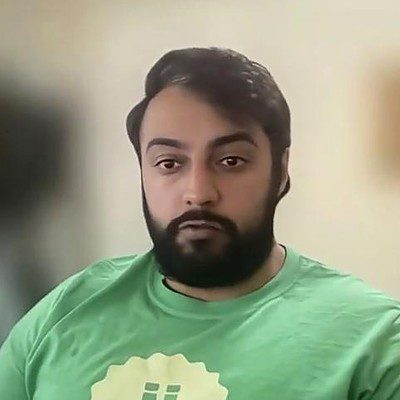
Key takeaways
- Bhaidani transitioned from private equity to crypto after discovering DeFi in 2019 and profiting during DeFi summer.
- SCIBR3 was founded in November 2022 to address a market gap in technical crypto-native go-to-market services and strategy.
- The agency grew from three founders to nearly 60 full-time employees in 2023, indicating strong product-market fit.
- Traditional business models like agencies and law firms remain viable in crypto without requiring blockchain-based structures like DAOs.
- Successful blockchain companies like Binance and Coinbase operate as traditional businesses supporting Web3 adoption rather than fully decentralized protocols.
From private equity to SCRIB3
Ashton Addison: How did you get into blockchain, and what led you to start SCRIB3?▶ 00:22
Ishan Bhaidani: I was in private equity and ran my own fund with my brother. I caught the DeFi bug in 2019 when friends showed me the early blue-chip protocols like Maker, Aave and Compound. DeFi was intuitive to me, and I picked it up before I even understood the back-end infrastructure of Ethereum. I put in my thousand hours of research, went through DeFi summer and did pretty well. I built the conviction that this will be the back-end infrastructure for all financial activity in the future. I started contributing around ecosystems, worked at another agency in the space, and spent time at Redacted Cartel and Gains Network in the perp DEX space. I realized there was a massive supply-demand gap of people who really understood the core use cases of the technology and could take it to market. Projects kept coming to us while we worked on Gains Network and asking for help, which gave me the thesis for SCRIB3.
Ashton: Do you need to build on-chain business models, or is there still room for traditional businesses in crypto?▶ 03:52
Ishan: There's a piece of the space for everybody, whether your passion is gaming, economics, finance or governance. I think people sometimes over-index on new business models with fee mechanisms on immutable smart contract platforms. There is still a massive need for traditional-style businesses like agencies, podcasting and media, and some of the most successful private businesses in the space look very much like traditional businesses. You don't need a DAO to run an agency or a law firm. Those concepts are cool and worth exploring, but I don't think that's the first place people need to look. I come from a retail, entrepreneurial family, so I've been building businesses my whole life.
Ashton: What does SCRIB3 offer, and who do you work with?▶ 06:26
Ishan: We started in November 2022 with three people, which, as many know, was not a great time to start a business. We spent 2023 scaling and are now close to 60 full-time people. I think that's a testament to product-market fit. Teams resonate with how crypto-native we are. You don't have to explain your business to us, so we can get straight into go-to-market strategy and token launches. We focus on six areas: content, social at scale, public relations, design, community development and business development. We want to be core contributors, not an agency looking in from outside. We work at every stage of the life cycle, from pre-seed projects to some of the largest teams in the space, like the Uniswap Foundation, Wormhole and Axelar. At any given time we work with about 30 teams, including a dozen in the top 200 by market cap.
You're talking about picking up pennies in front of a steamroller.
Why Bitcoin layer twos are worth watching
Ashton: What does working with teams that have already raised capital tell you about where the industry is heading?▶ 12:29
Ishan: We're a little more upstream than a traditional venture capital firm. We typically work with teams that already have the co-sign of top VCs. VCs are still separating noise from signal, but we get a pretty good read on the signal. We see a shorter timeline, the next one to two years, rather than theorizing about five or ten. A good example is Bitcoin layer twos and the growth of Bitcoin DeFi. People assumed they were slow, inefficient technologies. But now you're seeing realistic use of zero-knowledge proofs and succinct proofs to scale a Bitcoin layer two, and layer twos are being built for DeFi and gaming applications. Six or eight months ago people would have said they would never be fast enough. Fully homomorphic encryption could create new scaling opportunities too. Some people will think the true security of Bitcoin, the most decentralized physical infrastructure network, is safer for large-scale DeFi lending. I wouldn't call myself an EVM maxi, I'm incredibly bullish on the EVM, but it's a real narrative. You have to be nimble, because the speed at which this industry changes is a feature and a bug.
Spotting the FTX red flags
Ashton: You were one of the first to wave a red flag on FTX. What did you see in the lead-up to the crash?▶ 16:30
Ishan: A few things piqued my interest. With centralized institutions you can't do on-chain analysis, so it's hard to know a project's solvency. But I saw Alameda's co-CEO Sam Trabucco leave around May or June of 2022. Maybe he'd just become post-economic, but leaving what was thought to be the best business in the world, while they were supposedly making money hand over fist, was a red flag. Then FTX US CEO Brett Harrison left in September, in under a year. He was supposed to be the adult in the room. Leaving before your vesting period hits at a business valued at $30 billion is a massive red flag. I also had a conviction that a big domino would fall after Luna. You can't burn $60 billion in market cap in a week and not have something big go down. At Gains Network I saw that centralized and DeFi derivatives volumes were falling while on-chain derivatives market share was rising. FTX volumes were decreasing, yet spending stayed incredible: $20 million a year on Miami Heat naming rights for the FTX Arena, political contributions, a bloated payroll. Their product launches, like FTX stocks and the FTX NFT, weren't working, and what they said didn't match what they did. I put out a long Twitter thread around October. At the time I got killed for it. People pointed to on-chain metrics and arbitrage like the kimchi trade, but you're talking about picking up pennies in front of a steamroller. I have texts from people sending screenshots saying this guy doesn't know what he's talking about. A month later I felt pretty vindicated.
You can't stop an ETF anymore.
The case for Ethereum
Ashton: Are you optimistic about the market after the Bitcoin ETF, and what about an Ethereum ETF?▶ 25:16
Ishan: I think everybody is underweight ETH right now, and it will be obvious in hindsight. I'm one of the biggest EigenLayer bulls you'll ever meet. Exporting decentralized trust is a massive primitive, and I think it's a real zero-to-one innovation. EIP-4844 is coming too, and proto-danksharding will make gas fees a lot cheaper. That opens the door for more retail on layer twos, and I think we'll see more exchanges on-ramping directly to layer twos. Then there's the elephant in the room, the Ethereum ETF. You can't stop an ETF anymore. The verdicts on the Bitcoin ETF are going to be so easily played out in court for an Ethereum ETF that it's essentially a done deal. May might be a little optimistic, but it would be hard to see us not getting one before Q3 or Q4. Once that happens, the inflows are going to be incredible. Meanwhile, ETH is being sucked up by EigenLayer, liquid restaking tokens and platforms like Blast, so there will be a massive underweight supply. Ethereum is also very retail friendly. You can buy it on PayPal, anywhere you can buy Bitcoin, and it has real use cases. Personally, to be totally frank, I don't have any Bitcoin in my portfolio. I'm getting more excited about it, but I'd rather invest in layer twos and Ordinals. I'm also telling everyone to run a DappNode at home. I'm not a dev by trade, but I rent one, and with restaking it will be more realistic and more financially beneficial.
This interview has been edited for length and clarity. Recorded March 2024.