
Michael Heinrich / 0G Labs
0G Labs co-founder on why AI needs its own blockchain
In this episode
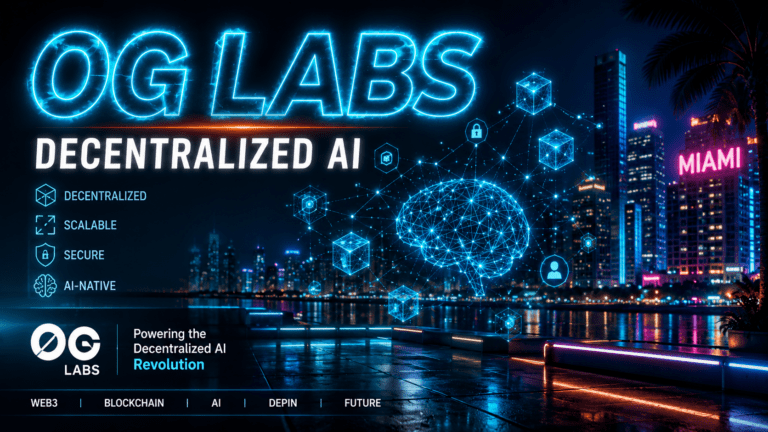
Centralized AI infrastructure gives a handful of companies control over the data, compute, and models that everyone else depends on — and most builders have no way to verify what's actually happening under the hood. DECENTRALIZED AI is the alternative, and 0G Labs is building the infrastructure layer to make it real.
Michael Heinrich, Co-Founder of 0G Labs, joins us live at Consensus Miami 2026 to break down why AI needs its own blockchain, what the Apollo launchpad is unlocking for AI-native projects, and how 0G's open-source infrastructure gives developers, agents, and communities real ownership over data and compute. From why existing chains like Ethereum and Solana fall short for AI workloads to what verifiable, trustless AI execution actually looks like in practice, this is a clear-eyed look at where decentralized AI infrastructure is headed.
Why AI workloads expose the limits of general-purpose blockchains and what 0G was built to fix How the Apollo launchpad works and what kinds of projects are being accelerated on the 0G network What open-source AI infrastructure means for developers who want to build without depending on centralized providers Why decentralized compute and data ownership are the two things that actually determine whether AI stays open
- Decentralized AI uses trusted execution environments and blockchain verification to ensure data privacy and prevent unauthorized use for model training.
- 0G Labs addresses limitations of general-purpose blockchains like Ethereum and Solana by building infrastructure specifically designed for AI workloads.
- Open-source AI models currently lag approximately three months behind state-of-the-art proprietary models like GPT-4, but the gap is expected to close.
- Over one hundred applications and companies are currently testing on the 0G network, including tools that integrate open-source models into existing platforms.
- AI agents handling sensitive functions like wallet access and financial decisions require established safety layers before widespread adoption can occur.
Chapters
Clips from this interview
Transcript
Read the full transcript
We're live at Consensus 2026 in Miami with Michael, a co-founder of Zero G Labs, the layer one for AI. As AI and grows deeper into blockchain or blockchain goes deeper into AI, I think AI is surpassing the scale of blockchain and just benefiting the whole world right now. Let's first of all, I would just like to start with a high level on
what do you see as the best synergy of blockchain with AI? And then we can dive into Zero G and all the latest updates. Absolutely. So, the best way to think about it is that when you look at AI, you think about hyperscalers, black box type of models. You get a bunch of GPUs together in one location. Even you go thinking about nuclear power plants to
like power all of these types of things. You have no idea where the data came from, what happened. At the end, you just get an API and an interface. You interact with the model and that's kind of black box AI. We're providing an alternative called decentralized AI effectively where everything's transparent, yet it can be private, and anybody can participate as
part of that network. It's a permissionless type of network. You as a user can provide a graphics card. You can participate in that network. It can be fully distributed, so it could be many many kind of power sources that are powering this type of thing. So, it's very user-owned type of future. And then, more importantly, there's also a truth layer element to AI. You can keep
AI accountable and add an AI safety level on top of that as well. And so, that's that's really the big difference and what Zero G and decentralized AI provide to the aspect. Definitely. And sounds like there's two parts to that. There's how the AI is hosted, if you could say, and then actually how you're interacting with AI and the data behind it, which has been a
controversial with certain different of you know some of these the oligopoly of AI platforms. Your data, where is your data going? Yes, you're using it to your own advantage, but also they're probably using it to their advantage. Yeah, absolutely. You That's the issue with black box AI. You can't individually verify what happened. You may be able to click a button to say
like don't use my AI for training data or my data for training of AI, but how can you verify that? The moment it's on somebody else's server, they can technically do whatever they want with that particular data. And it's very hard to independently verify and say like oh, you didn't use it for training purposes. So, if I have very sensitive customer data, personally
identifiable data, medical data, how do I know that's not being used to train models for example? And so, with decentralized AI, you can keep things completely private. For example, we use something called TE verification, trusted execution environments. And so, there's a physical like hardware device on a graphics card that ensures that the privacy is there. And then once the
computation has been done, there's an entry on a blockchain that basically says okay, this has been done to these specifications according to this level of privacy. And so, therefore you can independently verify that something has happened. And if there are all of these benefits to decentralized AI, what's the what's holding people back? Is it the user interface, the
friendliness of choosing that, you know the convenience? It seems like Claude pops up and it's just like hey Ashton, let's let's get to work. You know, is it that can work much more convenient that's stopping people from switching or just they just aren't aware? I think there's a couple of things. Awareness is certainly one one challenge and that's something that we hope to
address as we grow. Open AI has been around for I think it may be a decade pretty soon. And it took them seven plus years before they could actually release something that made the world really take AI like seriously at that point.
[snorts]
And so, we're only it's our third year into the journey at this monster May kind of 2023 is when we got founded
and so it's a lot lot of room to go. So there's the attention element but then there's a user experience element to it as well. Blockchains are not easy to use because you have to have a wallet interface. You have to top it up with a specific type of your own currency and so with AI agents and various other things like a payment layer we're trying to
abstract that user experience so it's significantly easier. And then the final thing is that open source models still lag about 3 months behind the state of the art of soda level models like office 4.7 or a GPT equivalent. So there's always some type of performance trade off there. But eventually we see that gap closing and models are going to be intelligent enough where they'll be good
enough for most tasks that you need. Yeah. Chat Chat GPT for example, you know they have that 10 year history but there was an inflection point when it came out on the App Store and it made it available to the public. I think they broke a record for like the fastest to a million users. Like the adoption just happened overnight as everyone started like experimenting with it.
You mentioned about abstracting that stuff away that is involved with the decentralized version and the wallet things like that. So what's the killer app on zero G that we can have that happen so people get on boarded into crypto without them knowing it. Yeah, there's a couple elements to it. Of course you can build a similar chat interface but it'd be completely private
and so there's a kind of killer app aspect to that alone. But ultimately it's going to be about the types of models that can be created. So for example, if I want to participate in AI and I have some sensitive data that I don't want to share but I want to create a model for other people to use that, I can then utilize blockchains to effectively monetize some of that data.
I can work with other experts to create a new model that others can use and I can benefit from the revenue streams. And so, I think in the future, those types of things will become more and more important. And then finally, really becoming the truth layer for AI and having an AI safety layer that can keep AI accountable as well. So, I see those as the a few
killer use cases. Definitely. It's always nice when you're able to earn from your contributions. You know, the fact that your information is staying private and in your own hands is nice, but if you want to give it away for the purpose of training, at least you should be rewarded for it.
Right. Yeah. Yeah, the way I think about it, if you're contributing to like a
Reddit or X or some other social media, you don't really own that data yourself. What if you not only own that data, but then can actually monetize it by giving it as training data to other AI models. Definitely. And you know, it's it's you need to have a perfect storm to be able to create an app that all of a sudden has millions of users in a couple days. And if you just make one
app, I know, you know, you're going to be fighting a big battle. But from what I understand, with the Zero G network, there's like over a hundred different apps and companies that are running on the ecosystem, testing out different things right now. Can you talk about that a little bit? Yeah, absolutely. There's many different types of applications,
anything from, you know, infrastructure-based ones that make a gentle commerce works or implementations of X42 payment protocol, for example, but extending it to other areas. Then there's more on the application level, where there's Gas AI, for example, that helps you run Open Claw in the Chrome browser as a plugin. Or live for a couple weeks, thousands of
users already. I was just going to ask about that cuz I'm like Open Claw has i- is sort of that when people think of open source AI, that's what comes to mind now. And it seems like the functions are have surpassed these regular LLMs, you know, like Open Claw's phoning you and telling you to do stuff or you know, tapping into the cameras in your house if you
let it to be able to like guide you on doing things. Can can we tie that into a blockchain ecosystem? Yeah, absolutely. And that's where the truth and safety layer comes into place. Like, do you really want your agent to hold your private keys and have access to your wallet for example? Not at this point until we have got this full safety layer established
effectively. Definitely. What It's going to come to that where why would I call up some old guy, my financial advisor on the phone when I have like the world's information at my fingertips and an AI agent to be able to help me manage that in my own way. Yeah, exactly. With the X402's the sort of paint from what I understand it's the way that AI agents will be able to
handle payments. Correct. How far along do you think that is in people that are using Open Claw and then people that aren't as technical and they're maybe just using regular LLMs right now? Yeah, so for X402 specifically it's a very early stage. So, if you think about last year 33 trillion in payment volume on stable coins or just in transaction volume of stable coins, X402 today does
process maybe 600 million or so. So, it's like a fraction of a percent. And so, very early in the agentic commerce side, but our belief is that next 5 plus years that all be most of the transactions of blockchains in the future. So, we're building towards that future. And then as far as the adoption of Open Claw versus other LLMs, Open Claw is slightly different because
an LLM is just a base model that you can prompt. And Open Claw takes it a step further to then say, "Not only is there an underlying model, but I'm going to give an agent the ability to use different types of tools and do work for me. And so open call with that use these kind of payment rails to actually then pay for things through an auction. And
they it's a natural synergy because on the blockchain based thing as I mentioned it's again about the trust and truth layer. Definitely. And with the interoperability of blockchains, you know, tying into the current infrastructure of DeFi on Ethereum or Solana, are there any issues with Zero G being able to help all parts of blockchain?
So Zero G has a full AI stack. So it's not just a blockchain itself. It's got a storage network, it's got a compute network, it's got an AI safety layer, service marketplace. And so these other components are built in a modular fashion. So any other blockchain can utilize these components. Even the agents that we built on Zero G can utilize some of the bridging
elements and then support another networks. Yeah, very cool. And with the second half of 2026, you know, AI, at least traditional AI models are just continuing to get stronger. There's so many facets of this vertical stack that you have. What are some of the top priorities for you and the team to focus on in the second half of this year? Yeah, it's comes down to basically
all the AI goals that we have. So things like deep research, couple of our papers just got accepted to ICML, for example. We're doing research on anything from agent-to-agent interactions to decentralized compute to AI safety type of issues. So a lot of those aspects we're working on. We're working on building our own models that provide new capabilities. So we're just
releasing a model that is able to have a 20 to 30% increase in benchmark results versus the underlying Coin 3.6 model. Okay. Because we were able to refine and kind of retrain it. And so that's those are exciting. So that's the AI side. Then there's the blockchain based side which is all about ecosystem building. So we have a accelerator called Apollo that's in
combination with Stanford and the blockchain builders association there. And building anything from kind of the D5 liquidity layer to further AI applications. We've even built AI applications just to demonstrate the decentralized network capacity. So we've built a vibe coding app app.0g.ai and within 3 weeks we've already burned about 4 billion tokens and so a very
good start. Very fun. Yeah. Okay, I'll put the link to that the vibe coding app in the show notes. What's the best way for people to follow along with the other apps, the Apollo and the updates as they come out? So we will update our hub page hub.0g.ai so that you can follow along some of the those latest news, but also follow our X 0g_labs
for a lot of these updates. Sounds great. Awesome. Thank you, Michael. All the best in keeping growing AI in the decentralized way, tying in blockchain, and making it open source, private and secure in the in the battle of AI. So thank you so much for the time.
Love love what we're doing. Our mission is to make AI a public good and we're not stopping anytime soon.
Thank you.
Related coverage
 OKX, MetaMask back GenLayer’s Internet Court launchJul 10, 2026
 0G Labs Wants to Make AI a Public Good — And It’s Building the Blockchain Stack to Prove ItMay 18, 2026
More interviews
 0G Labs' Michael Heinrich on cheaper open AI modelsNov 19, 2026
 Why Wall Street is moving toward 24/7 trading in 2026Nov 13, 2026
 How Wallet V is letting AI agents trade while keeping your keysNov 10, 2026
 How Silent Payments Keep Your Bitcoin PrivateNov 9, 2026
 How XYO is building proof in a world of AI fakesNov 5, 2026
 How Cap financed a Hollywood film with onchain creditNov 4, 2026