Key takeaways
- Altlayer provides application-tailored rollup solutions that create dedicated execution environments for high-traffic dApps like NFT projects and games.
- The platform's flash layering technique enables NFT mints to complete in seconds with no gas fees, then settles states back to Layer 1 blockchains.
- Altlayer supports both EVM and WASM-compatible blockchains, allowing developers to deploy without modification or compile new libraries into WASM.
- Multi-chain settlement allows applications to roll up states across multiple chains simultaneously, enabling users to access liquidity across Ethereum, Polygon, and BNB.
- Altlayer completed its first NFT mint with over 20,000 registrations in 18 seconds and is actively partnering with gaming, metaverse, and social applications.
Elastic scaling for busy apps
Ashton Addison: What does AltLayer provide, and how does it help the blockchain industry?▶ 00:26
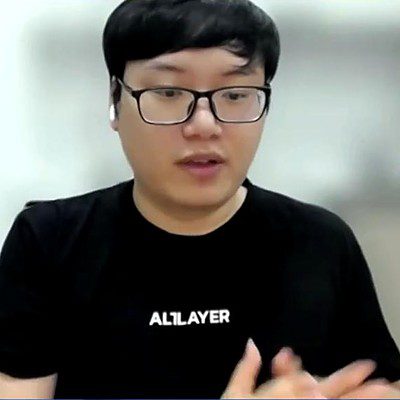
Dr. Yaoqi Jia: We're building application-tailored rollup solutions for dapps across different chains. Different L1s have their own scaling approaches, such as sharding, zones or parachains. But popular applications like NFTs and games have brought a lot of traffic over the past year and a half, and that sometimes congests a network or even stalls it. In that case we need elastic scaling, so we can offload that traffic and pressure from the L1 to a dedicated execution environment. That's where AltLayer comes in. We provide a new service built on a technique called flash layering. Developers click a few buttons and the protocol quickly spins up a dedicated rollup for them. For an NFT project, for example, you do the mint on this rollup, and users interact with the contracts and logic there. Once the mint is done, the rollup is torn down and the states are rolled up to the selected L1. The pressure is handled by the rollup, so throughput is high, latency is low and gas fees are low. We also provide execution that is both EVM and WASM compatible. Developers can deploy Solidity contracts without any modification.
Ashton: How is AltLayer different from other scaling solutions, and does it help with the multi-chain problem?▶ 03:27
Dr.: The unique part is that we're application-tailored. We work directly with partners such as NFT and game projects, and even decentralized exchanges. They have a lot of users and need a dedicated execution environment to handle the requests. Most L1s and L2s are general purpose, so thousands of applications compete for the same block space. Even if an L1 can handle tens of thousands of TPS, it will still get congested when many applications each have a lot of users. We believe that in the next three to five years there will be more and more of these super applications, especially in Web3. Axie Infinity, dYdX and Yuga Labs all started on Ethereum. Once they had more users, they either moved to their own application chain or looked for scaling solutions. We want to give apps their own dedicated block space. On multi-chain, an NFT project that launches on AltLayer can later choose which L1 to settle on. Once the mint is done, we can roll up the NFTs to Ethereum, Polygon or BNB, so the project can enjoy the liquidity and volume of all those chains.
We believe that in the next three to five years there will be more and more of these super applications, especially in Web3.
The first live test
Ashton: How far along is AltLayer, and what has it shown so far?▶ 07:26
Dr.: We started at the end of last year and spent the past few months on technical development. We have our testnet running internally. Last month we did our first NFT mint using flash layering, and over 20,000 people registered. The mint was done within 18 seconds, with no gas war, first come, first served, and no network congestion. After the mint we rolled all the NFTs up to Ethereum, and people traded them on OpenSea. Everything was very smooth, and the floor price is now over 0.35 ETH. So we already have a mature solution for flash layering and NFT minting. We can currently roll up to Ethereum, Polygon and BNB, and we want to support more chains gradually. We're also actively looking for partners in NFTs, gaming and the metaverse. We're talking to top-tier social network applications and decentralized exchanges as well, to understand what these future super applications will demand.
NFT 2.0 and onboarding newcomers
Ashton: Where do you see NFT 2.0 going, and where will AltLayer be used most?▶ 10:30
Dr.: NFT 2.0 means new use cases. More and more games will want their items tokenized as NFTs, and we believe NFTs will be a huge market. Beyond games, content like blog posts, video and audio can also be treated as NFTs onchain. We have a bunch of games in our pipeline that we're working with. We're also working out what game logic can be hosted on AltLayer. Because of high gas fees and network congestion on L1s, games couldn't put much logic onchain. With our technique, beyond the NFTs for items and access to the game, they can put more functionality onchain. We learned from DeFi Summer that once resources, data and assets are onchain, people can build DeFi Lego. I think NFT 2.0 will be a similar story. Other applications can build their own interfaces on top of existing data and assets, creating new Legos on top of existing NFTs.
Ashton: How are you making AltLayer usable for people with no technical background?▶ 14:10
Dr.: For developers, we try to make our technology as convenient as possible. There are many parameters and configurations that are easy to set, including block time, the number of block producers for the layer, and the gas mechanism. If you don't want a gas war, there's also a first come, first served mechanism. You click a few buttons, configure some parameters, and the protocol automatically spins up a dedicated layer. Then developers can focus on their own expertise, whether that's game development or smart contracts. For users who aren't familiar with crypto, we're working with wallet partners on session wallets. Users don't have to configure a wallet or convert crypto first. They click a few buttons to mint, and the protocol automatically rolls the NFT up from the layer to Ethereum, so they can trade it directly. We try to simplify almost every process for developers and users.
The mint was done within 18 seconds, with no gas war, first come, first served, and no network congestion.
The roadmap and a live demo
Ashton: What does AltLayer need to achieve over the next two years to become a staple scaling solution?▶ 17:07
Dr.: Over the next two years we want AltLayer to be the go-to platform for developers to spin up a layer-2 solution for their applications. That means more technical work to make it as convenient as possible, so choosing AltLayer is not intrusive for developers. I believe the paradigm will shift from a protocol thesis to an application thesis. So we want to provide application-tailored rollup solutions with an EVM- and WASM-compatible execution environment, settling to as many chains as possible. We also want to give users a very similar experience. They shouldn't have to install MetaMask or other wallets, or convert anything into crypto. We want that integrated into the protocol or our product, so developers and users both have a smooth experience. We want to become the go-to infrastructure provisioning platform for developers, and also help applications attract as many users as possible.
Ashton: How can people follow AltLayer, and is there anything they can try now?▶ 20:07
Dr.: You can visit our website, which is altlayer.io, and follow us on Twitter and Discord. We'll keep everyone posted on the latest news and technical development. We also run community events. We recently started another campaign where people can try playing a game running on AltLayer, with rewards for the top winners. The goal is to show how easy it is to deploy a game using AltLayer. Players can also experience that it's very fast and there's no congestion. You don't wait a few seconds. Within one second your actions are done. We want to show that AltLayer can be a very smooth technology for developers and users.
This interview has been edited for length and clarity. Recorded September 2022.