Key takeaways
- Pruf is a privacy-first, chain-agnostic NFT protocol for tokenizing and managing both digital and physical assets, not a competing NFT platform.
- The platform bridges supply chain tracking from manufacturing through retail into the consumer space where items retain utility and provenance value.
- Pruf solves authenticity and origin verification issues in digital assets by providing transparent proof beyond relying solely on platform databases.
- The solution offers a white-label, turnkey integration into existing brand websites, allowing creators to maintain brand identity without displaying products alongside competing items.
- Physical asset tracking focuses on sub-component management and consumer ownership proof, enabling sellers to verify items are not stolen or counterfeit.
A protocol, not a marketplace
Ashton Addison: What is Pruf's focus, and how does it solve these problems?▶ 00:22
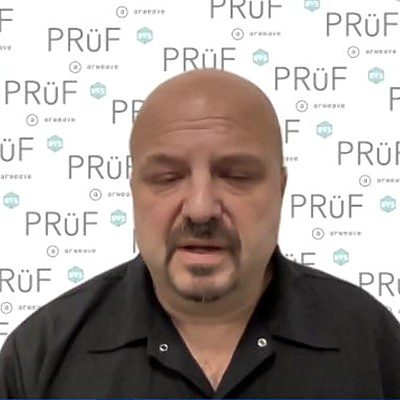
Clifford Smyth: At its core, Pruf is a privacy-first, chain-agnostic, NFT-based protocol for the tokenization, management and verification of both digital and physical assets. It's an important distinction that we're a protocol, not an NFT platform. We're not in competition with platforms; we're tooling to build platforms on. It's built for brands, artisans, artists, curators and collectors who want to extend their brands into the NFT space in a brand-centric environment. It's a white-box solution, so they can be brand-forward and not have their products displayed alongside competing or contrasting ones. For physical items, we solve problems around provenance, and we manage that with privacy. You can prove that you own something, but no one can look you up to see what you own. It's a one-way door. We also handle proof of authenticity, so manufacturers' products can be verified as genuine and not fakes or copies, along with proof of ownership and other aspects of supply chain management. In the digital space, our focus is authenticity and proof of origin. That's a big issue on existing platforms, where trust that something is an original rather than a copy rests on the platform's own records or database, which isn't very transparent to the end user or a prospective buyer. We also deal with data permanence, which is another big issue we see in the space.
Ashton: There are already plenty of NFT marketplaces. What gap does Pruf fill for artists and curators who want to create NFTs their own way?▶ 06:20
Clifford: Say I have a fine art product that is purely digital. On an existing platform, I'm presenting my art alongside a wide variety of products of different quality, right next to a collectible baseball card, say. As a consumer it's a jarring experience. It feels like being in Lego world. There's nothing wrong with that, but a collector or curator who wants to set up their own NFT offerings has a whole brand image, especially in the art world and in fine art photography. They're not going to want to put their work up alongside everything else. So we provide a turnkey solution. These places already have web presences and some web development going on. They can integrate the Pruf protocol and Pruf-enhanced NFTs into their existing platforms without doing any blockchain development and with minimal Web3 work. It's mostly packaged into our libraries. Another big advantage is this. If you run a traditional NFT marketplace, you have to figure out how to store the digital artifacts. If you're selling something for $100,000, how long will you keep that server online? How can you guarantee that it will be there in 20 years, in 10 years, in five years? So what are you really selling? A lot of offerings aren't thinking about what happens farther down the line. Everybody is excited and the space is exploding in popularity, but we're thinking a little farther ahead.
We're not in competition with platforms; we're tooling to build platforms on.
Taking provenance from supply chain to consumer
Ashton: Supply chain seems like one of blockchain's strongest use cases, yet few real-world assets are on-chain. Where is the friction, and how do you overcome it?▶ 03:37
Clifford: There's quite a bit of friction, honestly. Companies are used to handling this with strictly in-house record keeping. Blockchain offers transparency and global accessibility, and frankly that's not a huge priority for every company. So there are limitations in that segment, except in certain cases. What we've focused on is places where we can compartmentalize larger systems into subsystems. A complex piece of equipment, for example, can be separated into subsystems, each with its own tracking of life cycles and reuse, and that information can feed back and become valuable to customers. For pure supply chain management, like materials, there are players already doing a reasonably good job. Where we do something different is that we bridge forward into the consumer space. Once something has been tracked from the supply chain out to retail, it continues to have utility through asset management features and proof of provenance. Individual consumers can prove they own their items, and if they go to sell, they can say it's registered to them and isn't stolen. I think our main innovations in supply chain come from sub-component management and from that bridge into the consumer space.
Early adopters and the PRUF token
Ashton: You're early in your launch. How will you attract and keep early adopters?▶ 10:25
Clifford: That's a big part of our strategy. We have a grant program, basically an outreach program. If you have an NFT project you want to launch, we cover the cost of setting it up, including node costs and some PRUF to use the system. We also provide extensive developer and library support, so we'll handhold their web dev team through getting it operational. It's actually pretty simple. With a couple of small pilot projects, we've found it's pretty turnkey for most people, but we still provide that first-tier support. A lot of web developers aren't familiar with Web3, and it's intimidating. Right now, just try to hire a team to write contract code or do Web3 development. It's pretty crazy out there.
Ashton: How does the PRUF token fit into the platform, and how does it create a sustainable ecosystem?▶ 12:40
Clifford: On the business model side, the PRUF token is used to align incentives within the system, to make a sustainable and prosperous ecosystem. A node operator, someone minting NFTs on their platform, can choose to monetize different operations. For most business uses, I think they won't monetize things like transfers. They'll keep that industry standard. But they might want a commission on certain transactions, such as collateralized loans or auctions. The token pays for layer-two or network costs within the Pruf infrastructure. Node operators can also use it to pay layer-one gas costs if they choose, although I suspect a lot of them will pay gas themselves. PRUF is burned to mint a node, meaning to create a new minting authority. It can also be a unit of commerce for asset transfers. You can sell something for the blockchain's native token, which would be Ethereum in that case, or for a certain number of PRUF. That's all built-in revenue generation. It's also staked on nodes for DeFi revenue sharing, which is part of the network's distributed governance. People can stake on profitable nodes and earn a share of revenues, and that gives those nodes extra voting power. It incentivizes nodes that generate revenue to operate in the system. Because there won't be many nodes at first, we've set aside tokens for early synthetic staking, a straight staking return contract, to encourage stability. We've also got some interesting partners lined up, and an announcement coming that I don't want to blow just yet. They're prominent people from the fine arts side, with exhibits in the Smithsonian and the Getty. They want to move into the NFT space, but they're extremely image conscious and want control of the process, which only Pruf offers. What we're really trying to do is bring legitimacy to the space, so there's actual lasting value when you tokenize a piece of art.
How can you guarantee that it will be there in 20 years, in 10 years, in five years?
Where to learn more
Ashton: How can viewers follow along and get involved with the community?▶ 17:05
Clifford: Start with our website, pruf.io, which has the white paper, user stories and examples of our vision of a Pruf-enabled future. To see what we're thinking about and working on long term, we publish articles on our Medium, prufio.medium.com. To get involved in the community, there are always contests, bounty programs and bug bounty programs. Our Telegram group is the best place for that, and we're on Twitter as well.
This interview has been edited for length and clarity. Recorded May 2021.