
Toby Gilbert / PACT SWAP
Toby Gilbert on building DeFi without bridges or wrapped tokens
In this episode
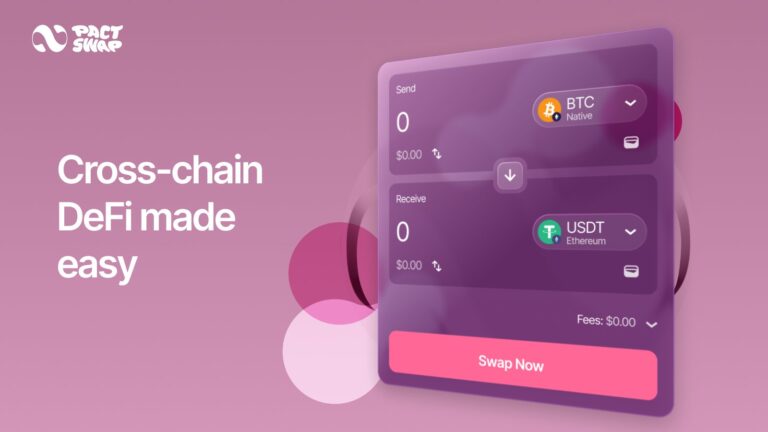
We sit down with Toby Gilbert, Co-Founder & CEO of PACT SWAP, to explore the future of decentralized finance without bridges or wrapped tokens. As the industry matures, structural flaws in traditional cross-chain infrastructure are becoming impossible to ignore—especially for institutions preparing for the next wave of adoption in 2026. Toby breaks down how PACT SWAP is building the world’s first truly unified, bridgeless liquidity layer, eliminating the risks of intermediary-based swaps while unlocking native BTC liquidity at scale.
From reactive smart contracts to collateralized accountability, this conversation dives deep into how secure, permissionless swaps across BTC, ETH, and Solana could reshape global finance over the next decade. If liquidity siloes disappear and DeFi becomes invisible to the end user, what does that mean for traders, institutions, and everyday users in hubs like Austin and Dubai? Watch to find out.
- PACT SWAP uses reactive smart contract frameworks instead of intermediary blockchains to enable cross-chain swaps, reducing costs by approximately 85% compared to competitors.
- Wrapped tokens are synthetic assets that don't represent true asset movement and create false liquidity, as users still need bridges to move underlying native assets.
- PACT SWAP's collateralized accountability system requires market makers to post collateral worth 2x the trade value, with automatic slashing if assets fail to settle.
- Institutional investors prefer centralized exchanges for low fees and regulatory compliance, while retail users seek decentralized solutions to maintain self-custody and avoid counterparty risk.
- Liquidity fragmentation across multiple chains remains PACT SWAP's primary challenge, requiring coordination between liquidity providers on a pair-by-pair basis.
Transcript
Read the full transcript
I'm Ashton Addison from the Crypto Coin Show, and today on Blockchain Interviews with Toby Gilbert, co-founder and CEO of Paxos Swap, here to talk DEXes, DeFi, bridgeless liquidity, and even how Bitcoin is getting into DeFi even more, and also how wrapped tokens era is finally over. That all these extra things that we've had to build bridges and places where there's
vulnerabilities and wrapped tokens that I'm sure will all go away as we abstract all that out and bring the mainstream into DeFi. Toby, welcome to the show and thank you for taking the time. Thank you for having me. Yeah. You've been involved in the decentralized side of trading for a while and seen how decentralized exchanges evolve over the years. They're
only getting better, and there's always been a debate on whether centralized exchange versus decentralized, which is better for each person. I would love to start out with a little bit on Paxos Swap, how you guys have built it as like a bridgeless liquidity layer and strong DeFi components, and then we can dive into all the details. Okay. So, I mean
I have a big problem with this. Namely, the fact that the gatekeepers for the liquidity that comes into crypto is coming in through centralized parties, namely the CEXes. If you are Okay, I whilst I appreciate that fiat will do that job, but they shouldn't necessarily be handling token-to-token swaps.
So, whereby if you're on an exchange, it's fully KYC'd and AML'd, get it, no problem. But, the token-to-token swap business has now been crushed, particularly in Europe, travel rules, Mika, and so on and so forth. So, that's not decentralized. That's entirely centralized. So, we all kind of got into the space to
be decentralized, but we where we've ended up is being centralized at the same time. The decentralized options are very expensive. And the reason for that is they glue a blockchain in between different blockchains, cuz they're incompatible. And we have sought to I would say mitigate that. And that's what we ended up with today
is instead of validate sets and nodes, we've replaced that with a reactive smart contract framework, which then cuts down the cost of what our competitors are doing. And therefore, we can then bring that to the masses. Mhm. Okay. So, breaking down decentralized exchange, for example, there's in one scenario, you're
you're just switching ether for stablecoins or something simple on the same chain. But, then if you want to move from Ethereum to Solana or any of these other layer ones, that's where especially the centralized component comes in. Well, let's look at it like Microsoft and Apple. They're they're they're two different operating systems as is Ethereum and Bitcoin, for example. So,
they're they're not they're not compatible. So, what has happened to date is you glue a blockchain in between different blockchains to then move the assets between them, which is insecure and costly. Mhm. What we've managed to do is come up with a proprietary solution whereby you have a cross-chain react smart contract framework that sits on both blockchains. It's a monitoring
system effectively. And it allows you to meet move the assets between the different blockchains without having a blockchain between the different blockchains. So, we've mitigated that risk and that cost. And as a result, we end up with something that's like 85% I would say cheaper than everybody else and far more secure. Wow.
with the wrapped token situation, that I don't know if they consider that, you know, the interim solution or why but people seem to be okay with if there's Bitcoin, we just wrap it and then we have a synthetic version on Ethereum. And now we don't need to do between bridges between blockchains because it's all on one chain. What do you think about that?
You're talking about wrapped tokens. Wrapped tokens aren't a native token. Mhm. So, it's a way to say, well, there's a synthetic asset sitting over there and we can move that. But ultimately, if you want to move the real asset that sits underneath this is that the synthetic asset, you're still going to move it. Mhm. So, it's a false movement at the end of the day. So, you know,
if you if you want to move the asset, then you still it's on chain and is what it is. But it can map down to an underlying asset, but it's not real. It is it's it's a bit of falsehood. Mhm. Can you explain in layman's terms if somebody has Bitcoin and they want to swap into Ethereum or another chain and they go to
Paxos swap, how easy is that without having to understand the underlying infrastructure and what risks there are? Absolutely. Yeah. Simple terms, you literally connect your wallet to the DEX. The cross-chain reactors smart contract framework monitors the different wallets that are connected to the DEX. The let's say on there's a bid and
ask and a bid side of the trade. On the bid side of the trade, collateral is put up by the solver, by the market maker. Mhm. And at that point in time, the cross-chain reactors smart contract framework is monitoring if the assets move. If they don't on the bid side of the trade, on the professional solver, then their collateral is slashed. Mhm. So it's
you either do it or you don't. Mhm. If it comes in, it comes in. If it doesn't come in, then they lose their collateral, which is on average two x the times of a trade. So does making a more decentralized version on a DEX, you know, is it make it a lot slower, especially when you have confirmation times of different blockchains? Same time. There's no difference whatsoever on the
confirmation times cuz we're still subject to the block confirmations of the underlying chains. But what it does do is make it cheaper. Mhm. By way of example, if you look at ThorChain, they have a hundred validator plus sets. Mhm. That has a cost attached to it. They lock up collateral, which is four hundred million dollars for a minimum term of three months.
We do it on a per trade basis. So, the savings on the collateral and also on the validated sets, we pass that down to the swappers. And that is an 85% saving on average. Hm. That's really nice. With Paxos, how do you balance having so many different chains and different assets, you know, and
liquidity behind that, making sure that it's not too fragmented across different chains or assets? Well, it's always a balance here. And that's our main challenge is how you bring in the liquidity to match off on the trades. So, we have a number of different liquidity providers that are pouring in at this moment in time. Some will take some risk on the basis
that, you know, say Doge is doing well against Bitcoin and so on and so forth. It's a it's a give and take situation. Mhm. You know, and that will be one of our main challenges. But, we have a hell of a lot of liquidity that is sitting there at this moment in time. But, it you know, it will be on pair-to-pair transaction basis
where people put the liquidity because obviously they want to earn on it. Mhm. Definitely. I'm not sure if you've been following the markets recently, you know, with the Bitcoin kept getting pushed down and then there's allegations that Chain Street was manipulating probably through, you know, market making pieces that you would be aware of
more in the on the centralized side. Is that isn't that possible just the same way on a DEX versus a CEX? Well, you know, the money goes where the is. It is a case of you know, the liquidity providers want to earn on the basis that there's trade happening. If there's no trade happening, then they the liquidity
doesn't come. So, this really is a case of saying we are cheaper. We have a solid platform that can handle transactions and therefore the volume is coming and therefore the liquidity is there. Liquidity doesn't exist in the crypto market unless that the trade is there. Mhm, definitely. How do you feel about institutions
or what do you think of the appetite for decentralized exchange from institutions or larger players when they might be used to more custody solutions? Well, institutional doesn't have the problem with AML and KYC. Mhm. So, they're perfectly prepared to play the game of going to a centralized exchange, take low trading fees, but
bearing in mind that the centralized exchange is swapping an asset on a ledger basis. Mhm. You're not actually taking custody of those funds. Mhm. Now, that isn't necessarily a problem unless there's a black swan event like, you know, FTX and someone getting caught out like that. But, whereby retail swappers or decentralized participants truly believe that they want to handle
the custody of their funds Mhm. and not lose it. Mhm. Not trust a third party, which is the premise of the whole space. Thereby they're two different markets. Institutional are very used to trusting a third party with their funds. Individuals that want to keep custody of their funds and be decentralized and never, you know, not
trust a third party that could or could not perform, well, then that's our market. Mhm. Mhm. With the
[clears throat]
with the sort of low retail interest right now because of low liquidity and prices outside of Bitcoin and Ethereum, a lot of altcoins, does that affect
you know, it affects the volume of all centralized exchanges, decentralized exchanges, but how can decentralized exchanges like ParaSwap sort of stay strong despite the market conditions and compete and bring keep users coming back and you know, client retention?
Interesting. Look, you know, at the end of the day, the majority of the traffic
doesn't come directly from retail customers, it comes from aggregators. So, we're we're talking about it's a you know, you think it's a big amount, but it's not in real world terms, a billion dollars a day. And this happens I've I come from the telecoms industry, it's a least cost routing model. So, what happens is, where's the liquidity on the pairs and
where's the cheapest ones? So, out of the billion dollars a day, which is relatively small, they route the traffic to you. This is not an individual customer acquisition strategy. This is the aggregators take it and they route the traffic. Yeah, for sure. So, for example, using platforms like 1 inch or these other aggregators
You got it. Yeah, ParaSwap, 1 inch,
Yeah. They look and they see, okay, you know, they're usually looking for the best deal if that's an option in for the client like I want the lowest fee and they see okay, Hash swaps using the smart contract and so it's going to route there automatically. Yeah, absolutely. That's how it works. That's amazing. With you know, you mentioned the black
swan event FTX. I think people they're always learning their lessons whether it's a centralized hack or something like the bybit which didn't affect the users funds but and other bridge and index hacks with the reactive smart contract and the aggregation, you know, what are the risk factors that your company needs to worry about in protecting the
security of the exchange and the routing? Okay, we're going to balance something here. I built payment platforms. So, you know, this is a case of you know, the biggest day we did on test transactions was about $900,000 a day of transactions. The platform performs differently when you do $10 million a day or $50 million a day or
$100 million a day. You got to scale it. And there will be bugs and we have to debug them. Excuse me. The challenge will come in between scaling and bringing liquidity in whilst you scale the platform. This is the biggest problem that we have. You know, $5 million $10 million a
day I'm not worried about. But we are the cheapest in the market and therefore we can get a lot of volume thrown at us. Am I ready for $100 million a day? In 3 months, yes. Today, please don't.
[laughter]
So, that there's got to be there's just got to be a build-up from my from my experience from payments.
And that will be the issue here because if you are the cheapest and we have the liquidity there, which we do have, then the aggregators can throw all the traffic in the world at us. But, you they're going to be bugs. You know, you've got to you've got to solve it, you've got to fix it. And that comes into conflict with what your road map is.
Cuz we want to get Solana base and turn on in the next couple of months, but your dev team is out eyeballing a platform on [clears throat] an operational level when they should be then adding new chains in. So, there's a trade-off between stability, scalability, and bringing on your road map. Mhm, definitely. And with that scalability, does the decentralized nature is that
what's the major roadblock to being able to scale faster, or what exactly needs to be done to get to that point that you're talking about in 3 months? No, decentralization is already there. That's at the core of what we do. But, it
[clears throat]
Solana, for example, is not EVM. It really is an entirely different operating system. And therefore,
you know, we want to be able to integrate it and make it seamless. And it's hard work. This isn't You know, we thought we would have it there 6 months ago, but we didn't. And you know, I've got to you know, If you've ever renovated an apartment, Ashton, Everything always takes longer. They the builders come in and they're like, "Oh, no, it's going to
take 2 months and everything's going to be finished." And 6 months later, they're still there painting the walls. That's the same with Dev. You know, they always quote you a far shorter timeline than what's happening. They always run over budget. And you're there struggling away to make it happen. And you know, Solana's been like that for us. But we're very, very close to it at
this moment in time, which becomes very interesting on memes or anything else when there's another run to have a DEX which is that and I'm not leading with saying there's no AML or KYC because you don't want that. If we have professional solvers, they run their own AML protocols. But at the same time, that's a huge opportunity where you could swap USDT or
you know, Bitcoin into a meme on a DEX. So we would look to pick that business up as and when it arises. Again,
[snorts]
Definitely. Yeah, it's I would feel better that you're working heads down in what most would consider a bear market. Maybe it's easier when the volumes are low to test it. And then the you know, the real the real test comes in
when once Bitcoin starts going up and sort of rises all tides. I had a I had a conversation today with a very well-known chap. I would say top 10 in the industry. He's not a mate of mine.
[snorts]
they do a lot of Web3 I'd say I can't give this away. Web3 gaming.
And I said to him, he said, "Why Why would you launch a token today?" And I said, "Because businesses that built in recessions are the ones that do well when the market turns." [clears throat] And he got he actually went he laughed at me. He said, "Yeah, you're absolutely correct." He said, "When are you launching the token?" I went, "Well, that sounds to me."
[laughter]
For sure. And what is that maybe can elaborate more on this Pact? Is there a governance token and when it is coming out, how does it integrate into the ecosystem? So, the token does a couple of things. Firstly, it all kind of voting or permissionless listings they need to be paid for in the native token. But more importantly,
the collateral for every swap is paid for in the underlying protocol token which CWEB. And the only way to access the fee pool is to burn the native token of the DEX which is the Pact swap token. So, when the market cap of the fee pool begins to overtake the market cap of the native token, there's an arbitrage play.
Interesting.
free zone. Yep. And relative to the Solana integration other chains, how much of a focus is on that and scaling combined with the token launch? There's a major major push for a big aggregator at this moment in time. I mean the next 30 days. So, all focus is on that. Token launch, I cannot comment. I'm not allowed to.
Otherwise, it'll be in a bid but very soon. Okay. What's the best way to follow along so that when you are able to release it, we know right away? Pact swap p a c t s w a p.io Okay. And will you guys also be sharing it on social communities or do Absolutely. All the channels. All the channels for that. Yeah, check it out.
Okay. Sounds great. I'm looking forward to it. Right. Yeah, I would say probably good. I'm going to test out the you know, I'm going to check I'm going to check in aggregators. Look for patches.
some get give give me some critical feedback. No, I think I think that this is super important, of course. DEXes need to have a bigger piece of the pie over CEXes and we're
transitioning to that. The aggregation is key. You know, it's there's there's so many moving pieces that you and your team would know best. Integrating different chains and scaling while trying to remain secure and decentralized. It's a lot of work. But it sounds like you guys have built a great foundation. We're trying. Yeah. Well, I'm looking forward to
seeing it continue to grow and just bring more liquidity and multi-chain, of course, that's that's important as they all get bigger. And I would I would love to follow along for the token launch and potentially have you back on you know, right before we launch so we can get the latest details and we'll know when when we find out when that is exactly, when it's able to
be disclosed. Would love to have you back. So
to that. Yeah, I appreciate the insights, Toby. Thank you.
Pleasure. Thank you. Yeah, and let's follow up in the near future. Looking forward. Thanks so much.
Related coverage
More interviews
 0G Labs' Michael Heinrich on cheaper open AI modelsNov 19, 2026
 Why Wall Street is moving toward 24/7 trading in 2026Nov 13, 2026
 How Wallet V is letting AI agents trade while keeping your keysNov 10, 2026
 How Silent Payments Keep Your Bitcoin PrivateNov 9, 2026
 How XYO is building proof in a world of AI fakesNov 5, 2026
 How Cap financed a Hollywood film with onchain creditNov 4, 2026