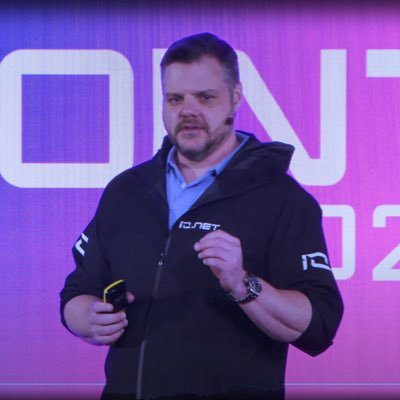
Key takeaways
- io.net aggregates underutilized GPU resources from data centers and consumer devices globally to create a decentralized compute network for AI applications.
- AI compute demand doubles every 3.4 months while traditional cloud providers face scaling limitations due to GPU shortages and long data center construction timelines.
- io.net offers users customizable options ranging from 30% cheaper enterprise-grade compute to 80% discounts on consumer-grade GPUs depending on performance needs.
- Decentralized compute networks can provide latency advantages by routing requests to geographically closer data centers compared to centralized cloud providers.
- io.net raised over 40 million from top-tier investors including Multicoin Capital and Hack VC, achieving day-one Binance listing as the world's largest AI decentralized compute network.
From fintech to a GPU marketplace
Ashton Addison: How did you get from traditional finance to building io.net?▶ 00:23
Tory Green: I started my career in a fairly traditional way: investment banking, private equity, corporate strategy. As a VC I was really an operating partner, so I took on COO, CRO, CMO and CFO roles at companies. It was a stable job and I liked it, but I always knew I wanted something more. I got into crypto in 2016 and went deep down the rabbit hole. I thought it was perhaps the most important technology invented in the last 100 years. I was hesitant to go in full time, though, because most protocols felt like solutions looking for problems. That changed in 2019, when I was COO of a machine learning fintech and saw firsthand the shortage of compute. I realized that decentralized networks were not only the best way to solve it, but probably the only way. That was the point of no return. Along the way we were in 14 countries in one year, raised over $40 million from top-tier investors, got a day-one listing on Binance and built the world's largest decentralized AI compute network.
Ashton: In layman's terms, what does io.net actually do?▶ 03:44
Tory: A GPU is a type of computer, and I'm vastly oversimplifying here, that is used to build AI models, optimize them and run them. AI has been the fastest-growing technology ever, and ChatGPT was the first app to reach 100 million users. But AI uses a ton of compute power. Zuckerberg just came out with a new Llama and said it will need ten times more processing power than the last version. The demand is enormous and the supply isn't there, at least in the traditional cloud, where most people get their GPUs from Amazon, Google or Microsoft. That centralized model can't scale. They face constant GPU shortages, and they have to keep building data centers, which means construction, long lead times, permitting and heavy capital expenditure. For the consumer that means low availability, long wait times and high costs. We're rethinking how people get compute. We're building an Airbnb for GPUs. There are thousands of data centers in the US alone running at around 12 to 18% capacity, and every consumer has a GPU in their computer. We aggregate all of those global sources into a single platform. That gives you access to nearly unlimited computing power, it's highly scalable, it's censorship resistant, and in some cases it performs better. Perhaps most importantly, it's much, much cheaper.
Ashton: Companies trust Amazon. Is a decentralized network as strong, cheap and reliable?▶ 06:55
Tory: The best way to think about us is like Priceline or Kayak. We're a network of different GPU sources, so just as you can book Emirates first class or Spirit for super cheap, you can choose here. A lot of our data centers are large, legitimate facilities with all the bells and whistles Amazon has: the latest H100s and A100s, NVLink. You can recreate what you get at AWS, even with SOC 2 compliance, for maybe 30% cheaper. Some companies just need really low costs, and for them we use consumer cards like 4090s. They may be a little slower, but you can get 80% off. There are also services like interruptible computing. So it's really about choice. In some cases you can even get better performance. Say a user in Vietnam asks an image app to draw a dog with a hat. On AWS that request may have to go from Vietnam to the US and back. We can set that user up with a data center in Singapore. Or take a hedge fund in New York. Rather than Amazon's data centers in Texas, we might find you one in upstate New York, which is a bit faster. If you're a hedge fund using AI, those couple of seconds of latency could make you billions.
We're rethinking how people get compute. We're building an Airbnb for GPUs.
Who supplies the compute, and can supply keep up
Ashton: Can anyone contribute spare GPU power, like extra Macs or overnight capacity?▶ 09:46
Tory: Yes, anyone can. The network supports consumer cards like 4090s. There's obviously more demand for enterprise cards, but I personally believe that will change as the technology grows and you see more applications for consumer cards. And eventually, I don't know when it's going to happen, I think mobile devices as well.
Ashton: Will compute supply ever catch up with AI demand?▶ 11:44
Tory: I don't think so. Chris Dixon said something insightful: the demand for compute always outpaces the supply. And AI is only one use case for GPUs. They're also used in video transcoding, rendering, IoT and zero knowledge. As the metaverse gets built, the compute requirements for rendering are going to be huge. So I think we're going to consistently see a shortage of compute.
Solana, the IO token and keeping providers honest
Ashton: What role does blockchain play, and why Solana?▶ 13:29
Tory: We're a crypto company, and right now we run on Solana, which has been a fantastic partner. We chose it because we handle an enormous volume of transactions, and you can get all our transaction figures on our website. Solana is hyperscalable and low cost. We also built an app that I believe is the first fully decentralized AI app. The payments are made fully on-chain and the compute is fully decentralized. Take an image generation app. When a user asks for a picture of a cat with boots, there are four or five transactions. You pay the app creator, the model creator, io.net and the compute provider. These are microtransactions, about a thousandth of a cent each, so we needed a network like Solana to support that volume at that cost.
Ashton: Are payments and rewards handled in stablecoins or the IO token?▶ 16:07
Tory: Primarily through the IO token. Users can pay in fiat, because a lot of our clients are web2 and don't want to deal with crypto. That gets converted, and all the suppliers are paid out in IO. IO has a few utilities. First, it pays for goods and services. Perhaps more importantly, it provides network security. Compute providers stake IO as collateral. If everything runs well they get it back, plus IO rewards for providing compute. If they act maliciously or shut down too much, we can slash their IO. Finally, we plan for it to become more of a governance token. We're following progressive decentralization, moving toward a DAO-based structure, and we're already setting up things like a grants DAO and token-based voting.
Ashton: How do you stop providers from misrepresenting their hardware or misbehaving?▶ 18:10
Tory: It sounds trivial, but how do you know it's a GPU? We have a proof-of-work system where, when a GPU comes in, we run it for a second to check. The second question is how you know it is what it says it is, because it's easy to come on with a consumer card and claim it's an enterprise card. Our tech team has different strategies to mitigate that. We're also releasing a program where we give data to the community so they can find people spoofing cards and receive a piece of those block rewards. That's why staking and tokenomic security are so critical. Right now only suppliers can stake, but we'll soon roll out something that allows anyone to stake.
So I think we're going to consistently see a shortage of compute.
Moving fast, then decentralizing, and the plan to beat AWS
Ashton: How do you move toward a DAO without adding bureaucracy that slows the company down?▶ 19:52
Tory: That's why we chose progressive decentralization. To disrupt the market you have to move fast, so we started as a more centralized entity, io.net Inc. With the token launch we took a step toward decentralization by creating the foundation. The idea is to move fast and capture market share. Then, over time, you introduce things like the grants DAO and token-based voting, and eventually move to a fully decentralized network.
Ashton: What are the major milestones ahead for io.net?▶ 21:05
Tory: What we're trying to do is pretty simple: disrupt AWS as the leading supplier in the cloud market. Simple, not easy. You have to build a business that can compete with and exceed AWS, GCP and Azure. First, we have an inherent competitive advantage in that we can undercut these providers, so we need to keep stealing share from them. Second, we have to maintain enterprise-grade service, so our tech team keeps making the platform more robust and releasing new products. Third, we keep leveraging our community, which I think is one of our biggest competitive advantages. It gives us insights that keep us innovative and agile. Finally, we keep building a world-class team. I'm interviewing for a lot of positions right now and talking to senior people at AWS, CoreWeave, RunPod and Lambda Labs. The idea is to bring in people who are disenchanted, and they'll give you the playbook for growth. Our state of the network address on our website covers our goals for the rest of the year and the long run.
This interview has been edited for length and clarity. Recorded September 2024.