Sony Music Publishing and Warner Chappell Music sued Anthropic on Friday. They say the company used BitTorrent to take songbooks, then fed them to Claude.
While Anthropic has already admitted torrenting books, it has never conceded that music sat inside those files, hence the copyright case.
Anthropic Music Lawsuit Explained
The complaint names two hauls, both from shadow libraries and containing unlicensed copies of published works.
Roughly 5 million books came from Library Genesis in June 2021.
Another 2 million came from Pirate Library Mirror in July 2022.
According to the publishers, sheet music and songbooks sat in those collections. Torrenting is not the only route in the filing.
The publishers also say Anthropic scraped lyrics from Musixmatch and LyricFind. Both sites pay for the right to display them.
“…one of the largest and most blatant ongoing thefts of intellectual property in history,” the opening line of the complaint reads.
A judge has already drawn this line once. Buying books and scanning them leaned toward fair use. Taking them from pirate sites did not. The same judge described those downloads bluntly.
Torrenting sits on the wrong side of that line, and it carries a second problem. The software uploads while it downloads. Every copy taken is also a copy shared.
Two of the four counts rest on that point, with both naming Dario Amodei and Benjamin Mann as individuals, not as employees. Companies settle. People give depositions.
What It Could Cost
The publishers want up to $150,000 for each song a jury finds was knowingly infringed. The publishers say hundreds of their songs sat in those files. They put the wider training claim in the tens of thousands.
Notably, however, Anthropic has beaten these publishers before. It beat their bid to block Claude’s training in a 2023 case over lyrics. It agreed to run output guardrails instead.
It has not commented on this one.
Everything now turns on discovery. Did the songs reach Claude through a purchase, or through a swarm?
The winds of change continue to impact how investors view the spot XRP ETFs, with the inflows in the past week exceeding $110 million for the first time since early December, 2025.
Naturally, the cumulative total net inflows have reached a new all-time high, while Bitwise’s XRP ETF has extended its lead as the largest of the bunch.
2026 Record Hit
On a rare occasion in the past several months, all five trading days saw double-digit net inflows. Investors kicked off the week by pouring $13.82 million on Monday and another $23.87 million on Tuesday. The most impressive day was Wednesday, when the net inflows hit $28.14 million. This was the single-best daily performance since January 5, when the funds attracted over $46 million.
Another $18.47 million entered the funds on Thursday, and $26.20 million on Friday. This brought the total for the week to $110.49 million – the best five-day performance since the week that ended on December 5.
The cumulative total net inflow reached $1.66 billion on Friday, a new all-time high following last week’s market shift, when investors returned to the XRP ETF scene. Before that, there were multiple examples of days with no actual net flows.
Spot XRP ETF Inflows. Source: SoSoValue
Bitwise’s XRP ETF remains the largest, with the cumulative net inflows skyrocketing to just over $600 million. The first to see the light of day, Canary Capital’s XRPC, follows suit with $483 million, while Franklin’s XRPZ is third with $462.86 million.
XRP Halted at $1.70
The underlying asset exploded between August 19 and 22, surging from the key psychological support at $1.00 to a multi-month high of $1.70. After gaining 70% in less than 72 hours, though, the asset slumped to $1.50 at the start of the business week.
Despite the impressive inflows mentioned above, it couldn’t maintain that level and dipped to and below $1.40 by the end of the week. It currently fights to reclaim that level after a 1.3% increase on a 24-hour scale.
Analysts believe the next move will depend on whether XRP can defend the $1.35-$1.38 support zone, which was tested on Friday after Kevin Warsh’s hawkish speech. If the token is to rebound, the first major obstacle it needs to overcome to continue upward is at $1.60, which is a level that has frequently stopped its breakout attempts in the past six months.
PowerCompute, a Bitcoin treasury and mining company, added $3.765 million to its debt after an early Bitcoin collar reset involving 307 BTC. The executed schedule records the unwind cost as added principal rather than cash or USDC.
The company’s Aug. 28 filing disclosed a $21,892,131.88 replacement 30-day collar balance with Arch Lending, up from $18,127,131.88. The facility remains secured by 307 BTC, but its annual interest rate rose from 2% to 6.5%.
PowerCompute’s borrowing subsidiary, US Digital Mining and Hosting Co., elected to add the unwind cost to the balance. The annex says the cost was agreed in place of any separate excess-appreciation settlement for the terminated period.
The prior collar began Aug. 3 and was due to reset Sept. 2. PowerCompute ended it Aug. 25, 22 days into the period, at a $78,500 reference price. That was above its always-on $66,370 ceiling, as shown in the prior reset confirmation. The original loan filing carried the $18.13 million balance and 2% rate.
The replacement loan’s full Aug. 25 to Sept. 24 interest bill is $118,582.38 under the contract’s 30/360 calculation. The annex governs the collar’s 30-day mechanics, while its reset schedule supplies the commercial figures despite longer-form language in the master agreement.
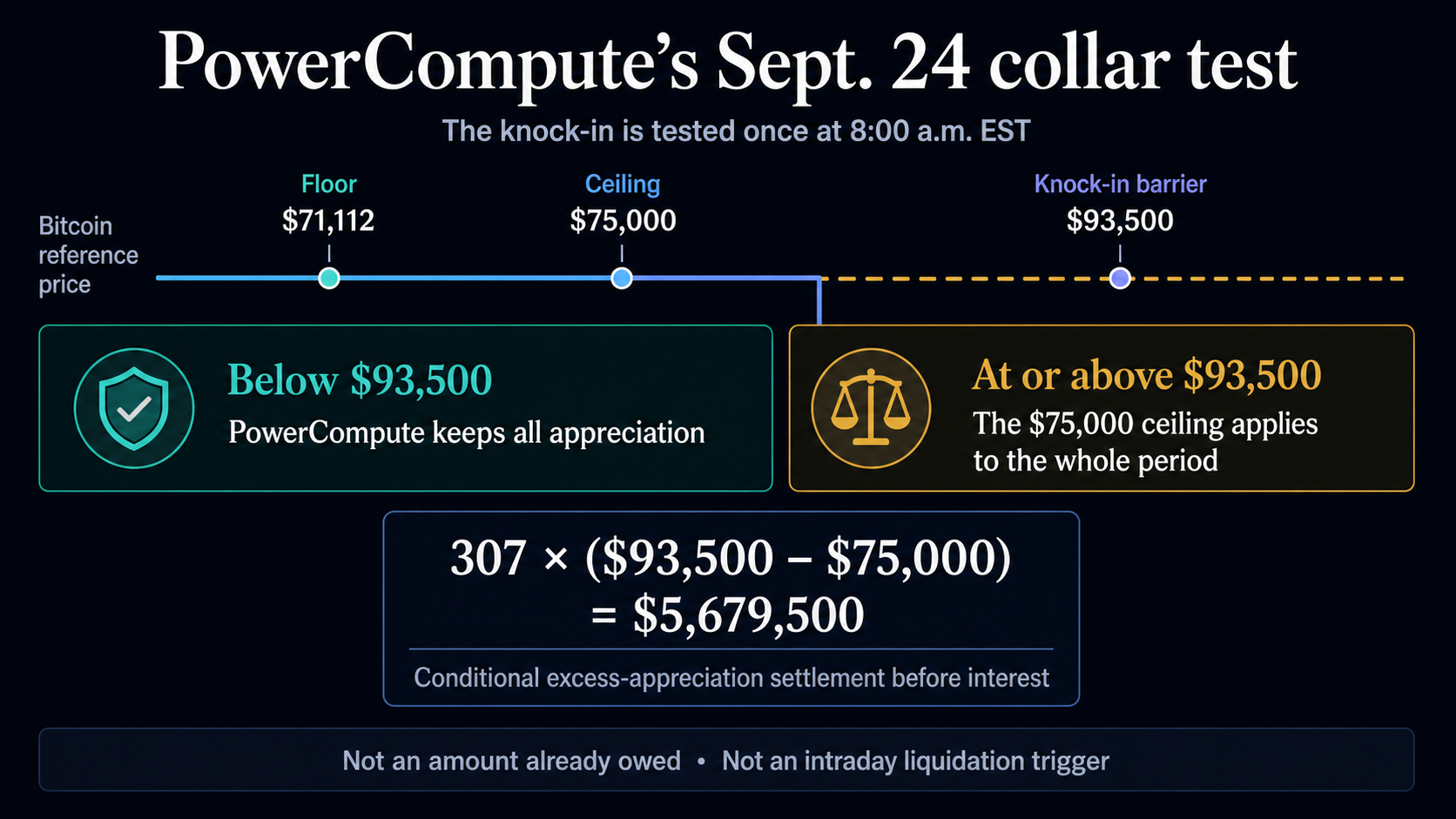
The new collar moves the next decision to Sept. 24. It sets a $71,112 floor, a $75,000 ceiling and a $93,500 knock-in barrier. Arch will test the reference price once, at 8:00 a.m. EST.
Below $93,500, the ceiling has no effect. PowerCompute keeps all Bitcoin appreciation, even if the reference price is above $75,000. At or above $93,500, however, the ceiling applies to the whole period.
Only if the Sept. 24 reference price reaches at least $93,500 does excess appreciation arise. At the barrier exactly, the formula is:
307 × ($93,500 − $75,000) = $5,679,500
That is conditional settlement arithmetic before interest, not an amount already owed. PowerCompute can settle it through retained BTC or USD/USDC. If it rolls the loan, it can instead add the amount to principal or incorporate it into the next ceiling and rate quote.
The barrier is not an intraday liquidation line. The annex bars ordinary margin calls and liquidations during the rolling period, limits ordinary recourse to the pledged Bitcoin subject to stated carve-outs and tests the collar only at reset. A voluntary mid-period exit would bring the test forward.
At 2:23 a.m. UTC on Aug. 29, CryptoSlate’s live Bitcoin page displayed $77,808.23, putting the barrier about 20.2% above that snapshot. The comparison is context, not a Sept. 24 price forecast.
CryptoSlate covered the initial collar after tracking PowerCompute’s earlier bridge-loan chain. The Aug. 28 filing converts the first structure’s modeled trade-off into a realized financing cost and starts a new 30-day test.
OCEAN Mining has completed a buyout of co-founder and 16-year veteran Bitcoin Core developer Luke Dashjr, ending his ownership and three leadership roles at the Bitcoin mining pool.
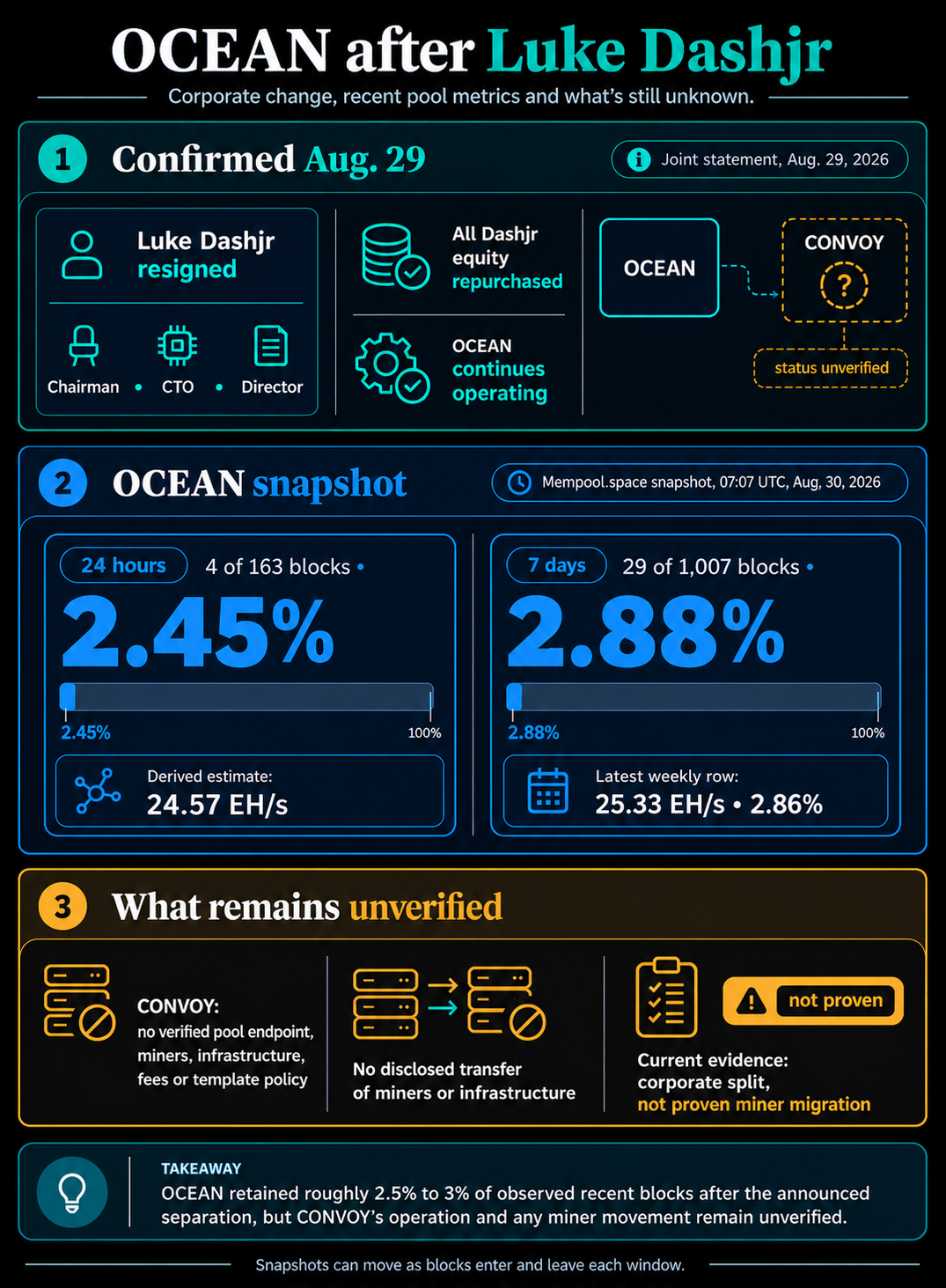
Dashjr resigned as chairman, chief technology officer and director, while OCEAN repurchased all of his equity, according to an Aug. 29 joint statement. Holding those board, technical and executive positions had placed him at the center of both OCEAN’s governance and its mining-policy decisions.
The private company did not disclose the repurchase price, its remaining ownership structure or successor appointments. OCEAN said it will continue operating its transparent, non-custodial pool, while Dashjr will pursue a new mining venture called CONVOY.
At the reporting cutoff, CONVOY had not published enough to verify an operating pool. Its public profile and the announcement disclosed no endpoint, codebase, participating miners, infrastructure, fees or block-template policy. They also disclosed no transfer of miners, staff other than Dashjr, or infrastructure from OCEAN.
A Mempool.space snapshot at 07:07 UTC on Aug. 30 attributed four of the previous 163 Bitcoin blocks to OCEAN, equal to 2.45%. Applying that share to the endpoint’s network hashrate estimate produced a block-share-derived estimate of about 24.57 exahashes per second.
The longer window was similar. Mempool.space attributed 29 of 1,007 trailing-week blocks to OCEAN, or 2.88%, while its latest weekly hashrate row put the pool at 25.33 EH/s and 2.86% of the network.
Across both windows, OCEAN remained within a broad 2.5% to 3% band that makes miner departures measurable without turning a single block into a trend.
Those figures describe hashpower directed to OCEAN, not mining machines owned by the company. A trailing 24-hour window can also move quickly as blocks enter and leave the sample, making it a snapshot rather than durable market share.
The joint statement said the separation reflected different visions following recent protocol developments, but it did not name BIP-110, Bitcoin Knots, a proof-of-work change or another proposal as the cause.
OCEAN added dedicated BIP-110 and no-signal endpoints in July, then returned its default endpoint to the non-BIP-110 chain on Aug. 9 while keeping both choices live. OCEAN said its DATUM system let participating miners control block construction. CryptoSlate’s earlier coverage detailed the surrounding fork and proof-of-work dispute, but the separation statement did not tie a specific development to the buyout.
A functioning CONVOY pool, published mining instructions or a sustained change in OCEAN’s share would provide the first measurable evidence that miners and template policy are moving. The corporate split alone does not.
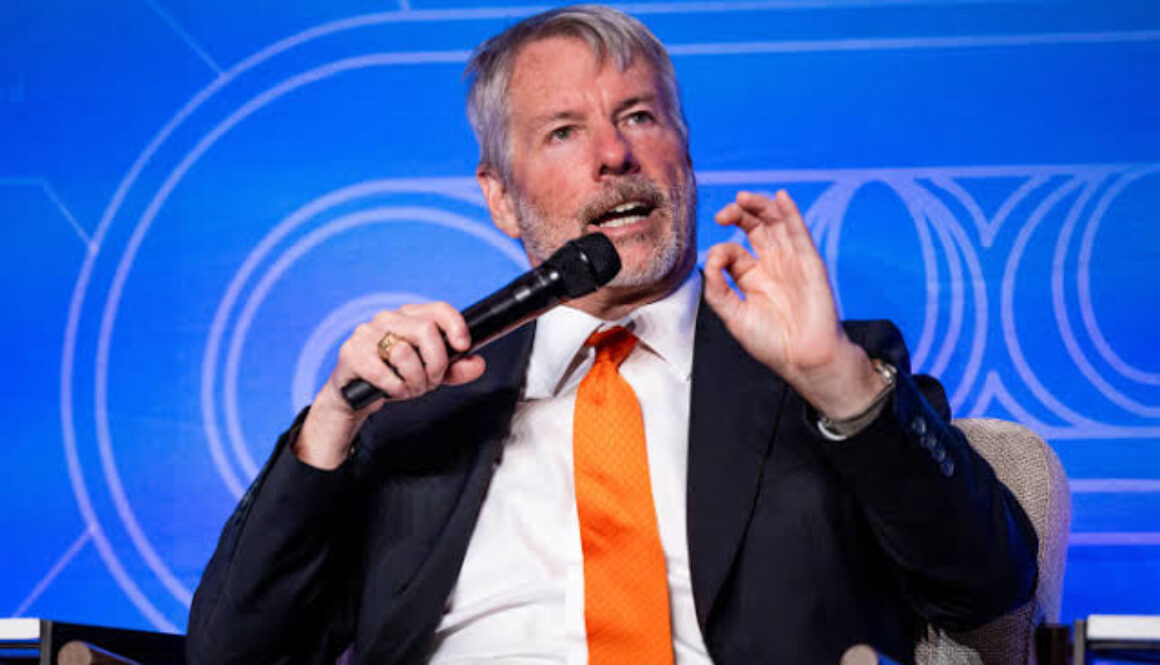
Strategy’s co-founder and former CEO, Michael Saylor, took it to X earlier today to post another cryptic comment, which the community is trying to decipher.
Alongside a chart showing that the company’s over 110 BTC purchases made in the past six years, Saylor said, “We’re ₿ack.” Naturally, most comments below the post speculated that the firm has resumed its bitcoin accumulation spree after a two-month pause.
Recall that Strategy’s latest announced bitcoin purchase came on June 22, as it was completed in the week between June 15 and 21. It paused its BTC accumulation strategy for the following two months and even announced a couple of sales.
It focused primarily on rebuilding its USD reserve, which climbed above $6.5 billion last week after the latest initiatives. The second came in the form of establishing a new program, called USD Cash, which now consists of $1.59 billion, alongside its regular greenback reserve of $5.1 billion.
In addition, Strategy continued repurchasing its STRC shares. The high-yield variable-rate preferred stock slumped far away from its par price of $100 to $75 a few months ago, but it recovered significantly to over $97 last week.
While some users anticipate a new purchase to be announced on Monday, others warned that Saylor’s latest message refers to something else: his company’s position turning green.
Bitcoin’s price recovered significantly in the past week and a half, surging from under $65,000 to over $78,500 as of press time. Given Strategy’s average accumulation cost of $75,653 per BTC, this means that the firm is now in profit for the first time since May. Its position was deep in the red (on paper) of over $10 billion until several weeks ago.
On the topic of when Strategy will start buying bitcoin again, the current CEO, Phong Le, recently shed some light, indicating that this could occur by the end of the year, without providing more details.
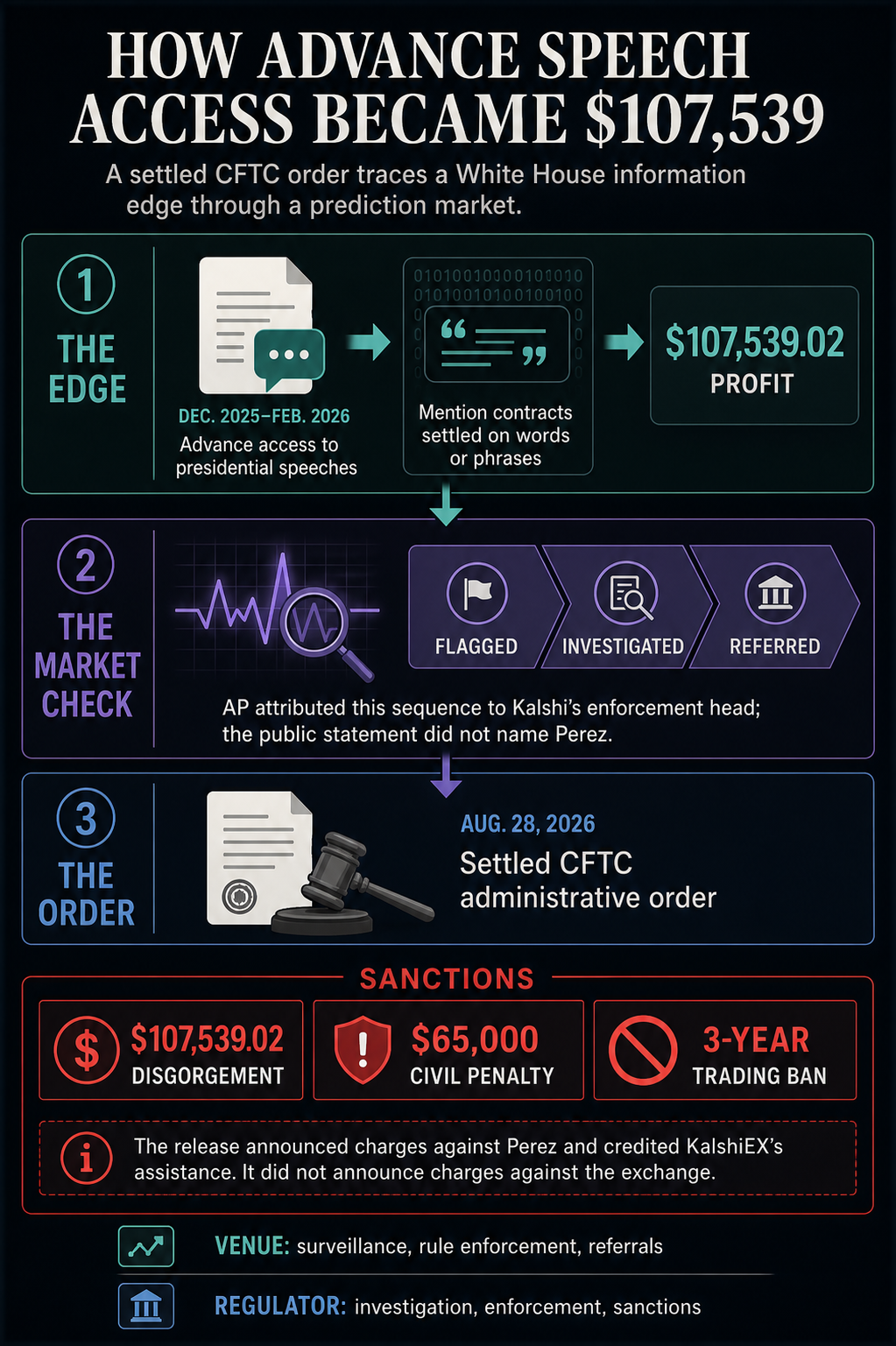
A White House speech insider who worked as a teleprompter operator must surrender $107,539.02 in prediction-market profits after the Commodity Futures Trading Commission found that he traded on advance access to presidential speeches.
The settled administrative order also requires Gabriel Perez to pay a $65,000 civil monetary penalty, cease and desist from further violations and accept a three-year trading ban. The CFTC said the penalty was substantially reduced because of Perez’s exemplary cooperation. The cited materials describe a civil regulatory settlement and do not report a criminal conviction.
How the White House speech insider gained a trading edge
The CFTC found that Perez traded presidential “mention market” contracts between December 2025 and February 2026 while working as a White House teleprompter operator. The event contracts, which the regulator describes as swaps, settled on whether the President would use particular words or phrases during speeches.
Perez saw the speeches before they were delivered, according to the order. The CFTC said he misappropriated that material nonpublic information in breach of a duty of trust and confidence, converting knowledge of the prepared text into more than $107,500 in profit.
Other traders were pricing the probability that a phrase would be spoken. Perez already had access to text that would help determine the outcome, giving him an information advantage built into the contract’s settlement question.
The CFTC release announces settled charges against Perez and separately says the agency appreciated KalshiEX’s assistance. It does not announce charges against the exchange or say the agency found a surveillance failure.
The Associated Press reported in July that Kalshi enforcement head Robert DeNault said the exchange’s surveillance team “promptly flagged, investigated and referred” the trades to the CFTC. AP noted that his public statement did not name Perez. The CFTC’s final release confirms assistance but does not disclose the detailed timing of Kalshi’s review or referral.
That record reflects two distinct policing roles. A February CFTC advisory says designated contract markets have an independent duty to maintain audit trails, conduct surveillance and enforce rules against prohibited practices. The CFTC retains authority to investigate and prosecute illegal trading and says it coordinates with exchanges on referrals.
Kalshi later added controls intended to move some policing ahead of the trade. In June, the exchange announced risk scoring for markets with heightened insider or manipulation risk, employment verification for some participants and expanded whistleblower tools. Those measures came after Perez’s December-to-February trading period, and the available sources do not establish whether they would have blocked his activity.
The settlement shows exchange referral and regulatory enforcement converging after the profits were made: Kalshi was credited with assistance, and the CFTC imposed disgorgement, a penalty and a market ban. It does not, by itself, show that the safeguards were timely or sufficient to prevent the trades.
Bitcoin’s major rally from under $65,000 to over $81,000 within a week or so changed the broader market sentiment from fear to greed, with analysts initially rushing to call the end of the bear phase.
However, its inability to push through the $81,000 resistance and the two rejections, alongside the Fed’s hawkish stance on Friday, added further doubt, both from a technical and a macro perspective. The good news is that whales have returned in full force.
$3B in BTC
Citing data from Santiment Intelligence, popular analyst Ali Martinez noted that these large market participants have accumulated roughly $3 billion worth of bitcoin in the past week alone. Adding more than 39,150 BTC in just seven days signals that this crucial cohort of investors continues to show interest in the primary cryptocurrency, alongside ETF buyers, who poured over $920 million into the funds in the past week.
In a separate post, Martinez doubled down on the whales’ growing activity, arguing that the recent rally was driven primarily by them. In contrast, retail investors have remained mostly on the sidelines or in the opposite corner, as further on-chain data suggests they have actually been selling.
Following the Friday Jackson Hole speech by new Fed Chair Kevin Warsh, in which he displayed a more hawkish stance, analysts are not so adamant that the bear market is completely over.
Rekt Capital warned earlier that BTC’s real test begins after the strong weekly close. He argued that if the latest surge is ultimately a bear-market relief rally, the cryptocurrency could pull back in the following few weeks. It now stands to demonstrate sustained strength at these elevated levels rather than immediately giving back the breakout.
Crypto Haris presented a considerably more bearish scenario, describing the move from $65,000 to $80,000 in days as a potential bull trap. Moreover, the analyst expects BTC to decline to $74,000 at first, before another leg down takes it back to the $67,000 region.
In general, Haris believes the cryptocurrency will first fall back to $62,000 before it eventually pumps to $90,000.
Delaware Life Insurance Company relabeled $16.4 billion of its investments this year. The money sits in private loans tied to companies it is connected to. Federal prosecutors and securities regulators are now investigating.
That money came from annuities and life policies sold to ordinary savers. Few of them know what backs the promise.
Prosecutors are Already Asking
The company’s second-quarter filing reveals grand jury subpoenas served in February. Clear Spring Life and Annuity Company also received them.
They came from the US Attorney’s Office in Manhattan. The Securities and Exchange Commission (SEC) opened a parallel investigation.
Delaware Life restated its related-party investments from ~$1.3B to ~$18B after grand jury subpoenas.
Bloomberg had that in July.
Nobody printed what is in the next column: $25,121,775,179 across both insurers. 43% of everything they own.
Both are examining one question. Should loans introduced by an affiliate have been flagged as related-party deals? Nobody has been charged.
Credit raters have already moved, with A.M. Best, Standard & Poor’s and Fitch each grading Delaware Life A-minus. All three attach a negative outlook or watch.
Private Credit Now Backs Retirement Promises
A survey published August 26 found something striking. It said 77% of US adults call crypto risky inside workplace retirement plans. Nearly half called it very risky.
Americans have mixed views on cryptocurrency in retirement plans; the majority view it as risky. Source: NIRS
“Americans are telling us that retirement security is becoming harder to achieve as they struggle with the affordability of everyday life. Housing, healthcare, debt and other expenses are competing with the need to save for retirement,” Dan Doonan, NIRS executive director, said in the report.
Their insurance money was already funding loans that have no public market prices. That gap says a lot about how savers judge risk.
Private equity firms drove the shift. The National Association of Insurance Commissioners (NAIC) counted 137 insurers under their ownership at the end of 2024. The count was 90 in 2018. Together, those firms held $704.3 billion.
Italy Already Ran This Experiment
Illiquidity only matters if people ask for their money. They can.
Cashing out an annuity early usually costs about 10%, according to the Bank for International Settlements (BIS). That fee falls each year.
Annuity policyholders pay surrender charges (7-10% in years 1-7).
That friction is what holds the platform together.
But: • $82.1B annual inflows = Ponzi mechanic • 1M+ savers, mostly retirees who watch the news • A single Gretchen Morgenson NBC story + 60 minutes = run…
— Nick Nemeth (Mispriced Assets) (@NickNemo17) May 19, 2026
Roughly half of global surrender values can be withdrawn within a week. The loans behind them take months to sell.
Eurovita showed what happened next after the Italian life insurer watched its solvency ratio slide from 230% to nearly 130% during 2022.
Rates rose, bond values fell, and customers cashed out.
Its private equity owner, Cinven, offered 100 million euros. The regulator wanted 400 million.
Italy froze withdrawals in February 2023, and the freeze held until October. Five rival insurers absorbed the policies, and savers lost nothing.
Eurovita/Cinven: flop raises concerns on buyout push into insurance https://t.co/V3MlNKsXPL | opinion
Apple CEO Tim Cook is stepping down from his role on Tuesday, September 1, ending a tenure in which he maintained a consistent stance against the company purchasing Bitcoin or other cryptocurrencies for its balance sheet, despite personally holding digital assets himself. Cook’s approach reflected a broader philosophy about maintaining shareholder focus and corporate capital allocation priorities.
John Ternus, a hardware engineer who spent 25 years working on Apple devices, is taking over as chief executive. Ternus has been instrumental in developing some of Apple’s most successful product lines throughout his career at the company. Cook will remain with the company in an executive chairman position, maintaining an ongoing advisory role during the leadership transition.
Cook’s 2021 Statement on Crypto
Cook addressed the question of Apple investing in cryptocurrency once, at a New York Times DealBook event in November 2021. He revealed that he personally owned crypto but drew a clear line when it came to corporate investment. This disclosure provided rare insight into Cook’s personal financial philosophy while also establishing his official position on the company’s treasury management.
I wouldn’t go invest in crypto, not because I wouldn’t invest my own money, but because I don’t think people buy Apple stock to get exposure to crypto.
Cook’s reasoning centered on a fundamental principle of corporate governance and shareholder expectations. The statement reflected his belief that Apple shareholders invest in the company for its core business operations and products, not for speculative asset exposure.
Cook did not disclose how much cryptocurrency he holds or provide further details about his personal digital asset holdings. His willingness to acknowledge personal crypto ownership while maintaining corporate distance from it highlighted the distinction he drew between personal investment decisions and fiduciary responsibilities to shareholders.
Stock Performance Since the Statement
The performance data from that point forward has largely vindicated Cook’s decision to keep crypto off Apple’s balance sheet. Bitcoin set a record near $68,991 the day after his November 2021 comments, marking a significant peak during the cryptocurrency bull market.
As of Sunday, Bitcoin was trading near $77,244, representing about 12% gains from that peak. Over the same period, Apple shares closed 2021 at $175.35 and ended Friday at $319.70, roughly 82% higher. This comparative analysis demonstrates that Apple’s core business growth substantially outpaced cryptocurrency returns during the same timeframe.
Apple currently holds $146.5 billion in cash and marketable securities as of June 27, according to company filings. This substantial capital reserve keeps alive the theoretical question of how such funds might be deployed under new leadership, though such changes would likely require board approval and careful strategic consideration.
The Stablecoin Question Under New Leadership
While the treasury investment question remains settled in Apple’s current approach, a different cryptocurrency-related matter may be more relevant under Ternus’s leadership. Reports in 2025 have tied Apple to early-stage discussions about using stablecoins to reduce settlement costs in payment transactions. Stablecoins represent a distinct category from volatile cryptocurrencies, serving primarily as efficiency tools rather than speculative assets.
Apple has neither confirmed nor shipped any such initiative. Services generated $30.7 billion in revenue for Apple last quarter, with Apple Pay handling card transactions rather than tokens or cryptocurrencies. The financial services segment represents an increasingly important component of Apple’s overall business strategy.
Any stablecoin integration would operate in Apple’s payments and financial plumbing layer rather than as a headline-making treasury move. The company already exerts significant control over cryptocurrency through App Store rules that gate crypto-related applications, maintaining careful oversight of the ecosystem.
Ternus has not yet been asked publicly about his stance on cryptocurrency investments or integration, leaving his position on these matters unknown as he assumes the chief executive role. How the new leadership approaches both treasury matters and emerging payment technologies may become clarified in coming months.
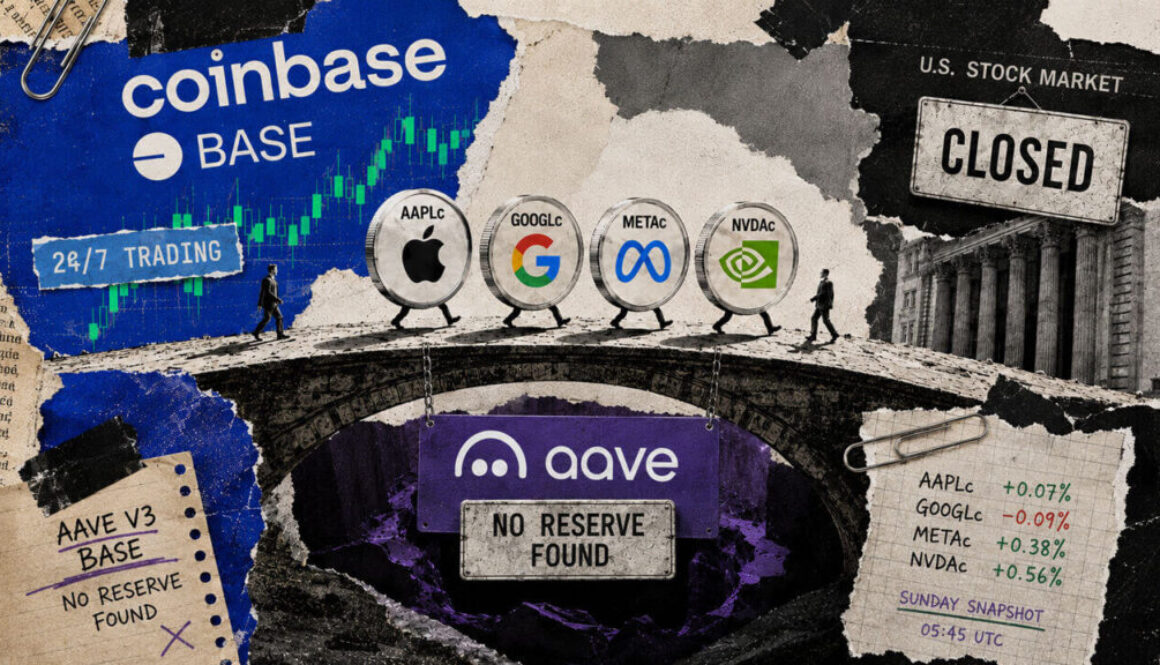
Coinbase’s new B20 stock tokens on Base place Apple, Alphabet, Meta and Nvidia-linked exposure on a blockchain that keeps trading through the weekend.
AAPLc, GOOGLc, METAc and NVDAc confer beneficial claims on underlying shares held within Coinbase’s tokenization structure; they are designed for eligible users outside the United States and differ from ordinary US-listed shares.
Coinbase describes continuous secondary transferability, while Base presents the assets as building blocks for decentralized finance. That DeFi pitch includes a prominent borrowing example. Base says a holder could use tokenized Nvidia exposure as collateral on Aave, creating an obvious risk question when the token continues trading and the underlying equity market is closed.
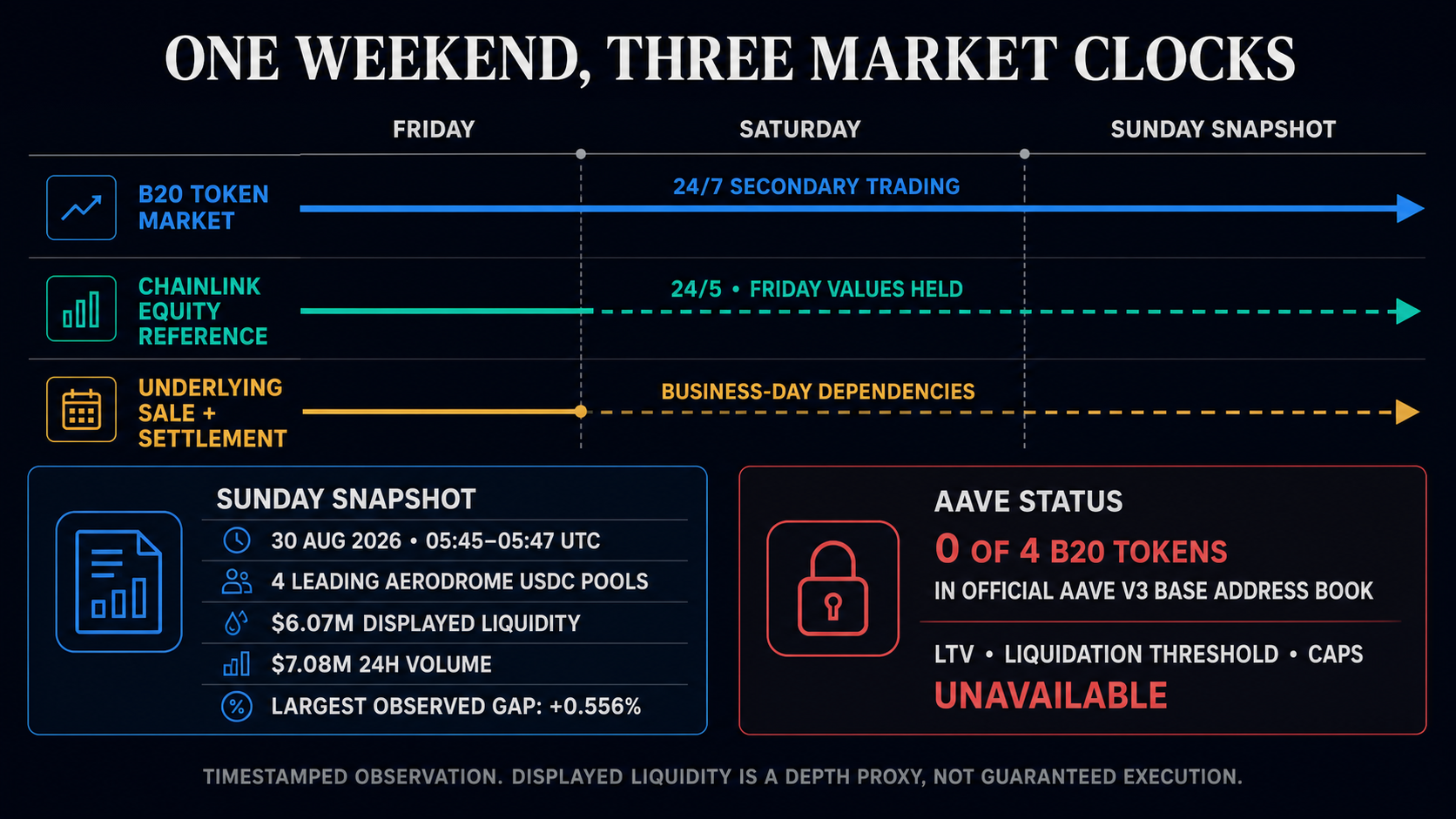
A Sunday review of the official Aave V3 Base address book found no reserve for any of the four tokens. The weekend therefore produced two separate findings: secondary-market prices were observable, while Aave lending behavior had no verified live B20 market to measure.
At 05:45–05:47 UTC on Aug. 30, the four leading Aerodrome USDC pools traded within roughly 0.6% of Chainlink reference values last updated Friday. Those held references make the measurement a snapshot of weekend token pricing against the last available equity-linked values. They do not provide a continuously refreshed estimate of the underlying shares.
Coinbase stock tokens held close to Friday reference values
Coinbase stock tokens separate continuous token trading from the operational rails behind the claim. Coinbase’s product page says primary minting and redemption are handled by KYC-onboarded institutional partners and Authorized Participants. Once issued, Base says the tokens can be transferred without wallet whitelists and traded through always-on automated market makers. A trader can therefore buy or sell tokenized exposure even while the primary US equity market is closed.
A snapshot of the leading Aerodrome pools at 05:45 UTC showed about $6.07 million in aggregate displayed liquidity and $7.08 million in aggregate 24-hour volume. DEX Screener defines pool-liquidity and volume fields for its live endpoint, but displayed liquidity remains a rough depth indicator. It does not promise that a trade of a particular size will clear near the quoted price.
The four official Chainlink feed proxies at 05:47 UTC returned Friday update times: 17:01:55 UTC for AAPL, 15:59:21 for GOOGL, 19:10:19 for META and 18:50:11 for NVDA. Comparing those held values with DEX Screener’s rounded dollar prices produced this Sunday snapshot:
All four gaps were smaller than 0.6% at the cutoff. This supports a dated statement about prices in those pools, rather than a durable peg, an issuer-solvency test or a guaranteed arbitrage relationship. Prices, volumes and pool balances can change after the timestamp. The comparison also says nothing about the execution price available for a large order.
The small gaps are still informative. Traders had a weekend market and chose prices close to the held equity references, despite the lack of fresh primary-market discovery. That behavior kept the first measured dislocation contained. Its relevance to collateral depends on a second layer: the rules a lending application uses when its reference feed stops advancing.
Base’s B20 integration guide says the launch assets use Chainlink 24/5 total-return feeds. Each value is derived from the underlying equity price and a multiplier, rather than the token’s DEX price. On weekends and holidays, the feed holds the last value and its updatedAt timestamp stops advancing. The Friday timestamps observed on Sunday were consistent with that documented behavior.
The weekend state reflects the feed’s schedule. It is distinct from an oracle outage. Chainlink’s equity-stream documentation describes extended market coverage and market-status data, while Base tells integrators to inspect updatedAt, apply staleness bounds and avoid settling or liquidating against a frozen value. Data delivery supplies the inputs; an application’s contracts still decide whether collateral can be deposited, borrowed against or liquidated.
That separation becomes important when the DEX market moves during a closed reference window. A sharp rise in the token price would not automatically lift a feed calculated from the held equity value. A sharp decline would require equally explicit handling so that a lending protocol does not rely on stale information for liquidations.
The Sunday prices remained close enough that this hypothetical pressure never emerged in the measured pools, yet the schedule mismatch remained present for roughly 35 to 38 hours at the snapshot.
Coinbase’s public page says primary creation and redemption are limited to KYC-approved institutional partners and Authorized Participants. The NVDA prospectus separately gives a “Vested Holder” a redemption right subject to prescribed instructions, compliance checks and operational acceptance.
The prospectus contains no categorical weekend bar on submitting an order. It defines a business day to exclude Saturdays, Sundays and holidays, and cash or stablecoin settlement requires the issuer to sell the underlying shares after validating a request. The terms also allow rejection, delay, suspension or modification in specified circumstances. Accordingly, the underlying sale and settlement process cannot be assumed to provide instant weekend arbitrage even while the token itself keeps trading.
For Coinbase stock tokens, this is the core 48-hour gap: the onchain secondary market remains available, the equity-linked feed follows a 24/5 schedule, and underlying execution and settlement retain business-day dependencies. A tight Sunday spread reduces the observed dislocation at one point in time. The different operating clocks remain in place.
Aave collateral controls remain prospective
The official Aave V3 Base address book contained no reserve, aToken, variable-debt token or Aave oracle entry for AAPLc, GOOGLc, METAc or NVDAc at the Sunday review. That finding is limited to the official V3 deployment list. It does not rule out every unrelated or unindexed contract anywhere on Base, yet it is the authoritative record for evaluating whether the marketed Aave use case had current V3 reserve parameters.
The forward-looking record points to work still ahead. An Aug. 3 Aave governance proposal said the initial assets, oracle configuration, risk framework and deployment contracts for V4 on Base would be finalized and published later. The proposal establishes direction, while leaving the B20 asset list and its risk controls unresolved.
No defensible live values were therefore available for a B20 loan-to-value ratio, liquidation threshold, supply cap, borrow cap or outstanding borrowing. There was also no verified Aave B20 liquidation activity from which to infer closed-market behavior. Base’s reference to Aave describes an integration goal; a live lending market requires deployed reserves and inspectable parameters.
Those eventual parameters will determine whether the timing mismatch becomes manageable collateral infrastructure. A lending deployment would need explicit oracle-freshness checks and a policy for deposits, borrowing and liquidations during closed reference periods. Conservative LTVs and liquidation thresholds could provide buffers. Supply and borrowing caps could bound exposure. None of those controls can be credited to the four tokens before the contracts and settings exist in the verified market.
The first weekend nevertheless supplied a useful baseline. Four active Aerodrome pools generated about $7.08 million of 24-hour volume and stayed within roughly 0.6% of held Friday values at the timestamp. That is evidence of orderly secondary-market pricing during one closed-market window. Its limits are equally concrete: the reference feeds were carrying Friday information, the prospectus preserved business-day dependencies for underlying sales and settlement, and the promoted Aave collateral layer lacked a verified live reserve.
Coinbase has made the market-hours mismatch visible onchain. The decisive stress test will begin only after a lending venue publishes its B20 reserve configuration and users place debt against the tokens. Until then, this weekend’s record belongs to the DEX and oracle layers, with collateral safety still awaiting deployed controls.