Solana has broken out of a 10-month downtrend after a strong August rally, with SOL reclaiming the $100 level and finishing the month up roughly 46%.
CoinGecko market data showed SOL recovering sharply through August, reversing a long stretch of weakness and putting momentum back on the side of bulls. The move makes Solana one of the stronger large-cap assets in the latest market rotation.
Still, this is a market structure story, not a guaranteed continuation call.
A 46% monthly rally is meaningful, but it does not prove the next leg higher is automatic. Solana now needs follow-through, stable liquidity, and continued ecosystem strength to hold the breakout.
For more details, visit the official Coingecko platform.
TL;DR
SOL reclaimed the $100 level after a 46% August rally.
The move broke a 10-month downtrend.
The breakout needs confirmation before traders treat it as a durable trend shift.
Why The Downtrend Break Matters
Long downtrends shape trader psychology.
When an asset trends lower for months, rallies often get sold. Traders become cautious, liquidity thins, and investors wait for evidence that momentum has changed. Breaking that structure can shift sentiment quickly.
Solana’s August move does that.
Reclaiming $100 gives the market a clean psychological level. Breaking the downtrend gives technical traders a reason to re-evaluate. A strong monthly performance gives momentum funds and retail traders another reason to pay attention.
That combination can be powerful.
Solana Has More Than One Catalyst
Solana’s rally is not happening in a vacuum.
The network has seen renewed attention around ETF access, mobile ecosystem activity, DeFi usage, governance debates, and high-throughput applications. Traders may also be rotating into assets that lagged earlier in the cycle but still have strong communities and liquidity.
SOL benefits from that setup.
It remains one of the few non-Bitcoin, non-Ethereum assets with enough liquidity, brand strength, developer activity, and exchange support to attract large flows during a risk-on move.
That helps explain why it can move quickly when sentiment turns.
Reclaiming $100 Is Symbolic
Round levels matter.
For Solana, $100 is not just a number. It is a sentiment marker. Holding above it can make the asset feel stronger, especially after a long downtrend. Falling back below it could make the breakout look less convincing.
That is why the next few sessions matter.
Traders will watch whether SOL builds support above $100 or treats the level as a temporary stop during a volatility spike.
Avoiding The Price Prediction Trap
A breakout does not guarantee a target.
Solana has moved strongly, but the market can still reverse. Broader crypto weakness, Bitcoin volatility, ETF flow changes, macro stress, or network-specific issues could all pressure the asset.
The responsible read is that SOL has improved its technical position.
That is different from promising a specific next price level.
What The Market Watches Next
The next signals are volume, ETF flows, on-chain activity, and whether Solana’s ecosystem keeps producing real usage.
If spot demand continues and network metrics support the move, the downtrend break may become more durable. If the rally is mostly momentum-driven, traders may become cautious once volatility cools.
For now, Solana has done something important.
It broke a long downtrend, reclaimed $100, and returned to the center of the large-cap altcoin conversation.
This article is based on public Solana market data from CoinGecko.
This article was written by the News Desk and edited by Samuel Rae.
This report is based on information released by Coingecko. at Coingecko
Dell Technologies reports fiscal second quarter results Tuesday after the close, and the options market is braced for a large reaction. Contracts expiring September 4 imply a swing of roughly 11% in either direction.
The at-the-money straddle, a paired call and put at the same strike, cost about $52 against Dell’s $456.01 close on Monday. Buyers profit only if the stock travels further.
Dell earnings options open interest by strike. Source: Option Charts
What Dell Guided For, and What Analysts Expect
Dell guided to revenue of $44 billion to $45 billion for the quarter, adjusted earnings of about $4.80 a share, and roughly $15.5 billion of AI server revenue. It expected its Infrastructure Solutions Group, the server and storage division, to grow about 75%.
Zacks Investment Research puts the consensus at $4.72 a share across five forecasts. Dell earned $2.10 in the year-ago quarter.
The bar is high because the previous quarter reset it. Revenue reached $43.8 billion in Dell’s record first quarter beat, up 88% year over year, and adjusted earnings of $4.86 landed far above Wall Street’s estimate.
Management then raised the full-year revenue outlook to $167 billion at the midpoint and lifted its AI server target to $60 billion. Shares have climbed roughly 260% in 2026 on that artificial intelligence demand.
“We booked $24.4 billion in AI orders and recognized $16.1 billion of AI server revenue. We’re increasing our AI server revenue expectations for FY27 to $60 billion, which only goes to show the AI opportunity shows no signs of slowing,” said Jeff Clarke, Dell vice chairman and chief operating officer, in the quarterly release.
Orders and backlog now matter more than the headline figure. Dell booked $24.4 billion of AI orders last quarter and closed with a record $51.3 billion AI backlog.
Margins are the second test. AI servers earn thinner margins than storage, and Chief Financial Officer David Kennedy has flagged memory chips, processors and hard drives as supply bottlenecks.
Dell has also described an inflationary parts market that forces frequent repricing, so a revenue beat paired with weaker margins would land badly. Data center names have already drawn profit-taking after big rallies.
Wall Street still leans positive. Of 15 analysts covering the stock, 11 rate it a buy and four a hold, with an average target of $523.54 and a low of $434.
Nvidia’s own quarterly beat drew only a modest reaction last week. Whether Dell raises its full-year guide again, and what it says about second-half supply, will decide which side of the straddle pays.
Strive, BitMine and MicroStrategy each disclosed fresh crypto purchases on Monday. The two Bitcoin buyers alone spent more than $500 million in a single week.
Buying high is the business model, not a failure of it. These firms turn share sales into coins, and shares sell best when coins are rising.
What the Three Firms Bought
Strive, run by chief executive Matt Cole, added 1,800 bitcoin (BTC) at an average of $79,431. Its stack reached 23,156 BTC, worth about $1.83 billion on Monday.
Strive acquired an additional 1,800 BTC for $143M at an average cost of $79,431 per bitcoin, bringing total holdings to ₿23,156.$ASST$SATApic.twitter.com/6ztKhC4PFF
The filing shows the mechanism plainly, after Strive issued 3,579,147 new Class A shares that week, and its cash still climbed $11.6 million to $183.5 million.
BitMine is playing a different game. Its 53,501 ether (ETH) marked a 65th consecutive week of buying, a streak running back to June 2025.
Yield is the distinction, given BitMine has staked 5,067,309 ETH, or 86% of the pile, through MAVAN, its American validator network.
Chairman Tom Lee projects $335 million to $390 million a year from that. The company now holds 4.9% of ether supply, leaving it 133,888 tokens short of the 5% target Lee set.
— Thomas (Tom) Lee (not drummer) FundstratDirect.com (@fundstrat) August 31, 2026
MicroStrategy was the third buyer. Its 4,603 coins ended a 10-week pause, and unlike BitMine it publishes an average cost per coin, currently $75,412.
ETF Money Turned Before the Treasuries Did
So why now? The answer starts with fund flows. US spot bitcoin funds absorbed more than $3.3 billion in August, according to SoSoValue data. In June they bled $4.5 billion.
That sequence is the engine, seeing as fund demand lifts coins, coins lift the treasury stocks, and selling those stocks buys more coins.
What Else Changed in August
Crypto funds drew $3.2 billion in inflows last week, marking their largest weekly intake since October 2025, according to Bank of America. This suggests growing optimism in the market.
BREAKING: Crypto funds attracted +$3.2 billion in inflows last week, their largest weekly intake since October 2025.
The largest crypto ETF, $IBIT, attracted +$928 million last week, following +$1.3 billion in the prior week, its biggest 2-week inflow since October 2025.
One popular story says money fled a wobbling AI bubble, but the calendar disagrees. July did that damage, where the Philadelphia Semiconductor Index fell 20.6% and Korea’s KOSPI shed 22%. August was kinder, with the Nasdaq 100 up 4.2%.
SOX, KOSPI, and NASDAQ Price Performance. Source: TradingView
The rotation shows elsewhere, as foreign investors pulled 10.17 trillion won from Korean equities in August. Volumes on Upbit, the country’s largest exchange, jumped roughly eightfold.
America also helped, after President Donald Trump pressed Congress on August 19 to pass the CLARITY Act, and a Senate vote is expected on September 15.
In tandem, the Treasury also widened long-dated bond buybacks that day, from $2 billion to at least $4 billion per operation. That relief proved thin. The 30-year yield dipped to 5.19% before settling back at 5.25%.
Bitcoin traded near $78,818 on Monday. What halts these companies is not a falling coin price. It is a closed financing window.
Bitcoin’s derivatives market is showing a curious split, with open interest falling nearly 4% since August 21, while funding costs for long positions have risen quickly.
Analyst Axel Adler Jr. says that combination could leave BTC exposed to a long squeeze if traders start rebuilding leverage while maintaining an increasingly bullish bias.
Falling OI Meets Rising Funding
In Adler’s latest brief, he put the focus on what is happening beneath Bitcoin’s price, with BTC-denominated open interest falling from 331,100 BTC on August 21 to 318,600 BTC on August 31, a decline of 3.8%. Over the past 24 hours, another 2,850 BTC has left open positions.
That means the derivatives market is still in a deleveraging phase following the short squeeze. But traders have not rushed to rebuild the amount of leverage that was cleared out during the earlier move.
Meanwhile, funding tells a different story, with the current funding rate at 0.00906%, while the eight-hour average sits at 0.00821% and the 24-hour average at 0.00725%. The shorter-term average is already 13% above the 24-hour figure, pointing to a stronger preference for long positions among active traders.
“The shorts have already been burned. Now the longs are in the crosshairs,” noted the market watcher.
For now, he does not consider the market overheated, with the concern coming if funding continues rising at the same time that open interest begins recovering. That would mean traders are adding new long leverage rather than simply maintaining a bullish bias within a smaller derivatives market. A decline in Bitcoin under those conditions could trigger forced liquidations as leveraged longs close.
The price action gives that risk some context, with Bitcoin dipping below $77,000 due to ongoing tensions between the US and Iran, as reported by CryptoPotato earlier today, before rising back up again to $79,000.
Why $79,700 Matters
The immediate technical question is whether Bitcoin can reclaim and hold $79,700, and CryptoRUs has identified that price as the level needed for a four-hour confirmation, with $77,000 to $78,000 acting as nearby support.
However, the setup is complicated by the amount of leverage already removed. More than $9.7 billion in crypto positions has been liquidated over the past two weeks, including $6.55 billion in shorts and $3.16 billion in longs. Bitcoin’s move back to $79,000 also caused roughly $30 million in short liquidations within an hour.
That leaves a distinction between forced buying and genuine spot demand, and according to the crypto intel provider, if BTC holds above $79,700 with stronger volume, the market may absorb higher funding without immediately becoming vulnerable to a squeeze. But if the level fails and Bitcoin falls through $77,000 to $78,000, rising funding could become much more uncomfortable for longs.
Adler’s warning is therefore conditional, rather than a prediction of an imminent liquidation event. Open interest is falling now, but the more dangerous setup would come if it starts rising again while funding keeps climbing.
More on the market’s state and the latest developments can be found in our video below:
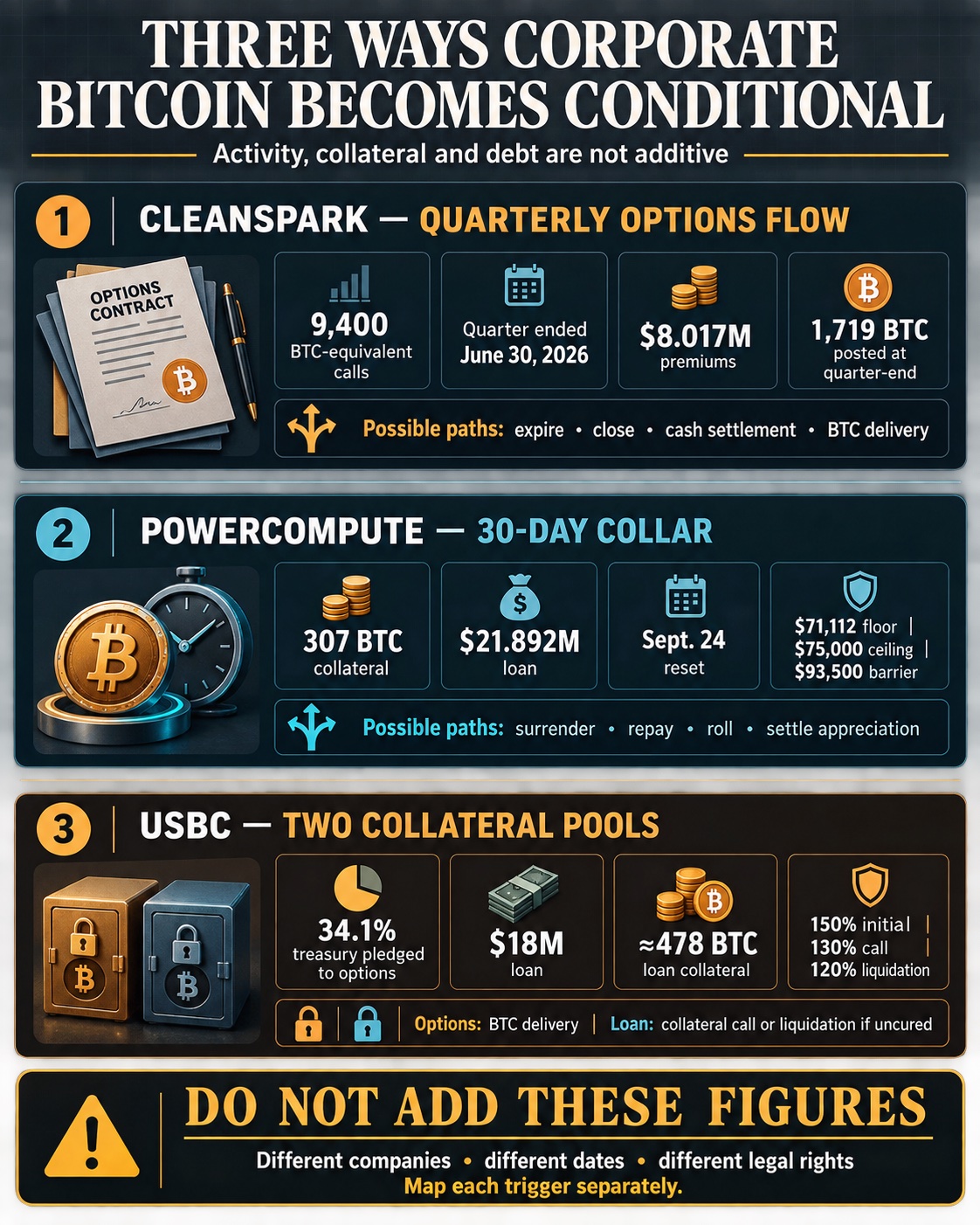
During the three months ending June 30, CleanSpark put 9,400 Bitcoin-equivalent call contracts through Spot+, its strategy for selling options around ongoing sales from its corporate Bitcoin treasury. Because the figure is expressed in Bitcoin equivalents, it can resemble a balance-sheet position even though it measures a quarter’s trading flow.
In its Aug. 6 quarterly filing for the period ended June 30, CleanSpark reported $8.017 million in premium proceeds from those calls. Bitcoin averaged $68,766 when the contracts were entered, against an average strike price of $76,383.
The distinction exposes a blind spot in corporate Bitcoin treasury analysis. A headline holding tells investors how much Bitcoin a company reports, while options, collars and secured loans can assign rights over some coins or connect them to future settlement choices.
CleanSpark, PowerCompute and USBC illustrate three versions of that conditional supply. Their filings show pathways to delivered Bitcoin, cash costs, more debt, capped upside or lender-controlled collateral. The disclosed measures span different companies, dates and legal structures, so combining them would produce a false exposure total.
CleanSpark’s corporate Bitcoin treasury flow and inventory differ
CleanSpark’s 9,400 Bitcoin-equivalent figure sits in the period-activity column. Its point-in-time disclosure was different: the company reported 12,205 Bitcoin as held at June 30 and a separate receivable for 1,719 Bitcoin posted to derivative trading counterparties.
CleanSpark’s July 7 June operational update presented 13,924 Bitcoin in total, including the 1,719 posted as collateral or receivable. This reconciles the company’s operational total with the filing’s accounting boundary.
The settlement figures show where potential supply became actual delivery. During June, CleanSpark reported 250 Bitcoin sold through call exercises, 25 acquired through put exercises and 244 acquired through a delta-neutral basis trade. Its quarterly digital asset management reconciliation reported $8.595 million in proceeds from premiums and incremental Spot+ trading. The activity table also lists 7,850 Bitcoin-equivalent close-out transactions with negative $3.523 million in the premium-proceeds column, while the reconciliation included $2.982 million of fair value above strike on settled derivatives.
Those figures occupy four distinct categories: 9,400 Bitcoin-equivalent calls were period activity; 1,719 Bitcoin was posted at period end; 250 Bitcoin was sold through call exercises in June; and the dollar values record premiums, close-outs and settlement accounting.
Company
Disclosure
What the Bitcoin measure means
What can happen
CleanSpark
Quarter ended June 30; holdings snapshot at June 30
9,400 BTC-equivalent Spot+ calls are period activity; 1,719 BTC was posted to derivative counterparties at period end
Calls may expire, close early, settle in cash or result in Bitcoin delivery
PowerCompute
30-day collar running Aug. 25 through Sept. 24
307 BTC secures a $21.892 million non-recourse collar loan
Reset choices can return, retain, sell or deliver collateral; a high-price knock-in can create a settlement cost or added debt
USBC
Options and loan disclosures as of Aug. 24
34.1% of the treasury was pledged for options; about 478 BTC separately secured a credit facility
Options can require Bitcoin delivery; a falling collateral ratio can produce a call and, if uncured, lender liquidation rights
PowerCompute offers the clearest example of why contract terms matter more than a single strike price. On Aug. 25, the company entered a $21,892,131.88 collar loan secured by 307 Bitcoin at 6.5% annual interest. The new principal included a $3.765 million cost to unwind the prior collar, which the borrower elected to add to the loan balance.
The contract annex sets a $71,112 floor, a $75,000 ceiling and a $93,500 knock-in barrier for the rolling period scheduled to end Sept. 24.
Bitcoin traded near $78,767 on Aug. 31, above the ceiling and below the barrier. PowerCompute had not forfeited appreciation above $75,000 at that price. The contract tests the barrier at the reset time on Sept. 24 and disregards price moves before that moment. An early exit would move the same test forward to the exit date.
If the reference price is below $93,500 at the applicable test, the ceiling has no effect and PowerCompute keeps the appreciation, even when Bitcoin is above $75,000. At or above the barrier, the cap knocks in and appreciation above $75,000 becomes payable to the lender. PowerCompute can settle that amount with pledged Bitcoin or cash. On a rollover, it may instead add the amount to principal or absorb it into the next pricing terms.
Below the $71,112 floor, PowerCompute may surrender the pledged Bitcoin in full satisfaction of the non-recourse debt, repay and recover the collateral, or roll after curing the shortfall. Without an election, the loan matures automatically and the annex’s collateral retention or sale provisions apply.
The result is conditional supply governed by a reset structure rather than continuous intraday liquidation. PowerCompute’s 307 Bitcoin is tied to a defined decision point and a menu of settlement routes. Its latest reset has already been examined in CryptoSlate’s PowerCompute coverage; the wider lesson is that an encumbered treasury coin need not be immediately for sale.
USBC separates option control from loan liquidation
USBC’s Aug. 27 filing disclosed two constraints on its Bitcoin as of Aug. 24.
First, 34.1% of the treasury was pledged for options trading. The Bitcoin sat in cold-storage wallets with custodial partners designated by the trading counterparties, which controlled the private keys. The program can create a right to receive or an obligation to deliver a fixed amount of Bitcoin, with exposure capped by the treasury’s holdings.
The 34.1% figure therefore describes collateral under counterparty control, rather than a forecast of imminent sales. Its outcome depends on the options positions and their settlement.
Second, USBC reported a separate $18 million Bitcoin-backed borrowing from Payward Interactive, with approximately 478 Bitcoin pledged under an account-control agreement and held by Payward Financial. The loan required a 150% initial margin. A decline to 130% permits a collateral call, while a fall to 120% can give the lender liquidation rights if the deficiency is not cured.
That pathway resembles conventional secured lending: lower Bitcoin prices weaken collateral coverage, potentially requiring more coins or repayment before liquidation becomes available. It differs from CleanSpark’s rolling option activity and PowerCompute’s reset-tested non-recourse collar. Prior USBC collateral coverage and broader corporate treasury loan analysis provide the lending context, while USBC’s options pledge adds a separate layer of counterparty control.
Together, the filings leave no defensible combined total for economically unencumbered corporate Bitcoin. CleanSpark distinguishes 12,205 Bitcoin held from 1,719 posted to derivative counterparties. PowerCompute identifies 307 coins tied to one live collar. USBC reports an options-collateral percentage and a separate credit-facility collateral balance. The companies, dates, units and legal effects differ.
CleanSpark’s earlier liquidity analysis showed why a treasury’s funding demands matter. The newer filings sharpen the measurement problem: every corporate Bitcoin figure needs labels for activity versus inventory, control of the coins, the price and time that activate the contract, and whether settlement means delivery, cash, more debt or lost upside.
A corporate Bitcoin treasury holding can look permanent even when part of its economics already belongs to a contract.
David Schwartz, the Ripple CTO emeritus, argued on August 31 that supporters of Bitcoin’s BIP-110 fork crossed from governance into an attack after rejecting the soft-fork result and continuing on a separate proof-of-work chain.
His exchange with fork supporter loogart captures the dispute: whether losing a consensus fight justifies creating a new Bitcoin chain, or whether that move itself amounts to attacking the network.
New Chain Goes Live
The account loogart opened the exchange by describing the sequence from the group’s perspective: it objected to the direction Bitcoin Core was taking, was told to fork, forked with a different proof-of-work algorithm, and is now building a separate chain, all while still being called an attacker.
“You’re not ‘still’ attacking,” Schwartz wrote in response to loogart’s take. “You switched from participating in governance to attacking when you refused to accept that you lost.”
Loogart replied that their group had accepted defeat and continued their version of Bitcoin elsewhere. They argued that open dialogue, a soft fork, and eventually a hard fork cannot amount to an attack because no one was compelled to follow, writing, “Nobody was forced to follow us.”
However, Schwartz rejected that framing, stating that inventing language that makes disagreement impossible to reason through moves the dispute beyond a good-faith disagreement and into what he called attacks and lunacy.
“I’m not arguing that you are incapable of pretending you have good faith disagreement over governance,” the XRP Ledger architect added. “I’m arguing that there’s lots of evidence that when you do so, you are pretending.”
The chain he referenced went live through a flag-day hard fork at block 961,640, replacing SHA256d with BLAKE2b as the mining algorithm. The update also introduced a new 164-byte block header and temporary rules capping block size at roughly 300 kilobytes until September 2027.
Bitcoin Knots developer Luke Dashjr defended the switch on August 30, arguing that BLAKE2b carries none of SHA256d’s known weaknesses, such as ASICBoost, and that the redesigned header closes a block-withholding loophole that previously relied on miner monitoring to catch.
A Fork That Struggled Before It Split Again
As CryptoPotato reported previously, the BIP-110 chain split from Bitcoin’s main chain at block 961,632 after failing to draw enough miner support.
The backing pool, Roughnecks, produced only two blocks before the branch stalled while the main chain kept its normal pace, and the gap between them grew to several hundred blocks within weeks. Dashjr was separately removed as an editor of Bitcoin’s improvement proposal repository over what was described as a conflict of interest in his handling of BIP-110.
The dispute traces back to Bitcoin Core dropping its old limit on OP_RETURN data, which let more non-monetary content, including Ordinals and Runes, fill blocks that BIP-110 supporters wanted reserved for payments.
That disagreement has since split Bitcoin’s online community into camps, exemplified by how one X user, Robin Seyr, called BLAKE2b hostile in the same way Bitcoin Cash (BCH) and Bitcoin SV (BSV) were viewed, while another poster, Luke Mikic, described BIP-110 as an attempt to fix bugs introduced by Taproot rather than an attack on Bitcoin at all.
Strive CEO Matt Cole took it to X to announce that the company has accumulated another 1,800 BTC for $143 million at an average price of $79,431 per unit. Thus, the firm’s total holdings have grown to 23,156 BTC.
From a USD perspective, the firm’s cryptocurrency stash is now worth $1.760 billion, given the asset’s price of $78,000 as of press time.
Strive acquired an additional 1,800 BTC for $143M at an average cost of $79,431 per bitcoin, bringing total holdings to ₿23,156.$ASST$SATApic.twitter.com/6ztKhC4PFF
Strive has accelerated its bitcoin purchases lately, including adding another 1,110 BTC last week, as reported. Cole published a chart yesterday on X highlighting all of the firm’s acquisitions completed in the past year or so, and the graph clearly shows a growing number of buys completed since March this year.
This is the third major crypto acquisition announced by big names today. It all started with Strategy, which, after a two-month pause, finally resumed its bitcoin purchases by splashing $370 million to acquire 4,603 BTC.
Bitmine followed suit. The former BTC miner acquired 53,501 ETH as its entire Ethereum stash surged past 5.9 million. It now owns 4.8% of the asset’s entire circulating supply.
Meanwhile, if you are interested in finding out more about the latest Strategy moves or the overall market state, check out our video below.
Dan Loeb’s Third Point has disclosed an equity position in Core Scientific, adding another institutional name to the growing trade around Bitcoin miners moving deeper into AI infrastructure.
The position appeared in Third Point’s Q2 13F filing, with the fund reporting 54,000 shares of Core Scientific. That is not the same as buying Bitcoin directly. It is equity exposure to a company that built its identity around Bitcoin mining infrastructure and has since become part of a wider market conversation around high-performance computing, data centers, and AI demand.
That distinction matters.
The trade is not simply “hedge fund buys Bitcoin.” It is more subtle: institutional capital is looking at parts of the old mining stack and asking whether those assets can be repurposed for the next compute cycle.
For more details, visit the official Sec platform.
TL;DR
Third Point disclosed a 54,000-share position in Core Scientific in its Q2 13F filing.
The position gives the fund equity exposure to a Bitcoin miner tied to the AI infrastructure theme.
This should not be described as direct Bitcoin accumulation by Third Point.
Why Bitcoin Miners Became AI Infrastructure Candidates
Bitcoin miners already own or lease large-scale energy and data-center infrastructure.
That made them natural candidates for AI compute pivots. The AI boom has created heavy demand for power, land, cooling, hosting, and high-density facilities. Some mining companies have been able to reposition part of their infrastructure for high-performance computing customers.
Core Scientific sits directly inside that market shift.
A company once valued mainly on Bitcoin production can now be assessed through a wider lens: power capacity, hosting contracts, data-center optionality, balance-sheet repair, and exposure to AI compute demand.
That changes how investors think about the sector.
Third Point’s Position Is A Signal, Not A Verdict
A 54,000-share position is not enough on its own to define the entire trade.
But Third Point is a well-known institutional investor, and its 13F disclosures are watched because they can show how sophisticated funds are positioning across changing themes.
The Core Scientific stake suggests that Bitcoin miner equities are no longer being viewed only as leveraged BTC proxies.
They may also be treated as infrastructure assets.
That matters because the mining sector has been volatile. Miners face Bitcoin price risk, energy costs, halving pressure, debt, hardware cycles, and operational competition. AI hosting offers a potential second business line that may be less directly tied to BTC price.
Not Direct Bitcoin Exposure
This point needs to stay clear.
Third Point’s filing does not show spot Bitcoin accumulation. It does not prove the fund is making a direct BTC treasury allocation. It shows a public-equity position in a company connected to Bitcoin mining and AI infrastructure.
That still matters for crypto markets, but for a different reason.
It shows institutional investors may be approaching Bitcoin-adjacent infrastructure through equities rather than coins. That can be attractive for funds that prefer regulated securities, public filings, and traditional portfolio frameworks.
Mining equities can offer crypto exposure without requiring custody of digital assets.
AI Could Reshape Miner Valuations
The biggest question is how durable the AI pivot becomes.
If miners can sign long-term compute or data-center contracts, their valuations may become less dependent on Bitcoin production alone. Investors may begin comparing them with infrastructure, power, or data-center companies rather than only with other miners.
But execution risk is high.
Mining facilities are not automatically AI data centers. AI workloads require different hardware, customer relationships, reliability standards, capital spending, and technical operations. Not every miner will successfully make that transition.
That is why institutional positions like Third Point’s are interesting. They show interest in the theme, but the winners still need to prove themselves.
The Market Read
The Core Scientific stake is another sign that the Bitcoin mining sector is changing.
The old story was simple: miners produced BTC and traded as leveraged proxies for Bitcoin. The new story is more complicated. Some miners are still BTC production businesses. Some are becoming energy infrastructure companies. Some are trying to become AI compute platforms.
Third Point’s filing adds weight to that second narrative.
For Bitcoin markets, this does not mean institutional investors are all buying BTC through mining equities. It means the infrastructure surrounding Bitcoin is becoming useful in other high-demand sectors.
That may make mining stocks more important to traditional investors, even when those investors are not directly buying the coin.
This article is based on Third Point’s Q2 13F filing and public disclosures relating to Core Scientific.
This article was written by the News Desk and edited by Samuel Rae.
This report is based on information released by Sec. at Sec
More than 2 million ETH is waiting to enter Ethereum staking as the amount already staked reaches a record high.
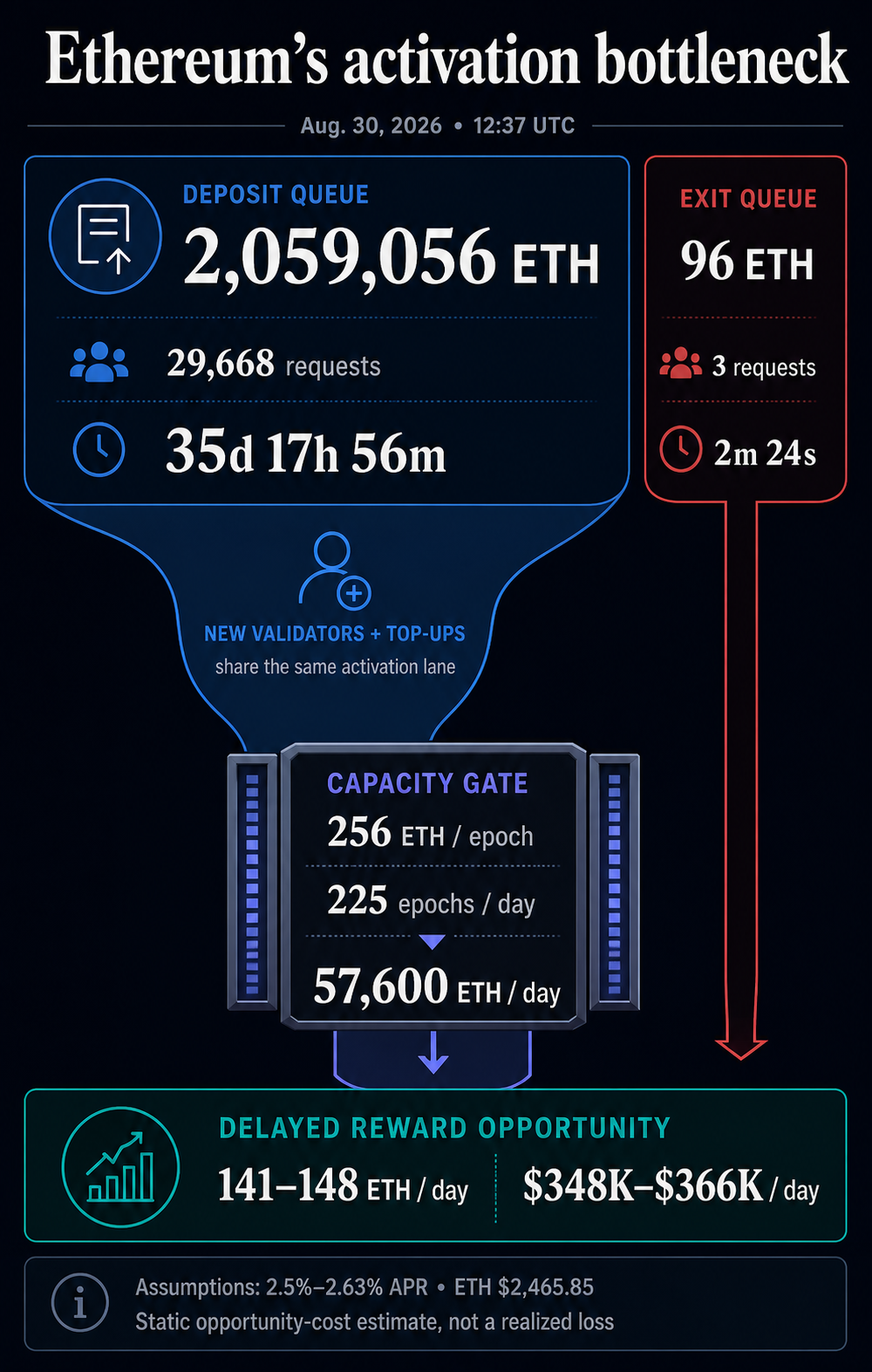
Ethereum’s validator activation queue held 2.059 million ETH at 12:37 UTC on Aug. 30, leaving a deposit joining the back of the line facing an estimated wait of about 35 days and 18 hours.
The backlog comes as more than 42 million ETH, nearly 35% of the cryptocurrency’s supply, is already staked. Both measures have climbed to record highs, extending a broader increase in capital committed to Ethereum’s proof-of-stake system.
Only 96 ETH was waiting in the validator exit queue at the same snapshot.
That imbalance shows demand for staking capacity remains well above Ethereum’s ability to activate deposits, even after the entry backlog declined from more than 4 million ETH earlier this year. It also creates a cost for participants because ETH waiting for activation does not yet earn consensus rewards.
At current staking rates, the 2.06 million ETH backlog represents roughly 141 to 148 ETH of potential consensus rewards per day, worth about $348,000 to $366,000 at an ETH price near $2,466.
The estimate represents delayed reward opportunity rather than a realized loss, since deposits already closer to the front of the queue will activate sooner.
Record staking runs into Ethereum’s throughput limit
Ethereum deliberately limits how quickly stake can enter and leave its validator set to prevent abrupt changes to the network’s security structure.
Under the Electra consensus rules, activations and exits are currently capped at 256 ETH per epoch. With an epoch lasting about 6.4 minutes, the network can process roughly 57,600 ETH per day through each side of the validator churn mechanism.
When deposits arrive faster than that capacity, the activation queue grows.
Beaconcha.in counted 29,668 pending deposit requests on Aug. 30, but that figure should not be read as 29,668 new validators.
Electra changed Ethereum staking by allowing compounding validators to hold an effective balance of up to 2,048 ETH while retaining the 32 ETH minimum. Top-ups to existing validators pass through the same activation lane as deposits funding new validators.
The 2.06 million ETH backlog therefore combines potential new stake with balance additions by existing operators. It does not establish that investors recently purchased 2.06 million ETH or that the entire amount represents fresh institutional demand.
The broader direction is clearer.
Staked ETH has climbed from about 36 million, or nearly 30% of supply, in January to more than 42 million in late August. At the same time, almost no stake was waiting to deactivate at the Aug. 30 snapshot.
The activation backlog itself has been moving lower. A Morgan Stanley Ethereum Trust filing recorded about 3.64 million ETH waiting and a 63-day delay on May 18, while Lido, the dominant liquid staking service provider, said the queue had exceeded 4 million ETH in January before falling to 2.9 million at the end of June.
The latest 2.06 million ETH reading extends that decline, but the queue remains large enough to impose a roughly five-week delay on new entrants.
A Morgan Stanley Ethereum Trust filing states that ETH allocated for staking would not accrue rewards while waiting for activation.
Ethereum’s staking page showed an annual reward rate around 2.5%, while a contemporaneous queue tracker put it near 2.63%.
Applied to the pending balance, that range implies about 141 to 148 ETH of consensus-reward opportunity each day.
A 32 ETH deposit joining at the back of the queue would forgo roughly 0.078 to 0.082 ETH in potential consensus rewards over the displayed 35.75-day wait, worth about $193 to $203 at the captured ETH price.
Those calculations assume unchanged staking rates and prices and exclude execution-layer rewards, maximal extractable value, provider fees, and compounding.
Who ultimately absorbs the delay also depends on the product.
A solo validator directly waits without earning consensus rewards. An exchange, fund or liquid-staking provider can spread the cost across a pool, absorb some of it or pass it through to users under its own terms.
Lido has already highlighted the economics of long activation waits, saying in its first-half report that foregone rewards made some stVault deposits unattractive.
Ethereum is therefore confronting an unusual consequence of record staking participation: demand to secure the network is high enough that access to the validator set itself has become scarce.
With more than 42 million ETH already staked and another 2.06 million ETH waiting for activation, the immediate constraint is not investors trying to leave. It is how quickly Ethereum can process those still trying to get in.
XRP has seen a notable improvement in its risk-adjusted returns. The Ripple token’s Sharpe Ratio on Binance has now reached its highest level since August 2025.
The indicator is currently stabilizing at around 0.207, according to CryptoQuant, while the price hovers close to $1.40.
Risk-Reward Profile
Over the past few months, XRP’s Sharpe Ratio stayed around negative or neutral levels and fell significantly during the crypto asset’s broader price decline. The recent increase suggests that returns have improved relative to the amount of volatility investors are facing.
The sharp rise in the Sharpe Ratio also occurred alongside the recovery in XRP’s price, which is up by almost 30% over the past month. This indicates that the recent move was accompanied by stronger risk-adjusted performance rather than being only an isolated price increase, CryptoQuant explained.
However, the indicator’s move to its highest level in a year does not confirm that XRP has entered a steady uptrend. The Sharpe Ratio could reverse quickly if market volatility rises or the token undergoes a significant correction.
Zooming out, institutional demand for XRP-linked investment products was also hard to miss. Last week, US-based spot ETFs pulled in $110.49 million in five days.
CryptoPotatoreported that it was the first weekly inflow above $110 million since early December 2025. All five sessions ended in positive territory, and each attracted more than $10 million. Monday saw $13.82 million come in, followed by $23.87 million on Tuesday. Wednesday led the week with $28.14 million, the funds’ strongest single-day showing since January 5.
Another $18.47 million arrived on Thursday, while Friday brought $26.2 million. The latest figures pushed total net inflows across the five ETFs to a record $1.66 billion. Bitwise remains ahead of the other issuers; its ETF now holds slightly more than $600 million in cumulative inflows.
What’s Next?
Regardless of how promising XRP’s setup may appear, a move toward $1.80 or $2 could remain out of reach until the token reclaims $1.54, according to crypto analyst ChartNerd. That level represents both a six-month resistance wall and the weekly 50 EMA. He further explained,
“Just to be clear, and to reaffirm. I am not suggesting XRP can’t push up towards $1.80/$2. I am suggesting we are under resistance, and if we do get the follow through, it will likely open up an even deeper retrace than what we would witness rejecting the weekly 50 EMA at $1.54.”