
Mike Weeks / SAGINT
Mike Weeks on tokenizing critical minerals for trade
GuestMike WeeksCompanySAGINTTopicDePIN & InfrastructureTopicRegulation & PolicyTopicRWA & Tokenization
Prefer to listen?Audio version on Spotify
In this episode
Global commodity trade runs on slow settlement and trust gaps — and most teams have no way to prove provenance without adding friction. Mike Weeks, Executive Chairman & Co-Founder of SAGINT, breaks down how SAGINT is building a compliant commodity exchange and settlement stack designed to digitize the lifecycle of critical minerals. Learn how tokenization can reduce fraud, improve auditability, and make mine-to-market traceability usable in the real world, plus how SAGINT thinks about OECD due diligence, Dodd-Frank 1502, and multi-jurisdiction compliance from day one.
sagint.com · @sagintinc on X · Watch on Refinitiv
Key takeaways
- SAGINT addresses critical gaps in commodity trade by combining traceability, trust, and efficient digital trading processes for minerals.
- Team resilience is essential for startups facing financial pressure, as founders must prepare teams for worst-case scenarios rather than expecting smooth growth.
- High-performance teams require training in stress management and decision-making under pressure, which most tech startups neglect entirely.
- SAGINT emerged from studying carbon markets and discovering widespread documentation and traceability failures across traded commodities.
- Startup environments differ fundamentally from structured institutions like military or government, offering no safety net or guaranteed support systems.
Chapters
Related coverage
 Bitcoin Holds $68K While the Whole World Burns.Apr 1, 2026
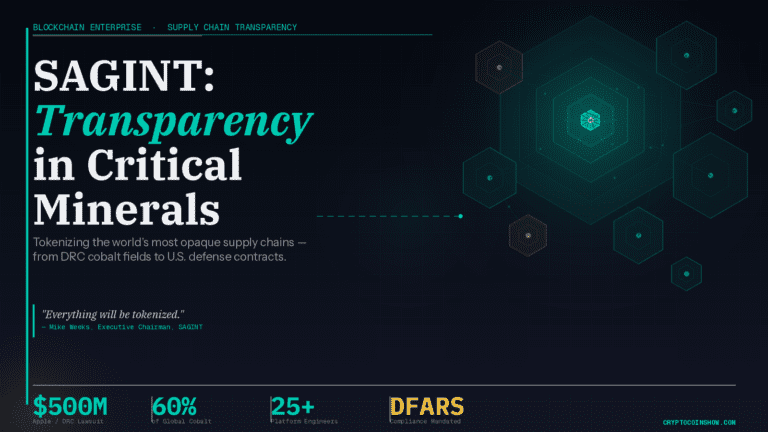 SAGINT: Bringing Transparency to Critical Mineral Supply Chains Through TokenizationMar 18, 2026
More interviews
 Quantum computers could crack Bitcoin keys by 2028, says Postquant Labs CEONov 24, 2026
 0G Labs' Michael Heinrich on cheaper open AI modelsNov 19, 2026
 Why Wall Street is moving toward 24/7 trading in 2026Nov 13, 2026
 How Wallet V is letting AI agents trade while keeping your keysNov 10, 2026
 How Silent Payments Keep Your Bitcoin PrivateNov 9, 2026
 How XYO is building proof in a world of AI fakesNov 5, 2026
Get new interviews firstCCS Insider, the free newsletter from Ashton Addison. Twice a week.